-
-

-
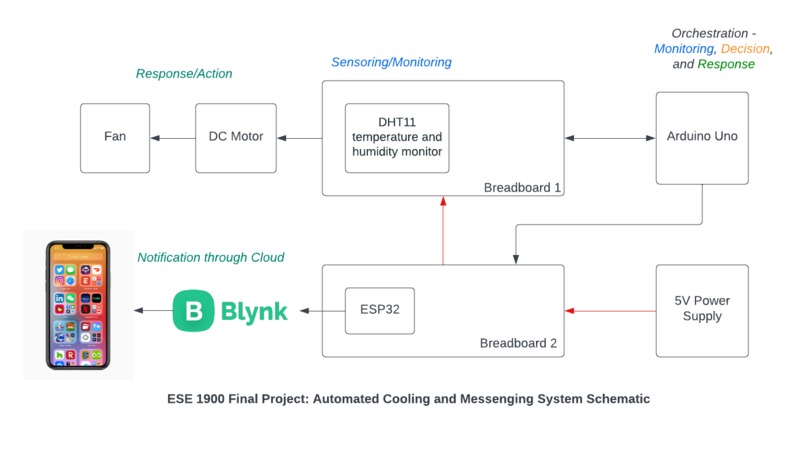
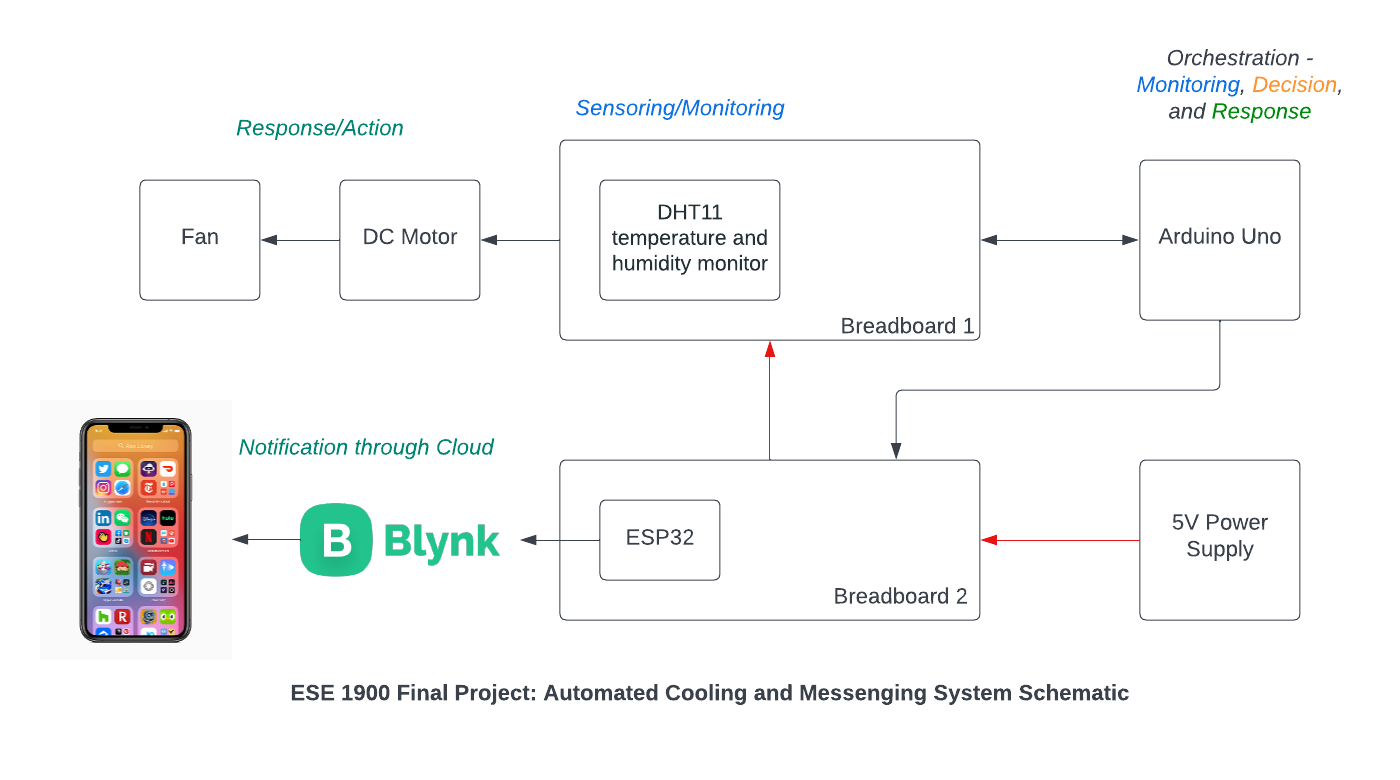
Final Project System Schematic

Inspiration
Many pharmaceutical items are required to be stored below a certain temperature at all times. When something goes wrong and temperature of their storage environment becomes too high, it is important to deploy temporary corrective measure and notify the appropriate personnel in a swift manner. An automated prevention and response system is critical in preserving valuable resources such as COVID vaccine and other expensive medication. Furthermore, we see such solution has great potential in both business and retail market. In the latter case, individuals who rely on expensive medication such as Latanoprost, an eye drop for correcting ocular pressure that needs to be refrigerated, would certainly benefit from such a system defending against prolonged power outages. Our goal is to implement a low cost but modern, effective system to manage the life cycle of valuable assets.
What it does
This smart IoT system integrates monitoring, decision making, and responsive actions. It detects the surrounding temperature to check if it is violating a desired threshold or range. When the temperature is above a certain temperature, the fan automatically turns on as a temporary corrective measure while a message is sent to the person(s) in charge of managing the resources.
How we built it
We take an iterative approach with multiple "sprints". Our first sprint focuses on implementing the sensor and monitoring section. The second sprint involves integration between monitoring and temporary corrective action. Specifically, a DC motor is used to rotate the fan when necessary. A DHT11 temperature and humidity monitor is used to detect the surrounding temperature. When it detects the surrounding temperature to be above 25C (our choice of temperature threshold), the DC motor automatically turns on and spins the fan. During the last sprint, we focus on the IoT perspective in remote notification capability. Specifically, we employ Wifi101 board/ESP32 to send a notification to a person's phone when the temperature is above 25C.
Technology Description
The hardware components include Arduino Uno, ESP32, DH11 Temperature and Humidity monitor, DC motor, small fan, breadboards, 5V power supply, and connecting cables. The ESP32 works in conjunction with Blynk to support push notification to mobile device like iPhones. Software code were developed and deployed to the Arduino to orchestrate the monitoring, decision making, and response of the system. The source code can be found in the Github repository through the link below.
Challenges we ran into
A main challenge erupted when trying to figure out a way to implement a messaging system. Initially, a Wifi101 board was used in an attempt to send emails/notifications , but proved to be difficult. Thus, we sought a roundabout solution by using a ESP32 chip to send messages to Blynk instead.
Accomplishments that we're proud of
Our success in being able to assemble the circuit in such that we were able to make the DC motor spin in line with the temperature is something that we are especially proud of. We attribute the smooth execution to our practice of leveraging proven technology, techniques, and experiences. In addition, finding a method to send messages based on temperature took quite a bit of trial and error with our components and code. Thus, we are quite proud that our persistence and commitment paid off at the end.
What we learned
Code for Arduino can be quite versatile and can be written to function for almost any case. When constructing code, we had to figure out a way to incorporate multiple components to work along with each other, which required us to experiment to determine the correct code formation. In a more general sense, our troubleshooting experience taught us valuable lesson in managing a project. It is important we keep an open mind, explore different alternative solutions, and stay focus on driving to the final result.
What's next for Stay COOL!!!
A possibility for the future of our group is to figure out how to productize this prototype, making the project more robust and sustainable in actual working environment. Despite its functions being quite useful, the fragility of our current contraption may prove to be impractical for a real life fridge or cooling environment. We should explore how our design fairs in a much colder environment. Thus, finding a way to compact out contraption together to be more consumer friendly is a possible future.
Built With
- arduino
- bylnk

Log in or sign up for Devpost to join the conversation.