Inspiration
What it does
How we built it
Challenges we ran into
Accomplishments that we're proud of
What we learned
What's next for Group-19_Hackathon_RESPIRA
Inspiration
Interstitial lung abnormalities (ILA) can be an early sign of progressive interstitial lung disease, but at the time they are first detected it is often difficult to know which patients will remain stable and which will progress.
Our goal was to turn a very high-dimensional proteomic dataset into something clinically interpretable: a small molecular signature that could complement information already available to clinicians and help stratify patients by progression risk.
Rather than building the most complex model possible, we focused on a model that was simple, explainable and potentially usable in clinical practice.
What it does
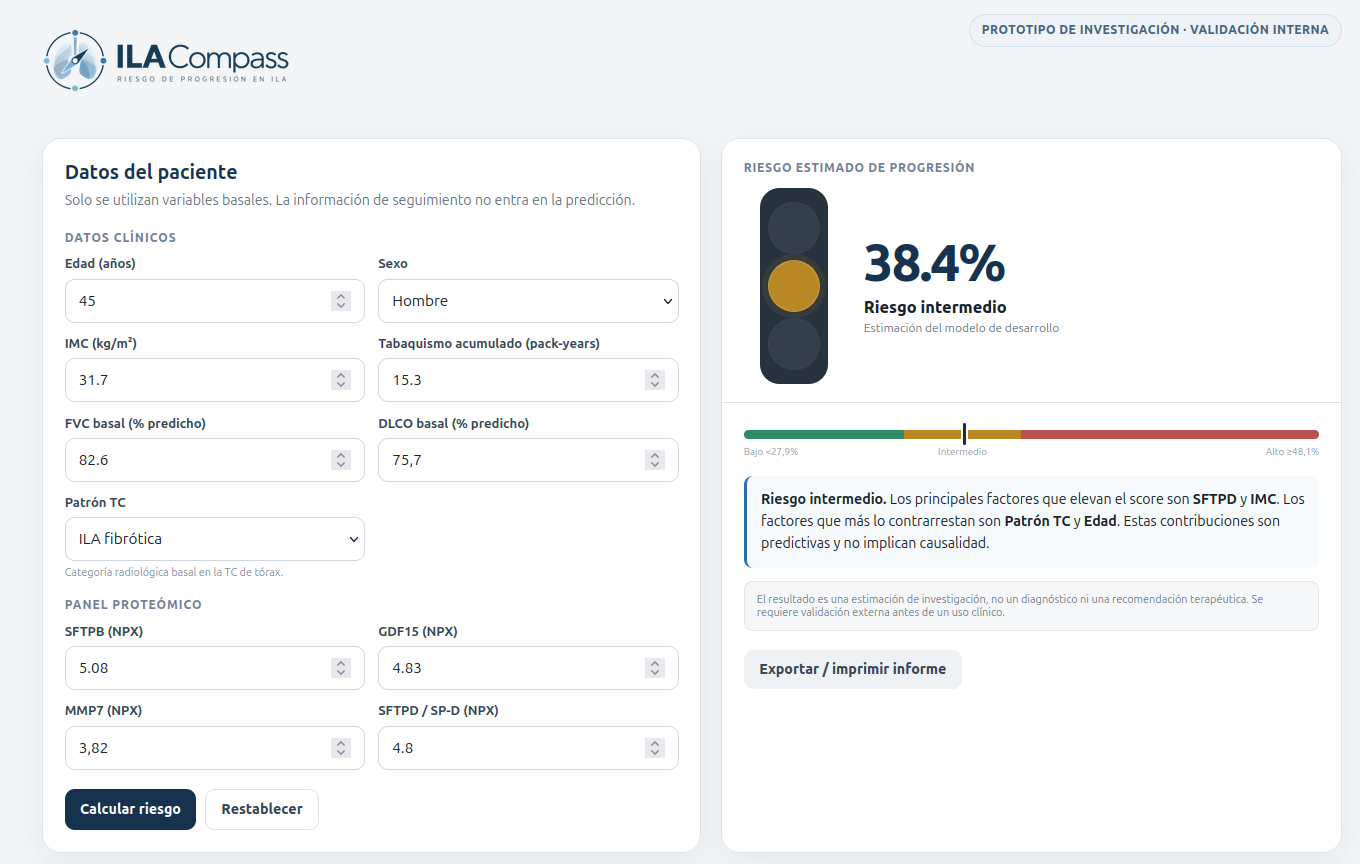
ILA Progress Risk estimates the probability that a patient with ILA will progress to clinically significant interstitial lung disease.
The model combines baseline clinical information:
- Age
- Sex
- BMI
- Smoking exposure
- Baseline FVC
- Baseline DLCO
- CT pattern
with a four-protein serum signature:
- SFTPB
- GDF15
- MMP7
- SFTPD
The application returns:
- An estimated progression probability
- A low, intermediate or high-risk classification
- A visual traffic-light risk indicator
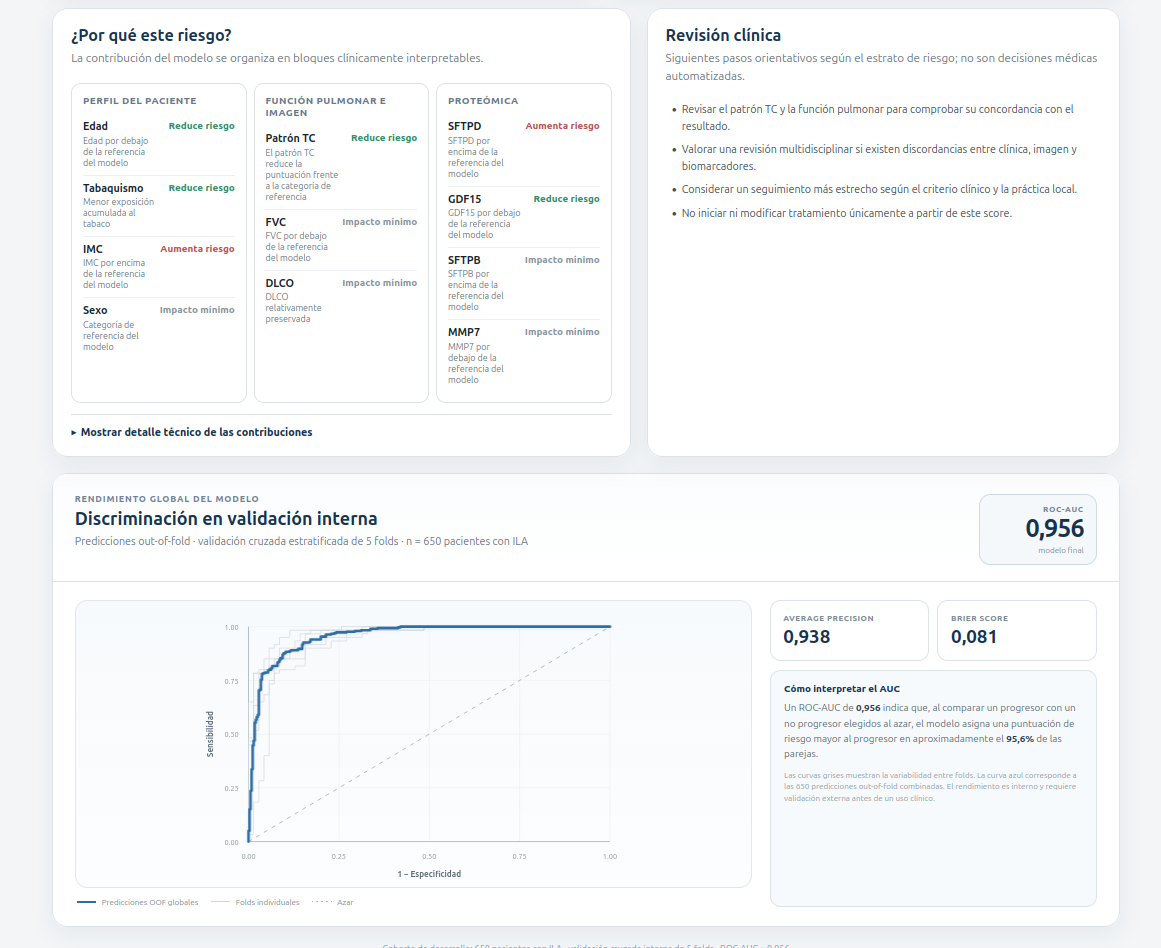
- The factors that most influence the prediction
- A short interpretation of the result
- Suggested next steps for clinical review
The tool is designed as a research prototype and clinical decision-support concept, not as a validated medical device.
How we built it
The original dataset contained 1,000 patients and 2,944 serum proteins measured using Olink proteomics.
For the main prediction task, we focused only on patients who already had ILA at baseline:
- 300 progressive ILA
- 350 non-progressive ILA
This resulted in a modelling cohort of 650 patients.
We deliberately excluded healthy controls and patients with already established ILD because our question was not whether a patient was healthy or sick, but:
Given that a patient already has ILA, will they progress?
We also excluded follow-up variables such as later FVC measurements and delta FVC to avoid data leakage.
Data preprocessing
All preprocessing was performed inside the machine-learning pipeline:
- Missing numerical values were imputed using the median of the training fold
- Numerical variables were standardized
- Categorical variables were one-hot encoded
This ensures that information from the validation fold is never used during training.
Machine learning
We used an L2-regularized logistic regression.
We chose logistic regression because it provides:
- Direct probability estimates
- High interpretability
- Transparent coefficients
- Lower risk of overfitting than more complex black-box models
Performance was evaluated using stratified 5-fold cross-validation. Each patient therefore received an out-of-fold prediction from a model that had not been trained on that patient.
Our final integrated model achieved:
- ROC-AUC: 0.956
- Average Precision: 0.938
- Brier Score: 0.081
We also derived development-stage risk groups from the out-of-fold predictions:
- Low risk: 4.8% observed progression
- Intermediate risk: 39.0%
- High risk: 88.6%
These thresholds are exploratory and would require external validation before clinical use.
Why these four proteins?
We wanted a panel that was both predictive and biologically interpretable.
The final proteins represent complementary biological processes:
- SFTPB and SFTPD: alveolar epithelial injury and surfactant biology
- GDF15: cellular stress response
- MMP7: extracellular matrix remodeling and fibrosis
We also evaluated alternative biomarkers such as WFDC2 and CCL18. Although some showed strong biological and literature support, they did not provide enough additional predictive value to justify increasing the size of the final panel.
This allowed us to maintain a compact four-protein signature.
Challenges we faced
One of the main challenges was avoiding overfitting in a dataset containing almost 3,000 proteins but only 650 relevant patients.
It would have been easy to build a very complex model that performed well on the development data but would be difficult to interpret or reproduce.
We therefore focused heavily on:
- Preventing information leakage
- Cross-validation
- Feature reduction
- Comparing clinical-only and proteomic models
- Biological plausibility
- Model simplicity
Another challenge was translating a statistical model into something useful for clinicians. A raw probability alone is not enough, so we built an interface that explains which factors are pushing the prediction higher or lower and presents the result as an interpretable risk category.
What we learned
The most important lesson was that good predictive performance does not necessarily require a highly complex model.
Clinical variables alone already provided strong discrimination, but the proteomic signature added complementary molecular information and improved the model further.
We also learned that biomarker selection should not be based only on statistical significance. The strongest solution came from combining:
- Predictive performance
- Biological evidence
- External literature
- Stability
- Clinical interpretability
Finally, we learned how important it is to distinguish between internal validation and true clinical validation. Our results are encouraging, but the next essential step would be to freeze the model and test it in an independent external cohort.
What's next
The next steps would be:
- Validate the model in an independent cohort
- Assess calibration across different hospitals and populations
- Re-evaluate the risk thresholds prospectively
- Test whether the four-protein panel can be translated into a simpler clinical assay
- Evaluate whether risk-guided follow-up improves clinical outcomes and resource allocation
Our long-term vision is a simple workflow:
[ \text{Clinical data + CT + blood sample} \rightarrow \text{Progression risk} \rightarrow \text{More personalized follow-up} ]
The aim is not to replace clinicians, but to provide an additional molecular signal that may help identify high-risk patients earlier.
