Inspiration
Damage to buried utilities costs the US an estimated $83.2B a year — 668,999 incidents, $227M a day — and most of it traces back to one thing: locate data that looks precise on a laptop screen, but isn't. Existing tools draw buried lines as confident, exact paths even though the underlying locate tolerance is never actually exact. We wanted to build the opposite: a Lens that tells the truth about uncertainty, right where the crew is digging, instead of hiding it behind a clean-looking line in the truck.
What it does
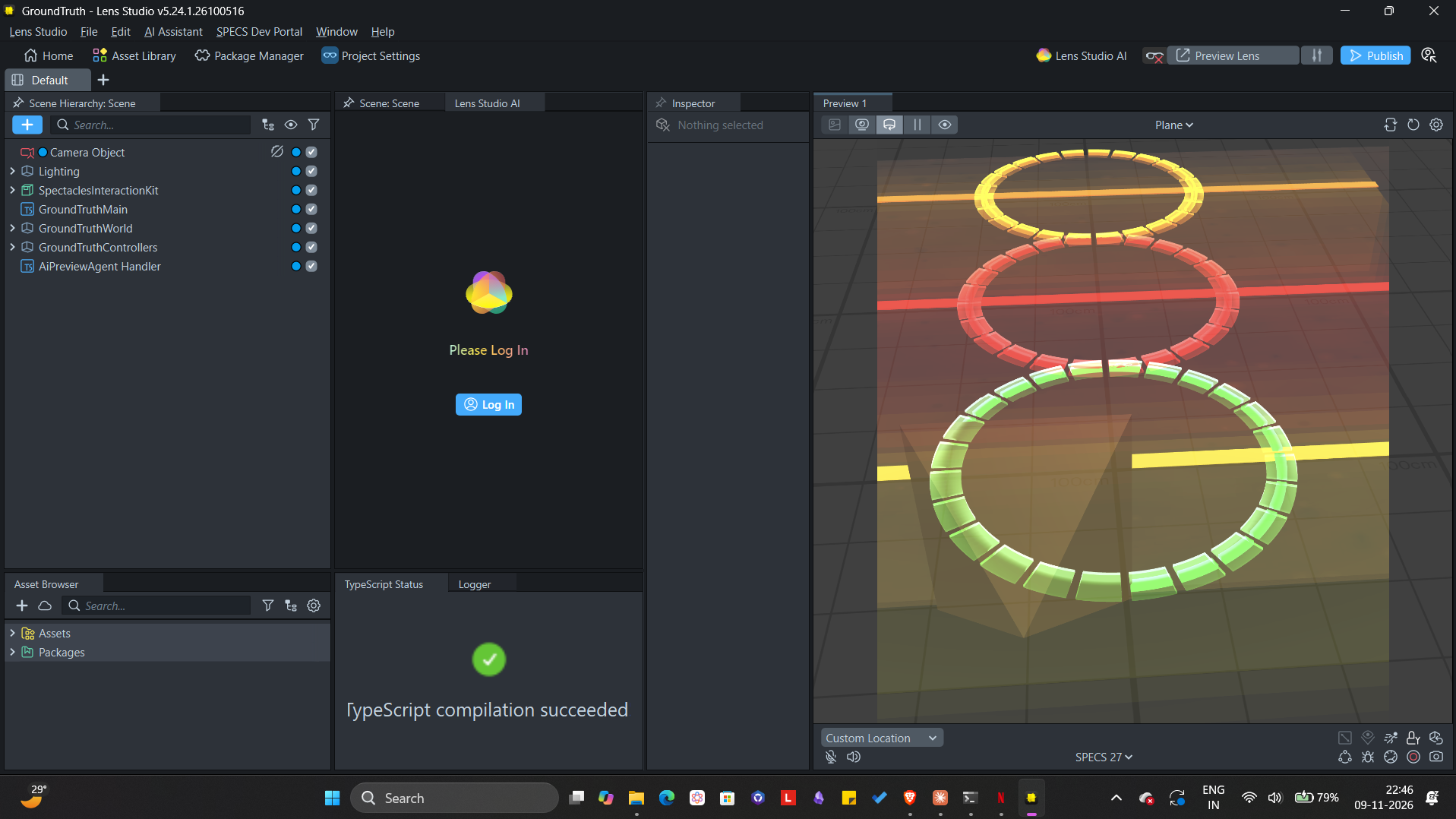
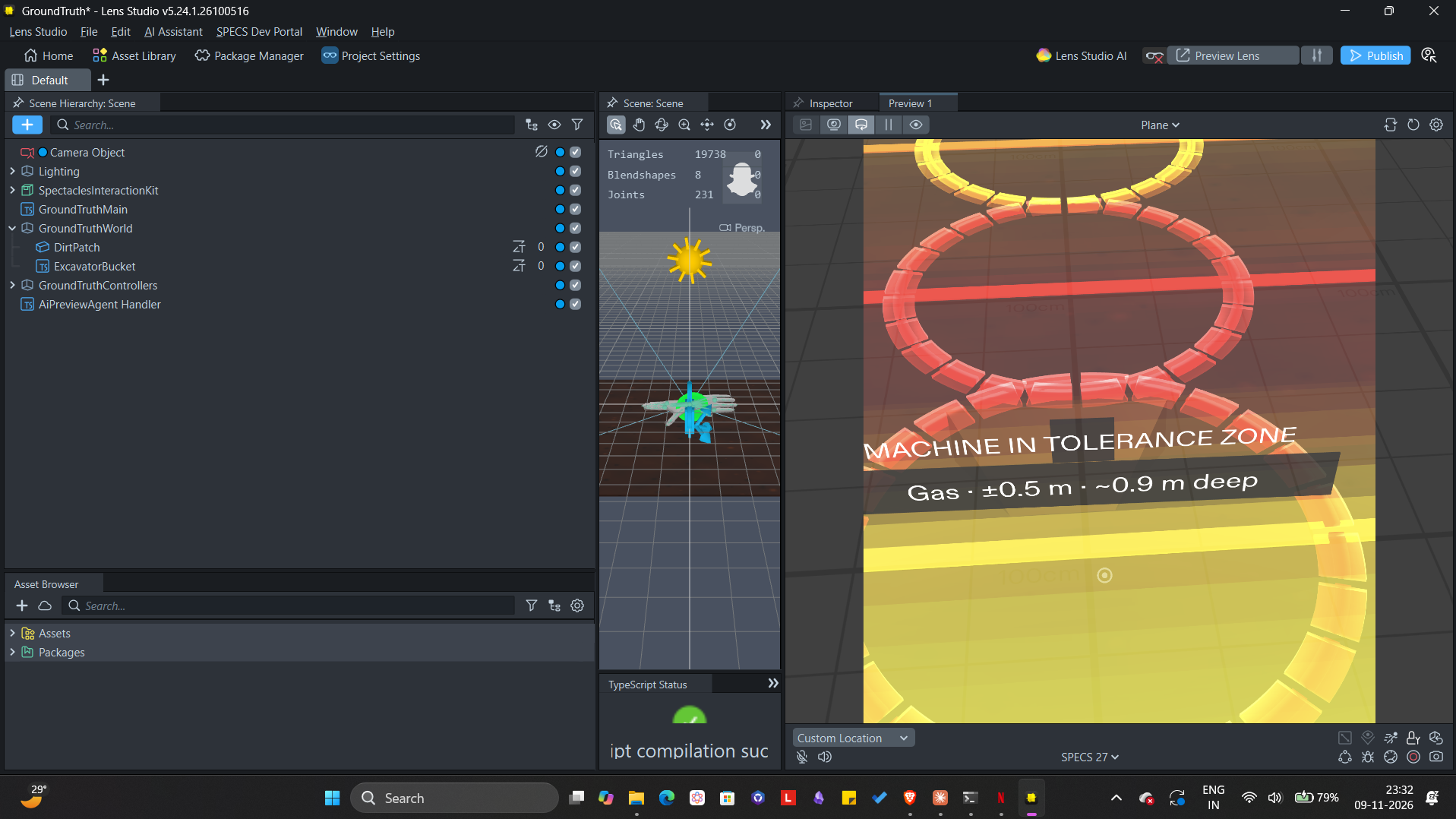
GroundTruth is a Specs Lens that reads a crew's painted locate marks and draws each buried utility as a corridor sito its real locate tolerance — not a fake-prh machinery and the tolerance ring turns red and warns before metal touches dirt. Dig by hand instead, and a live depth gauge counts you down to the buried lineWhen the pipe is finally exposed, one pinch onto the true measured position and showsexactly how far the original map was off. That correction is logged, so the next crew that arrives sees a tighter, truer corridor — no training required. The grface, and every dig makes the next onesafer.
How we built it
Planned with the Devpost Learn skill pack, then built end-to-end in Lens Studio with Snap's CLAD agents over the Studio MCP — scene construction, a state macTHOLE → VERIFY → LOG → NEXT_CREW), Spectacles Interaction Kit for hand/pinch/grab, a custom glow shader pass for the corridor and ring visuals, and procedural geometry (MeshBuilder, curved tolerance ringort fit. Everything runs in Lens Studio'sInteractive Preview — no SPECS hardware needed, per the hackathon's own guidance.
Challenges we ran into
The biggest one: the scene we built through the MCP bridge only ever existed in the live editor session and was neversaved to disk — a restart wiped it, and we hpersist the project to recover. We also hit a real bug in the shipped LEAF testing package (a type error in its own ScenarioIndexDecorator.ts) that broke compilation the moment we tried to use it, s be dropped in favor of manual verification.On top of that, simulated hand/pinch input in desktop Preview proved unreliable for the stroke-based digging gesture specifically, so we added pinch-while-in-riner alongside the real hand-tracking path, sothe mechanic is testable without a device.
Accomplishments that we're proud of
Getting the actual design idea right: drawing honest uncertainty instead of a fake-precise line is a small visual choice that does a lot of work — it's the whn a laptop map. We're also proud of thecorrection-logging loop (NEXT_CREW) — watching the gas corridor visibly tighten and shift onto the corrected position with zero explanation text is the moment thaunder two seconds.
What we learned
AR's real value here isn't precision — it's ful design call was making the corridor lookuncertain instead of fake-confident, because that's what actually serves someone standing over a hole with a shovel. We also learned to never trust an editor sesrce an explicit save and verify the filechanged on disk before calling anything "done."
What's next for GroundTruth
Real locate-tolerance data from utility records instead of mocked defaults, on-device testing with actual Spectacles hand tracking, and extending the full dig-totelecom (currently gas-only) so every utility on the patch gets the same correction loop.
For the other fields on this same page:
- Built with: lens-studio, typescript, spectar
- Try it out link: https://github.com/Arya-Mm/Ground-truth
- Video demo link: https://youtu.be/fdk7XtlO
Built With
- ar
- clad
- lens-studio
- spectacles-interaction-kit
- typescript

