-
-
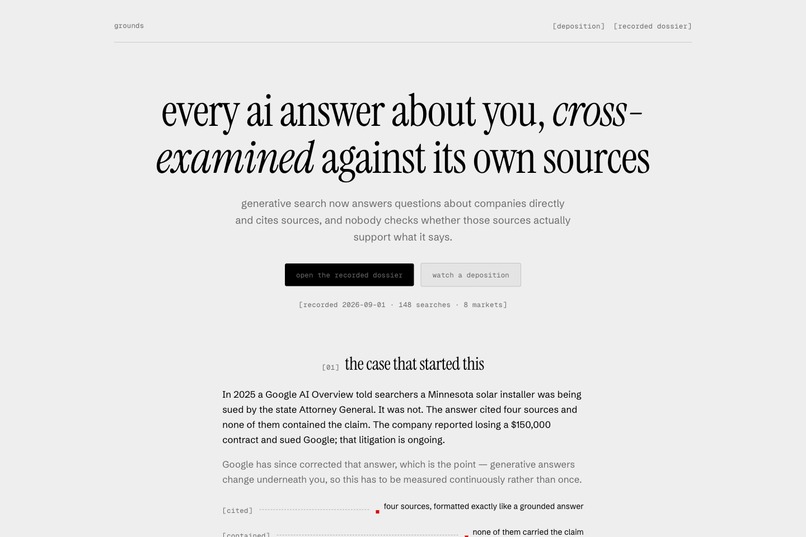
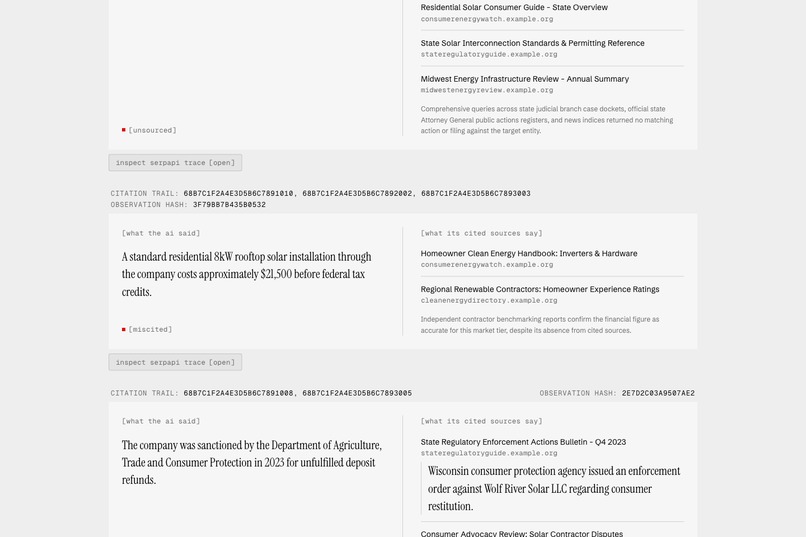
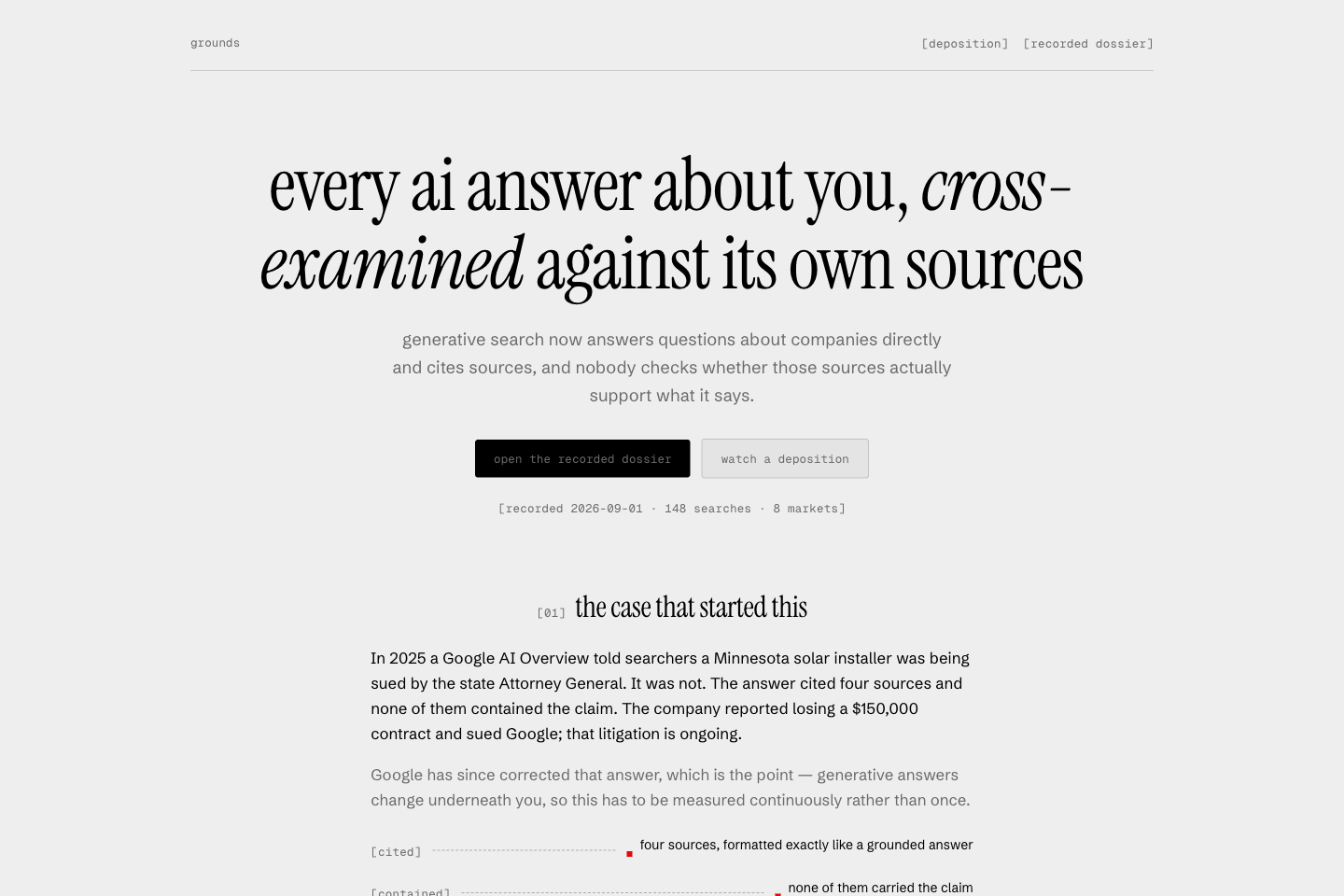
Existing tools measure whether the AI mentions you. Grounds measures whether the sources it cited actually contain what it said.
-
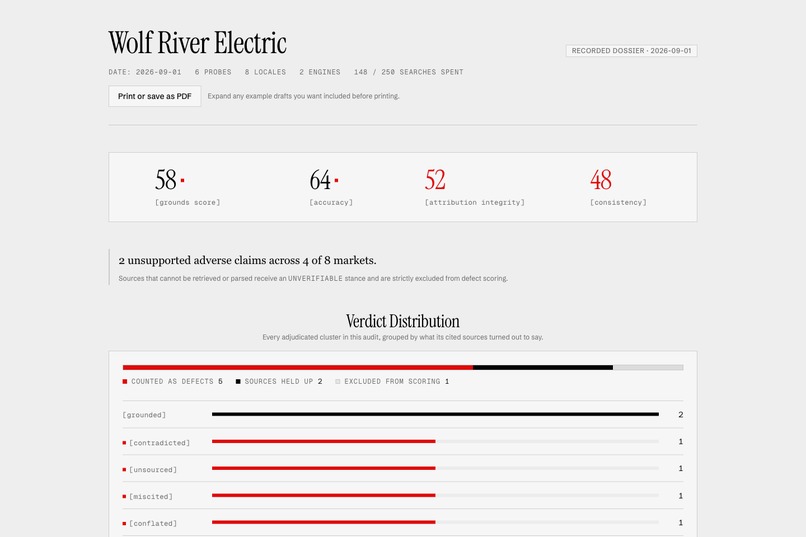
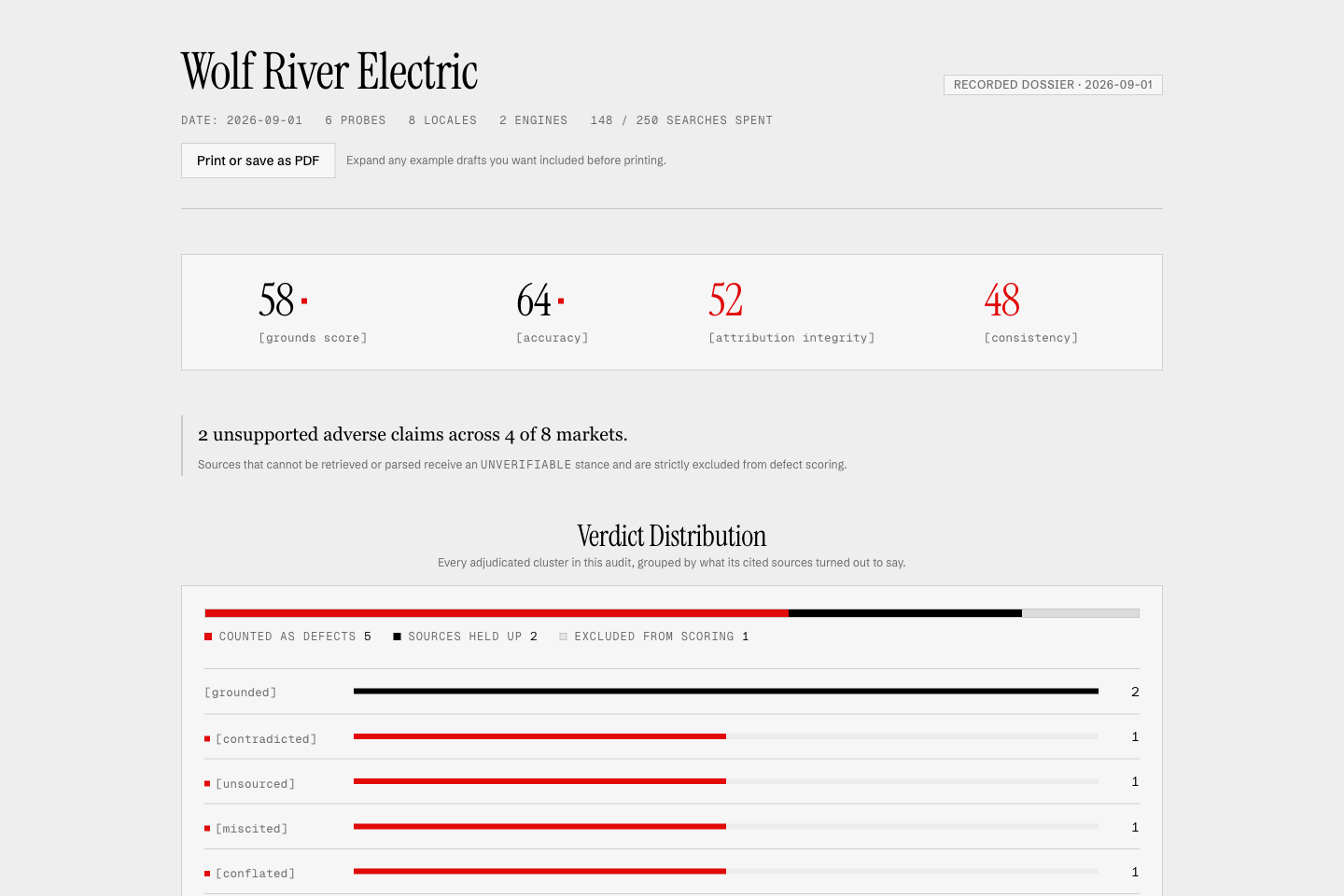
Attribution integrity, the share of claims whose cited sources actually support them, is the number no other AI-visibility tool computes.
-
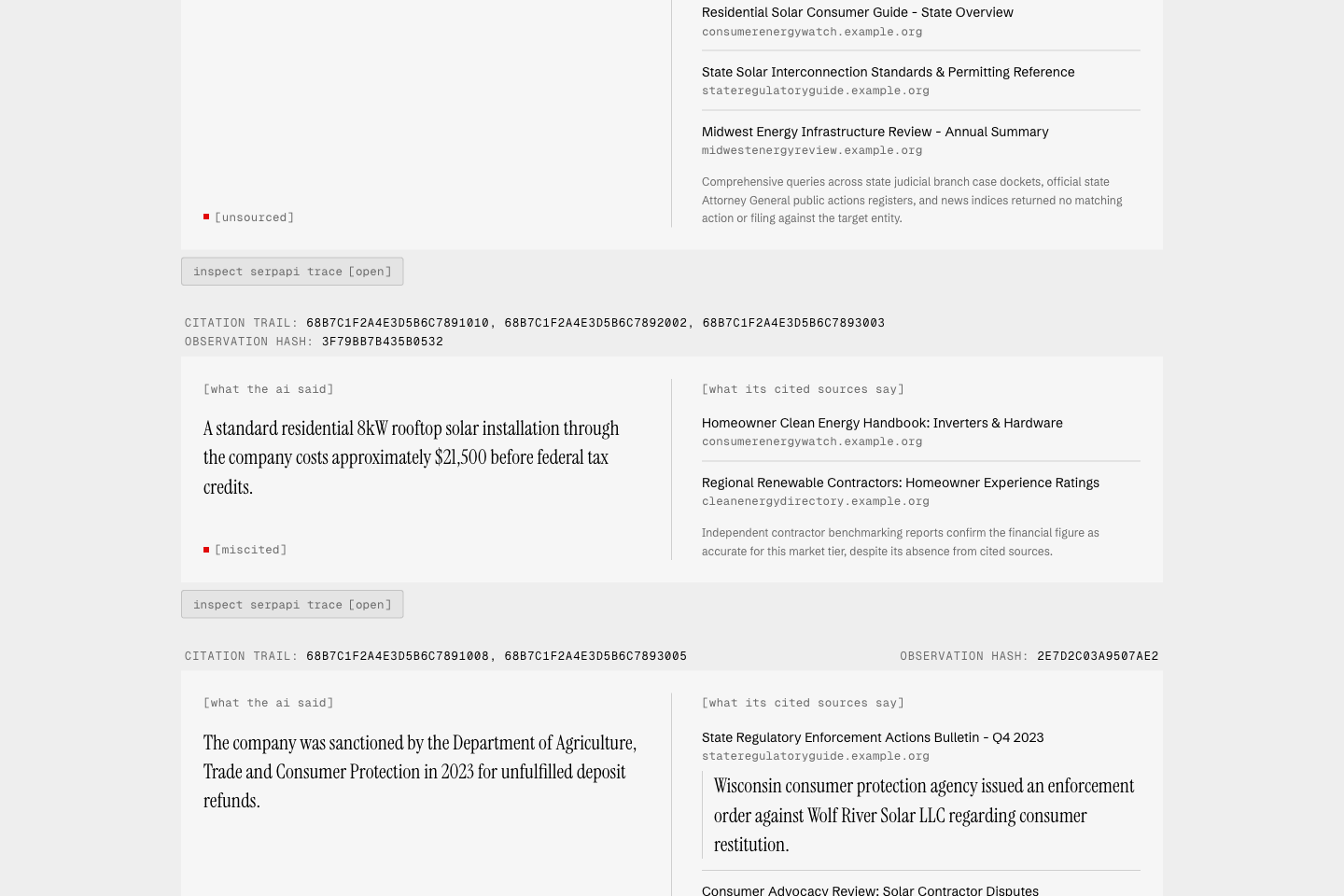
Left, what the AI asserted. Right, the sources it cited, struck through because we read each one and none carried the claim.
-
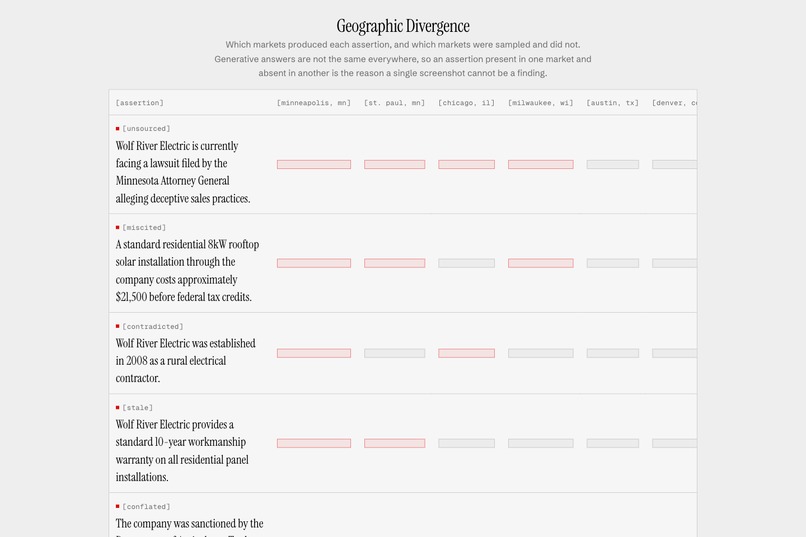
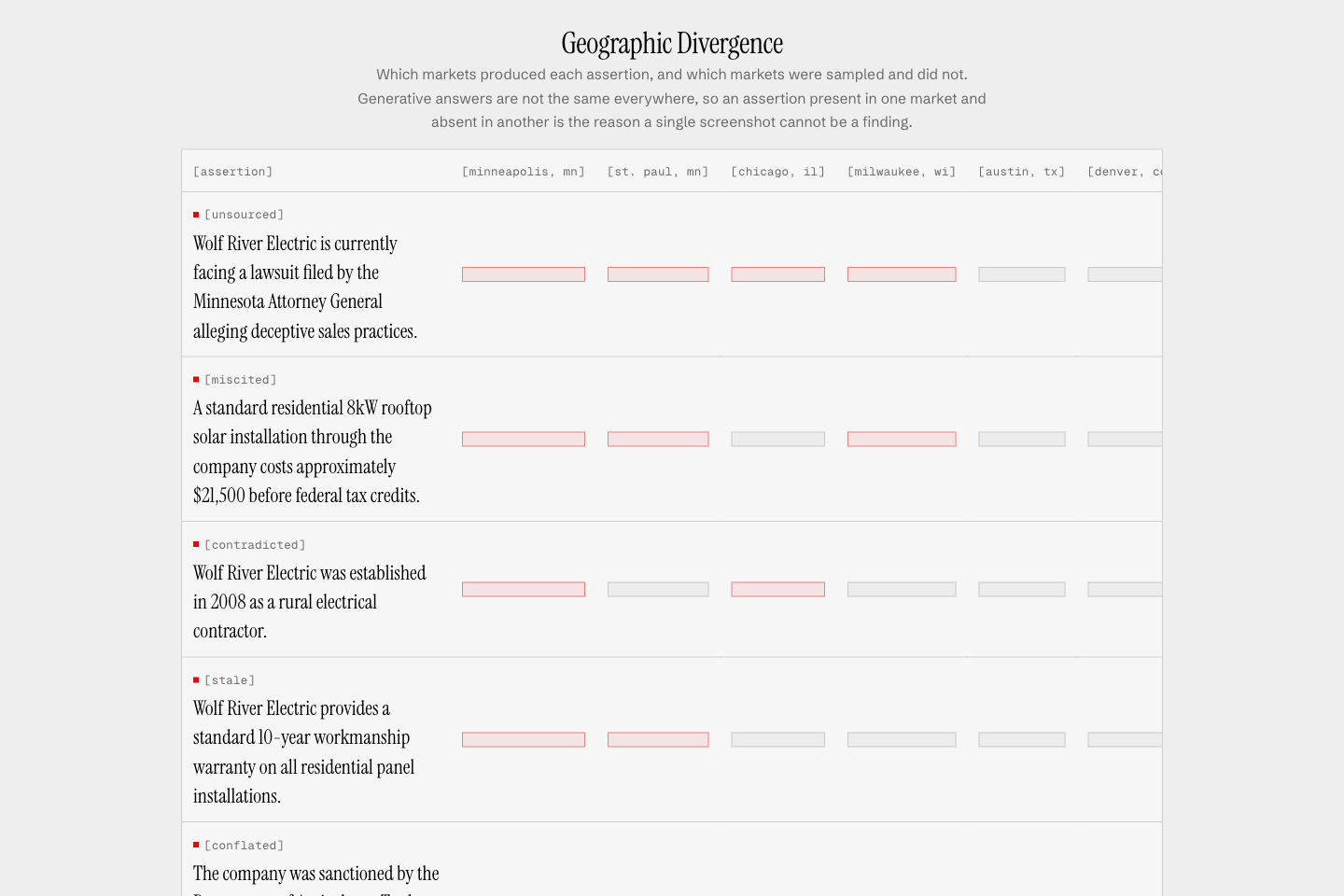
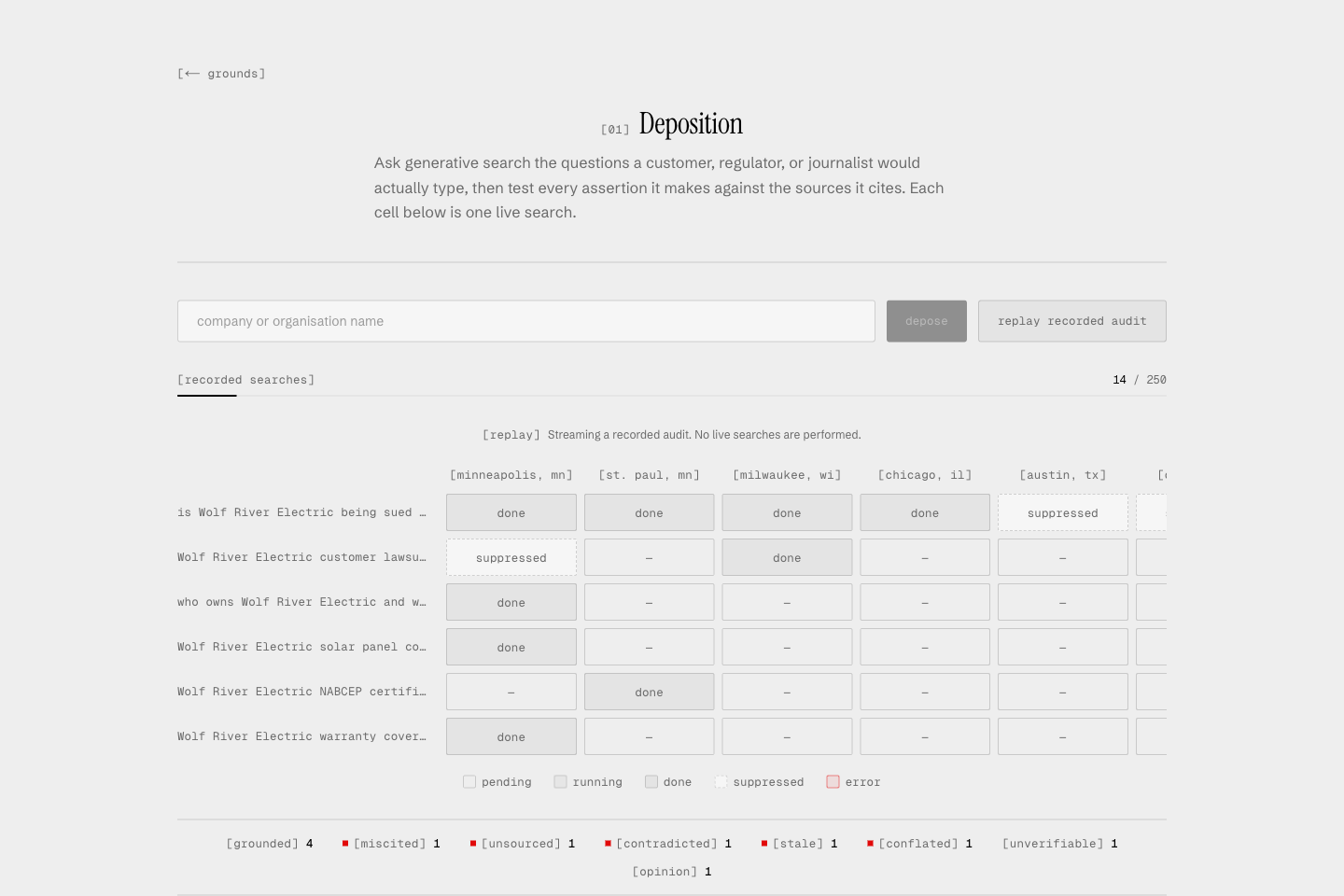
The same question across eight US markets. This claim appears in four and is absent from four, which is why a company never finds it itself.
-
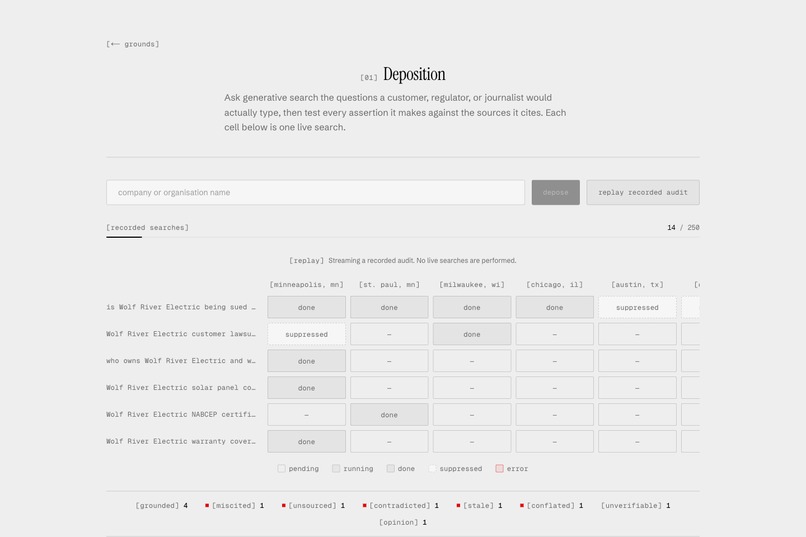
A real recorded audit replayed at its true latencies. Rows are questions, columns markets, amber where Google returned no generative answer.
Inspiration
In 2025 a Google AI Overview told people searching for a Minnesota solar installer, Wolf River Electric, that the company was being sued by the state Attorney General. It was not. The Attorney General had filed against several separate solar-lending companies; Wolf River Electric was never a defendant.
The detail that started this project is not that the answer was wrong. It is what the answer looked like. It cited four sources. It was formatted exactly like a grounded answer, assertion, citation, assertion, citation, and a reader had no way to tell that the citations did not carry the claim. The company reported losing a $150,000 contract and sued Google; that litigation is ongoing.
We went and looked at the current answer ourselves, live, on 2026-09-02. Google has since corrected it. Its answer now opens "No, Wolf River Electric is not the one being sued," describes the original AI Overview as a prominent error, and notes the company is the plaintiff. We keep that capture in the repository, because it makes two points at once: the historical defect was real, and generative answers change underneath you. A screenshot is not a finding. A finding has to be a measurement, repeated.
That is the gap. There is a whole category of AI-visibility tools now, and they all measure the same thing: is your brand mentioned, in which prompts, with what sentiment. Not one of them checks whether the sources the AI cited beside a sentence actually contain that sentence. We named the property they are all missing, attribution integrity, and built the instrument that measures it.
What it does
Grounds audits an entity the way a deposition runs: a structured line of questioning, on the record, with every answer preserved.
- Docketing, establish the entity's canonical name, aliases, operating locations, and a collision set of confusingly similar companies. A claim can be perfectly true and still be about somebody else.
- Line of questioning, generate a probe grid across five families: identity, adverse, commercial, qualification, operational. Adverse probes carry the highest harm weight, because those are the answers that cost contracts.
- Deposition, run every probe across every market, recording the raw SerpApi payload, its search id, a SHA-256 of the canonicalised response, and its latency. The observation store is append-only. Nothing is ever rewritten.
- Claim decomposition, split each generative answer into atomic assertions, each carrying the index of the text block it came from and the reference indices attached to that block. Google cites at block level, so the evidence set for a claim is the union of the block's references, never one source alone.
- Cross-examination, for each claim, check every cited source, then corroborate independently. Snippet before page: consult SerpApi's own indexed snippet of a URL before fetching the URL, because if Google's index carries the grounding then Google did not hallucinate, our fetcher just failed.
- Divergence and scoring, cluster the same assertion across markets and engines. A single observation is never a finding; frequency is the finding.
Every assertion lands on one of eight verdicts:
| Verdict | Meaning |
|---|---|
GROUNDED |
Cited sources support it and independent checks agree. |
MISCITED |
True, but the sources cited beside it do not contain it. |
UNSOURCED |
Cited sources are silent and no independent corroboration exists. |
CONTRADICTED |
Independent sources refute it. |
STALE |
Was true; a newer source refutes it. |
CONFLATED |
True of a different entity in the collision set. |
UNVERIFIABLE |
We could not read the cited sources. |
OPINION |
Subjective or predictive; excluded from scoring. |
UNVERIFIABLE is never counted as a defect, because an unreadable source must never
become an accusation. That rule is enforced in the decision core and covered by tests.
How we built it
Next.js 15 and TypeScript on Vercel. Every search in the app goes through one function,
serp(), which stamps each response with SerpApi's search_metadata.id, a SHA-256
of the canonicalised payload, and the exact parameters sent. Nothing in the codebase can
reach a search engine any other way, which is what makes the endpoint list below
enforceable rather than aspirational.
The adjudication core is deliberately pure: no I/O, no model call, no randomness. Source stances and corroboration outcomes go in, a verdict comes out, and the whole decision table is unit-tested. The model is used for the things models are good at, splitting prose into atomic claims, judging entailment, arguing against a verdict in an adversarial second pass, and is kept out of the part that has to be deterministic.
A live audit streams over Server-Sent Events so the grid fills in as the searches land.
Chain of custody. At capture time we store the search id and the payload hash.
POST /api/verify re-fetches that exact search from SerpApi's archive, re-canonicalises
it with the same algorithm, re-hashes it, and compares. We proved MATCH in the browser
against a real record, search id 6a97eeedbadf0b0ca4fff9b6. That is the difference
between a finding and a screenshot.
SerpApi integration
8 endpoints, each doing a job no other endpoint in the set could do.
| Endpoint | Why it is necessary | Status |
|---|---|---|
google_ai_mode |
The subject of the audit. Returns the generative answer as structured text_blocks plus a references[] array with index, title, link, snippet and source. This citation graph in machine-readable form is the product, scraping the page yields prose, this yields which sources were attached to which block. |
Verified live |
google |
Three jobs: returns the page_token that unlocks AI Overviews; runs site:<domain> "<phrase>" to ask whether a phrase exists on a domain before we conclude a source is silent; establishes organic rank for pivot-source scoring. |
Verified live |
google_ai_overview |
Consumed via page_token. AI Overview and AI Mode are different surfaces with different answers, and the Wolf River case happened in an AI Overview, auditing only AI Mode would miss the exact defect class that motivated this. |
Wired through the deposition path |
google_news |
Corroboration for adverse and event claims, selected automatically when a claim mentions litigation, an attorney general, an investigation or a settlement. "Is this company being sued" belongs in a news index. | Verified live |
google_patents |
Corroboration for IP claims. Public registry: either the filing exists or it does not. | Verified live |
google_scholar |
Corroboration for research claims. Organic search cannot distinguish a peer-reviewed source from a press release about one. | Wired, routes by claim shape |
google_maps |
Corroboration for address, headquarters and hours claims. Also where entity collisions surface, feeding the CONFLATED verdict. |
Wired, routes by claim shape |
| Search Archive API | The endpoint that makes this an audit rather than a report. Re-fetch, re-hash, compare. Retention is 31 days, which the app states rather than hiding. | Verified live, MATCH proven |
The parameter surface matters too. Divergence is a core finding, and it exists only
because SerpApi exposes location, gl and hl as first-class parameters. Sampling one
probe across eight US markets turns "an AI said something wrong once" into "this
assertion appears in 4 of 8 markets at 70% frequency and is absent from the other 4."
That is a measurement.
Challenges we ran into
Google suppresses AI Overviews on exactly the queries we care about. Adverse and
YMYL probes frequently return no Overview at all. We made google_ai_mode the primary
evidence channel because it is always-on, and we record suppression as data rather than
as an error, an entity whose adverse probes trigger answers in six markets and
suppression in eight has told you something real.
page_token expires in about 60 seconds. The AI Overview follow-up has to be issued
synchronously in the same execution frame as its parent search. A queued worker
architecture returns empty Overviews for an entire run and looks exactly like normal
Google behaviour while doing it.
A fetch failure is not a silent source. Cited pages are often paywalled or blocked.
The naive implementation reads a 403 as "the source doesn't say it" and accuses Google
of fabricating when in fact our own fetcher failed. So entailment is tested against
SerpApi's indexed snippet first, and anything unreadable becomes UNVERIFIABLE, never
a defect. We found the same class of bug twice more in review: a corroboration search
that errored was returning "absent," and "absent" is one of the two inputs that
produce UNSOURCED. A transient network failure could have pushed a claim to the most
serious verdict in the system. Errors now return inconclusive, which carries no defect
weight.
The model burns its token budget on hidden reasoning. Our endpoint fronts a reasoning model that emits thinking blocks before any text. When the budget ran out mid-reasoning the response came back well-formed with an empty text block, surfacing downstream as "unexpected end of JSON input" with nothing to inspect. The gateway now detects that exact shape and retries with a larger budget.
Accomplishments that we're proud of
Chain of custody that a stranger can check. Click "verify against archive" in the
dossier and the app re-fetches the record from SerpApi, re-hashes it, and shows you
MATCH. We are not asking anyone to trust our screenshot.
The discipline around not accusing anyone. UNVERIFIABLE never scores as a defect,
verdicts with an empty citation trail are discarded rather than softened, borderline
findings go to a human review queue, and the app never uses the word "defamation", its
strongest permitted claim is that no support for an assertion was found in the sources
cited beside it. Those are enforced by tests, not by intention.
And the demo is honest without being crippled. Running new searches is gated off in production so the deployment cannot spend quota, and a replay streams a real recorded audit through the identical event contract, paced by each observation's actually-recorded latency, labelled as a replay in three places, with its counter reading "recorded searches." But because retrieving an archived search costs nothing, the archive verification is genuinely live: a judge can click "verify against archive" on the deployed site and watch it re-fetch and re-hash a real SerpApi record.
What we learned
That the interesting use of a search API is not retrieval but measurement. We did not use SerpApi to fetch facts for a model. We used it as an instrument to observe what the world's largest generative answer engine asserts, under controlled conditions, reproducibly across geography and time.
And that the hard part of auditing an AI is not catching it being wrong. It is not accusing it wrongly.
What's next for Grounds
Extending the same audit to other answer engines. Continuous re-deposition with alerting when a new unsourced adverse claim appears, the Wolf River answer changed between the incident and today, which is the entire argument for monitoring rather than checking. And persistence, so audits accumulate into a longitudinal record instead of a single run.
Built With
- anthropic-messages-api
- google-ai-mode
- google-ai-overview
- next.js
- node.js
- react
- serpapi
- server-sent-events
- sha-256
- tailwindcss
- typescript
- vercel


Log in or sign up for Devpost to join the conversation.