
What problem does Ground One solve?
Poorly planned human environments cause a lot of suffering among inhabitants: long commutes to work, excessive prices for homes and the necessity to take large loans, pollution in metropoles, rural depopulation, ...
We believe that better human environments are needed urgently in this world. Ground One provides tools to catalyse this innovation by enabling visionary architects to gather communities around their concepts and build traction around them.
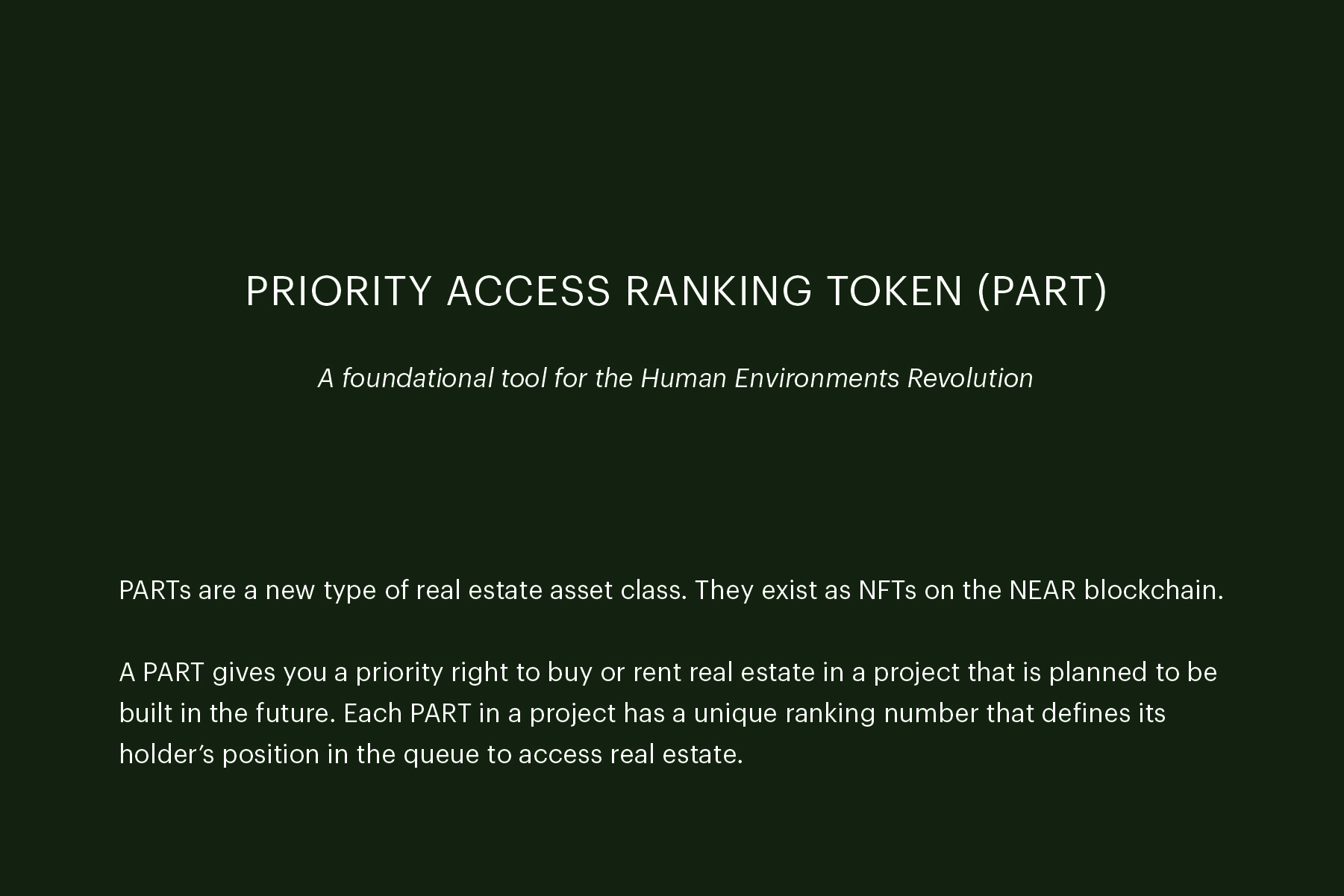
Inspired by the way crypto projects build traction by community involvement, Ground One has developed a new kind of NFT to give the community a stake in the project. We call it Priority Access Ranking Token (PART). Think of it as a ranking ticket that gives you access to properties to be built in the future.
What makes our project stand out?
Real World Application (not another DeFi, metaverse or NFT-art project).
A new type of property right, that can only exist as an NFT. In other worlds, a Web3-native real estate asset class.
A smart solution to solve some of the world's biggest problems: badly planned human environments and excessive financiarisation of real estate.
What's in it for NEAR?
The human desire for quality of life in terms of built environments is extremely powerful. It touches a broad, mostly "non-crypto" public. Our project can therefore bring millions of new users to the NEAR protocol.
Given that the PART token is a Web3-native real estate asset class that can only exist on a blockchain, the project is likely to draw the attention of many law and finance professionals to the NEAR protocol. These professionals are then likely to use NEAR for their own projects.
Ground One's aim is to collaborate with world-leading architects to develop tomorrow's most desirable villages, neighbourhoods, towns and cities. This could potentially entail a massive exposure for the NEAR brand, in association with leading design professionals.
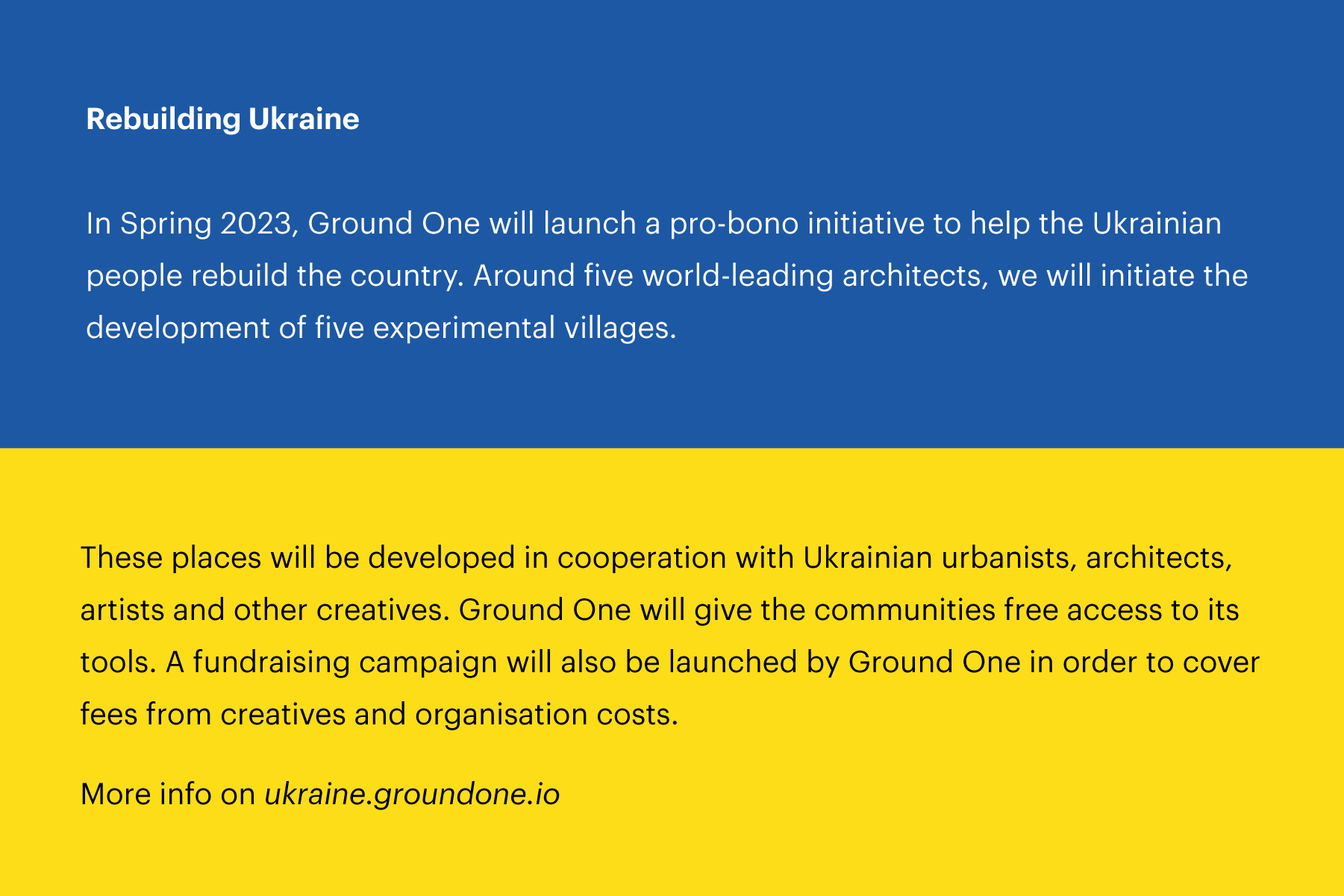
Why can our project help war-torn countries like Ukraine?
Wars take away the homes of people. They also takes away their communities. Wars leaves refugees with the feeling that their roots have been taken away from them.
Ground One provides tools for refugees to make plans of future built environments in their homelands around world-leading architects. These plans recreate communities around a new vision for a shared way of life. The communities thus built and the concepts developed put funding and execution of innovative built environments on fast track.
Our project for Ukraine: link

Inspiration
François, one of our team members, has been working in the real estate industry for 15 years. He got the idea of Ground One after working on innovative built environments with his think tank April Initiative (link). He noticed that there are a lot of architects with great concepts for better human environments on one side, and people who want to live in better places on the other side. Hence the idea to link both parties by giving people a stake in the architects' visions through NFTs.
The PART system itself was inspired by the City of Vienna ticketing system for affordable living. It has proven to be an efficient way to reduce financiarisation of real estate and keep prices of real estate low. Using Web3, we bring the system to a whole new level.
What it does
Ground One's offer can be described as DAO tooling built around PART NFTs.
People can buy PART tokens and join a community that builds new forms of living together. By owning a PART token, people secure a place in the queue to buy or rent properties in the project developed by the community, when it gets built.
A foundational tool for the Human Environments Revolution
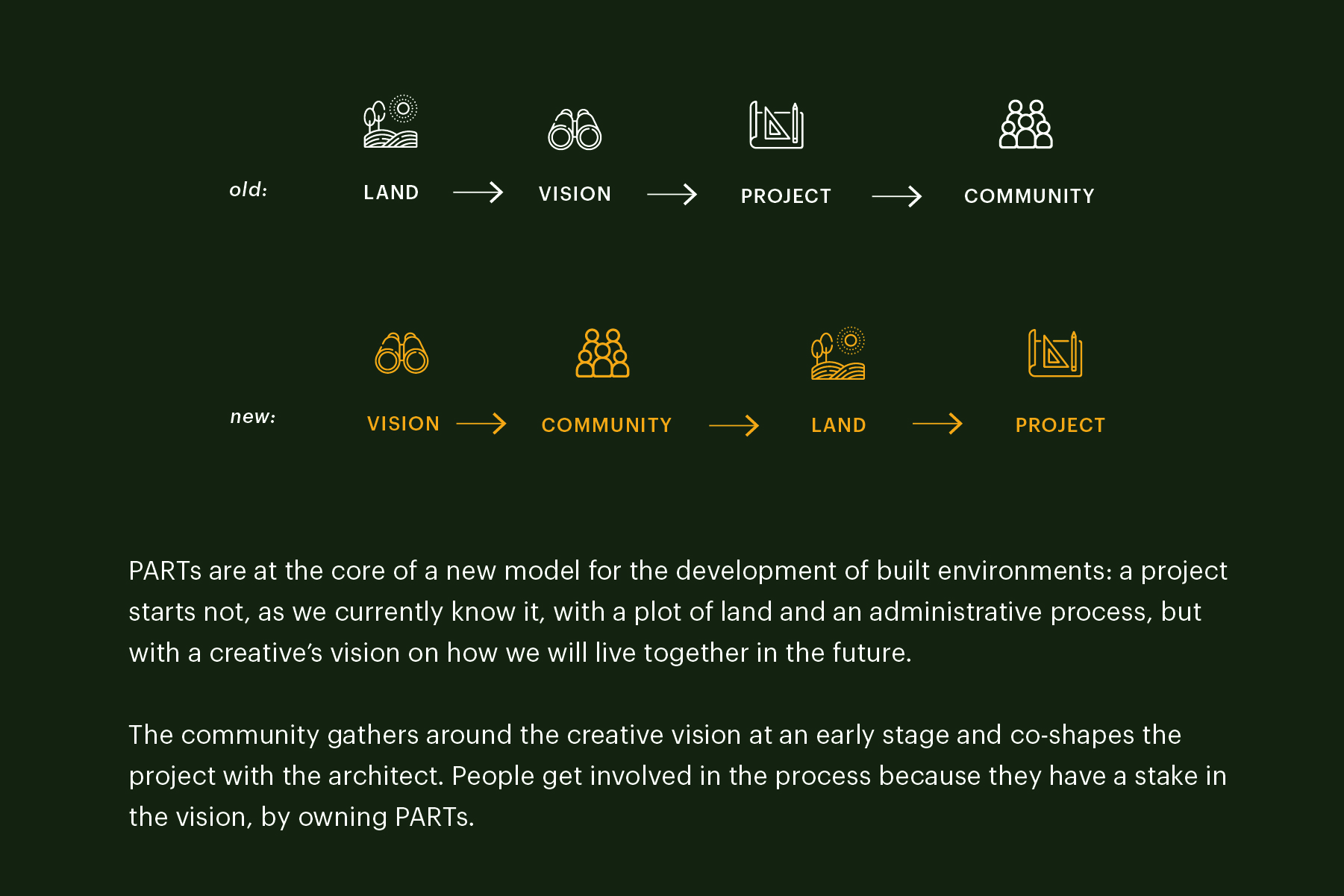
PARTs are at the core of a new model for the development of built environments: a project starts not, as we currently know it, with a plot of land and an administrative process, but with a creative’s vision on how we will live together in the future.
The community gathers around the creative vision at an early stage and co-shapes the project with the architect. People get involved in the process because they have a stake in the vision, by owning PARTs.
The PART process for real estate development is inspired by the way crypto projects build traction by community involvement, enabled by giving the community a stake in the project.

Process Overview
The PART system is a two-step process designed to distribute real estate within a community. It is based on the PART tokens, NFTs on the NEAR blockchain.
The process can be described as a ticketing system. Let's take an example: you go to City Hall to renew your identity card. You take a ticket that gives you a position in the queue. Your ranking defines at what point it is your turn to go to the civil servant who will process your request. A PART token is a similar type of ticket, but for real estate. When it is your turn, you get to select the property you want in a project.
The two steps of the PART process are:
Step 1
The PART issuer (architect, developer, institution, ...) creates PART tokens, then distributes or sells them among the community.

Step 2
Once the concept has been developed by the community and the real estate is ready to be sold, properties are represented on-chain by the architect/developer. Then PART holders register which properties are their favourites. Finally, a smart contract calculates which property is assigned to which PART holder, according to the PART token's ranking and the PART holder's preferences.

Further functionalities we plan to implement: Discord Access using PART NFTs, Payment by credit card, NEARDrop, Governance (Sputnik), Spending DAO, KYC
How we built it
With a team of three, we could split the workload nicely:
François: business, marketing and design matters
Frangiskos: frontend development
Tobias: smart contract development
A prototype was designed by François on Adobe XD, which served as a basis for the application development. The website was developed using Squarespace.
For the front-end we are using a modern stack which includes React, Next.js, Typescript and Tailwind CSS which makes our application performant and offers us the flexibility to design it to fit our exact needs. We are using AWS Simple Email Service to send email confirmations of blockchain transactions to users.
The smart contracts were developed with TypeScript and Rust. It was advantageous that there are examples and templates to build upon. In the future we are planning to migrate all contracts and testing of them to Rust as it provides a more secure base.
Challenges we ran into
The TypeScript sdk is not on par with Rust yet which resulted in some unexpected behaviour (bugs) in the contracts which was time-consuming to fix. Also at this point, the testing with Javascript doesn’t provide the same set of functionality as testing with Rust does. This was our first exposure to Rust which is why we initially started with TypeScript and developed further with Rust.
Luckily the Near dev-support channel and office-hours provided some way to reach out for help, which we are highly grateful for.
A mentor might be even more beneficial as many challenges were straight coding issues with components involved (near api js, near wallet, etc.) which could save some headaches.
Also it’s hard to evaluate in the current situation the security of our contracts for production usage.
Accomplishments that we're proud of
We have managed to provide a fully-functional POC (proof of concept) Dapp which offers a unique and pioneer solution in solving a specific real-life problem.
What we learned
Web3 offers a robust, flexible and secure infrastructure which supports the development of decentralised applications that not only can provide the functionality that traditional Web2 applications offer but can additionally provide features that were previously not possible by leveraging blockchain technology. There are challenges you need to face in the development of a Dapp, but the benefits that Web3 offers outrun this.
What's next for Ground One
For the hackathon, we focused on the functionality of our solution to provide a fully-functional Dapp. Going further, we will fine-tune everything and focus on the user experience. We also plan to add more DAO tooling features, such as governance and accessing messaging applications using PART tokens.
Furthermore, we are working on solutions to provide legal frameworks for the DAOs of the Ground One ecosystem. We are also working on the legal notions backing the PART tokens.
We plan to test our solution with a first round of 5 architects in the next few months. In order to achieve this, we're now looking for a grant to get the platform ready, audit our smart contracts and fund the legal fees required to set up the legal strategy.
Testing our Dapp
Our website can be tested on our site: link
Pre-configured projects for test purposes can be found here: link
Our video demo has been limited to showing the USER APP, for time reasons, but feel free to also test our ISSUER APP. We're quite happy with the result: you can create PART contracts directly from the app using the contract factory feature on NEAR, which makes it very user friendly. A demo of the a PART contract creation can be found here: link
Using several different wallets on testnet can be useful to test the distribution of PARTs and properties.
To learn more about the process, please check our whitepaper (link). You'll also find a sequence diagram on the bottom left.
Team Members Profiles
François de la Caffinière: link
Tobias Leinss: link
Frangiskos Frangeskides: link

Built With
- near-sdk-js
- near-sdk-rs
- nextjs
- react
- rust
- tailwind-css
- typescript
- vercel


Log in or sign up for Devpost to join the conversation.