-
-
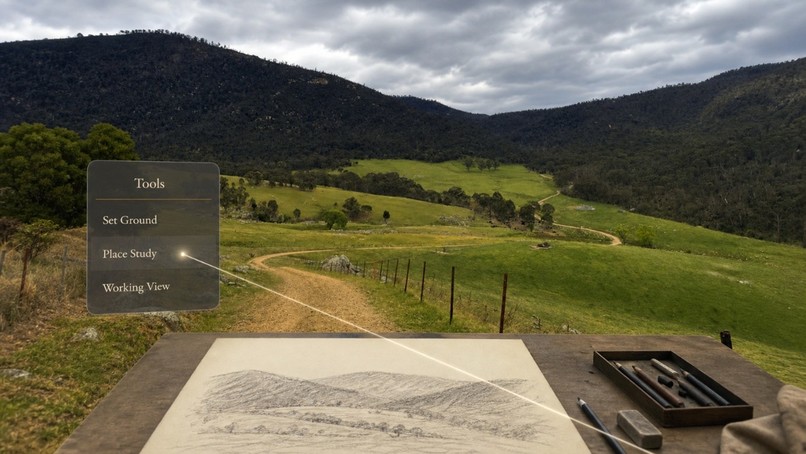
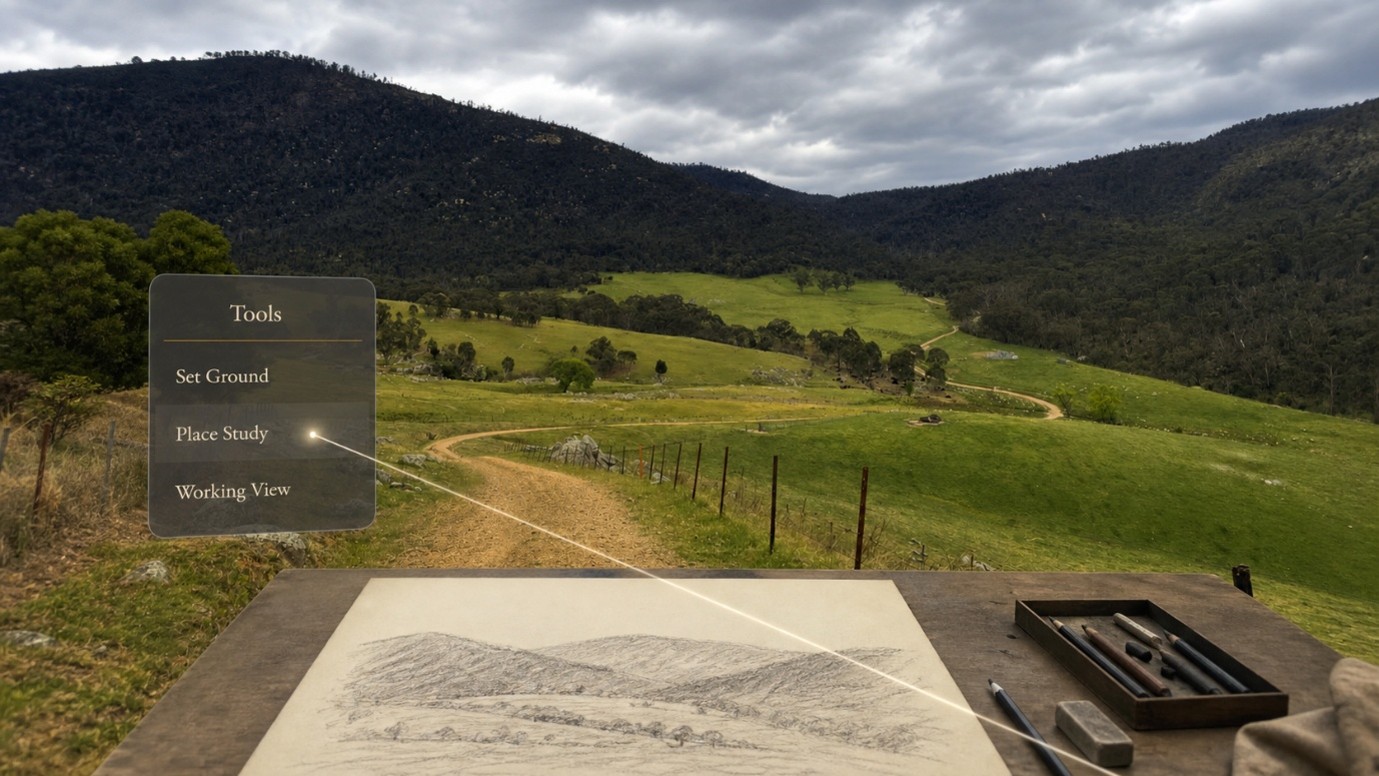
Landscape with passthrough and anchored AR guides
-
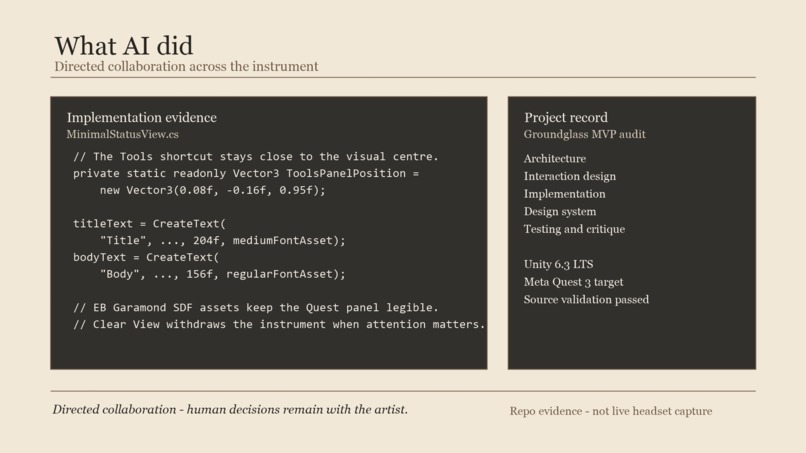
What AI did
-
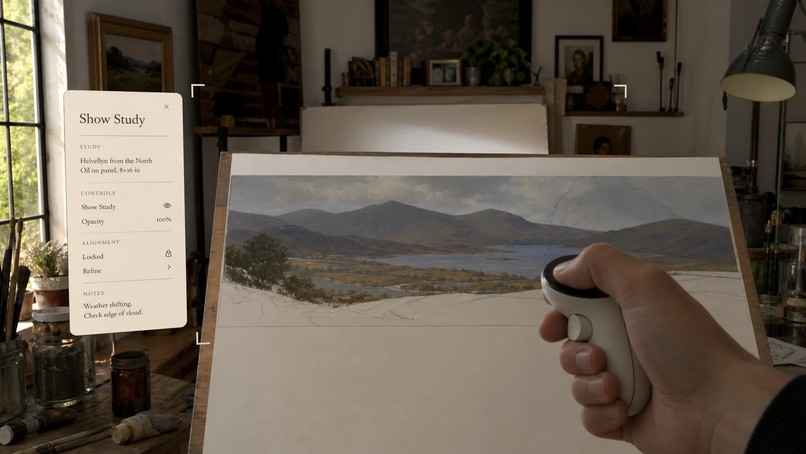
Anchoring the AR

Inspiration
When I was seven years old, I asked my father to teach me how to draw a realistic human eye.
Instead of showing me a technique to copy, he gave me a lesson in anatomy. We talked about eyelids, tear ducts, eyelashes, the eye as a sphere held in shape by internal pressure, and the way light reflects from its moist surface. Only after understanding what an eye is, he explained, can we begin to draw it truthfully.
I have since realised that this was not simply a lesson in drawing. It was a lesson in how artists learn.
Before one learns to draw, one first learns to look.
That lesson has stayed with me throughout my life and became the foundation for Groundglass Atelier.
Rather than asking how AI might create images, I wanted to ask a different question.
Could AI help artists become better observers instead?
Groundglass Atelier stands within a centuries-old tradition of artistic optical instruments; the camera obscura, camera lucida, Claude glass and the ground-glass focusing screen. None of these devices replaced artistic judgement. Each helped artists look more carefully.
What it does
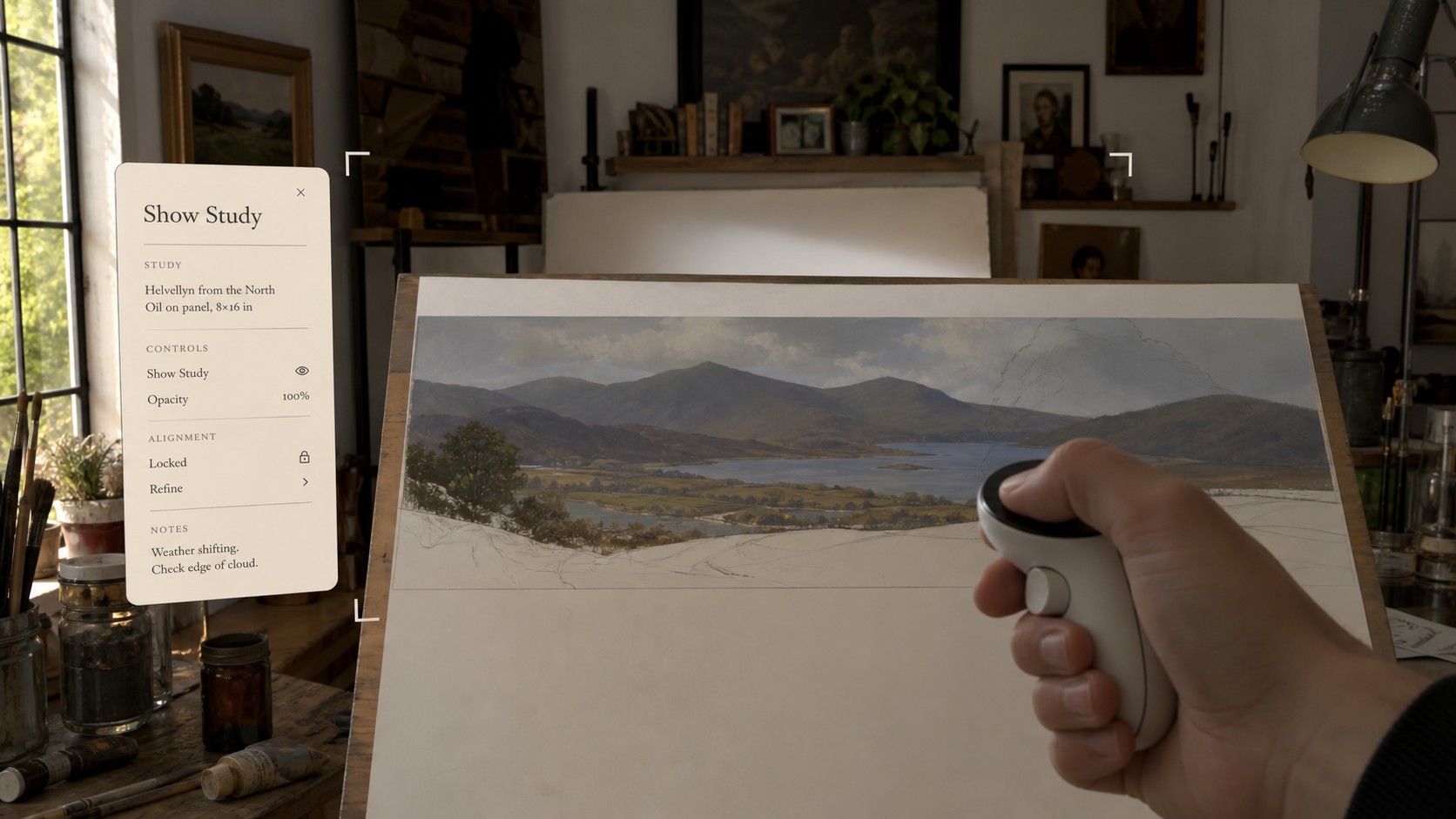
Groundglass Atelier is an augmented optical instrument for artists.
Using mixed reality, it registers reference images onto physical surfaces, supports proportional comparison, tonal study and mural transfer, and then quietly withdraws so that attention returns to the subject rather than the technology.
It is deliberately designed not to generate artwork. The drawing, painting and creative decisions remain entirely the artist's own. Its purpose is to cultivate observation rather than automate creation.
How I built it
I built Groundglass Atelier with Codex and GPT-5.6 through an iterative process that moved freely between software engineering, interaction design, classical drawing practice, art history and mixed reality.
Rather than treating Codex as a code generator, I used it as a thinking partner throughout the design process. Together we explored software architecture, interaction models, interface design, historical precedents, cinematography, visual identity and implementation, refining ideas through repeated cycles of discussion, prototyping and revision before translating them into working software.
One of the most important design decisions was to think of the system not as an app attached to a particular device, but as an artist's instrument. Whether working on a phone, a headset or future viewing devices, the artistic study remains continuous while the instrument changes.
Challenges I ran into
There were a lot of crashes! This is my first time creating anything like this, and it all felt very new. This project came together in just two days, and I really enjoyed the problem solving under pressure. But the greatest challenge was not technical. It was about design. I had to avoid adding too many features and quickly decide what to leave out.
Every design decision had to answer a single question...
Does this deepen observation?
If the answer was no, it didn't belong.
That principle led to a deliberately restrained interface and features such as Veil, Show Study and subtle optical overlays that assist perception before quietly disappearing.
A second challenge was balancing contemporary mixed reality with centuries of artistic tradition. I wanted the technology to feel like the natural successor to historical optical instruments rather than a break from them.
Accomplishments I'm proud of
I'm most proud that Groundglass Atelier developed a coherent philosophy rather than simply a collection of features.
Instead of asking AI to replace artistic practice, it asks how AI might participate respectfully within an existing tradition of observation, apprenticeship and craftsmanship.
I'm also proud that the interface became quieter as the project progressed. The technology should succeed by helping the artist notice the world… and then getting out of the way.
What I learned
Building Groundglass Atelier reinforced something I have long suspected: that AI is most valuable when it extends human thinking, rather than replacing it.
Working with Codex showed me that the richest collaboration often happened before a single line of code was written. Some of the most important breakthroughs emerged while discussing philosophy, architecture, historical context and interaction design, with implementation following naturally from those conversations.
The project also confirmed an older lesson: that the best artistic tools are not those that make the work for us, but those that help us see more clearly.
What's next
This prototype establishes the foundation for a broader family of artistic instruments.
Next, I want to expand support across multiple viewing devices, develop richer mural and studio workflows, and explore new ways mixed reality can support observational practice without interrupting it.
Groundglass Atelier is built on a simple belief:
The future of creative AI is not only about making images. It is also about cultivating the attention from which great art has always grown.

Log in or sign up for Devpost to join the conversation.