-
-
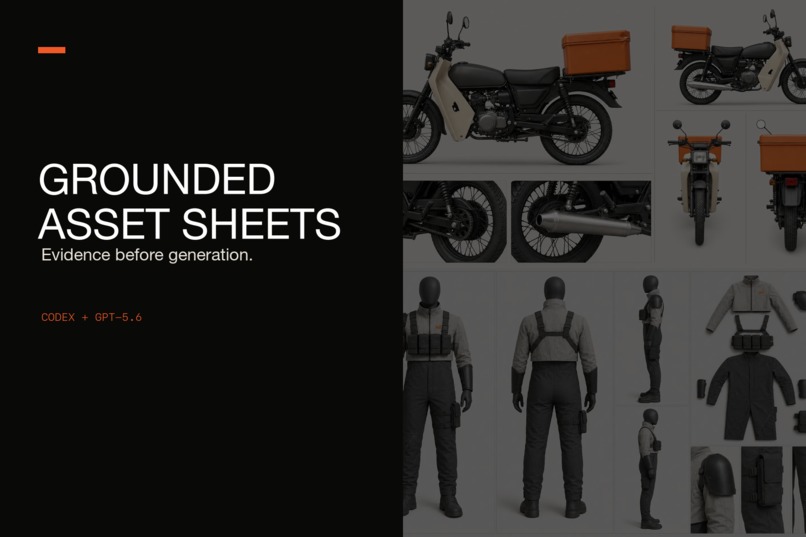
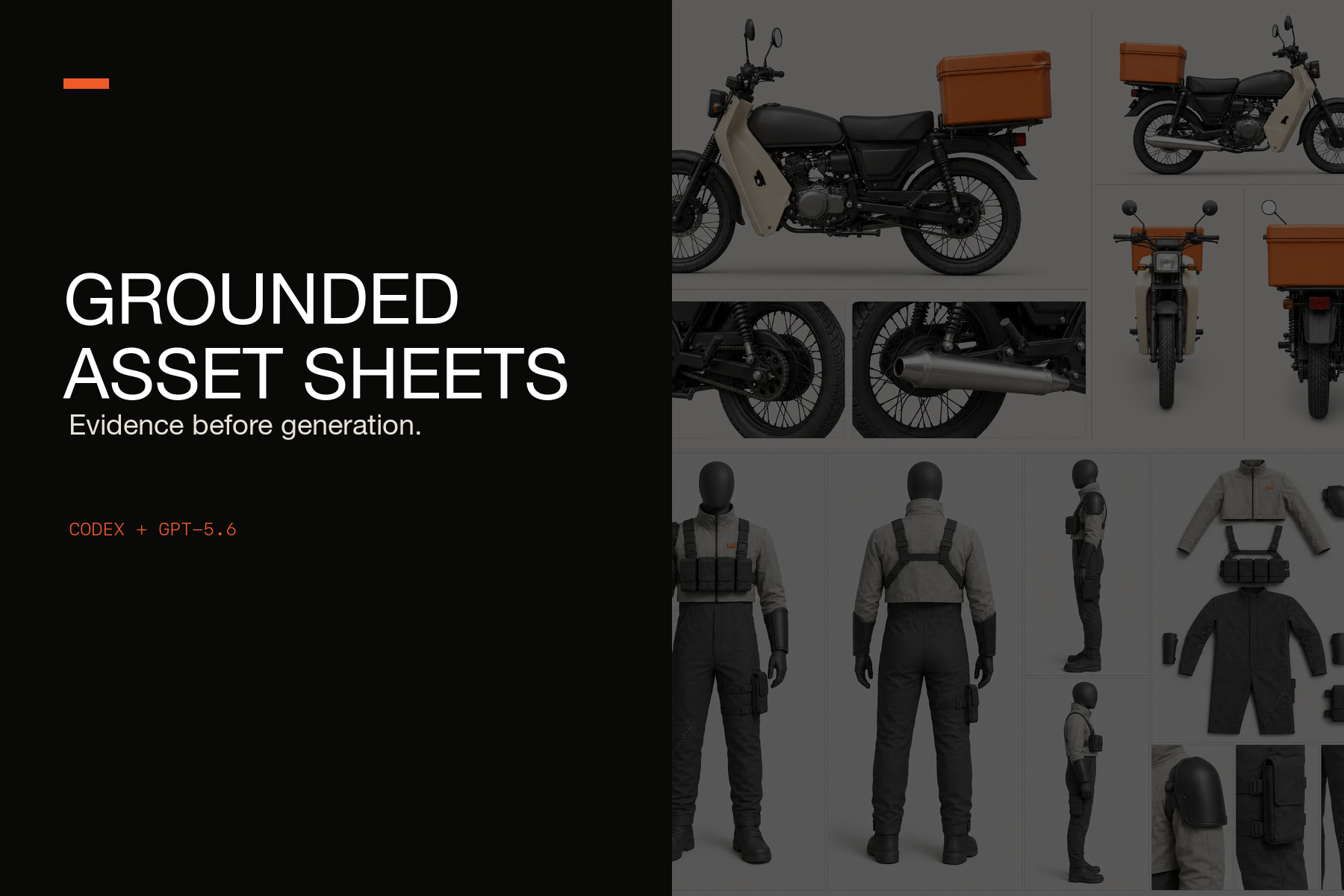
Grounded Asset Sheets — evidence-first contracts for visual continuity.
Inspiration
AI image generators can produce a convincing asset while silently changing the facts that make it usable: handedness, part counts, layer order, attachment points, persistent damage, drivetrain side, or room layout. Longer prompts can add detail, but they do not create an auditable source of truth.
Grounded Asset Sheets began with a practical question: what if visual continuity were treated like an executable contract instead of a prompt-writing problem?
What it does
Grounded Asset Sheets is an open agent skill and specification for turning references and approved requirements into evidence-grounded visual asset packages.
It creates:
- a camera-neutral asset record;
- a source register and field-level evidence ledger;
- typed identity, structure, state, unknown, and prohibition fields;
- view plans designed to reveal high-risk facts;
- generator-ready briefs;
- validation and minimal-repair QA loops.
Four adapters cover objects, wearables, vehicles, and scenes. They share one evidence model while preserving the constraints unique to each asset class.
How we built it
The project is a dependency-free Python skill package with Markdown specifications, JSON fixtures, an asset-record validator, unit tests, and GitHub Actions validation.
During OpenAI Build Week, Codex with GPT-5.6 helped inspect the existing skill contract, implement a consolidated evidence-report command, write failing-case tests, and run the validation loop. The new command validates every public fixture in one pass and can output either a human-readable Markdown report or machine-readable JSON.
Human judgment remained the approval boundary. It set the fidelity rules, rights-safe public scope, and the distinction between confirmed evidence, inference, unknowns, and prohibited invention.
Challenges
The hardest part was separating facts from presentation. A dramatic camera angle can hide a wrong attachment; a mirrored image can look polished while reversing the drivetrain; a repair pass can fix one defect and mutate three correct regions.
We addressed those problems by:
- keeping the asset contract camera-neutral;
- making asymmetry and side-specific placement explicit;
- retaining unresolved facts as unknowns instead of guessing;
- treating prohibitions as first-class validation inputs;
- limiting repair to the smallest failed region;
- using only synthetic, rights-safe public examples.
Accomplishments
- Four working adapters: object, wearable, vehicle, and scene.
- Four public JSON fixtures that pass the standard-library validator.
- A consolidated evidence report with Markdown and JSON output.
- Twelve passing unit tests, including failing cases for bad source references and invalid records.
- CI validation for the package, fixtures, schema, tests, and report.
- A synthetic micro-world showcase with no real brand, product, franchise, or third-party reference image.
The current public fixtures contain 4 registered sources, 12 evidence-backed fields, 21 structural components, 10 explicit unknowns, and 21 explicit prohibitions, with 0 validation errors and 0 warnings.
What we learned
Reliable visual generation is not mainly a prompt-length problem. It is an evidence-modeling problem.
Unknowns are useful data. Prohibitions are executable requirements. And a good asset sheet is not only an attractive image—it is a compact continuity system that another agent or human can inspect, challenge, and reuse.
What's next
- Add richer cross-record continuity checks.
- Export evidence reports as reusable review artifacts.
- Add more rights-safe evaluation fixtures and regression cases.
- Connect the contract to generation and image-comparison tools without weakening human approval authority.
Grounded Asset Sheets is open source under MPL-2.0.

Log in or sign up for Devpost to join the conversation.