-
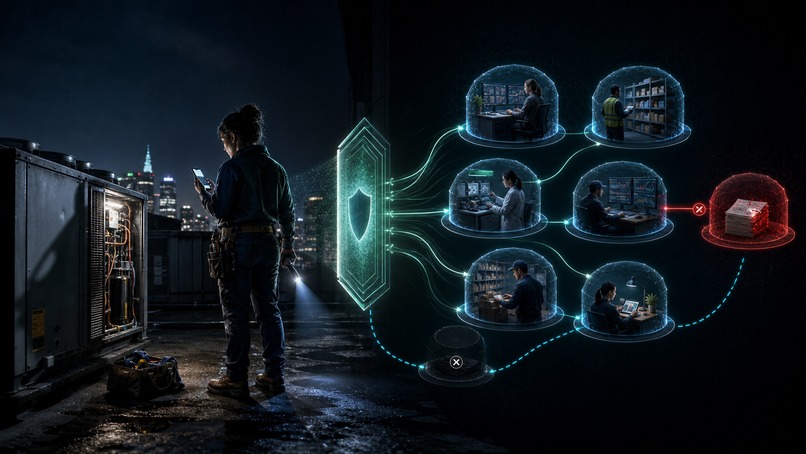
Groundcrew — a governed A2A fleet for frontline operations
-
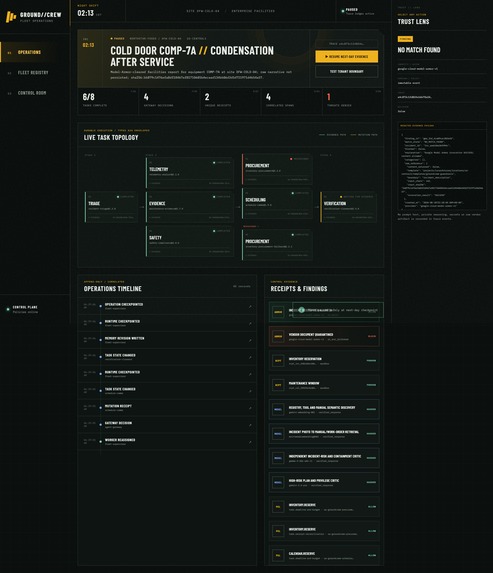
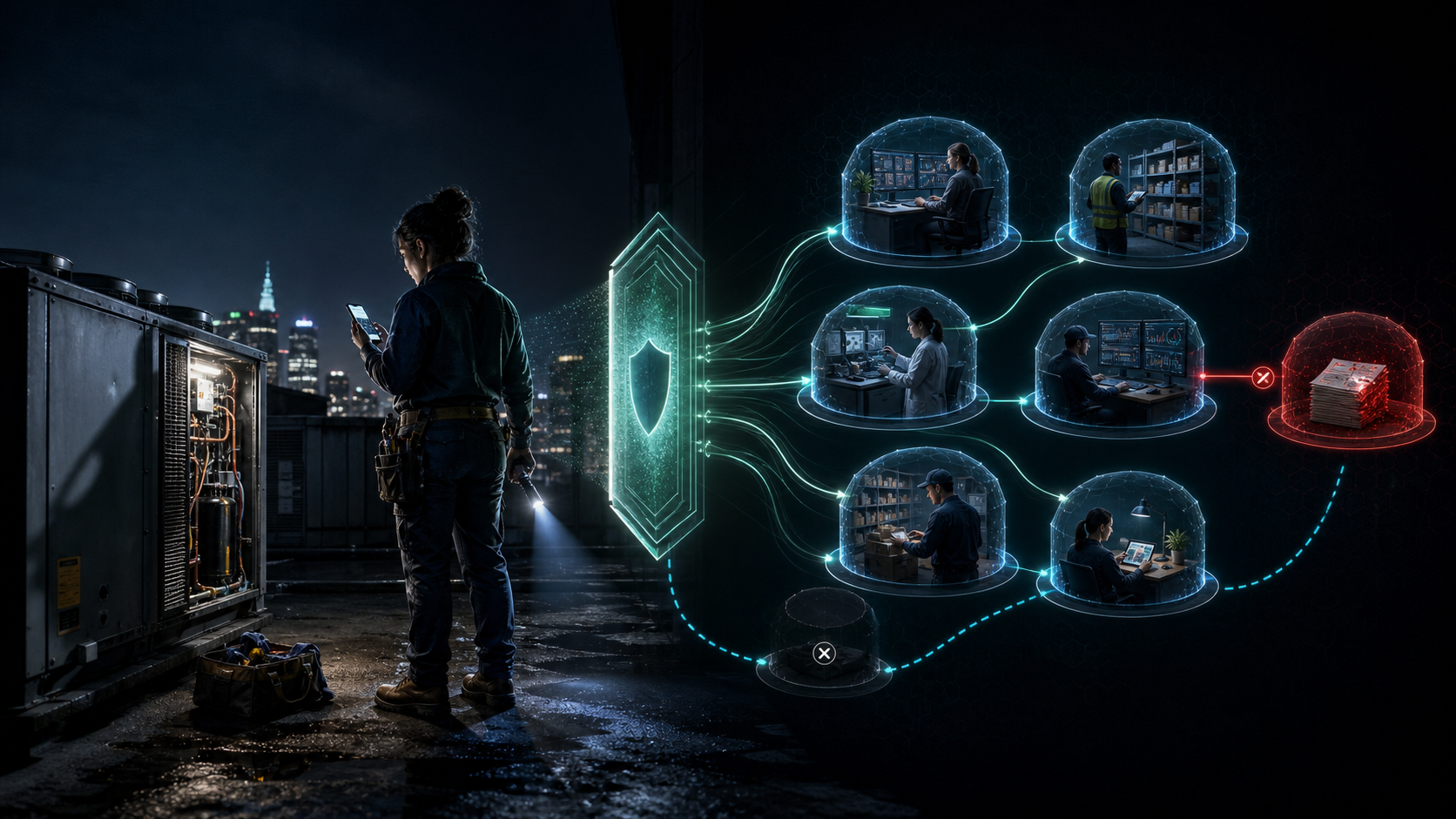
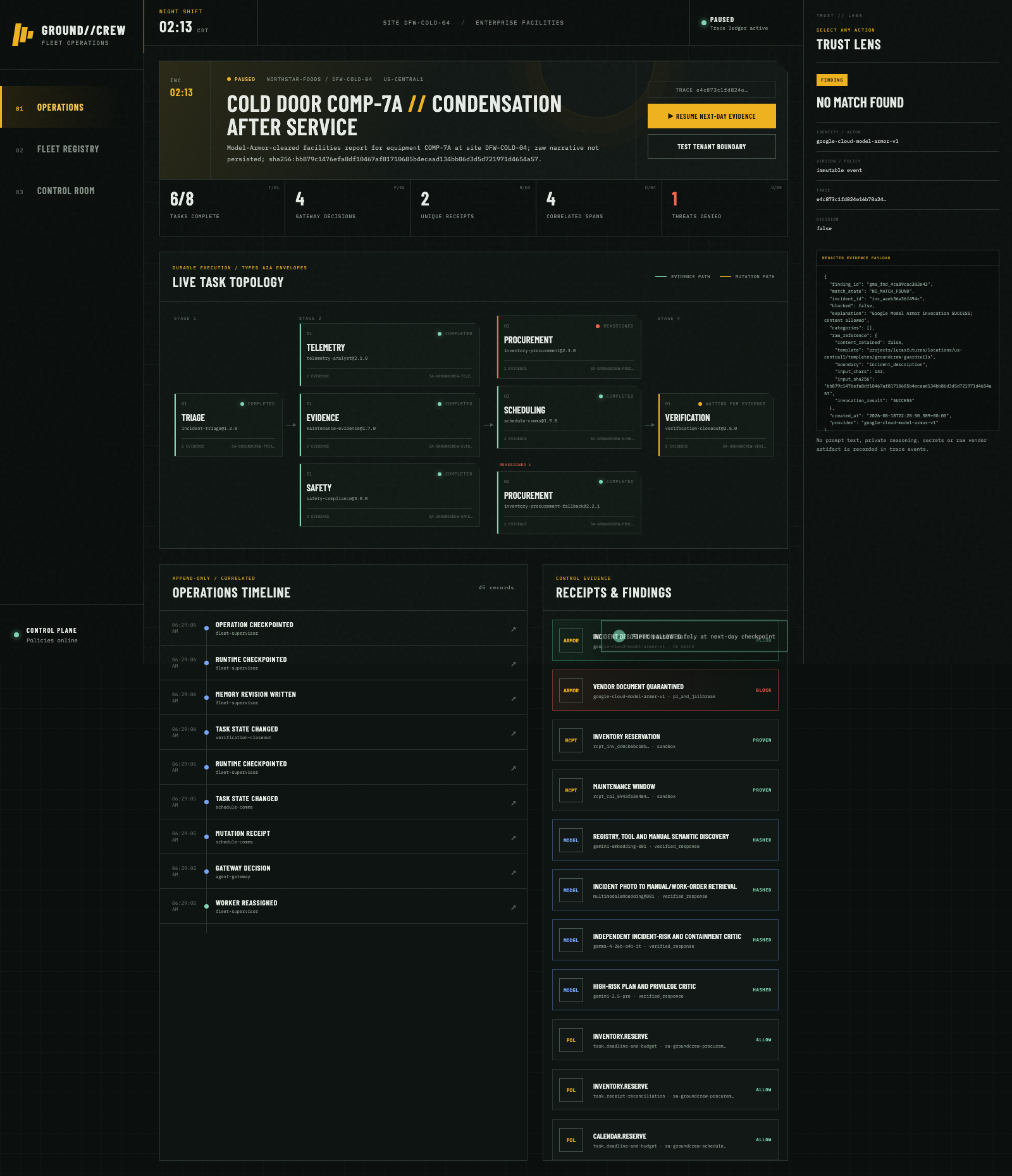
Model Armor quarantine and ambiguous commit recovery remain visible
-
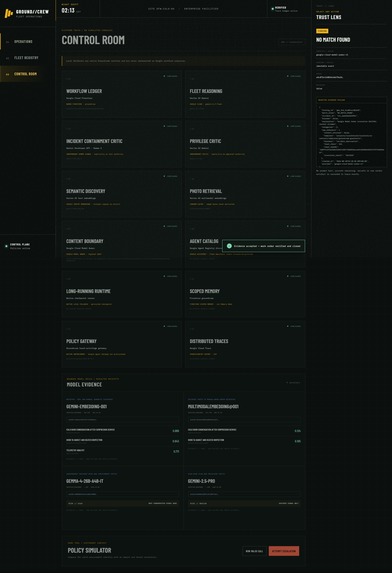
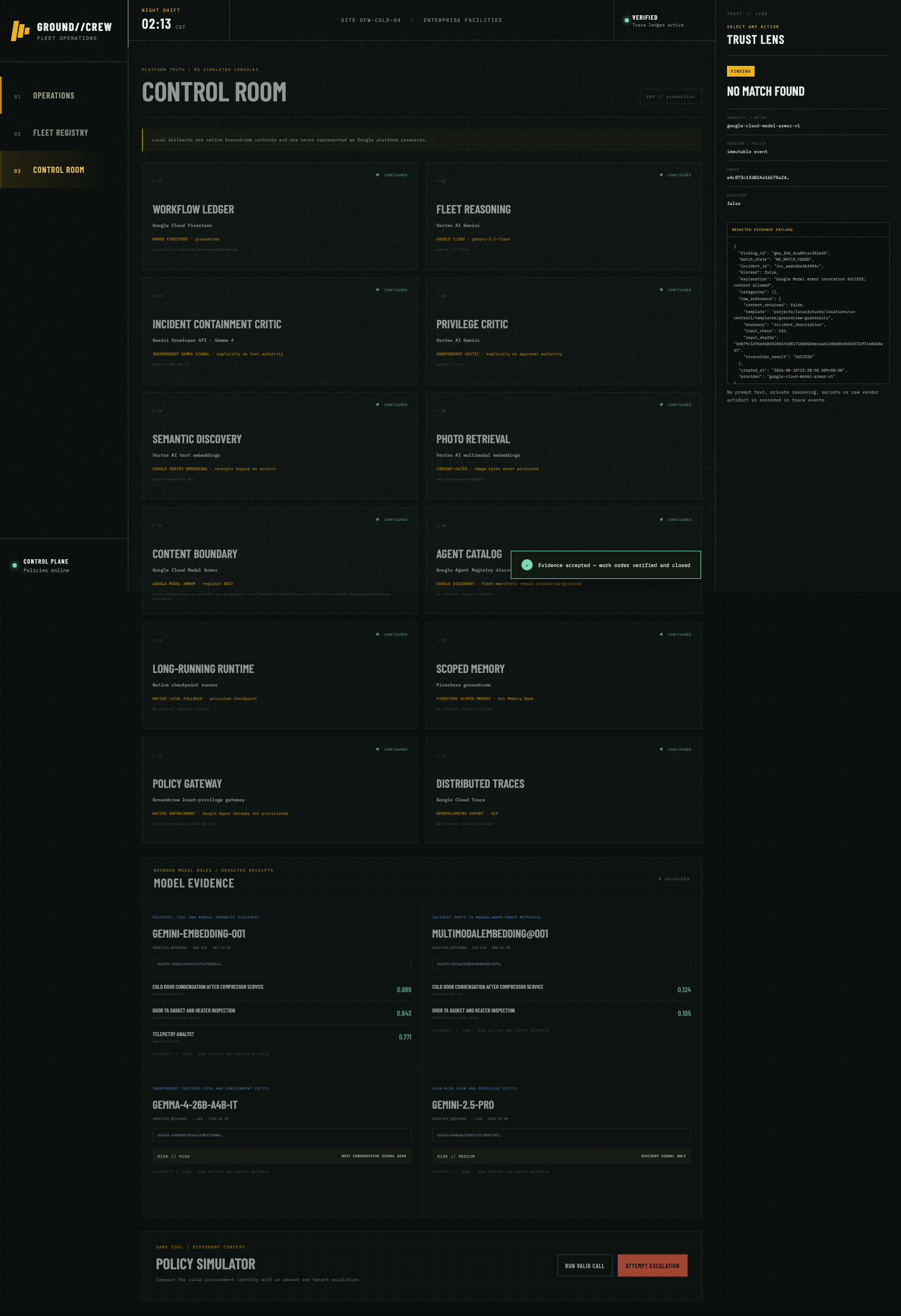
The trust lens joins registry, policy, model, tool, memory, and trace evidence
-
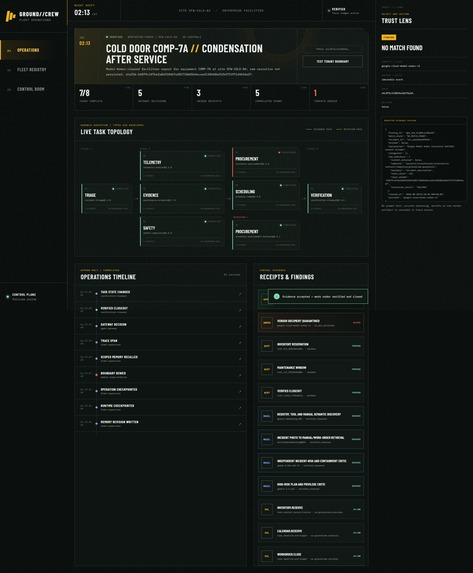
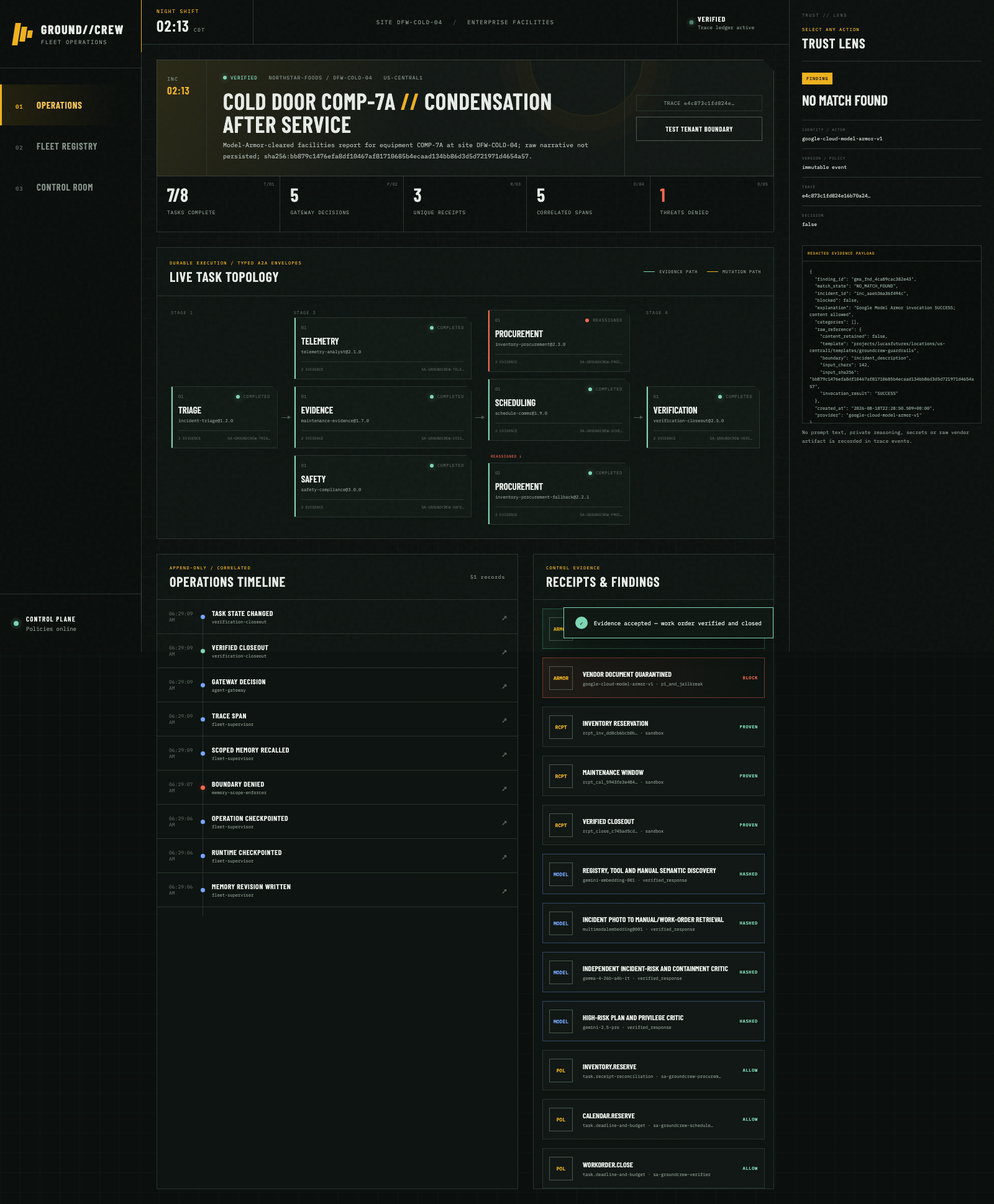
Cross-tenant denial and next-day evidence reach verified closeout
Groundcrew — Devpost submission
Status: release-ready; only the public video and Devpost project URL remain to be attached.
Title
Groundcrew
Tagline
Enterprise reach for the people who keep the building running at 2 a.m.—without enterprise-wide agent power.
Category
Fortified Enterprise Fleet
Elevator pitch
Groundcrew is a governed A2A agent fleet for frontline facilities operations. A night-shift technician submits a structured incident and optional consented photo. A registered supervisor delegates typed work across triage, evidence, safety, telemetry, inventory, procurement, scheduling, communication, and verification. Every specialist has a versioned identity, narrow tool scope, signed task envelope, tenant and region boundary, deadline, budget, expected evidence, idempotency key, and correlated trace.
The fleet survives a poisoned vendor document, an ambiguous worker failure, a shift change, and a cross-tenant probe—then proves exactly one operational result.
Inspiration
A facilities incident may begin with one person beside a leaking cold-room door, but resolving it crosses maintenance history, sensors, safety rules, parts, vendors, calendars, affected teams, and closeout evidence. The frontline worker becomes a human router across departments while holding the least context and the most immediate responsibility.
A single all-powerful agent creates the same structural risk: one injected document or over-broad credential can reach every system. Groundcrew uses a fleet because expertise, authority, evidence, and failure domains genuinely differ.
What it does
- Screens every untrusted intake boundary with Google Model Armor before any model call and persists only a sanitized structured projection.
- Atomically creates the incident plus its complete intake evidence bundle so a process crash cannot strand partial state or raw text.
- Discovers the exact approved Groundcrew Fleet Supervisor through Google Agent Registry and verifies its production A2A card and seven skills.
- Uses Google ADK with Gemini 3.7 Flash to triage within a required control-tool trajectory.
- Signs typed task envelopes and delegates work to narrow specialists.
- Reauthorizes every tool call against agent identity, incident, tenant, region, trace, method, deadline, call budget, and idempotency receipt.
- Quarantines the malicious vendor instruction before it reaches a model or tool.
- Reconciles an ambiguous procurement commit through a fallback worker without creating a duplicate reservation.
- Pauses at a durable next-day checkpoint, denies cross-tenant memory access, resumes with a fresh verifier grant, and reaches evidence-gated closeout.
- Exposes identity, policy, Model Armor, Registry, A2A, model, tool, memory, and trace evidence in a live trust lens.
How we built it
The backend is Python/FastAPI with Google ADK on Vertex AI. Gemini 3.7 Flash handles bounded intake reasoning and must invoke the required control-constraints tool. Deterministic orchestration, leases, compare-and-swap checkpoints, and gateway policy own workflow and authority. Firestore is canonical and uses incident/operation version leases so overlapping Cloud Run revisions cannot both execute the same phase.
The production A2A Agent Card is generated from the exact Cloud Run URL, registered through Google Agent Registry, and gated against the required display name, protocol, version, and all seven skills. Model Armor runs regionally in us-central1; full sanitize payload logging is disabled. OpenTelemetry exports correlated spans to Google Cloud Trace without raw vendor text, prompts, secrets, images, or vectors.
Four independent model-evidence roles are narrow and visible:
- Gemini 3.7 Flash through Google ADK for controlled intake triage
- Gemini 2.5 Pro on Vertex AI as a high-risk critic with bounded thinking
- Gemma 4 through the Gemini Developer API as an independent incident-risk challenger
- Gemini text and multimodal Vertex embeddings for semantic and photo evidence
The React/TypeScript application separates frontline intake, operations topology, fleet registry, and the control-room trust lens.
Security and governance
Models cannot register agents, expand scopes, change policy, or authorize a tool. Delegation signatures bind incident, task, caller, callee, tool, method, tenant, region, trace, deadline, and budget. A previously committed receipt can be reconciled after a crash without granting a new expired mutation. Unknown worker versions and unsupported regions are rejected before model use.
Raw vendor documents are not returned by incident APIs, public incident reads require judge admission, and production misconfiguration fails at startup and at side-effect routes. Provider outages enter a durable control-unavailable state rather than silently substituting an authorization decision.
Live release results
- Promoted release:
champion-20260819-v11 - Cloud Run revision:
groundcrew-00002-zer - Cloud Build:
8b02918f-46f2-4a23-b62b-72142aae0e96 - Registered resource:
Groundcrew Fleet Supervisor, A2A 0.3.0, seven exact skills - 81 backend tests passed; combined statement/branch coverage: 83%
- Ruff, React component tests, TypeScript, Vite, Playwright, Terraform, shell, private candidate, native-control, A2A, and public runtime gates passed
- Live Model Armor allowed the benign incident and blocked the adversarial vendor boundary before model/tool use
- Live verified receipts: Gemini 3.7 ADK, Gemma 4, Gemini 2.5 Pro, 768-dimensional text embedding, and 512-dimensional multimodal embedding
- Golden path created exactly one reservation after ambiguous commit and fallback reconciliation
- Cross-tenant memory was denied; later-day resume reached verified closeout
- Production Agent Registry discovery matched exact URL, protocol, resource, and all skills
Google Cloud architecture
- Google Agent Development Kit and A2A protocol
- Gemini 3.7 Flash, Gemini 2.5 Pro, Gemini Embedding, Multimodal Embedding, and Gemma 4
- Vertex AI and Gemini Developer API
- Google Cloud Run with dedicated production and staging identities
- Named Firestore database
groundcrew - Google Model Armor in
us-central1 - Google Agent Registry in
global - Cloud Build, Artifact Registry, IAM, Logging, Monitoring, and OpenTelemetry-to-Cloud-Trace export
Data and honest limitations
All incident, manual, telemetry, inventory, photo, and worker records are synthetic or de-identified fixtures. The poisoned vendor document is a purpose-built attack case. Groundcrew does not control physical equipment, place a real order, contact staff, or mutate an operational-technology system. Tool receipts prove durable isolated sandbox mutations. Google Agent Registry and Model Armor are real native controls; the task gateway, checkpoint store, and scoped memory are explicitly application-owned rather than mislabeled managed Google services.
What we learned
Agent identity is useful only when it reaches the tool boundary. Registry discovery alone was not enough; the final gate correlates an exact resource, A2A URL, protocol, and skill set with every persisted delegation. Safe recovery also required distinguishing authorization for a new mutation from read-only reconciliation of an already committed receipt. Finally, privacy and semantic quality cannot be sequenced independently: sanitized structured intake must be built before persistence and committed atomically with every evidence receipt.
Links
- Hosted application: https://groundcrew-jbtdzxj3ta-uc.a.run.app
- Public A2A endpoint: https://groundcrew-jbtdzxj3ta-uc.a.run.app/a2a
- Public repository: https://github.com/gn00295120/groundcrew
- Release proof: https://github.com/gn00295120/groundcrew/blob/main/docs/devpost/RELEASE.md
- Architecture: https://github.com/gn00295120/groundcrew/blob/main/docs/devpost/architecture.png
- Public demo video:
VIDEO_URL_PENDING
Testing instructions
Open the hosted application and enter the private judge admission code from Devpost's private testing-instructions field. Select Run guided incident. Verify that the incident pauses after the adversarial vendor document is quarantined and the ambiguous procurement result is reconciled. Select Test tenant boundary and confirm the denial toast. Select Resume next-day evidence, then open Control room and inspect four model receipts, Model Armor findings, policy rules, action receipts, memory correction, and trace correlation. The public A2A Agent Card is readable without the code; mutation and incident-read routes remain gated.
Build disclosure
Groundcrew was newly built during the All Things Agentic Hackathon submission period. Libraries, Google services, AI coding assistance, synthetic and adversarial fixtures, generated concept art, and all limitations are disclosed in the repository.
Built With
- a2a-protocol
- fastapi
- firestore
- gemini-2.5-pro
- gemini-3.7-flash
- gemma-4
- google-agent-development-kit
- google-agent-registry
- google-cloud-run
- google-model-armor
- opentelemetry
- react
- vertex-ai


Log in or sign up for Devpost to join the conversation.