Inspiration
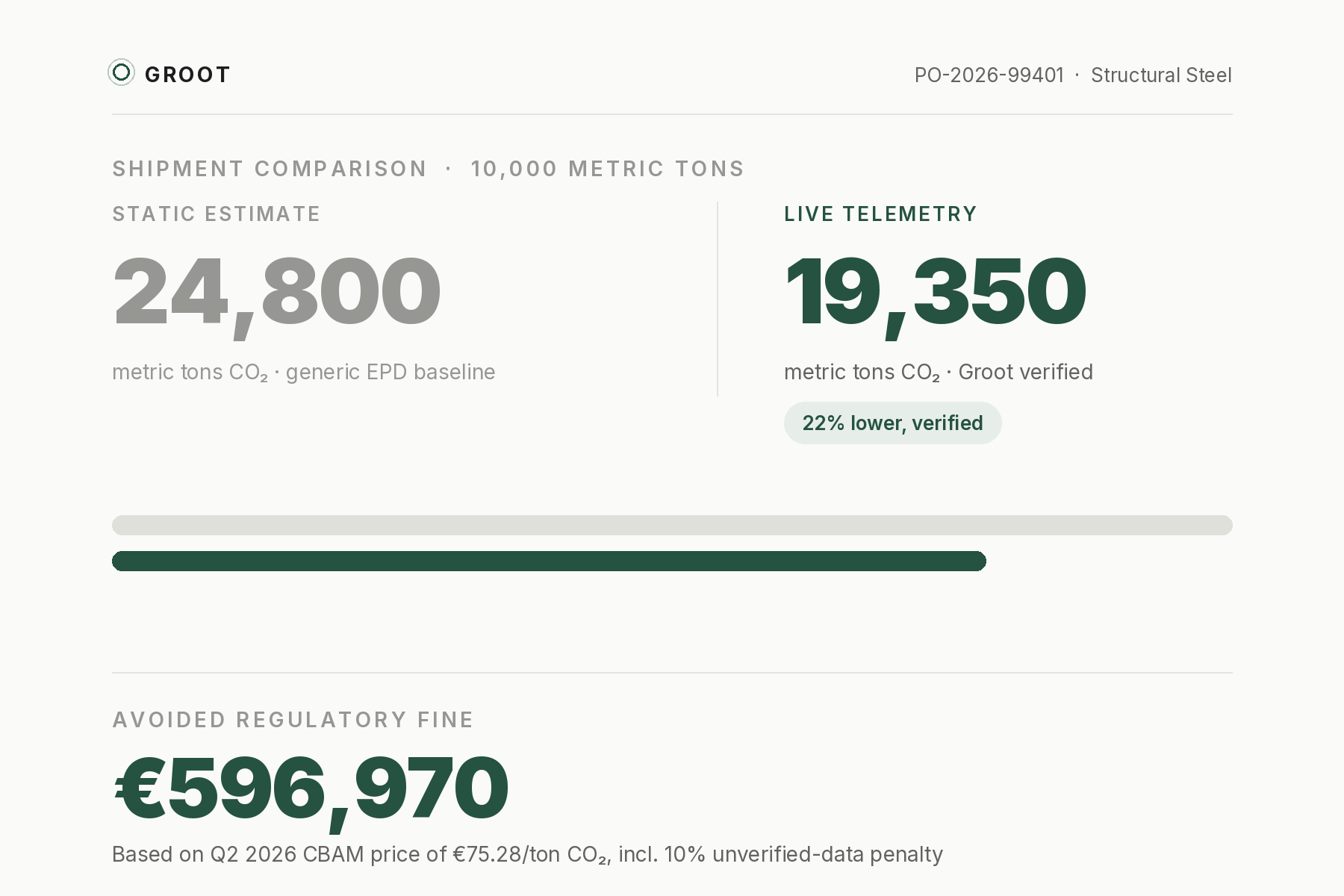
Scope 3 carbon accounting in construction relies on static PDF certificates based on generic averages, regardless of when or how a material was actually made. A steel batch smelted during peak solar hours and one smelted at night when coal peaker plants are running can have wildly different real footprints, but today's system treats them identically. With CBAM now pricing carbon at roughly €75 per metric ton in 2026, plus a 10% penalty for unverified data, this is no longer just an ESG reporting gap; it's a direct financial liability. We also noticed major tech companies seeing emissions spikes tied to data center construction, which told us the exact enterprise buyers who need this most are building right now.
What it does
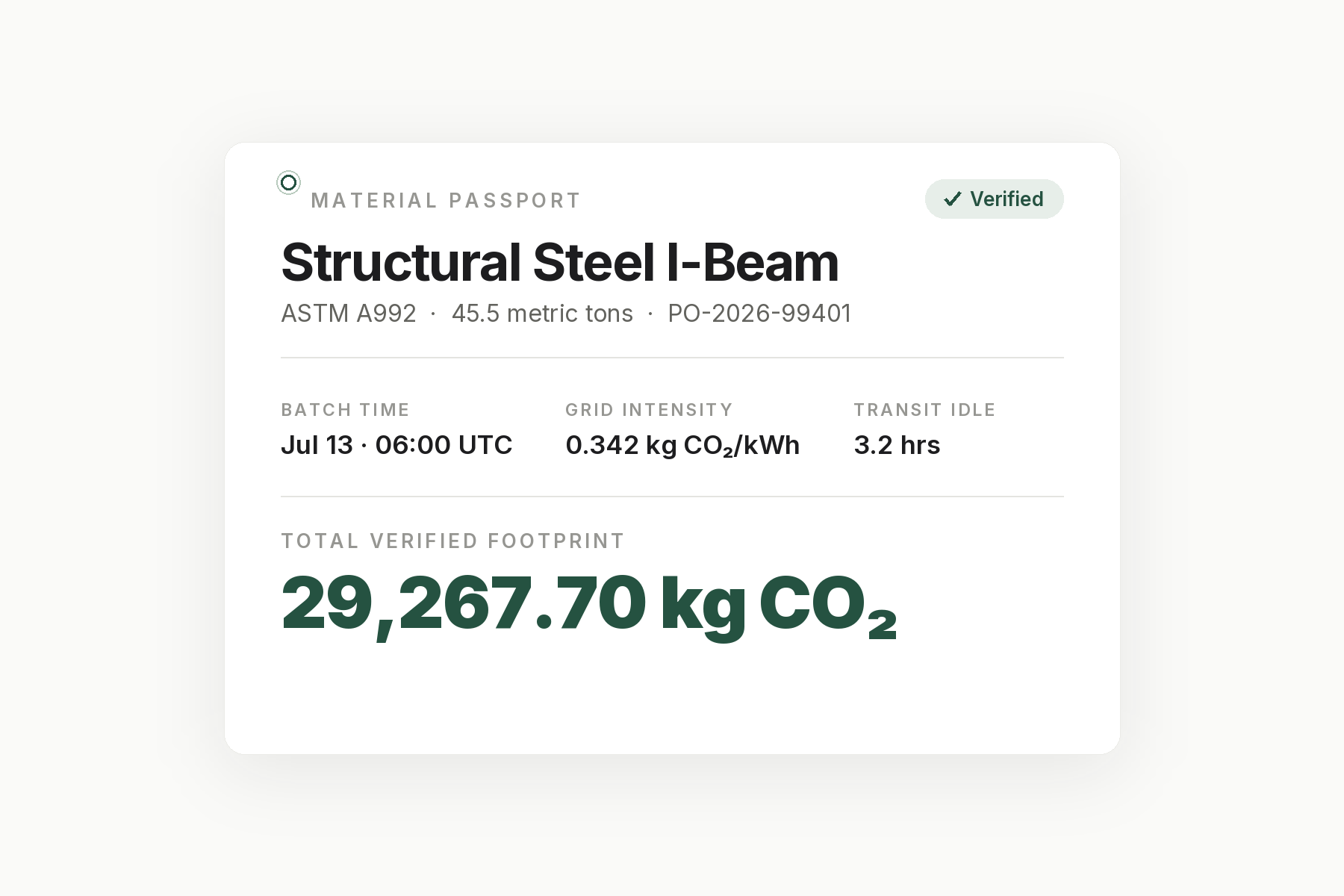
Groot is a proposed carbon telemetry engine for construction supply chains. It would ingest live data from freight IoT trackers, port congestion logs, and manufacturing facility energy grids to compute the real, time-stamped carbon footprint of a material batch, from fabrication to delivery. Each shipment would generate a Digital Material Passport, a verifiable, auditable carbon record designed to embed directly into existing material delivery ticket workflows.
How we'd build it
The core is two auditable emissions formulas rather than a black-box estimate.
Total footprint per material batch:
$$ E_{\text{total}} = E_{\text{fabrication}} + E_{\text{logistics}} $$
Fabrication emissions:
$$ E_{\text{fabrication}} = \sum_{i} \left( M_{i} \times EF_{\text{raw}, i} \right) + \int_{t_{\text{start}}}^{t_{\text{end}}} P_{\text{mfg}}(t) \cdot CI_{\text{grid}}(t) \, dt $$
Logistics emissions:
$$ E_{\text{logistics}} = \sum_{j} \left( V_{\text{fuel}, j} \times EF_{\text{fuel}, j} \right) + \left( t_{\text{idle}} \times C_{\text{idle}} \right) $$
The proposed stack: a Python/FastAPI backend to run the emissions logic, and a React/Tailwind dashboard to compare static baseline estimates against live telemetry-derived footprints, with a running "avoided regulatory fine" figure based on current CBAM pricing.
Challenges
- Designing a formula where every term maps to something a real IoT integration could actually measure, so it holds up under an actual compliance audit rather than just looking good in a pitch.
- Translating a carbon number into a financial figure that lands immediately, which meant working from real CBAM pricing mechanics rather than an invented multiplier.
- Scoping a problem that touches IoT data, grid intensity, logistics telematics, and regulatory pricing down to something we could explain clearly within the idea submission.
What we learned
Most "carbon accounting" today is closer to a fiction than a measurement: a flat number applied uniformly no matter when or how something was actually produced. Once you account for grid timing or vehicle idle time, the true footprint of a material can shift dramatically, and that shift now has a direct, calculable cost under frameworks like CBAM.
What's next for Groot
- Build a working prototype against simulated telemetry data
- Integrate with real freight IoT and grid-intensity APIs
- Expand the Material Passport schema beyond steel and concrete
- Explore direct integration into Kaya AI's delivery ticket workflow
Built With
- iot
- javascript
- json
- python
- react
- rest-api
- tailwindcss
- vite

Log in or sign up for Devpost to join the conversation.