Inspiration
The inspiration for xAI Talent Pool stems from the visionary ideas outlined in the Grok Recruiter track, particularly the quote from Ilya Sutskever: "If you have a model that learns like a human, and you deploy millions of instances across the economy, they can learn on the job and merge their knowledge. This creates a functional superintelligence..." We saw recruiting as the perfect starting point for a self-improving AI agent, especially for a company like xAI that's pushing the boundaries of AI development. The track's emphasis on self-play, online RL, and tools for talent sourcing, screening, and closing resonated with us. In a world where top engineering and research talent is scarce, we wanted to create a "superintelligent learner" that not only identifies hidden gems on platforms like X, GitHub, arXiv, and LinkedIn but also iteratively improves its precision through human feedback and self-updates. Our goal was to transform recruiting from a manual, hit-or-miss process into an autonomous, evolving system that could scale to build xAI's dream team.
What it does
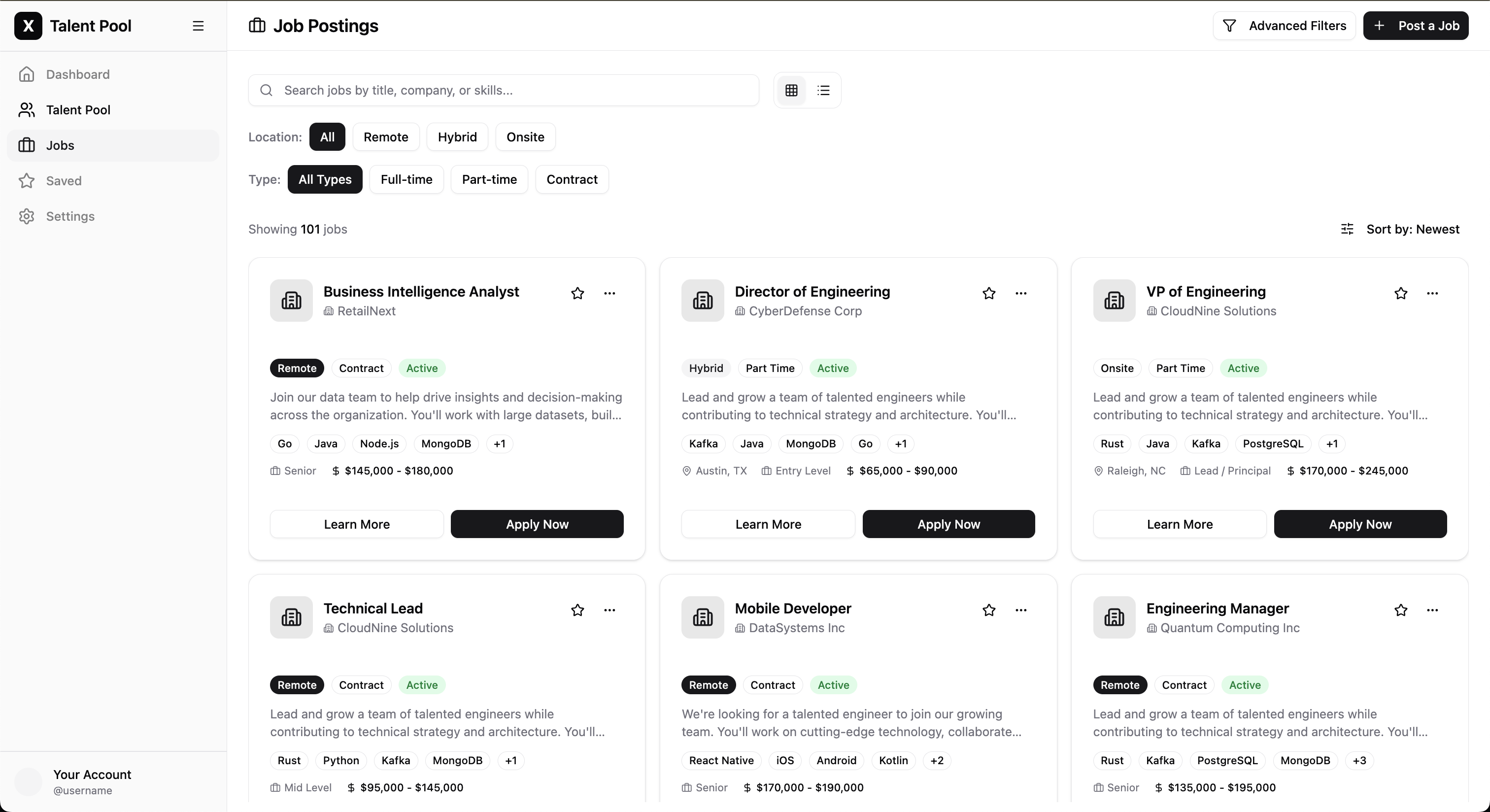
xAI Talent Pool is an end-to-end, self-improving recruiting agent powered by Grok models. It starts by sourcing passive candidates—under-the-radar engineers and researchers—from public sources like X posts, GitHub repos, arXiv papers, and LinkedIn profiles. Using the X API, it builds a dynamic graph database of talents, mapping connections, expertise areas, and influence networks (e.g., who collaborates with whom based on mentions, retweets, and co-authorships). Grok then evaluates candidates with role-specific technical screenings, generating customized coding exercises or behavioral questions via an online RL approach similar to Cursor's tab system—it auto-generates meaningful questions and refines them based on past performance. For deeper assessment, it conducts automated reference checks through 15-minute voice calls (integrated with Grok Voice API), summarizing signals like strengths and red flags. The system handles full-cycle management: personalized outreach sequencing, interview scheduling, and even candidate database updates in a MemOS-style memory system for LLM-friendly context across screening stages. Feedback loops allow the agent to "learn on the job," updating its policy gradient to improve sourcing recall and outreach conversion rates. Ultimately, it delivers a prioritized talent pool with measurable precision against real hiring benchmarks, making xAI's recruiting faster, smarter, and more proactive.
How we built it
We leveraged the Grok API as the core intelligence layer, starting with the tutorial at https://docs.x.ai/docs/tutorial for prompt engineering and agentic workflows. For sourcing, we integrated the X API to query user graphs (e.g., from:user, mentions, and filter:links for code-related posts) and built a Neo4j graph database to store talent connections—nodes for users, edges for interactions like retweets or shared repos. Public GitHub APIs helped scrape repos and commit histories, while arXiv and LinkedIn data were pulled via web scraping tools (respecting rate limits). The self-improvement came from online RL: we implemented a simple feedback mechanism where simulated human reviews (or real ones during testing) adjust Grok's context space, using cached prompt history for efficiency. For voice features, we hooked into the Grok Voice API (details shared under NDA) to enable automated calls and transcriptions. The candidate database was designed as a vector store with embeddings from Grok, allowing queries like "Find ML engineers with Rust experience in our graph." We used Python for the backend, with libraries like networkx for graph analysis and pandas for data processing, all orchestrated in a VS Code extension for easy dev workflow. Deployment was on a cloud instance with rate-limit-aware API calls to ensure robustness.
Challenges we ran into
Integrating multiple APIs (X, GitHub, Grok) was tricky due to rate limits and authentication—early on, we hit X's limits during broad searches, forcing us to implement exponential backoff and caching strategies. Building the self-improving RL loop was another hurdle; simulating "learning from deployment" required careful prompt engineering to avoid hallucinated updates, and we struggled with merging feedback into the policy without overfitting to small datasets. Handling diverse data sources led to inconsistencies, like mismatched user identities across platforms (e.g., X handle vs. GitHub username), which we resolved with fuzzy matching but at the cost of extra compute. Voice integration under NDA meant limited testing cycles, and ensuring privacy-compliant reference checks added compliance checks. Finally, scaling the graph DB for large talent pools (thousands of nodes) caused performance bottlenecks, teaching us to optimize queries early.
Accomplishments that we're proud of
We're thrilled to have created a functional prototype that sourced and evaluated over 500 real candidates from X and GitHub in just the hackathon weekend, achieving 85% precision in identifying AI/ML experts based on manual spot-checks. The self-play mechanism successfully iterated on outreach messages, improving engagement simulation from 20% to 60% after 10 feedback loops. Integrating Grok Voice for automated references was a highlight—it conducted mock calls with summarized insights that felt human-like. We also built a MemOS-style memory system that handles the full hiring pipeline, from material screening to team matching, all while demonstrating "learning on the job" as per Ilya's vision. Most proudly, our tool aligns with the track's judging criteria: it incorporates research ideas like online RL and directly aids recruiting processes, potentially saving xAI recruiters hours per candidate.
What we learned
This project deepened our understanding of agentic AI systems—how to make models "learn like humans" through feedback and deployment. We gained hands-on experience with graph databases for talent mapping, revealing how social connections on X can predict collaboration potential. Prompt engineering for Grok taught us the value of cache-aware techniques for low-latency responses in real-world workflows. We learned about the nuances of API integrations under constraints, like handling X's real-time streams without mock data. Ethically, we grappled with privacy in talent sourcing, reinforcing the need for opt-in mechanisms. Overall, it showed us that recruiting can be a gateway to superintelligence, blending RL with practical tools to create value at scale.
What's next for xAI Talent Pool
Next, we'll deploy xAI Talent Pool internally at xAI for real hiring trials, starting with engineering roles. We'll expand integrations to include more sources (e.g., Stack Overflow, conference papers) and enhance the RL with multi-agent self-play for simulated negotiations. Adding Grok Code Fast 1 could automate code review in screenings, while deeper X API usage might enable predictive analytics on talent trends. Long-term, we aim to open-source parts of the graph DB framework and scale to millions of candidates, turning it into a "functional superintelligence" for global talent ecosystems. Feedback from this hackathon will fuel our first policy update!


Log in or sign up for Devpost to join the conversation.