-
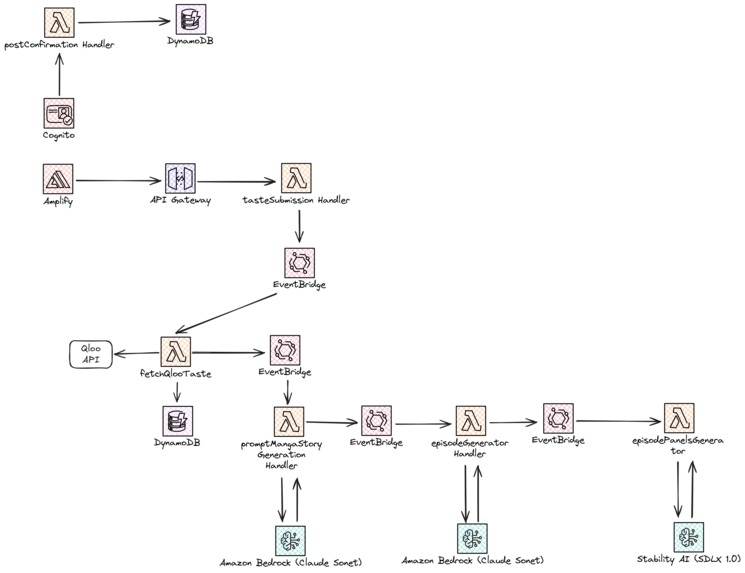
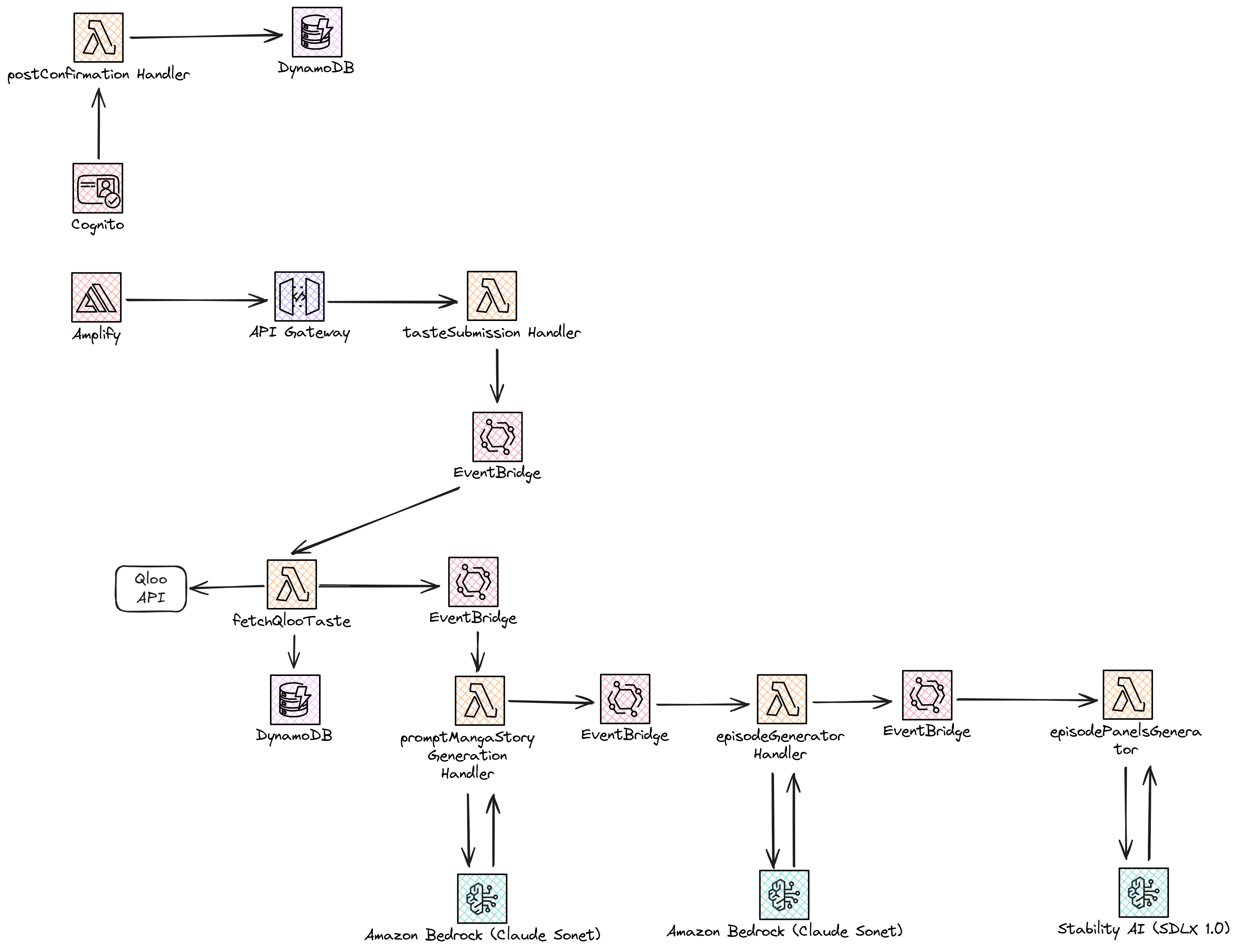
Architecture Diagram
Inspiration
The inspiration for Griot came from recognizing a fundamental gap in content personalization: most recommendation systems rely on explicit user data or behavioral tracking, which raises privacy concerns and often misses the deeper cultural context that truly drives our preferences. We were fascinated by the idea that someone's taste in music, their favorite travel destinations, or their dining preferences could reveal profound insights about the type of stories that would resonate with them.
Manga, as a storytelling medium, is uniquely positioned to benefit from this cultural intelligence. Unlike other forms of entertainment, manga spans countless genres, themes, and artistic styles, making it the perfect canvas for deeply personalized content creation. We envisioned a platform that could understand not just what genres you like, but why you like them based on your broader cultural preferences.
What it does
Griot is an intelligent manga generation platform that creates personalized manga content by combining the narrative power of Large Language Models with Qloo's cultural intelligence API. Here's how it works:
Cultural Preference Analysis: Users input their preferences across entertainment, lifestyle, and cultural domains (genres, themes, art styles, target audience, content rating)
Qloo Integration: The platform leverages Qloo's Taste AI™ to analyze these preferences and discover deep, cross-domain cultural connections - understanding how someone's taste in music or travel might inform their storytelling preferences
Intelligent Story Generation: Using Claude (Anthropic's LLM), Griot generates personalized manga stories that reflect the user's cultural profile, creating narratives that resonate on a deeper level than traditional recommendation systems
Multi-Episode Continuation: Users can continue their favorite stories, with the system maintaining narrative consistency while incorporating their evolving preferences
Batch Processing: The platform supports generating multiple stories simultaneously, allowing users to explore different narrative directions based on their cultural profile
How we built it
Griot is built on a modern, scalable serverless architecture that prioritizes both performance and privacy:
Frontend Architecture:
- Next.js 15 with React 19 for a responsive, modern user interface
- TypeScript for type safety and developer experience
- Tailwind CSS for consistent, responsive design
- AWS Cognito integration for secure authentication
Backend Architecture:
- AWS Lambda functions for serverless compute, ensuring scalability and cost-efficiency
- Amazon DynamoDB with single-table design for high-performance data storage
- Amazon EventBridge for event-driven architecture, enabling loose coupling between services
- Amazon S3 for content storage and delivery
- AWS CDK for infrastructure as code, ensuring reproducible deployments
AI Integration:
- Qloo's Taste AI™ API for cultural intelligence and cross-domain preference analysis
- Amazon Bedrock with Claude for natural language generation and story creation
- Custom prompt engineering to ensure generated content aligns with cultural insights
Key Technical Features:
- Circuit breaker pattern for resilient external API integration
- Exponential backoff retry logic for handling transient failures
- Comprehensive monitoring with CloudWatch and X-Ray tracing
- Input validation and sanitization for security
- Rate limiting to prevent abuse
- Privacy-first design - no personal identifying data required
Challenges we ran into
1. Qloo API Integration Complexity The biggest challenge was understanding and effectively utilizing Qloo's API structure. The API supports multiple entity types (books, movies, TV shows, video games), and we had to implement fallback logic to try different entity types when certain ones weren't permitted for our use case. We solved this by creating a robust client that attempts multiple entity types in order of relevance to manga content.
2. Cultural Intelligence Translation Converting Qloo's cultural insights into meaningful manga story elements required significant prompt engineering. We had to map abstract cultural preferences to concrete storytelling elements like character archetypes, plot structures, and thematic elements. This involved creating sophisticated tag mapping systems and preference translation logic.
3. Event-Driven Architecture Complexity Implementing a fully event-driven system with EventBridge required careful orchestration of multiple Lambda functions. Ensuring proper error handling, retry logic, and state management across distributed services was challenging. We implemented comprehensive monitoring and correlation IDs to track requests across the entire system.
4. Scalability and Performance Balancing the computational requirements of LLM generation with cost and performance constraints required careful architecture decisions. We implemented batch processing capabilities and optimized our Lambda functions for cold start performance.
5. Privacy and Security Ensuring the platform remained privacy-first while still providing personalized experiences required careful design of our data models and API interactions. We implemented comprehensive input validation, rate limiting, and secure authentication flows.
Accomplishments that we're proud of
1. Seamless LLM-Cultural Intelligence Integration We successfully created a system that meaningfully combines Qloo's cultural insights with LLM capabilities, demonstrating how cultural intelligence can enhance AI-generated content beyond traditional approaches.
2. Production-Ready Architecture Built a fully serverless, scalable architecture with comprehensive error handling, monitoring, and security features that could handle real-world traffic and usage patterns.
3. Privacy-First Personalization Achieved deep personalization without requiring personal identifying information, proving that cultural preferences can drive meaningful content customization while respecting user privacy.
4. Robust Error Handling Implemented sophisticated error handling including circuit breakers, retry logic, and graceful degradation that ensures the system remains functional even when external services experience issues.
5. Comprehensive Testing Developed extensive test suites covering unit tests, integration tests, and end-to-end workflows, ensuring system reliability and maintainability.
What we learned
Technical Insights:
- Cultural Intelligence is Powerful: Qloo's cross-domain insights revealed connections we hadn't anticipated - how someone's travel preferences could inform their storytelling preferences in surprisingly accurate ways
- Event-Driven Architecture Benefits: The loose coupling provided by EventBridge made the system more resilient and easier to extend with new features
- LLM Prompt Engineering: Learned sophisticated techniques for translating abstract cultural insights into concrete creative direction for language models
Product Insights:
- Privacy-First is Possible: Users are more willing to share preferences when they understand no personal data is required or stored
- Cultural Context Matters: Traditional genre-based recommendations pale in comparison to culturally-informed content generation
- Iterative Personalization: The ability to continue and evolve stories based on user feedback creates a more engaging experience than one-shot generation
Development Insights:
- Infrastructure as Code: Using AWS CDK dramatically improved our deployment reliability and environment management
- Observability is Critical: Comprehensive logging and tracing were essential for debugging distributed systems
- External API Resilience: Robust error handling and fallback strategies are crucial when integrating with external services
What's next for Griot
Short-term Enhancements:
- Visual Generation: Integrate Amazon Bedrock's image generation capabilities to create manga-style artwork that matches the cultural aesthetic preferences
- Interactive Storytelling: Allow users to influence story direction through choices, with Qloo insights informing the available options
- Social Features: Enable users to share and discover stories from others with similar cultural profiles
- Mobile App: Develop native mobile applications for iOS and Android
Long-term Vision:
- Multi-Modal Cultural Analysis: Expand beyond text preferences to analyze user's visual, audio, and behavioral preferences for even deeper personalization
- Creator Tools: Provide tools for manga creators to understand their audience's cultural preferences and optimize their content accordingly
- Cross-Cultural Exploration: Help users discover content from different cultural contexts that align with their underlying preferences
- Educational Integration: Partner with educational institutions to create culturally-relevant educational manga content
Technical Roadmap:
- Real-time Generation: Implement streaming responses for faster story generation
- Advanced Analytics: Provide creators and users with insights into cultural trends and preferences
- API Platform: Open APIs for third-party developers to build on Griot's cultural intelligence capabilities
- Global Expansion: Support for multiple languages and cultural contexts beyond the initial English-focused implementation
Griot represents a new paradigm in content personalization - one that respects privacy while delivering unprecedented personalization through cultural intelligence. By combining Qloo's unique insights with the creative power of LLMs, we've created a platform that doesn't just recommend content, but creates it specifically for each user's cultural profile.
Built With
- amazon-bedrock
- amazon-cloudwatch
- amazon-cognito
- amazon-dynamodb
- cdk
- eventbridge
- lambda
- next-js
- qloo
- react
- s3
- typescript

Log in or sign up for Devpost to join the conversation.