-

The Landing Page
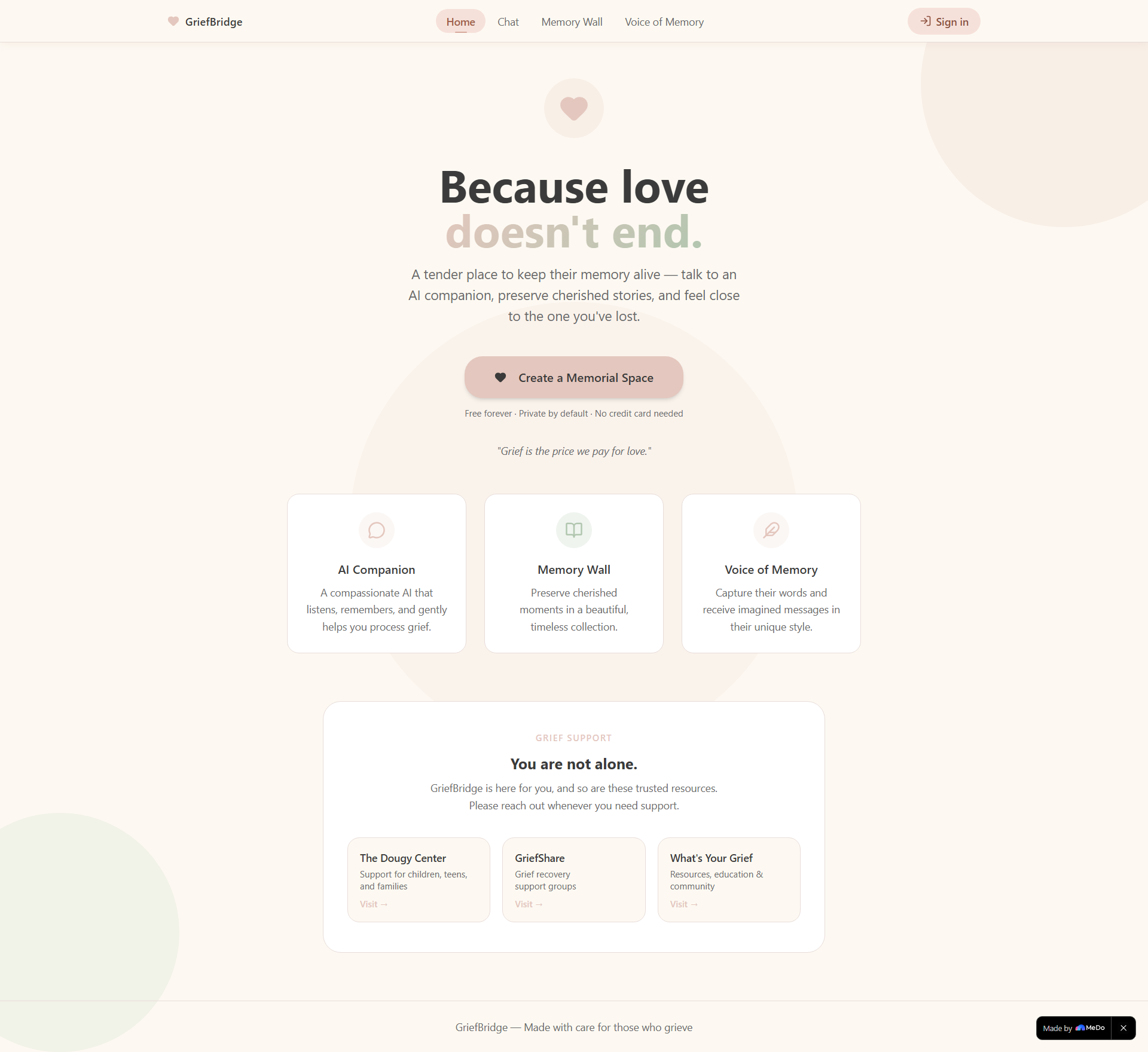
Inspiration
I kept thinking about the 1 in 4 people who are actively grieving right now. They open their phones every day and see productivity apps, social feeds, shopping tools — but nothing built for them. Nothing that holds space for loss. That gap is what inspired GriefBridge.
What it does
GriefBridge is a full-stack AI grief companion and digital memorial platform. When you sign up, you tell the app who you lost — their name, personality, favorite phrases, and memories. From that moment, the entire app becomes personal to them.
It has four core features:
AI Companion Chat — A compassionate AI that always remembers your loved one's name and personality. It asks warm follow-up questions like "Tell me a happy memory of Sarah..." and lets you save meaningful moments directly to your Memory Wall with one click.
Memory Wall — A beautiful private space to collect and revisit memories. Each card is dated and softly designed. You can share the wall publicly as a memorial page with a unique link.
Voice of Memory — You enter quotes and phrases your loved one used to say. The AI generates a short message written in their style, using their personality and words. Every message is clearly labeled as AI-imagined — honest, but deeply comforting.
Digital Memorial — A shareable public page with a lit candle animation, memory cards, and the person's name. Friends and family can visit it anytime.
How I built it
I built GriefBridge entirely using MeDo. I used multi-turn conversation to build an AI that carries full context — the deceased's name, personality description, and personal phrases — across every feature of the app. I iterated through MeDo's chat editor to refine the onboarding flow, the streaming chat responses, the rate limiting system, and the public memorial share feature.
MeDo generated the complete full-stack app including Supabase authentication, a live database for memories, rate limiting logic, prompt injection protection, and one-click public deployment.
Challenges I ran into
The hardest part was making the AI feel genuinely personal without being misleading. The Voice of Memory feature required
Built With
- ai-multi-turn-conversation
- api
- medo
- postgresql
- react
- rest
- supabase
- tailwind-css
- typescript

Log in or sign up for Devpost to join the conversation.