GridWatch — Predicting Energy Insecurity Before Crisis Strikes
Inspiration
Every winter, thousands of low-income families face an impossible choice: pay the heating bill or buy groceries. Utility companies and city agencies often act only after missed payments or service disconnections, when families are already in crisis. We wanted to explore whether AI could help shift energy assistance from a reactive process to a predictive one by identifying vulnerable communities before utility shutoffs occur.
What It Does
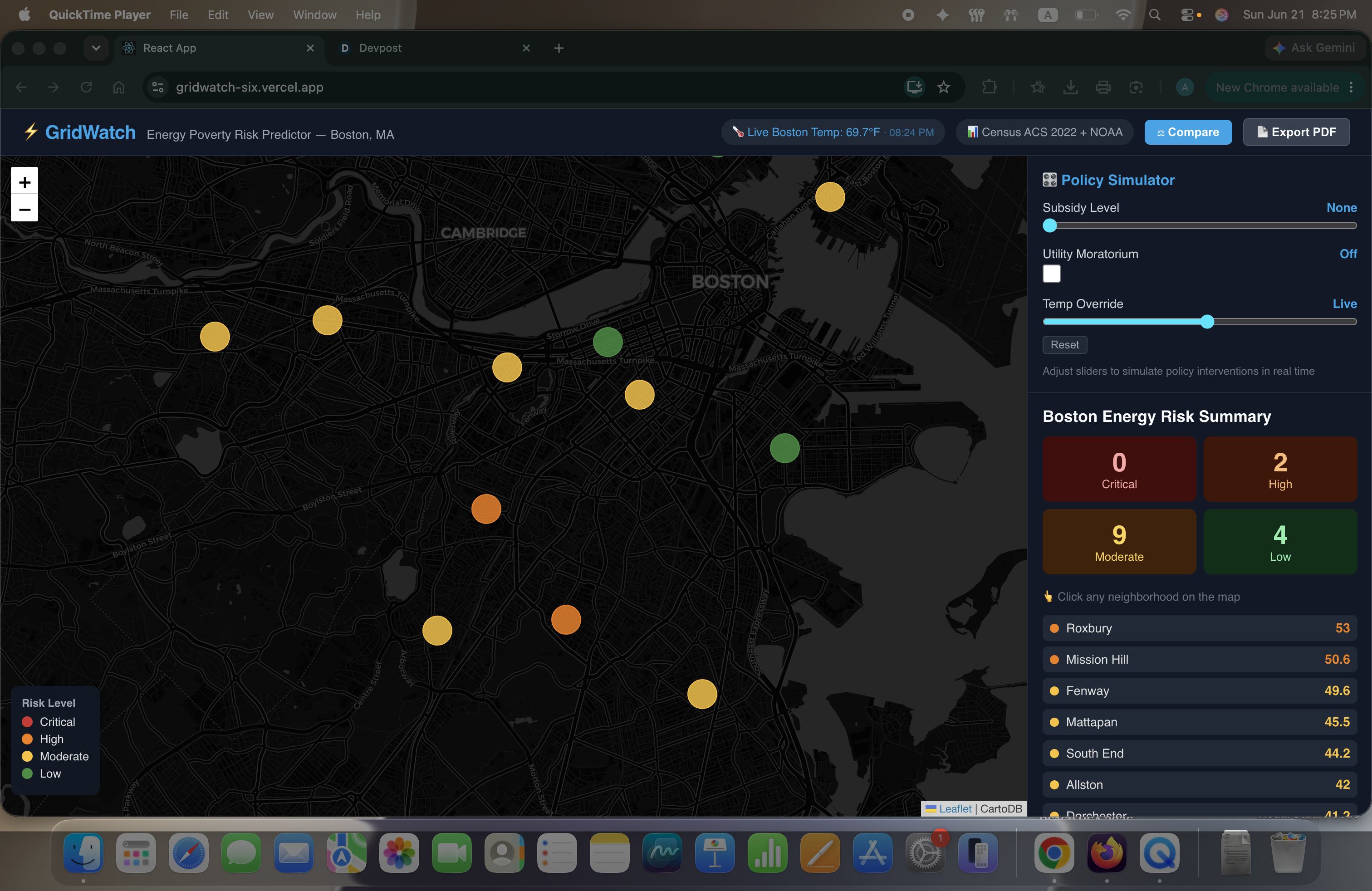
GridWatch is an AI-powered energy poverty risk prediction platform that forecasts energy insecurity risk up to 30 days in advance.
Using socioeconomic, housing, and weather-related factors, GridWatch analyzes neighborhood-level conditions and produces a risk score from 0–100. Users can view an interactive Boston map color-coded by risk level, explore historical trends, and simulate policy interventions such as utility moratoriums or financial assistance programs.
The system helps social workers, utility assistance coordinators, and city officials identify high-risk neighborhoods before residents experience service disconnections.
How We Built It
GridWatch combines multiple public data sources, including:
- U.S. Census ACS 2022 demographic and income data
- NOAA weather observations and forecasts
- Historical energy burden and housing cost indicators
The application was built using:
- React and TypeScript for the frontend
- Interactive mapping and visualization tools
- Python-based machine learning models for risk prediction
- AI-generated explanations that translate model outputs into plain language recommendations
The system processes neighborhood-level indicators, generates a risk prediction, and presents the results through a decision-support dashboard.
Challenges We Faced
One of the biggest challenges was finding data that accurately represents energy insecurity at the neighborhood level. Public datasets often exist in different formats, geographic boundaries, and update schedules.
Another challenge was balancing prediction accuracy with interpretability. We wanted users to understand why a neighborhood received a particular risk score instead of treating the model as a black box. This led us to include AI-generated explanations and transparent risk factors alongside every prediction.
We also had to design responsible AI safeguards to ensure the system supports human decision-making rather than replacing it.
What We Learned
Through this project, we learned how public datasets can be combined to address real social challenges. We gained experience in data integration, predictive modeling, visualization, and responsible AI design.
Most importantly, we learned that AI can create meaningful impact when it helps decision-makers act earlier and allocate resources more effectively, especially for vulnerable communities.
Impact
GridWatch transforms energy assistance from reactive intervention to proactive prevention.
Instead of waiting for a family to call for help after losing heat, social workers can identify emerging risks, prioritize outreach efforts, and deploy support before a crisis occurs.
By helping communities act earlier, GridWatch has the potential to reduce utility disconnections, improve public health outcomes, and strengthen support systems for vulnerable households.
Links
Live Demo: https://gridwatch-six.vercel.app
GitHub Repository: https://github.com/Ansh4814/gridwatch
Built With
- api
- fastapi
- leaflet.js
- python
- railway
- react
- recharts
- reportlab
- scikit-learn
- vercel


Log in or sign up for Devpost to join the conversation.