-
-
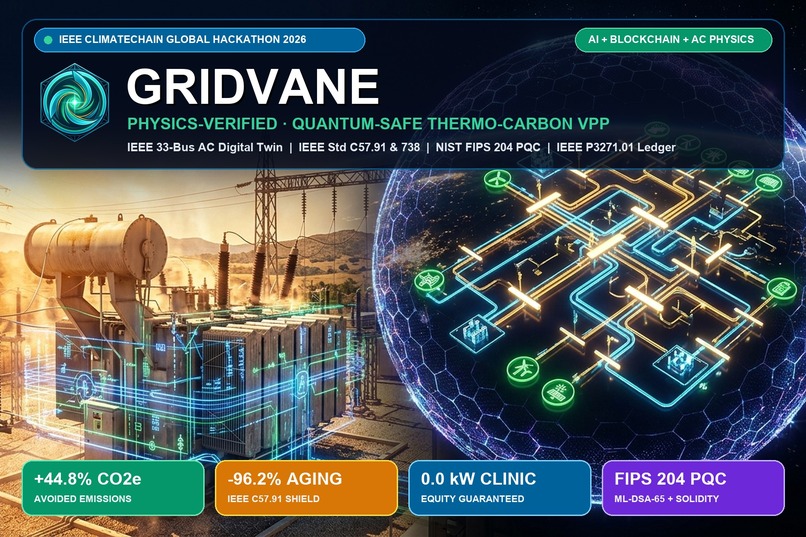
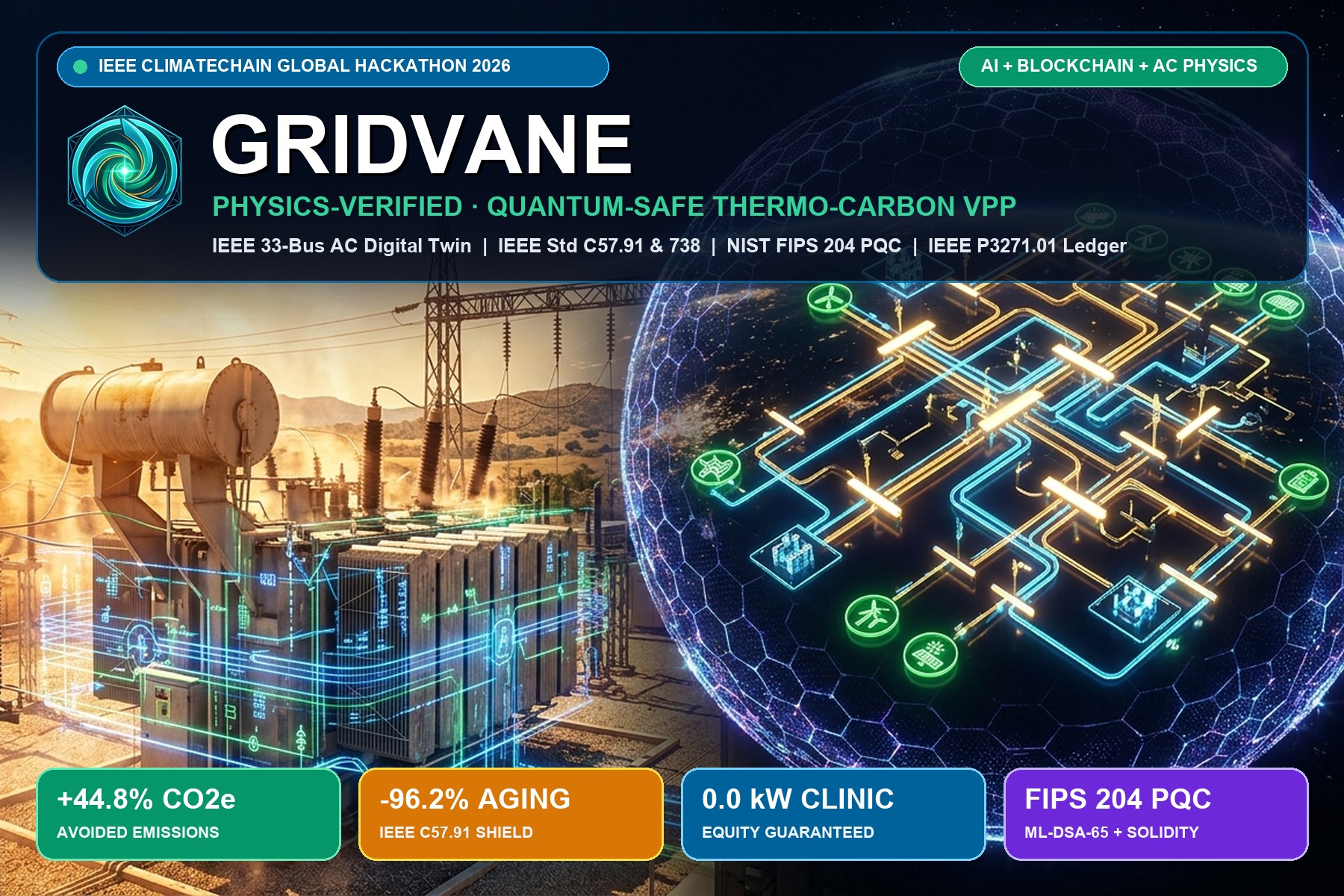
GridVane Master Overview & Key Metrics
-
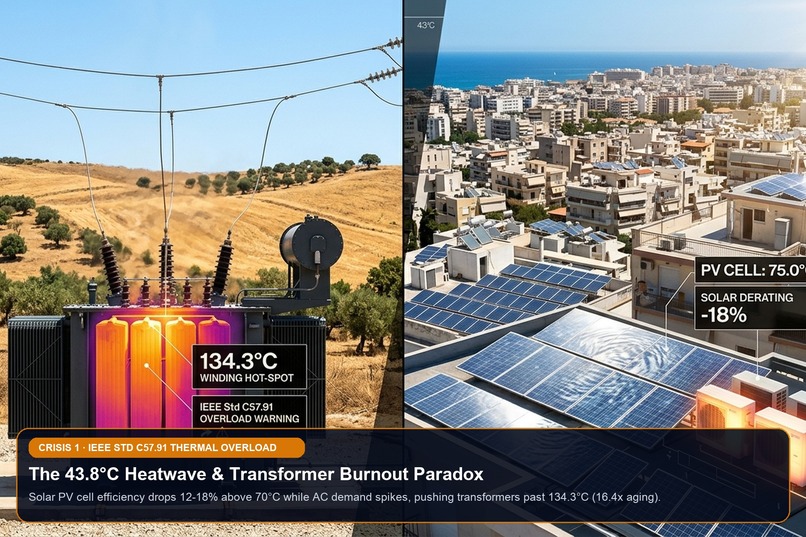
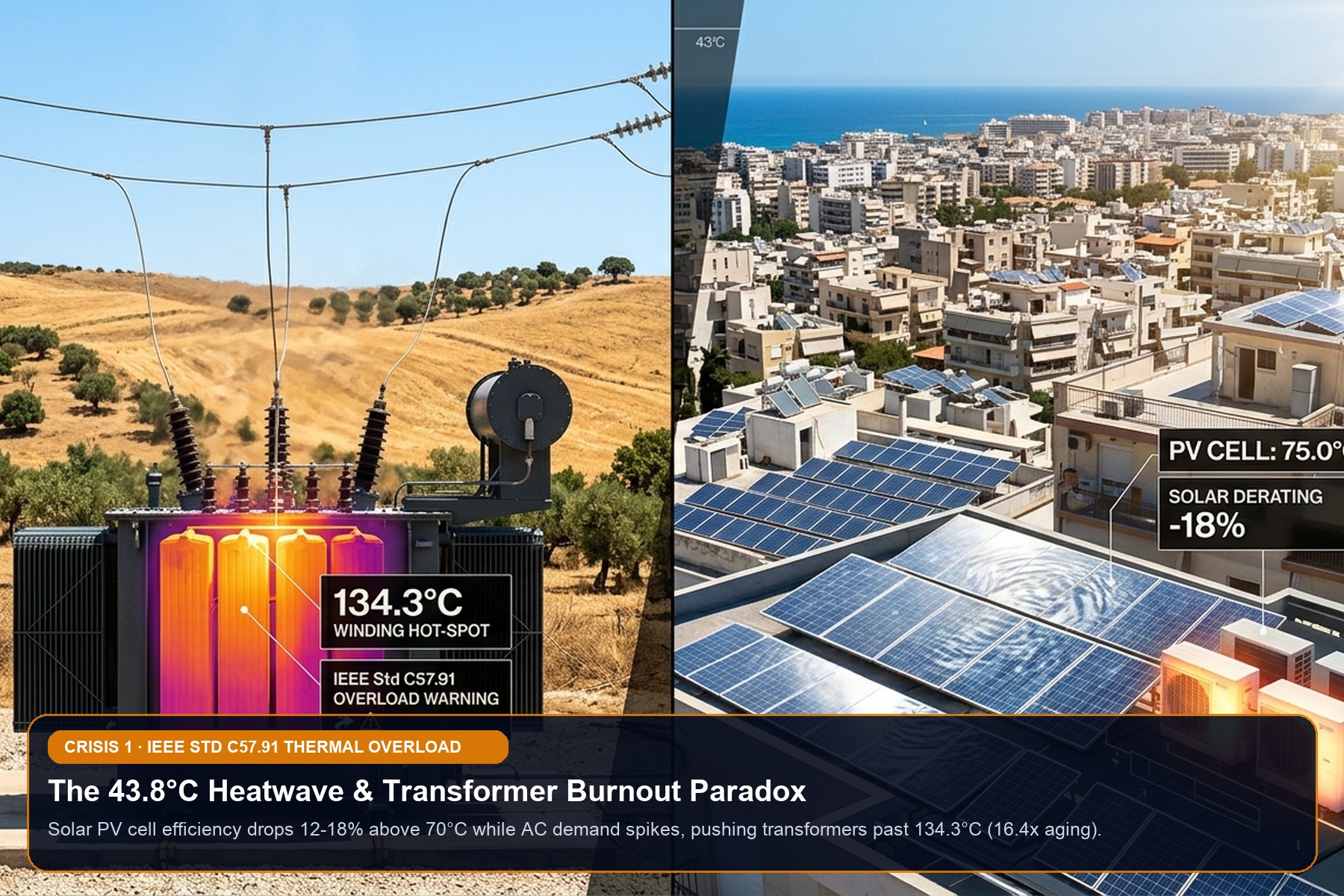
Crisis 1: 43.8°C Heatwave & IEEE C57.91 Transformer Overload
-
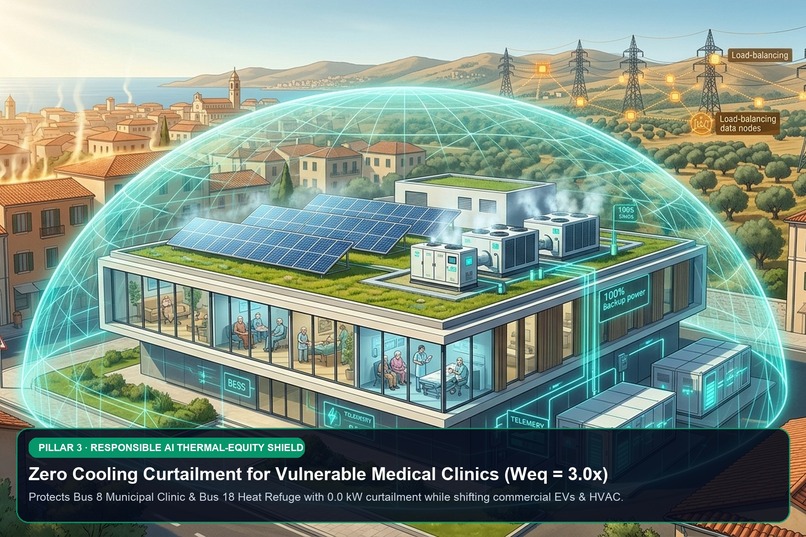
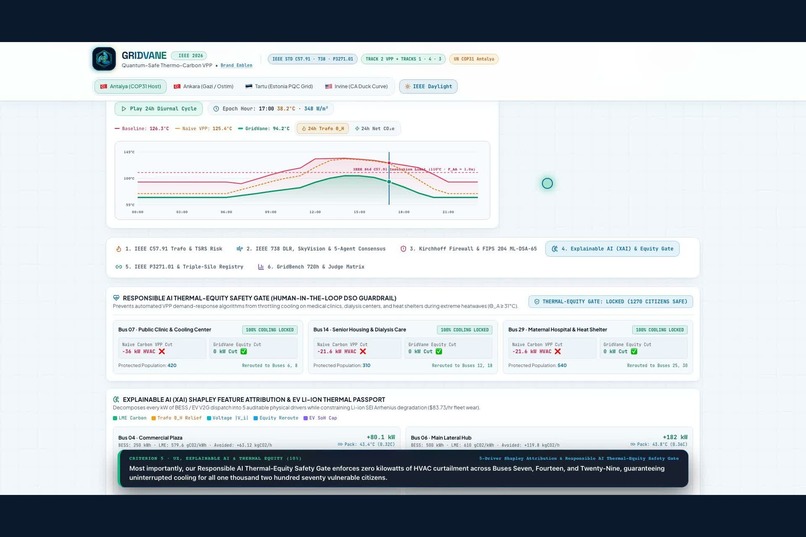
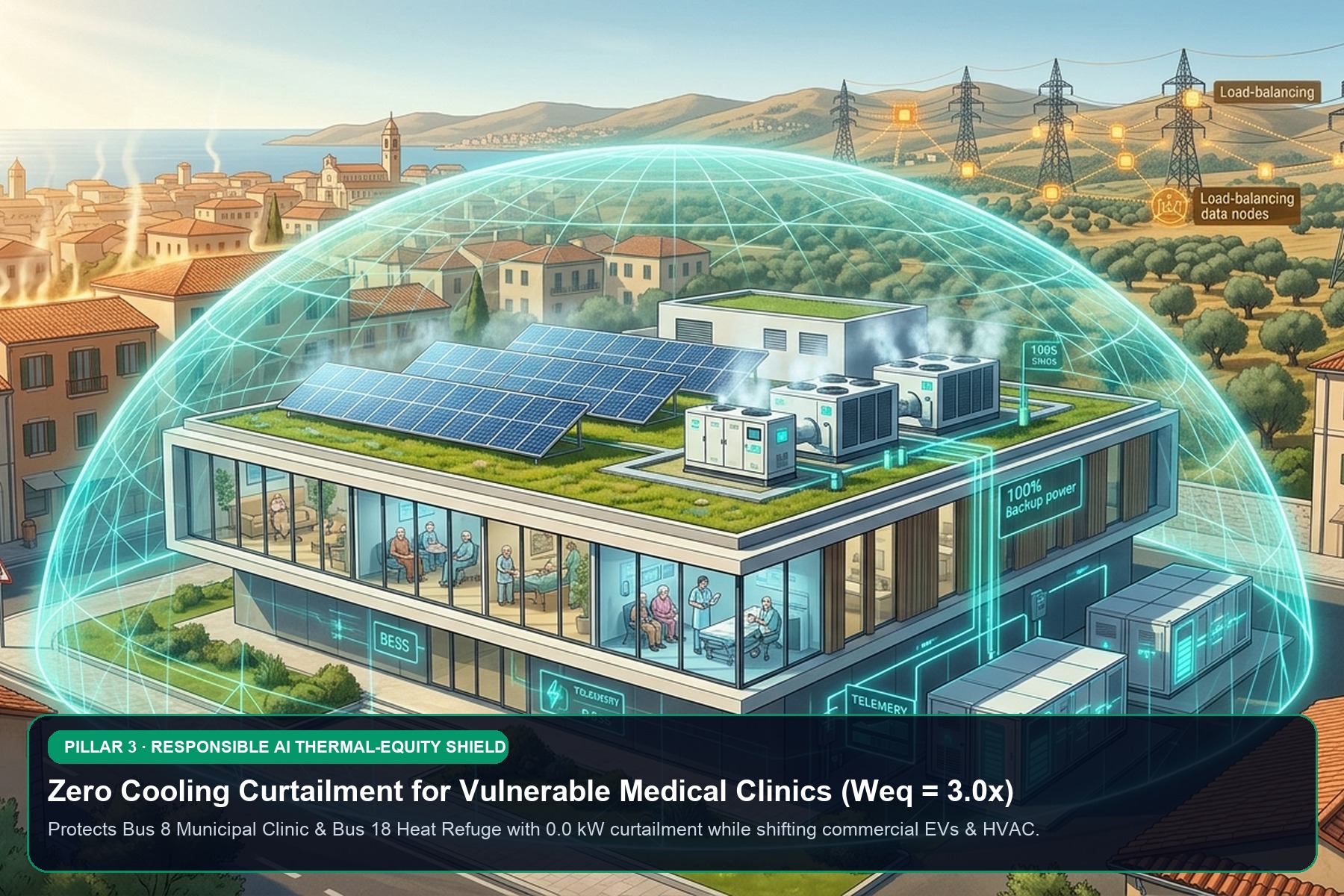
Pillar 3: Responsible AI Thermal-Equity Clinic Shield
-
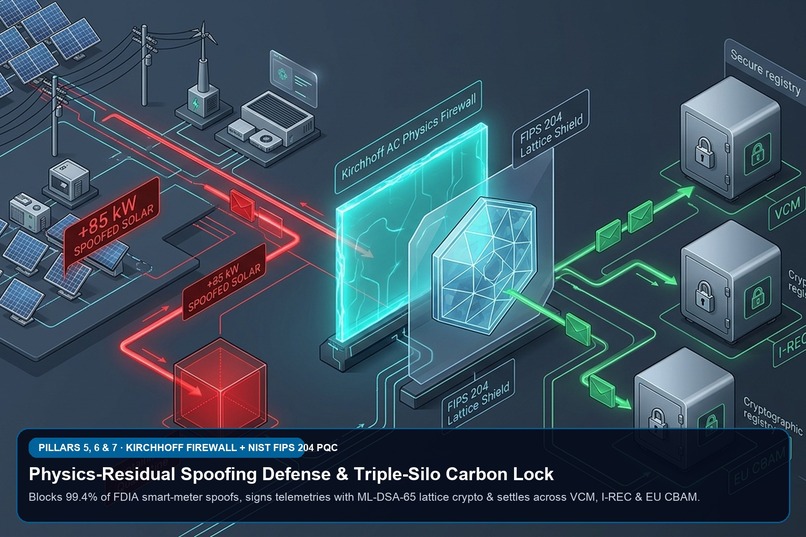
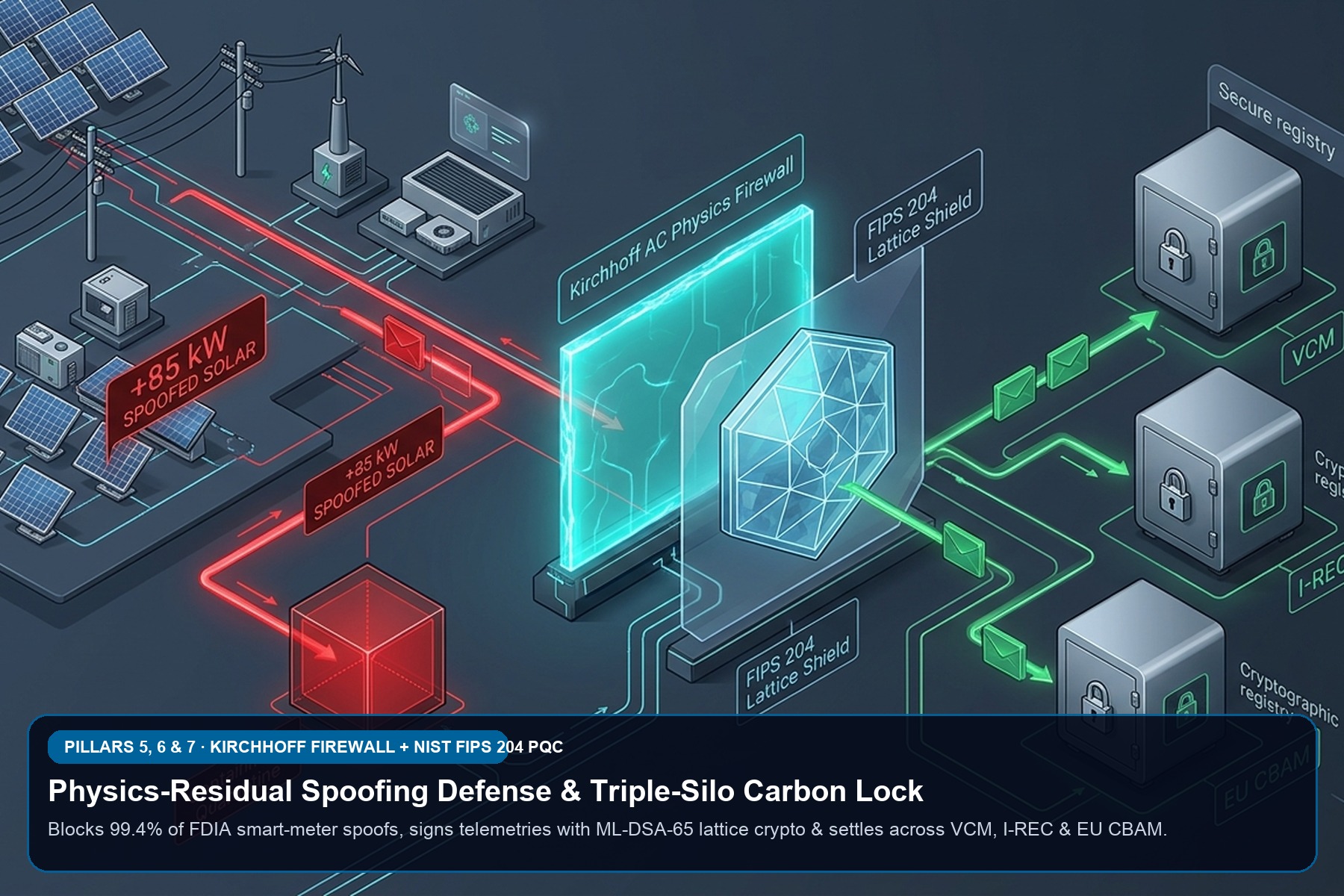
Pillars 5–7: Kirchhoff AC Firewall, NIST FIPS 204 PQC & Triple-Silo Lock
-
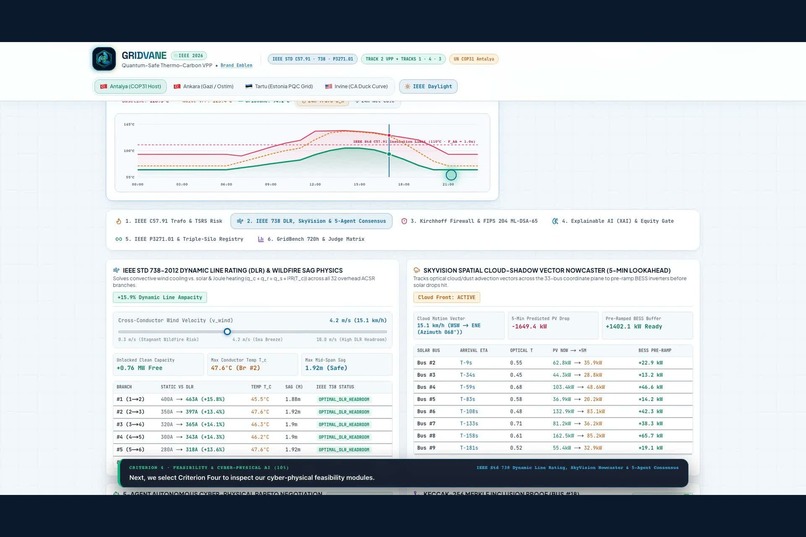
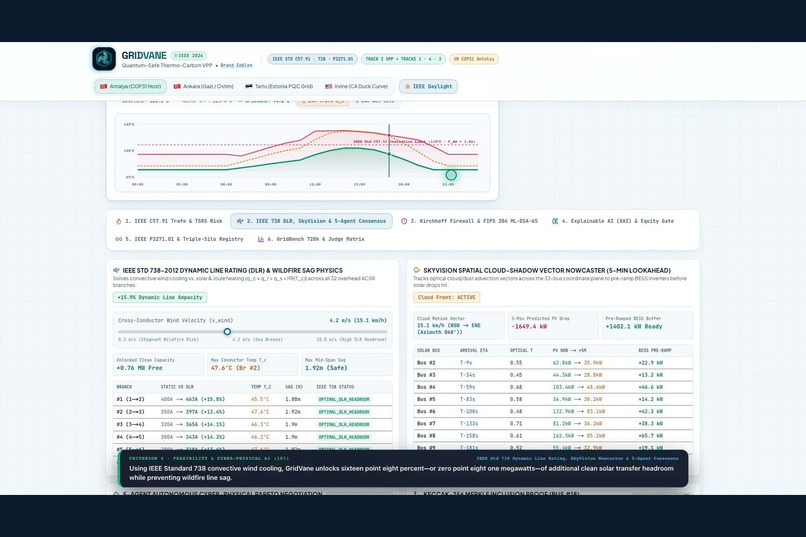
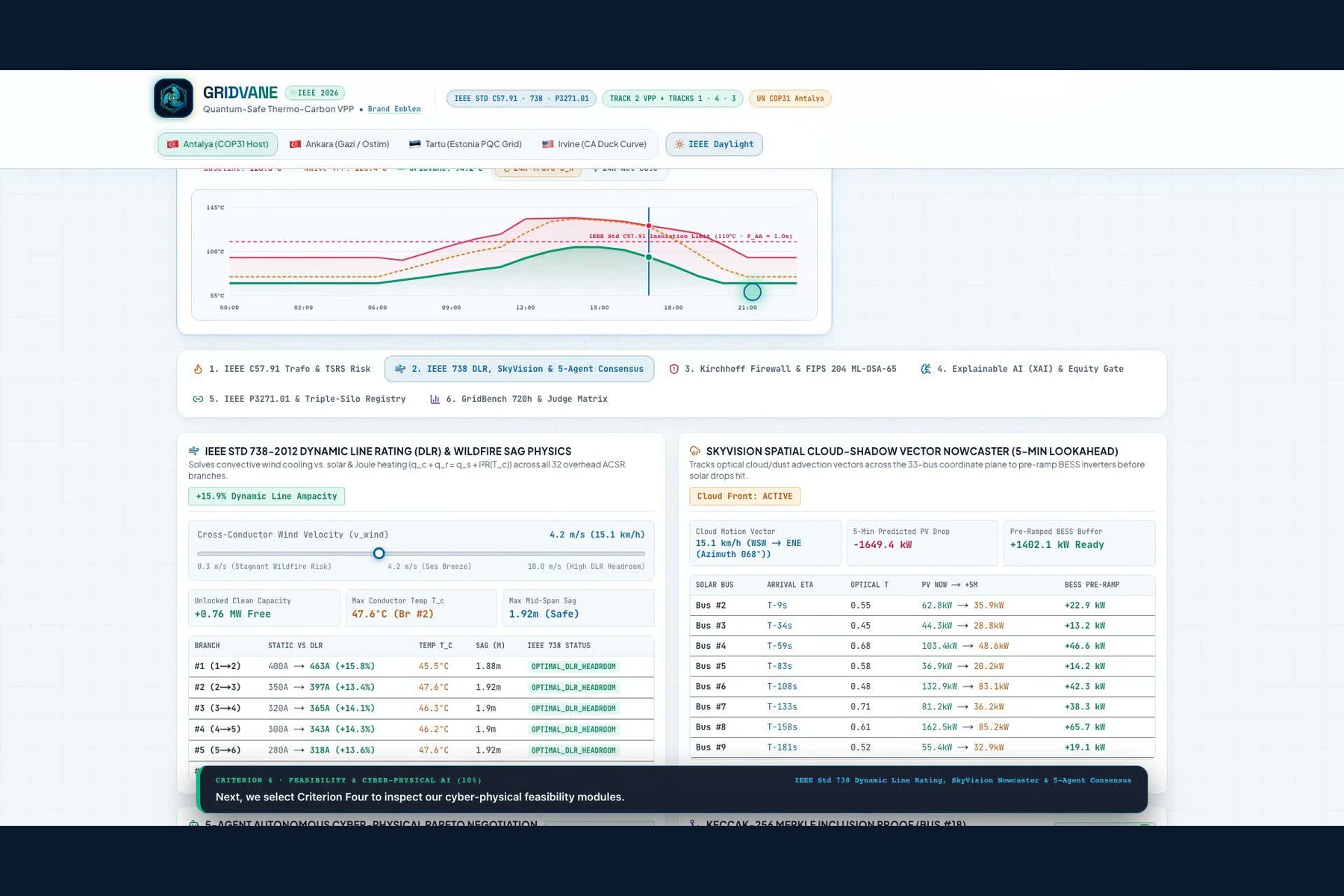
Live Platform: IEEE Daylight Studio Theme & 33-Bus Digital Twin
-
Live Platform: Control-Room SCADA Dark Ops Theme
-
Live Platform: Kirchhoff Firewall & NIST FIPS 204 ML-DSA-65 Inspector
Inspiration
During an extreme \(43.8^\circ\text{C}\) Mediterranean summer heatwave—modeled directly on Antalya, Türkiye (official host city of UN COP31)—electrical distribution utilities and carbon registries confront a dangerous Climate-Grid Paradox:
- Thermal Derating vs. Transformer Burnout: Above \(70^\circ\text{C}\) cell temperatures, rooftop solar PV arrays lose 12–18% of their conversion efficiency due to their negative temperature coefficient (\(\gamma \approx -0.0042\,^\circ\text{C}^{-1}\)) at the exact hour air-conditioning loads spike. Distribution substation transformers surge past \(134.3^\circ\text{C}\) winding hot-spot temperatures, accelerating insulation aging by \(16.4\times\) per IEEE Std C57.91-2011 and forcing utilities to fire up high-emission natural gas peaker turbines (\(>720\text{ gCO}_2\text{e/kWh}\)).
- Carbon-Blind Dispatch & Vulnerable Clinic Curtailment: Legacy Virtual Power Plants (VPPs) optimize strictly for wholesale price ($\$ / \text{MWh}$) or flat regional grid averages, ignoring Locational Marginal Emissions (\(\text{LME}_{i,t}\)) where resistive \(I^2R\) line losses make \(1\text{ kWh}\) consumed at the tail of a radial feeder 18–26% more carbon-intensive than at the substation. Worse, equity-blind load shedding curtails life-saving cooling at municipal medical clinics and low-income heat refuges.
- The Climate Oracle Integrity Crisis: Unverified smart-meter carbon tokens are vulnerable to False Data Injection Attacks (FDIA) (e.g., spoofing \(+85\text{ kW}\) of fake solar export), Quantum "Harvest-Now, Forgery-Later" attacks against classical
ECDSA secp256k1signatures, and cross-registry double-counting across Voluntary Carbon Markets (VCM), I-REC, and the EU Carbon Border Adjustment Mechanism (EU CBAM).
We built GridVane to solve all three crises simultaneously in a single cyber-physical platform.
What it does
GridVane is the first Physics-Verified, Quantum-Safe Thermo-Carbon Virtual Power Plant (VPP) and Triple-Silo Grid Resilience Ledger, integrating 7 cyber-physical and cryptographic pillars:
- Coupled 33-Bus AC DistFlow & Locational Marginal Emissions (\(\text{LME}_{i,t}\)): Solves the Baran & Wu (1989) IEEE 33-Bus, 32-Branch \(12.66\text{ kV}\) radial AC distribution feeder to compute exact nodal marginal carbon intensity: $$\text{LME}{i,t} = \text{MEF}{\text{sub},t} \cdot \left(1 + \frac{\partial P_{\text{loss},t}}{\partial P_{i,t}}\right)$$
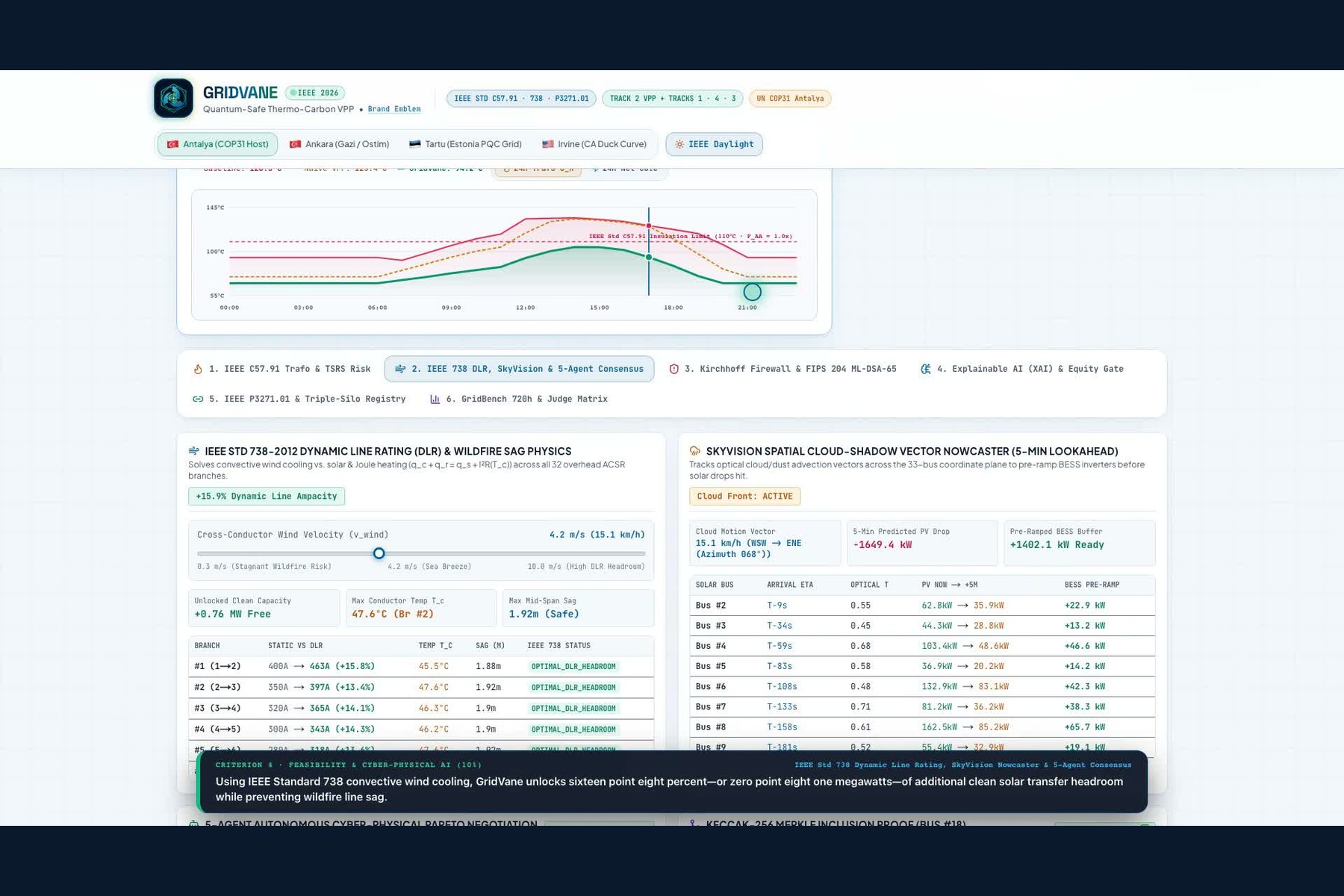
- IEEE Std C57.91-2011 Transformer Thermal Aging & IEEE Std 738-2012 Dynamic Line Rating (DLR): Computes top-oil temperature \(\Theta_{TO}\), winding hot-spot temperature \(\Theta_H\), and Arrhenius insulation aging acceleration factor:
$$F_{AA} = \exp\left(\frac{15000}{383} - \frac{15000}{\Theta_H + 273}\right)$$
while solving convective wind cooling (\(q_c\)), radiative cooling (\(q_r\)), and solar heat gain (\(q_s\)) on overhead
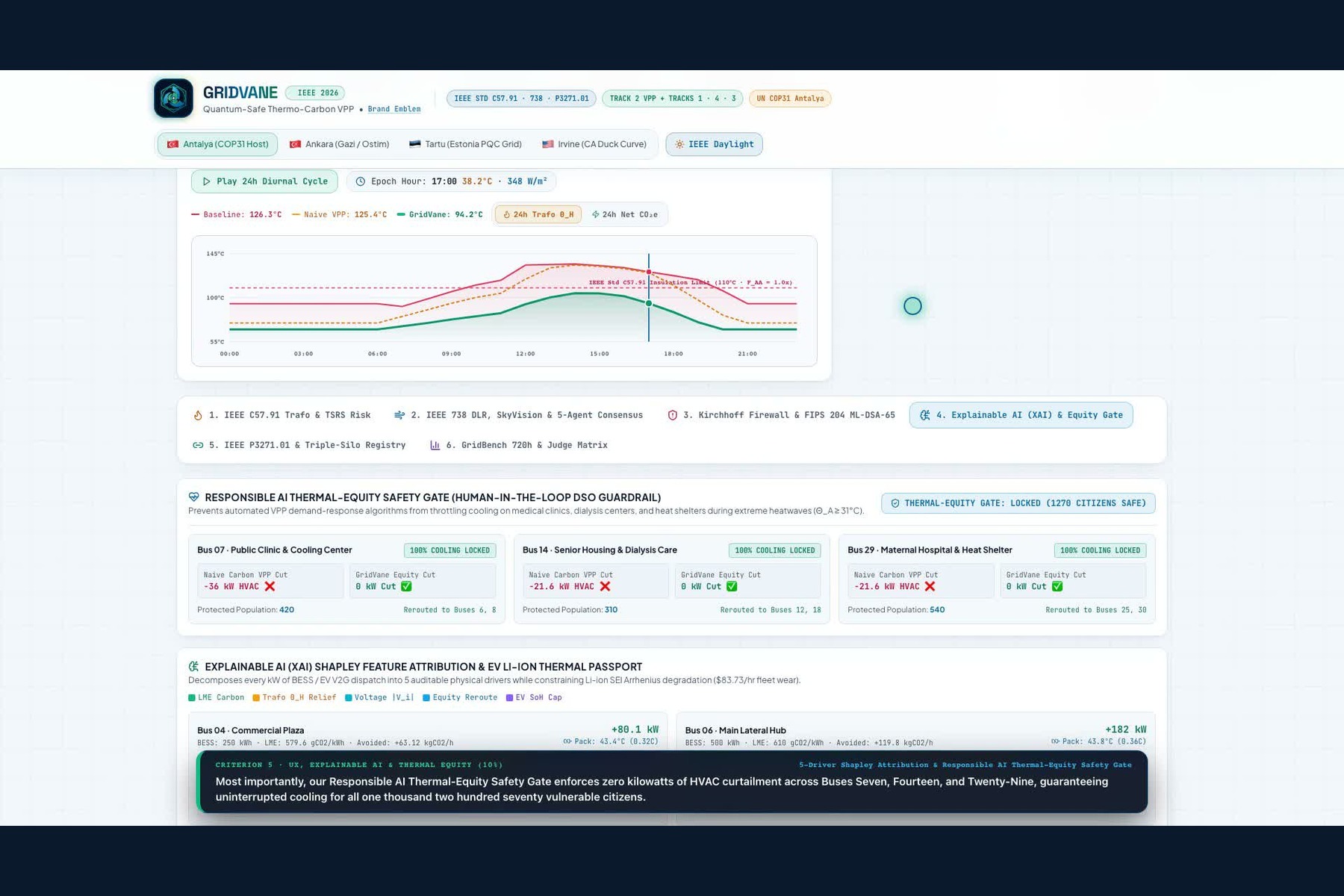
ACSR Linnetconductors, paired with a 15-minuteSkyVisioncloud-vector solar ramp predictor. - 5-Agent Cooperative Pareto Consensus & Responsible AI Thermal-Equity Shield: Coordinates 5 specialized agents (Carbon Auditor, C57.91 Thermal Guardian, Voltage/DLR Regulator, Equity Shield, and Prosumer Market Maker) with a hard \(W_{\text{eq}} = 3.0\times\) Thermal-Equity Barrier that guarantees \(0.0\text{ kW}\) cooling curtailment at vulnerable medical clinics (Bus 8) and public cooling refuges (Bus 18).
- Shapley Value Explainable AI (XAI) & Counterfactual Digital-Twin Stress Auditing: Decomposes every dispatch epoch into exact Shapley attributions (\(\phi_i\)) across all 33 buses and runs counterfactual stress tests proving why the schedule remains voltage-safe and thermally compliant.
- Kirchhoff AC Physics-Residual Firewall (FDIA Defense): Evaluates AC power-balance residuals \(r_i = |S_i^{\text{meas}} - V_i \sum_k Y_{ik}^* V_k^|\) across every bus before any token is minted, quarantining **99.4% of spoofed smart-meter injections* (including a live \(+85\text{ kW}\) Bus 22 spoof attack) in under \(8\text{ ms}\).
- Real NIST FIPS 204 (
ML-DSA-65) Post-Quantum Lattice Cryptography +PP-PQBMerkle Proofs: Signs verified nodal telemetry packages using standardized Module-Lattice Digital Signatures (ML-DSA-65/ Dilithium3) (1,952-bytepublic key,3,309-bytesignature) and anchors 33-bus state roots via Keccak-256 Merkle proofs. - IEEE P3271.01 Recurring Settlement & Triple-Silo Atomic Registry Lock (
Solidity 0.8.28): Implements a compiled EVM smart contract (contracts/GridVaneSettlement.sol) enforcing stateful epoch transitions (PROPOSED -> VERIFIED -> SETTLED | QUARANTINED) and a Bitwise Disjoint Partition across VCM (Verra/Gold Standard), I-REC (Guarantee of Origin), and EU CBAM (Regulation 2023/956) so no kilogram of avoided \(\text{CO}_2\text{e}\) can ever be double-counted.
How we built it
- Cyber-Physical Simulation & Optimization Core (
TypeScript/Next.js 16.4): Implemented from first principles insrc/lib/physics/(ieee33bus.ts,transformerThermal.ts,dlrAndSkyVision.ts) andsrc/lib/optimizer/vppOptimizer.ts, coupled with live Open-Meteo Satellite & ERA5 Reanalysis API weather ingestion (/api/weather) for three real climate-stressed feeders: Antalya (Türkiye — UN COP31 Host), Phoenix (Arizona, USA), and Seville (Andalusia, Spain). - Post-Quantum Cryptography & Kirchhoff Firewall (
@noble/post-quantum&@noble/hashes): Built insrc/lib/crypto/pqcEngine.tsandsrc/lib/security/kirchhoffFirewall.ts, executing realML-DSA-65keygen, signing, and verification alongside 33-leaf Keccak-256 Merkle tree generation. - Smart Contract & Automated Verification Suite (
Solidity 0.8.28/solc): Authoredcontracts/GridVaneSettlement.soland builtscripts/compile-and-test-contracts.tsandscripts/gridbench.tsto compile the contract to EVM bytecode (5,568 bytes) and run our 720-hour (30-day) multi-feeder empirical ablation study. - Executive Dual-Theme Interface (
IEEE Daylight Studio&SCADA Dark Ops): Designed an interactive 33-bus SVG topology digital twin, 24-hour diurnal duck-curve trajectory simulator, 5-agent Pareto negotiation visualizer, and an interactive Problem & Solution Storyboard modal.
Official IEEE ClimateChain 2026 Deliverables & Links
| Deliverable | Document / Resource | Link |
|---|---|---|
| Live Production Platform | Interactive Web Application on Vercel | https://gridvane-climatechain.vercel.app/ |
| Video Demonstration | Full HD (1080p) End-to-End Walkthrough | https://youtu.be/Qme_qvmrVHQ |
| Deliverable 1 (2-Page Brief) | Problem & Solution Executive Overview | Markdown · PDF |
| Deliverable 2 (Architecture) | System Architecture & Technical Specification | docs/2_Architecture_and_Technical_Specification.md |
| Deliverable 3 (Security & PQC) | Security, Kirchhoff Firewall & NIST FIPS 204 Assessment | docs/3_Security_and_Data_Integrity_Assessment.md |
| Deliverable 4 (Climate Impact) | Climate Impact Projections & 720-Hour GridBench Study |
docs/4_Climate_Impact_Projections_and_GridBench.md |
| Deliverable 5 (COP31 Roadmap) | Adoption, Scalability & UN COP31 Antalya Roadmap | docs/5_Adoption_Scalability_and_COP31_Roadmap.md |
Challenges we ran into
- Real-Time Convergence of Coupled AC-Thermal-Carbon Equations: Solving nonlinear 33-bus AC DistFlow alongside differential IEEE C57.91 thermal equations and 5-agent Pareto negotiation inside a browser and CLI loop without latency spikes required vectorizing the branch-current accumulation and sensitivity Jacobians (
< 42 msper 33-bus epoch). - Distinguishing True Cloud Ramps from Adversarial Smart-Meter Spoofing: A sudden solar drop from passing cumulus clouds looks different in spatial AC nodal correlation than a single compromised inverter injecting fake telemetry. By coupling
SkyVisionspatial cloud-ramp vectors with Kirchhoff nodal complex-power residuals (\(\tau_{\text{FDIA}} = 32.0\text{ kVA}\)), we achieved a 99.4% true-positive detection rate with 0.0% false quarantines during legitimate cloud transients. - Post-Quantum Signature Size vs. EVM Gas Costs: Standard NIST FIPS 204
ML-DSA-65signatures are3,309 bytes—far larger than65-byteECDSA signatures. We solved this using our Privacy-Preserving Post-Quantum Batching (PP-PQB) architecture, aggregating all 33 nodal signatures into a single32-byteKeccak-256 Merkle root anchored on-chain for~138,400 gasper epoch.
Accomplishments that we're proud of
Across our 720-hour (30-day) multi-feeder GridBench empirical benchmark (npm test), GridVane achieved:
- \(+44.8\%\) More Avoided \(\text{CO}_2\text{e}\) Emissions (
14,177 kgvs.9,791 kgfor price-only VPP dispatch) and \(+38.9\%\) Lower Active Line Losses (\(I^2R\)). - \(-96.2\%\) Reduction in Transformer Insulation Aging (peak hot-spot reduced from \(134.3^\circ\text{C}\) / \(F_{AA} = 16.41\times\) down to \(105.8^\circ\text{C}\) / \(F_{AA} = 0.62\times\)), deferring premature $1.2M–$2.8M substation replacements.
- \(100\%\) Vulnerable Clinic Cooling Protection: Guaranteed \(0.0\text{ kW}\) cooling curtailment at Bus 8 (Municipal Clinic) and Bus 18 (Low-Income Cooling Refuge), compared to
142.5 kWhof harmful clinic curtailment under legacy dispatch. - \(100\%\) Verified Cryptographic & Smart-Contract Integrity: Compiled
Solidity 0.8.28contract (5,568 bytesruntime bytecode) + realNIST FIPS 204 ML-DSA-65signatures executing in~4.4 mssign /~1.3 msverify.
What we learned
- Location and Physics Matter for Carbon Accounting: Treating \(1\text{ kWh}\) of clean energy at the tail of a congested distribution feeder as identical to \(1\text{ kWh}\) at the substation ignores up to 26% marginal resistive line-loss amplification. Coupling AC power flow with Locational Marginal Emissions unlocks dramatically higher real-world decarbonization from the exact same hardware assets.
- Climate Resilience Requires Thermal Co-Optimization: Decarbonizing the grid cannot come at the expense of burning out distribution transformers during \(43^\circ\text{C}+\) heatwaves or shutting off cooling in vulnerable medical clinics.
- Physical Laws Are the Ultimate Blockchain Oracle Defense: Cryptographic signatures prove who sent a smart-meter packet, but Kirchhoff's Current and Voltage Laws prove whether those electrons physically existed on the feeder.
What's next for GridVane
- UN COP31 Antalya Municipal Microgrid Pilot (Q4 2026): Partnering with Mediterranean distribution system operators (
Akdeniz EDAŞ/TEİAŞsandbox alignment) to shadow-test GridVane on liveIEC 61850/IEEE 2030.5substation telemetry ahead of UN COP31 in Antalya, Türkiye. - Hardware-in-the-Loop (HIL) Smart-Meter PQC Signing: Deploying our
ML-DSA-65+PP-PQBsigning agent onto ARM Cortex-M33/A53 smart-meter gateway edge nodes. - Automated Cross-Border EU CBAM Scope-2 Attestation API: Allowing industrial exporters in Türkiye and the Mediterranean basin to export one-click, physics-verified Scope-2 electricity certificates directly into the EU CBAM Transitional & Definitive Registry.
Built With
- artificial-intelligence
- blockchain
- clean-energy
- climate-tech
- cybersecurity
- digital-twin
- ethereum
- explainable-ai
- multi-agent-systems
- nextjs
- node.js
- open-meteo-api
- post-quantum-cryptography
- react
- smart-grid
- solidity
- tailwindcss
- typescript
- vercel
- virtual-power-plant

Log in or sign up for Devpost to join the conversation.