-
-
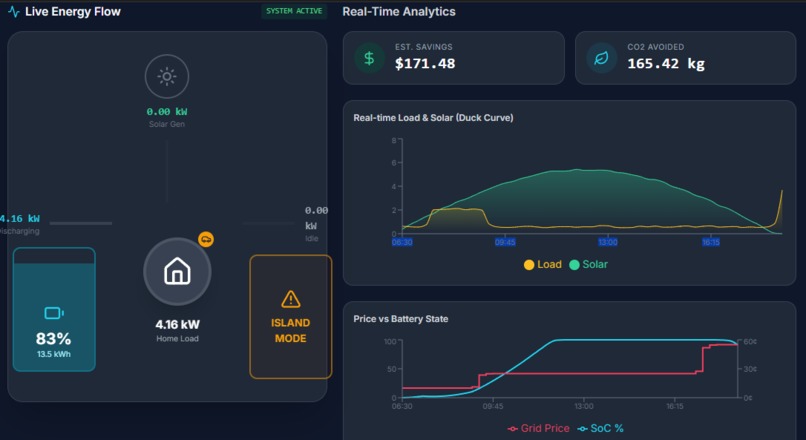
Grid Sync Energy Flow and RT Analysis
-
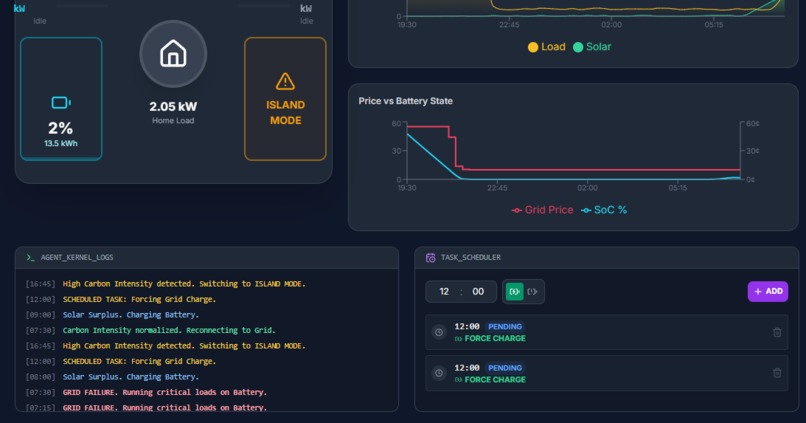
Grid Sync Agent Kernel Log and Task Scheduler
Inspiration
We were struck by the paradox that AI is essential for the green transition yet consumes massive amounts of energy. We aimed to create "Algorithmic Austerity"—an AI that stabilizes the grid using physics-informed models at the edge without becoming a carbon burden itself.
What it does
GridSync is a decentralized AI agent that turns homes into Virtual Power Plants (VPPs). It uses hyper-local weather forecasting and Reinforcement Learning (RL) to optimize energy flow between solar panels, EV batteries, and the grid, maximizing homeowner profit while ensuring grid stability.
How we built it
- The Eye: Hyper-Local ForecastingInstead of relying on coarse global models, GridSync uses Physics-Informed Neural Networks (PINNs) to predict weather at a sub-12km resolution. By minimizing a specialized loss function, the AI ensures its predictions stay within the bounds of physical laws (thermodynamics):
$$L = L_{data} + λL_{physics}$$
- The Brain: RL OptimizationA Reinforcement Learning (RL) agent acts as the decision-maker. It calculates the optimal time to store, use, or sell energy by balancing profit against the "hidden" costs of AI carbon emissions and hardware wear:
$$\text{Maximize } J = \sum_{t=0}^{T} \gamma^t (P_{grid}(t) \cdot E_{flow}(t) - D_{batt}(t) - C_{AI}(t))$$
- The Conscience: Edge DeploymentTo ensure the AI doesn't consume more power than it saves, the system is built with TinyML. By quantizing model parameters from 32-bit floats down to 8-bit integers, the team reduced inference energy consumption by 75%, allowing the agent to run locally on devices like a Raspberry Pi.
Challenges we ran into
Data Scarcity: Overcome by using GANs to generate synthetic extreme weather training data. Trust: Solved the "Black Box" nature of RL by integrating SHAP values (Explainable AI) to show users why decisions were made. Compute Constraints: Balanced accuracy and power by running heavy physics models every 4 hours and light LSTMs for real-time adjustments.
Accomplishments that we're proud of
75% Reduction: Slashed inference energy consumption through quantization. Physical Consistency: Successfully integrated thermodynamic laws into our neural networks to ensure realistic forecasting. Net-Positive Impact: Developed a scoring system that ensures the AI never consumes more carbon than it saves.
What we learned
We discovered that 80-90% of AI's footprint is in inference, making edge deployment non-negotiable for climate tech. We also learned that hybrid models (Physics + AI) outperform pure data-driven models in chaotic environments.
What's next for GridSync Agent
We plan to scale from individual homes to "Micro-neighborhood" clusters, allowing peer-to-peer (P2P) energy trading between neighbors. We are also looking into integrating hardware-level security to protect the decentralized grid from cyber threats.

Log in or sign up for Devpost to join the conversation.