Inspiration
Modern electrical grids depend on maintaining a stable operating frequency of 60 Hz. While small frequency fluctuations are normal, sustained oscillations can indicate underlying grid instability, place stress on electrical equipment, and potentially contribute to widespread power outages.
We wanted to explore how dedicated digital hardware and agentic AI could work together to detect these disturbances and provide meaningful diagnostic insights. This inspired us to build GridSent, bridging electrical engineering, digital signal processing, and artificial intelligence to address challenges in critical infrastructure monitoring.
What it does
GridSent is an interactive power grid monitoring and diagnostic platform that combines FPGA-based signal processing with NVIDIA Nemotron.
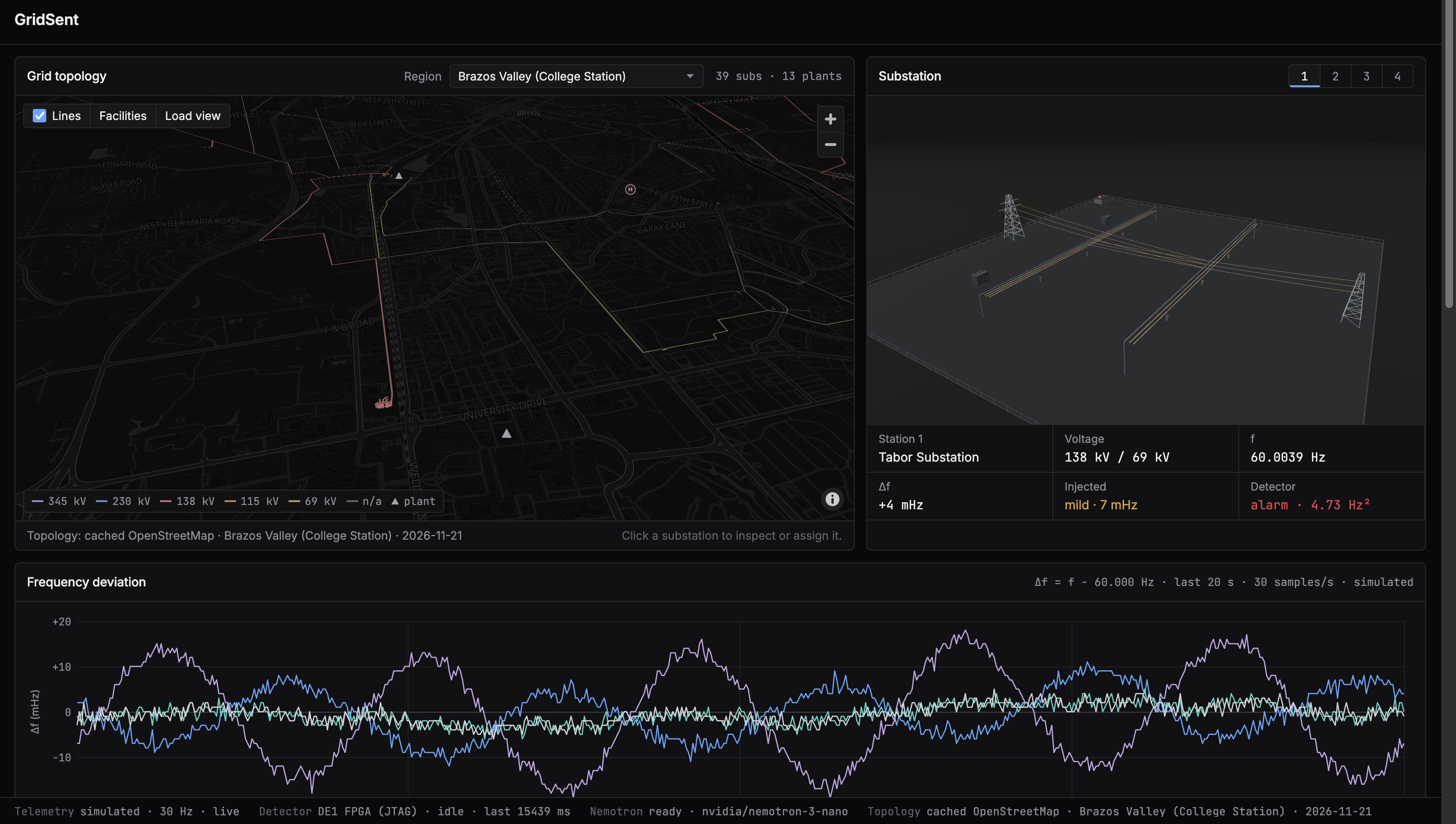
Our platform continuously simulates frequency measurements from four interconnected substations, incorporating Gaussian measurement noise, correlated frequency drift, and dynamically generated oscillatory disturbances.
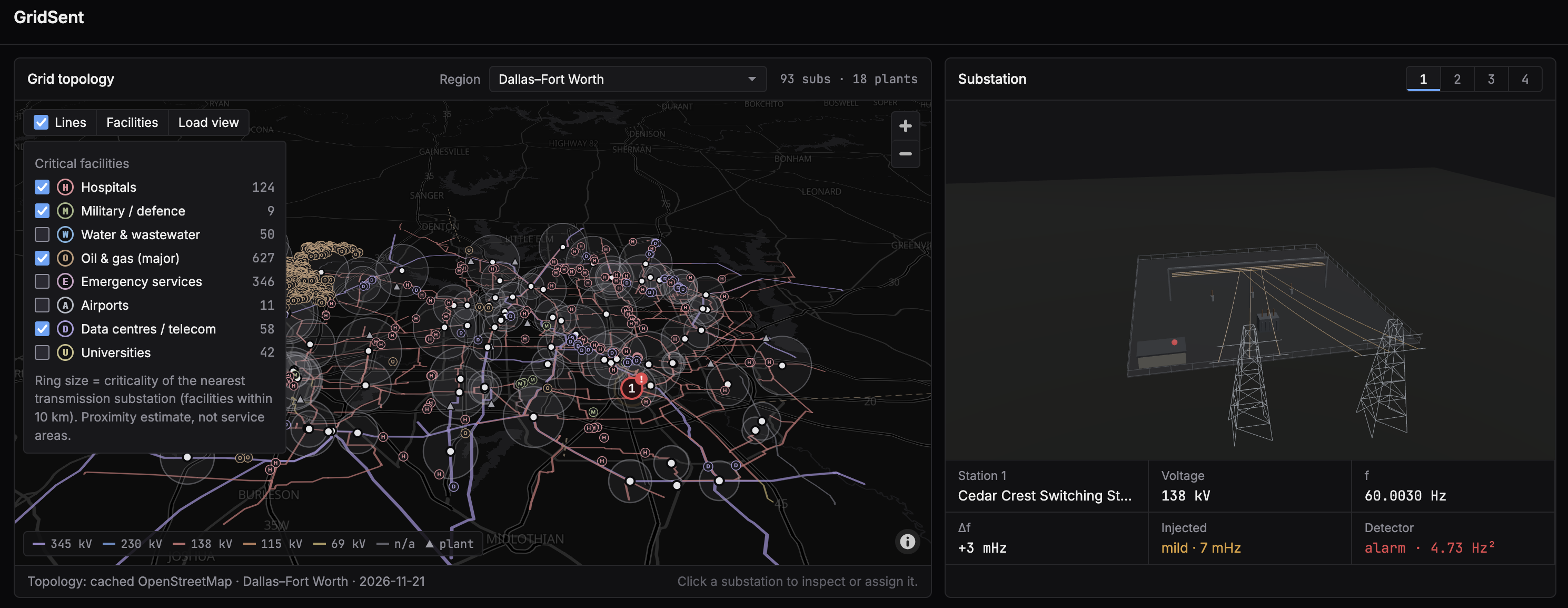
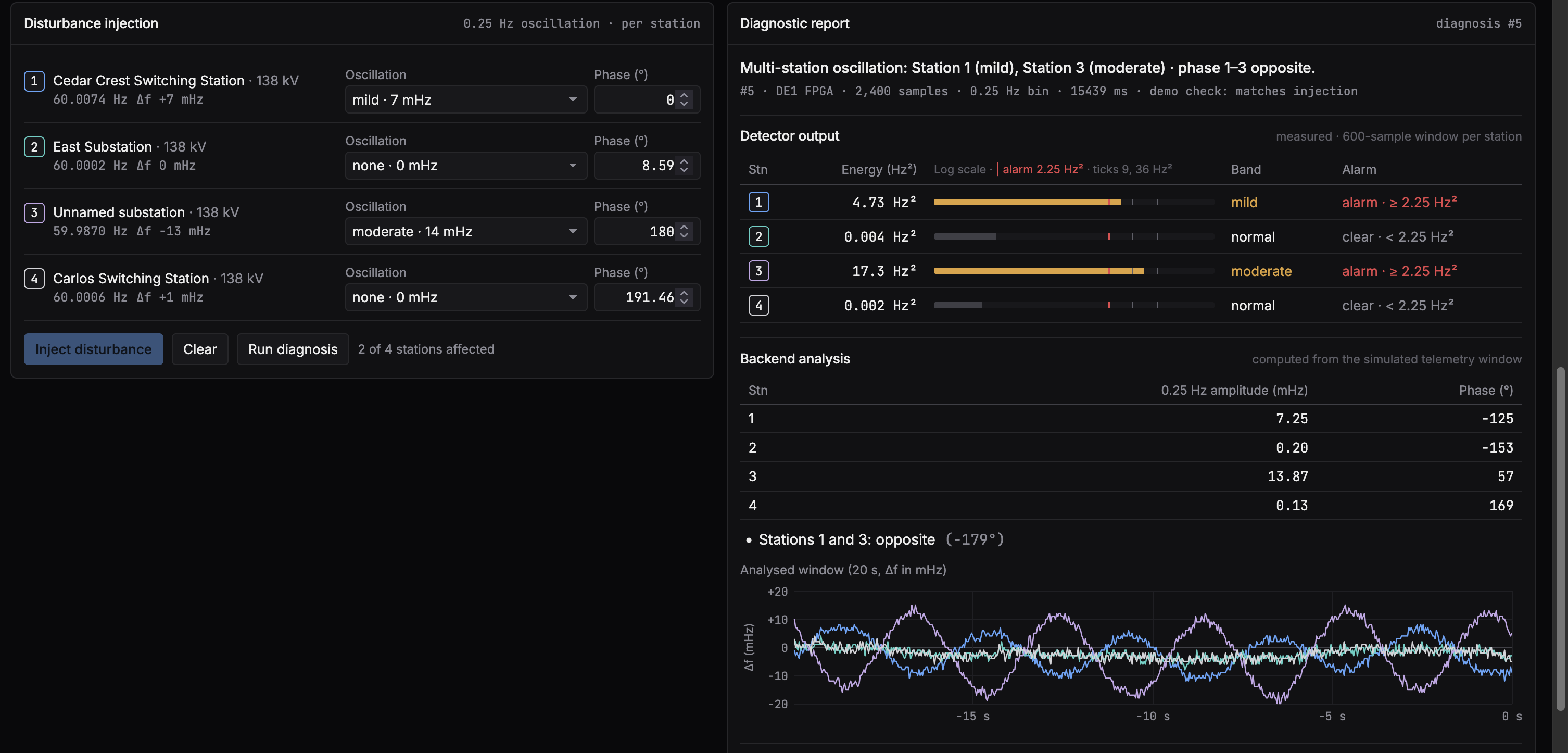
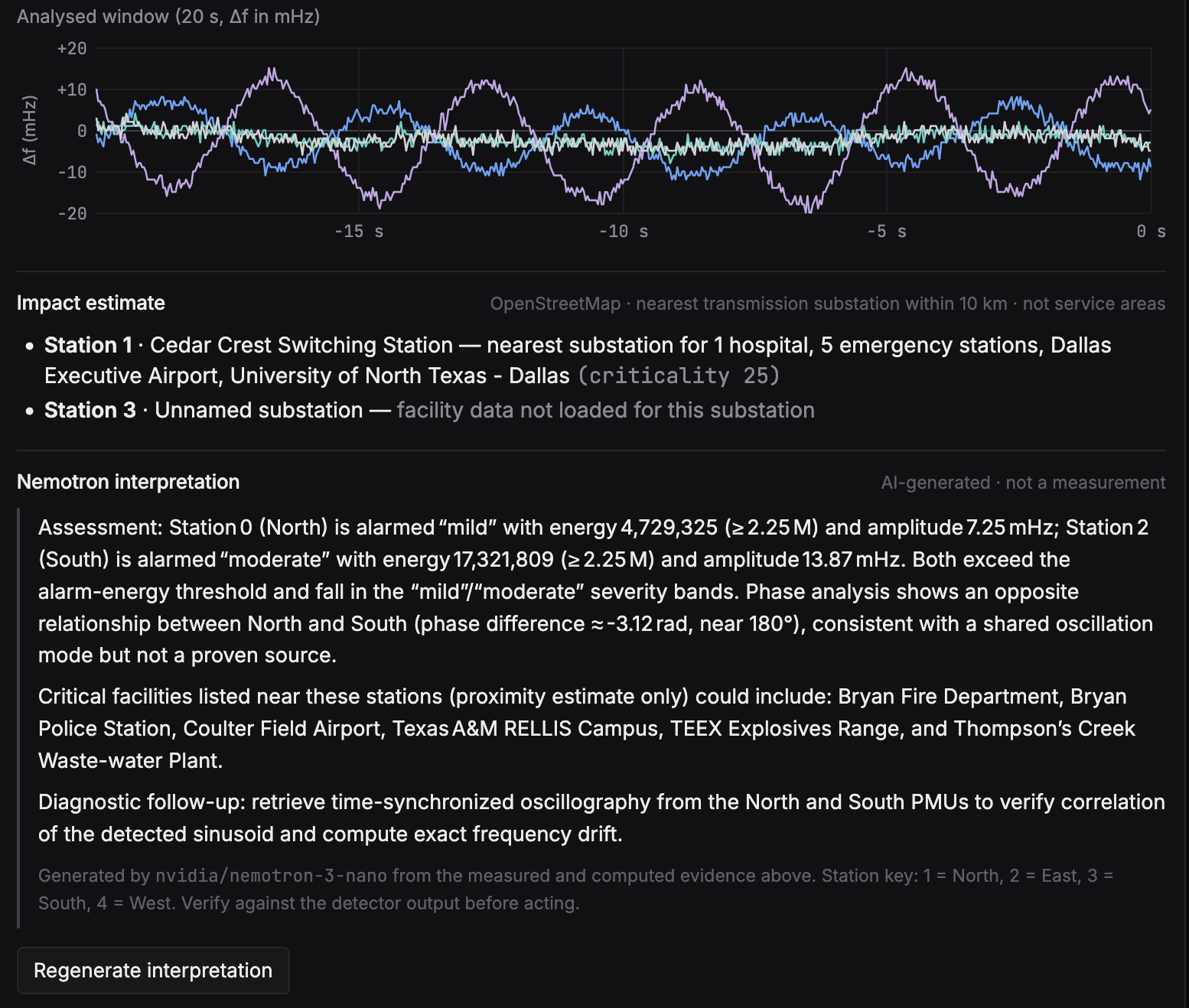
Users can monitor grid behavior through an animated, real-time dashboard and initiate diagnostic investigations of individual substations. Frequency measurements are transmitted to a physical FPGA, which detects and quantifies oscillatory components within the signals. NVIDIA Nemotron then analyzes the hardware-generated results alongside historical telemetry and relationships between substations to identify potential disturbances and recommend further investigation.
How we built it
- FPGA and signal processing: We programmed an Altera DE1 Cyclone II FPGA using Verilog to perform quadrature correlation, effectively computing a single-frequency component of the Discrete Fourier Transform (DFT). Our circuit targets 0.25 Hz oscillations, a representative frequency associated with inter-area power system oscillations. It utilizes fixed-point arithmetic, precomputed sinusoidal coefficients, and multiply-accumulate operations to process 600 samples per substation across a 20-second observation window.
- Hardware communication: We developed a custom binary packet protocol with checksum validation and established bidirectional communication between our Python backend and the physical FPGA through Virtual JTAG using the USB-Blaster interface.
- Python backend: We built a continuous stochastic grid simulator using Gaussian noise and correlated frequency drift. The backend maintains synchronized measurement histories, streams live telemetry through WebSockets, communicates with the FPGA, and coordinates diagnostic investigations.
- Frontend: We developed an interactive Next.js dashboard featuring animated grid visualizations, live frequency graphs, individual substation monitoring, and AI-generated diagnostic reports.
- NVIDIA Nemotron: We integrated Nemotron using NVIDIA Brev cloud GPU infrastructure to investigate oscillatory disturbances using quantitative evidence, including oscillation strength, relative phase relationships, and historical frequency measurements.
Challenges we ran into
- Establishing reliable communication between a legacy FPGA development board and a modern full-stack application.
- Implementing Fourier-based signal processing using fixed-point arithmetic while maintaining numerical accuracy.
- Designing a binary communication protocol that reliably handles multiple synchronized measurement streams.
- Generating physically motivated synthetic grid measurements rather than arbitrary randomized data.
- Coordinating hardware processing, live frontend updates, and AI inference without interrupting continuous grid monitoring.
- Configuring and integrating a cloud-hosted Nemotron inference endpoint.
Accomplishments that we're proud of
- Successfully implementing frequency-domain signal processing on a physical FPGA rather than relying entirely on software simulation.
- Developing an end-to-end pipeline connecting dedicated digital hardware, a real-time software platform, and agentic AI.
- Detecting meaningful oscillatory components within noisy frequency measurements.
- Building an interactive dashboard that makes complex power system behavior more accessible and interpretable.
- Bringing together multiple engineering disciplines and technologies within a 12-hour hackathon.
What we learned
Throughout this project, we gained practical experience with FPGA programming, digital signal processing, fixed-point arithmetic, Fourier analysis, stochastic modeling, real-time software communication, and cloud-hosted AI inference.
We also learned how oscillation amplitude, frequency, and relative phase relationships can provide valuable insights into the behavior of interconnected power systems.
Most importantly, we learned how specialized hardware and artificial intelligence can complement one another. Rather than relying on an LLM to perform numerical signal processing, we use deterministic hardware to produce quantitative evidence and AI to interpret that evidence within a broader engineering context.
What's next for GridSent
- Integrating real-world phasor measurement unit (PMU) datasets.
- Implementing parallel FPGA processing pipelines to detect multiple oscillation frequencies simultaneously.
- Expanding our simulator to incorporate voltage phase angles, transmission power flows, generator outages, and other grid disturbances.
- Developing more sophisticated oscillation mode shape and damping analysis.
- Benchmarking hardware performance against conventional software-based approaches.
- Scaling our architecture to support larger electrical networks and additional substations.
Ultimately, we envision GridSent evolving into a comprehensive AI-assisted decision-support platform that helps power grid operators detect, understand, and investigate emerging stability issues before they escalate.
Built With
- python
- verilog
