Inspiration
Critical infrastructure can generate enormous amounts of telemetry, but raw data alone does not always make it easy to understand what is happening.
I wanted to explore a simple question: Can we turn distributed infrastructure signals into evidence that people can actually understand and act on?
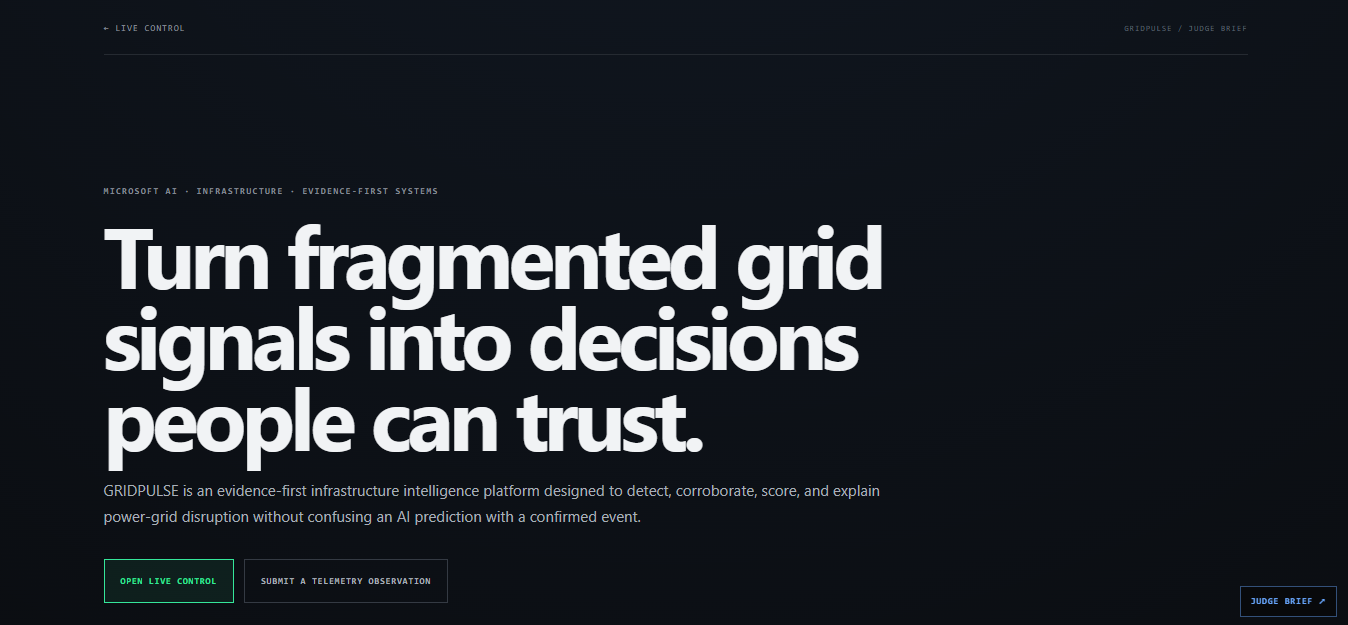
That idea became GRIDPULSE — an evidence-first infrastructure intelligence platform designed to connect telemetry, corroborate observations, and prepare a trustworthy evidence layer for AI-assisted analysis.
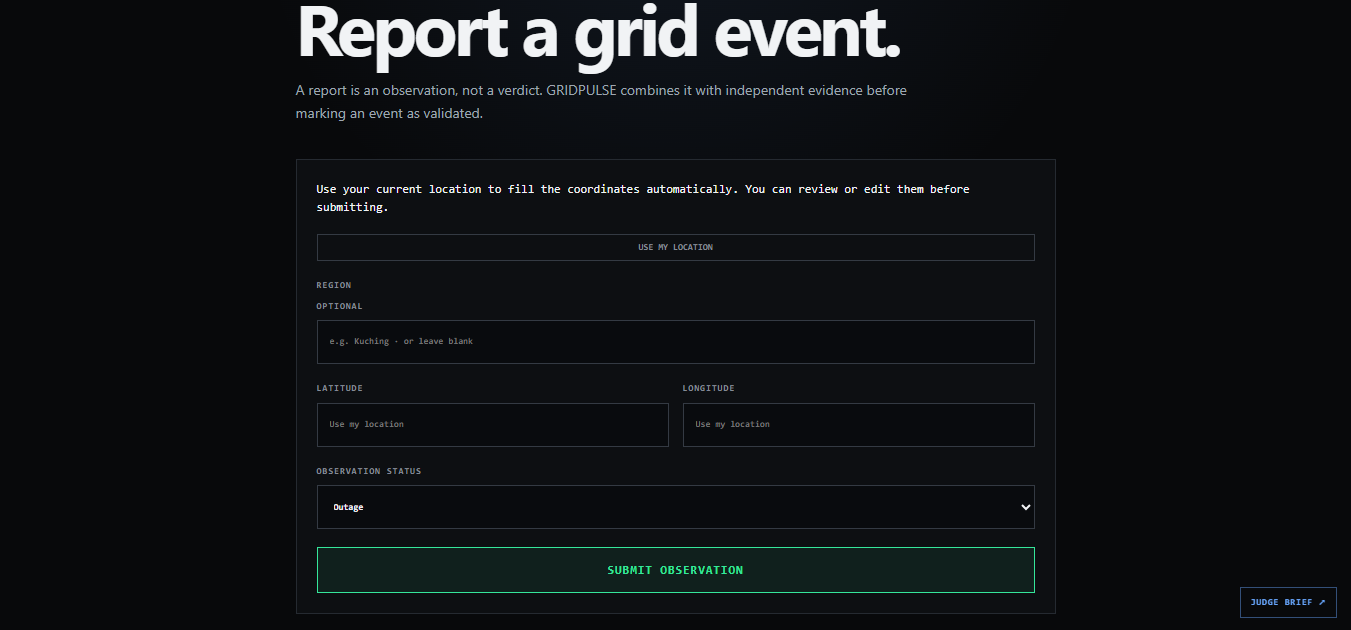
The goal was not to make another dashboard filled with numbers. It was to build a system where every important signal has context: what was observed, where it happened, when it happened, how confident the system is, and what evidence supports it.
What it does
GRIDPULSE provides an intelligence layer for infrastructure telemetry.
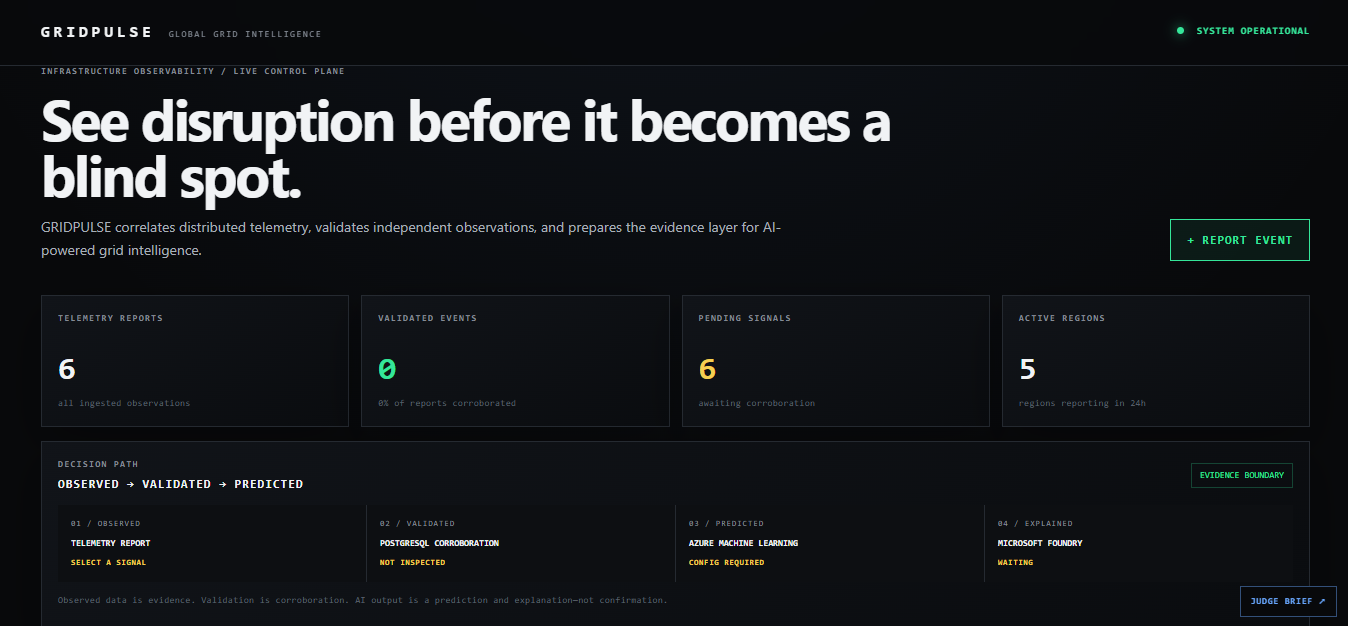
The platform organizes incoming observations into a control-plane experience that helps users understand:
- Current telemetry activity
- Validated and pending events
- Active regions
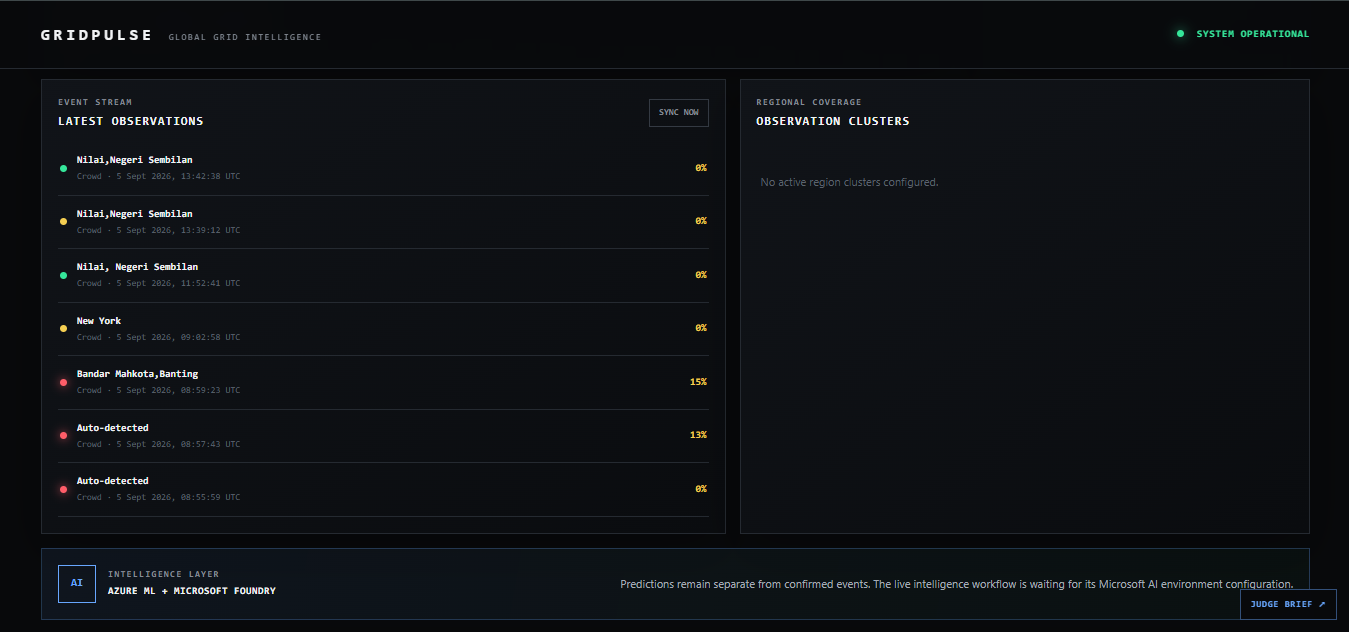
- Regional coverage
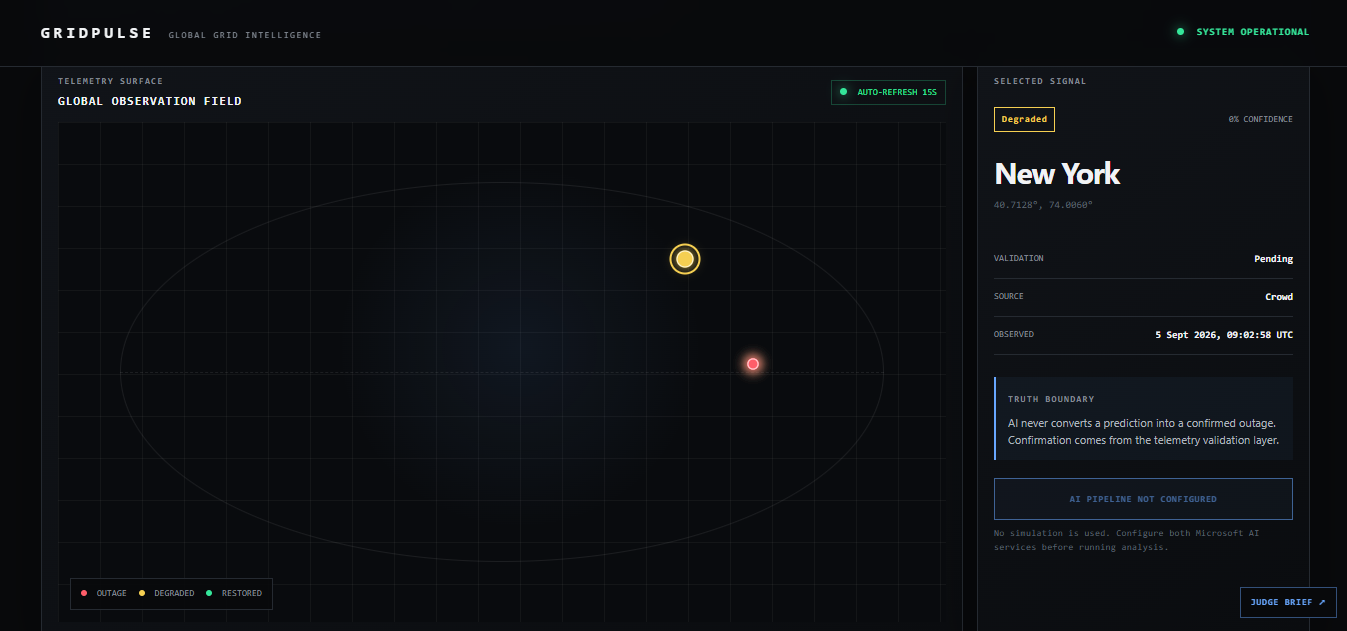
- Evidence supporting individual signals
- Event timelines
- Infrastructure intelligence generated from observed data
A core principle of GRIDPULSE is observed ≠ predicted.
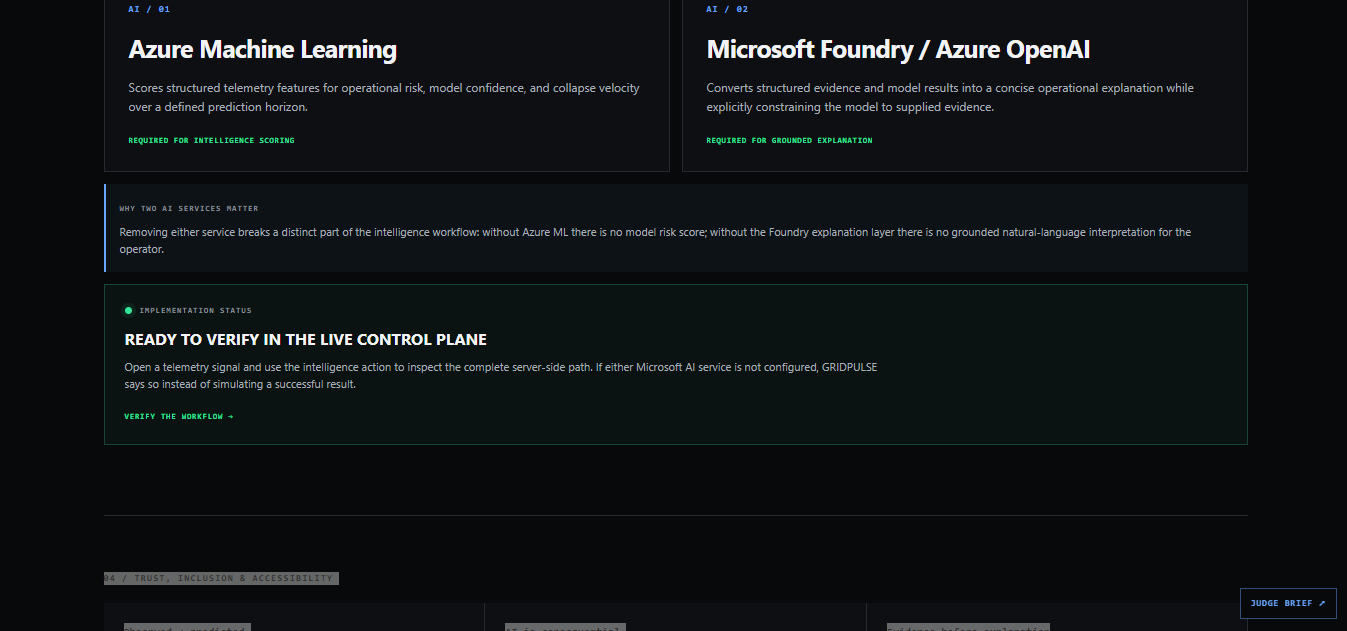
The interface separates observed telemetry from higher-level intelligence so that AI-generated explanations do not replace the underlying evidence.
The system is designed around an evidence chain:
Telemetry → Corroboration → Risk scoring → Grounded explanation → Human decision
How we built it
GRIDPULSE was built as a modern full-stack web application.
The frontend uses Next.js, React, TypeScript, and Tailwind CSS to create a responsive control-plane interface.
The data layer uses PostgreSQL/Supabase to organize telemetry, events, regions, and supporting evidence.
The architecture is designed to integrate machine-learning risk scoring through Azure Machine Learning and grounded AI explanations through Microsoft Foundry / Azure OpenAI.
The application is deployed through Vercel, with the source code maintained publicly on GitHub.
I focused on making the system understandable as well as technically ambitious. Instead of hiding complexity behind a single AI response, GRIDPULSE exposes the evidence and system state that an operator would need to evaluate the result.
Challenges we ran into
One of the biggest challenges was deciding how to represent complex infrastructure information without overwhelming the user.
It was tempting to add more charts, metrics, and visualizations, but every element needed to have a purpose. I therefore focused on creating a clear hierarchy between raw observations, corroborated events, and higher-level intelligence.
Another challenge was designing the AI layer responsibly.
An AI explanation can sound convincing even when the underlying evidence is weak. GRIDPULSE therefore treats evidence, confidence, timestamps, sources, and location as first-class information rather than treating the AI response as the source of truth.
Building and connecting the different layers of the application also required working through frontend, database, deployment, and integration problems along the way.
Accomplishments that we're proud of
I'm proud that GRIDPULSE grew beyond the idea of a simple monitoring dashboard into a complete infrastructure-intelligence concept.
Some of the parts I'm most proud of are:
- The evidence-first architecture
- The distinction between observed signals and predictions
- The regional intelligence and event-stream experience
- The PostgreSQL-backed data model
- The planned ML risk-scoring layer
- The grounded AI explanation architecture
- The operator-focused control plane
- A publicly accessible deployed application and source repository
Most importantly, the project helped me think about AI systems not just as generators of answers, but as systems that should remain connected to evidence.
What we learned
Building GRIDPULSE taught me that a technically impressive system is not automatically a useful system.
The hardest part was often deciding what information should be visible, what should be trusted, and how to communicate uncertainty.
I also learned a lot about full-stack development, database-backed applications, deployment, system architecture, and designing interfaces around real operational workflows.
The project reinforced an important principle for me:
Good intelligence should make evidence easier to understand, not make evidence easier to ignore.
What's next for GRIDPULSE
GRIDPULSE is still an evolving project.
The next stage is to make the intelligence pipeline more complete by strengthening telemetry ingestion, corroboration, risk scoring, and grounded AI explanations.
I also want to expand regional coverage, improve the operator experience, add stronger evidence visualization, and make the system increasingly useful for exploring infrastructure conditions in real time.
The long-term vision is for GRIDPULSE to become a platform where complex infrastructure signals can be transformed into transparent, explainable intelligence without losing sight of the evidence underneath.
Built With
- apis
- azure
- css
- design
- foundry
- github
- learning
- machine
- microsoft
- next.js
- openai
- postgresql
- react
- responsive
- rest
- supabase
- tailwind
- typescript
- vercel
- web


Log in or sign up for Devpost to join the conversation.