-
-
Arxchitecture
Devpost form — paste-ready
Track: The Fortified Enterprise Fleet Live: https://gridmind-wuvfpvopoq-uk.a.run.app Repo: https://github.com/PRACHIT27/GridMindAI
Elevator pitch (200 char limit)
Four correct answers can still add up to a plan nobody can build. GridMind checks power, cooling, space and budget together, and returns one that holds.
Inspiration
Modern AI data centers run at 100 to 750 MW, and every GPU generation pushes rack density higher. When a new high-density workload needs a home, four teams have to sign off: power engineering, cooling, facilities and finance. Today that happens one team at a time, over email and spreadsheets, over several days.
The failure mode that got our attention is not that a team gets it wrong. It is that all four can be right and still describe a plan that cannot be built. Power approves the room with the most electrical headroom. Cooling approves the only room that can remove the heat. Facilities approves the room with free racks. Three correct answers, three different rooms, no valid plan, and nobody owns the joint check.
The industry has a name for what that leaves behind: stranded capacity, meaning megawatts a site has paid for and cannot use.
What it does
A request arrives: six racks of GB200 NVL72, 132 kW and 1,360 kg each.
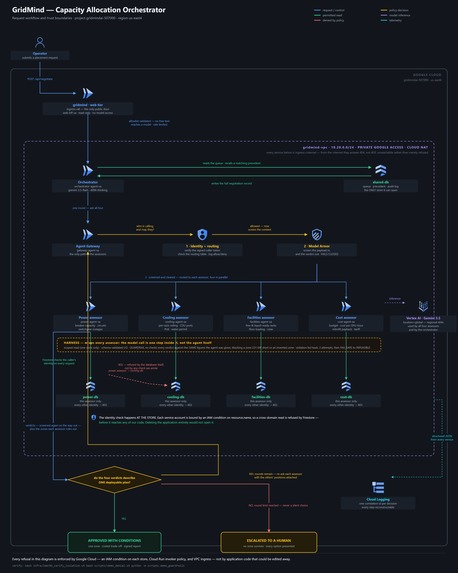
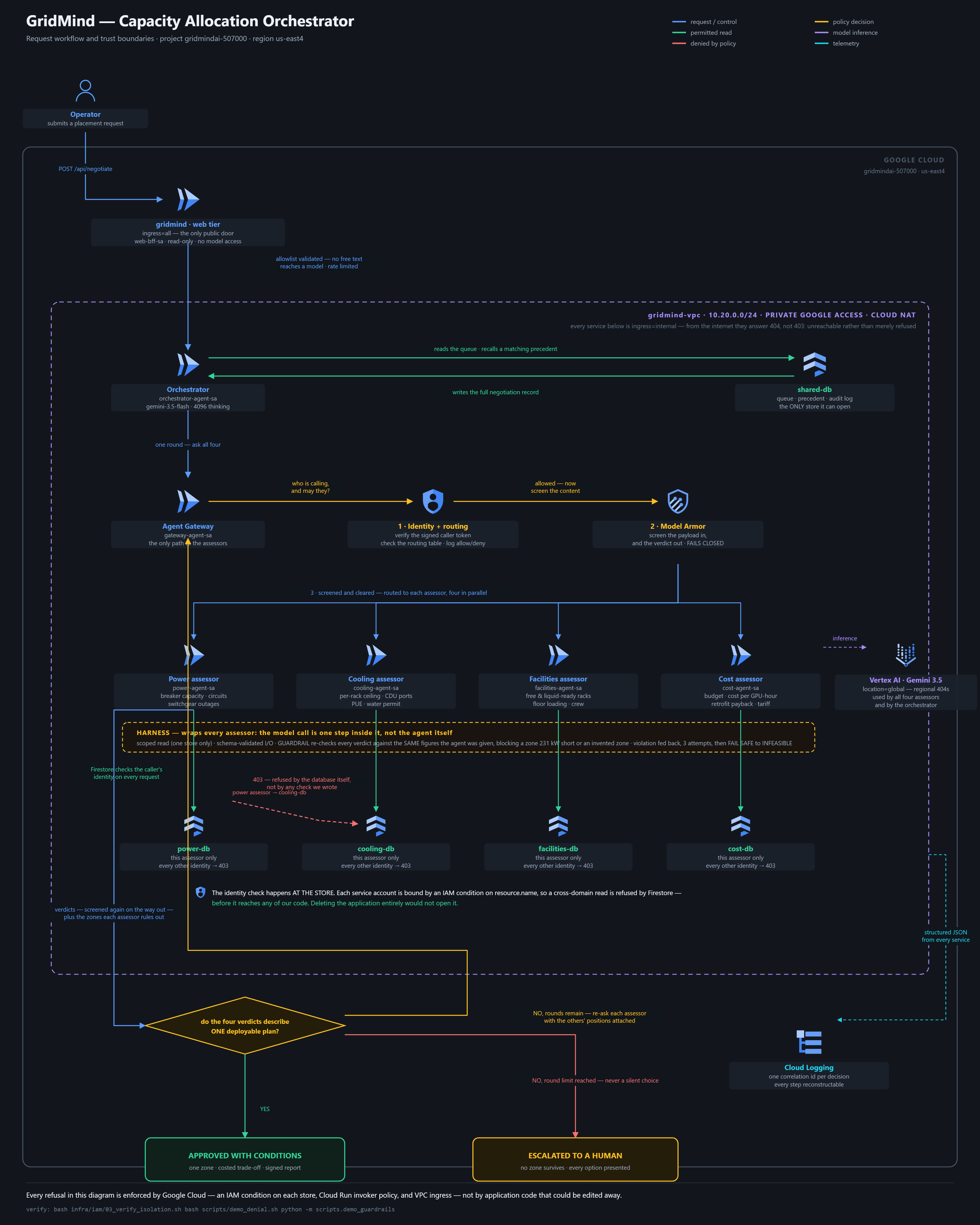
Four specialist agents assess it in parallel, each reading only its own database.
- Power — breaker headroom, spare circuits, switchgear outages, grid events
- Cooling — per-rack thermal ceiling, CDU ports, PUE, water discharge permit
- Facilities — free and liquid-ready racks, floor load rating, crew and retrofit time
- Cost — operating budget, cost per GPU-hour, retrofit payback, tariff rules
In our demo facility, round one produces exactly the failure above: power says zone A, cooling says zone C, facilities and cost say zone B.
The orchestrator does not count votes. It asks whether the four verdicts describe one physically deployable plan. They do not, so it opens a negotiation round and re-prompts each agent with the others' positions attached. Facilities then volunteers something it had no reason to mention before: zone C has five liquid-ready racks and more that can be plumbed in about fourteen hours each. Cost recalculates, because retrofitting one rack costs $48,000, not the $288,000 it had assumed for six.
Decision: zone C, five ready racks plus one retrofit, fourteen hours of delay.
Each agent also reports the zones its own axis excludes. Intersecting those four lists leaves exactly one surviving zone, and in round one not a single agent had endorsed it. That intersection is the thing no individual team can compute from inside its silo, and computing it is the point of the system.
You get back a target zone or a refusal, the plan to get there, every agent's verdict beside the evidence it was actually shown, and a PDF decision report.
How we built it
Gemini 3.5 on Vertex AI, with flash-lite for the four specialists and
flash with a 4,096-token thinking budget for reconciliation. The Google GenAI
SDK with Pydantic response schemas for structured output. Cloud Run for
seven services under seven service accounts, and Firestore for five separate
databases.
Security that is enforced, not described
The load-bearing finding: Firestore Security Rules are not evaluated for server-side Admin SDK access. They apply only to client SDK and Firebase Auth traffic. A design that scoped agents with per-collection rules would have enforced nothing at all, while looking correct in a diagram.
So each domain gets its own database, and each service account is bound through an
IAM Condition on resource.name, which is enforced for client-library access.
Verified by live API calls with real agent credentials:
| Identity | Own store | Other stores | From the internet |
|---|---|---|---|
| four specialists | 200 | 403 | 404 |
| orchestrator | shared only | 403 (all four) | 404 |
| public web tier | shared, read-only | 403 | 200 |
The orchestrator is incapable of reading facility data, so "it only sees the agents' verdicts" is a property of the platform rather than a promise.
Note the shape of that last row: the only internet-facing service holds the least privilege. Read-only, one store, and no permission to call a model at all. Someone who fully owns the public container gets a request queue and a decision log, not the facility, and no way to spend the inference budget.
Model Armor screens inter-agent traffic at the gateway in both directions and fails closed. Cloud Logging threads one correlation id through every model call, guardrail check, screening result and routing decision, so a whole multi-agent decision is reconstructable from a single filter.
Harness engineering
The model call is one step inside a structural layer, not the agent itself. Schema-validated I/O, IAM-scoped tool access, retry that feeds the violation text back as correction, and guardrails that re-check every verdict against the same figures the agent was handed, including the alternatives it proposes.
Both loops are bounded and neither can spin. Each agent call retries at most three times, and negotiation runs at most three rounds. When either is exhausted the system refuses. It fails safe, never open. An agent that cannot reason reliably about a 90 MW electrical envelope stops the line rather than approving and hoping.
Conflict detection itself is deterministic. Whether two zone ids differ is not a judgement call, so no model decides it. The model reconciles conflicts. It never detects them.
Challenges we ran into
Gemini 3.5 is only served from Vertex's global endpoint. Regional endpoints
404 for those model ids, and gemini-2.0-flash is retired. Pointing at a region
would have silently dropped us to a non-compliant model.
Thinking tokens share the output budget. A 4,096 thinking budget inside a 4,096 ceiling returns JSON truncated mid-string.
A lazy-singleton race. Four concurrent agents each built their own client, and the garbage-collected losers closed the shared HTTP transport. Three of four agents failed in round one for no visible reason.
A data leak that all our security tests passed. A single shared notes field
had copied the sentence "5 liquid-ready racks against 6 needed" into all four
databases. Every agent could solve the problem alone, so the multi-agent premise
had quietly collapsed while all 14 isolation checks stayed green. Airtight
permissions plus a leaky payload is not isolation. A second test now scans every
value written to each store.
A prompt injection channel we had left open. Free text from the request
description reached the model verbatim. It is now an allowlist of fixed choices
and numbers, with extra="forbid" on the schema, and the description the model
sees is generated server-side.
Our own eval suite lied to us. It ran in-process and bypassed the gateway, so it reported 12/12 green while production was completely broken, twice. We removed it rather than keep a suite that manufactures confidence during an outage.
Accomplishments that we're proud of
The isolation is real and you can check it in thirty seconds. Twenty-one live checks, and every denial comes from Google Cloud rather than from our code. Delete every check we wrote and they all still hold.
We caught the Security Rules gap before it made the whole design decorative. It would have been very easy to ship per-collection rules, demo them, and have enforced nothing.
Our own leak test caught us breaking our own premise. The multi-agent argument had collapsed into four agents that could each solve the problem alone, and none of the permission tests could see it, because permissions were not the thing that was wrong.
The fail-safe held against bugs that were not in the agents. Two gateway outages during the build, and both times the system returned "escalated, needs a human" instead of crashing or approving something. It protected us from a failure we had not thought of.
The negotiation produces answers no single agent proposed. Zone C was nobody's first choice in round one. It only exists as an answer because four independent exclusion lists get intersected, which is exactly what no team can do from inside its own silo.
What we learned
That the most dangerous failures were the ones our tests were structurally unable
to see. Both production outages presented identically, as ESCALATED, because the
fail-safe worked perfectly. Correct behaviour made a missing network route look
like an agent decision.
That a passing test suite during an outage is worse than no suite, because you trust it.
And that an LLM is the wrong tool for part of this. Comparing 792 kW against 3,053 kW of headroom is arithmetic, and a constraint solver would be faster, cheaper and provably optimal. Where the model genuinely earns its place is interpreting constraints that vary between facilities, negotiating trade-offs, and explaining a decision to the team it affects. Our guardrails are already a small deterministic solver checking the model's work, and that split is the right shape for a real product.
What's next for GridMind
A read-only stranded-capacity audit as the entry point. Point it at a DCIM export and report the megawatts an operator has paid for and cannot use. No integration risk, no trust barrier, and it earns the right to be in the decision loop later.
Durable async execution, the last partial GEAP capability. Results are already durable; delivery is still synchronous. Cloud Tasks closes it.
A constraint solver underneath the reasoning, so the model does the judgement and the arithmetic is provable.
Real facility data. The physics here is sourced from published figures, but how these decisions actually get made inside an operations team is something we would need to learn by shadowing one, not by writing a seed file.
Built with (25 tags)
Every tag below is something the project actually uses, checked against
requirements.txt, the gcloud services enable list in infra/, and the
imports in agents/.
google-cloud, gemini, vertex-ai, google-genai, cloud-run, firestore, model-armor,
cloud-iam, cloud-logging, cloud-monitoring, cloud-build, artifact-registry,
cloud-nat, vpc, python, fastapi, pydantic, uvicorn, tenacity, httpx, reportlab,
docker, javascript, html5, bash
Deliberately not tagged: google-adk. It is in requirements.txt but nothing
in agents/ imports it, so claiming it would be inaccurate.
The facility iad-dc-01 is simulated. The agents, the infrastructure and every
denial shown are real.
Built With
- claude
- gaep

Log in or sign up for Devpost to join the conversation.