-
-
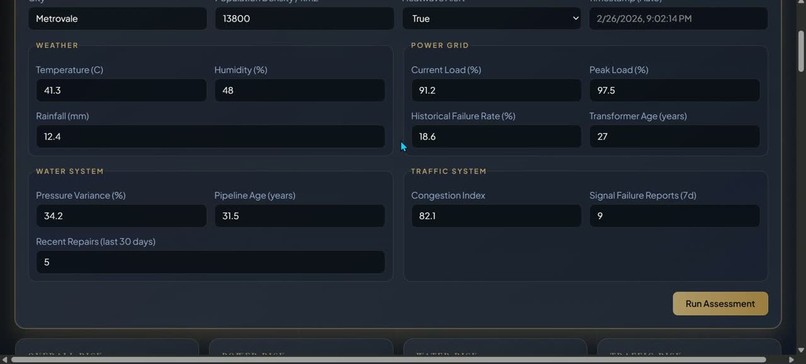
Executive Scenario Console with full multi-system telemetry inputs and one-click risk assessment.
-
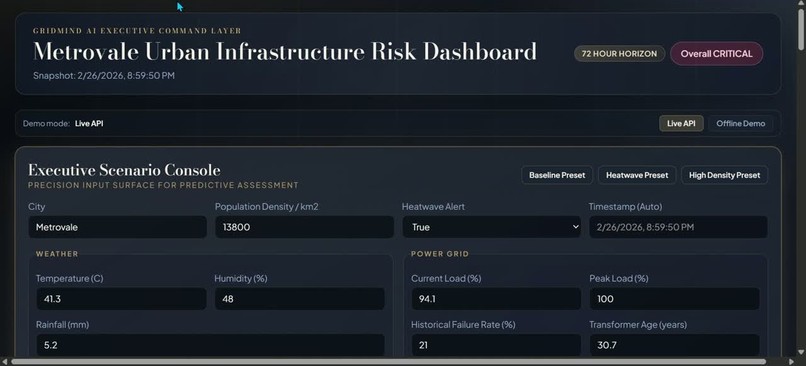
GridMind AI live command dashboard showing 72-hour city risk posture and scenario controls.
-
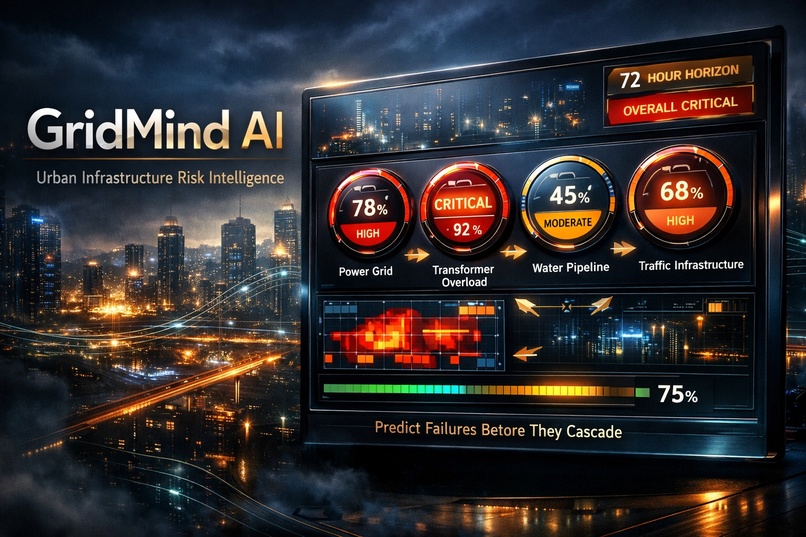
GridMind AI campaign thumbnail: “Predict Failures Before They Cascade” across power, transformer, water, and traffic systems.
-
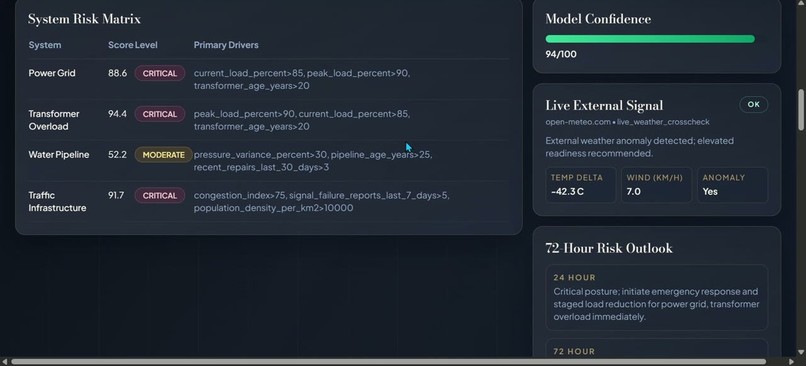
System Risk Matrix highlighting critical drivers, model confidence, external signal validation, and 72-hour outlook.
-
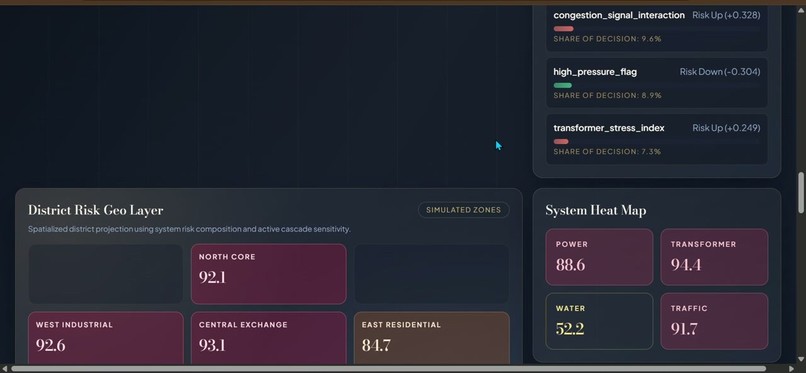
Spatial risk intelligence view with district geo-risk zones and cross-system heat map for rapid prioritization.


Inspiration
Cities often discover infrastructure stress only after outages begin. During heatwaves, heavy rain, and traffic pressure, failures can cascade across systems and hit vulnerable communities hardest. We built GridMind AI to give municipalities a 72-hour early warning layer so teams can intervene before disruption escalates.
What it does
GridMind AI predicts near-term (0-72h) failure risk for:
- Power Grid
- Transformer Overload
- Water Pipeline
- Traffic Infrastructure
It outputs:
- Risk scores and levels per system
- Overall city risk posture
- Cascading failure pathways
- Priority intervention zones
- 24h and 72h outlook
- Confidence score and executive summary
- Model explainability (top features + metric context)
How we built it
We built a hybrid architecture:
- Backend: FastAPI + Pydantic validation
- Frontend: React + TypeScript + Tailwind dashboard
- Risk engine: rule-based thresholds + weighted scoring + compound amplification + cascade logic
- ML layer: NumPy logistic regression per target, blended with rule probabilities
- Persistence: assessments saved to JSONL history
- Demo resiliency: Live API mode + Offline fallback mode
Modeling/evaluation:
- PR-AUC used for imbalanced failure prediction
- Baseline comparison: random vs rule-only vs ML-only vs hybrid
- Chronological backtesting for temporal realism
- Calibration tracked with ECE and reliability bins
- Explainability surfaced in UI via top feature contributions
Challenges we ran into
- Class imbalance and sparse subsystem incidents (especially power/water) made some targets hard to learn.
- “Real” MVP data was structured simulation, so we had to clearly communicate data provenance and avoid overclaiming.
- Early evaluation scripts were too slow; we optimized runtime for hackathon speed.
- Live demo reliability required handling API/CORS/runtime issues and adding robust offline fallback.
Accomplishments that we're proud of
- Built an end-to-end working product, not a mock:
- Data input -> validation -> risk assessment -> persistence -> dashboard rendering
- Implemented a real hybrid AI pipeline with measurable uplift over random baseline.
- Added explainability, calibration, and confidence reporting for operational trust.
- Delivered executive-grade UI with cascade visualization, geo-risk layer, impact model, and evidence board.
- Made the demo resilient with both online and offline execution modes.
What we learned
- Infrastructure AI success depends more on data quality and operational framing than model complexity alone.
- Hybrid rule + ML systems are valuable for safety, interpretability, and graceful degradation.
- Public-sector tools must expose uncertainty and evidence, not just predictions.
- Strong storytelling (community protection and resilience outcomes) is as important as technical depth in impact hackathons.
What's next for GridMind AI: Community Resilience Forecasting Platform
- Integrate real municipal telemetry (SCADA/IoT/event streams) and external hazard signals.
- Expand labeled incident coverage across more cities and longer timelines.
- Improve weak classes (power/water) with feature expansion and class-aware training.
- Add full geospatial map operations (district heatmaps + cascade route overlays).
- Deploy production monitoring: drift detection, scheduled recalibration, and model governance.
- Pilot with city operations/NGO partners for real-world impact validation.

Log in or sign up for Devpost to join the conversation.