GridLight in one minute
- Sustainability impact: in a simulated SVCE EV home, moving big loads to midday cuts grid CO₂ 18% for a $62/month saving on EV2-A. The same saving on an overnight timer raises CO₂ 7%. GridLight shows the difference.
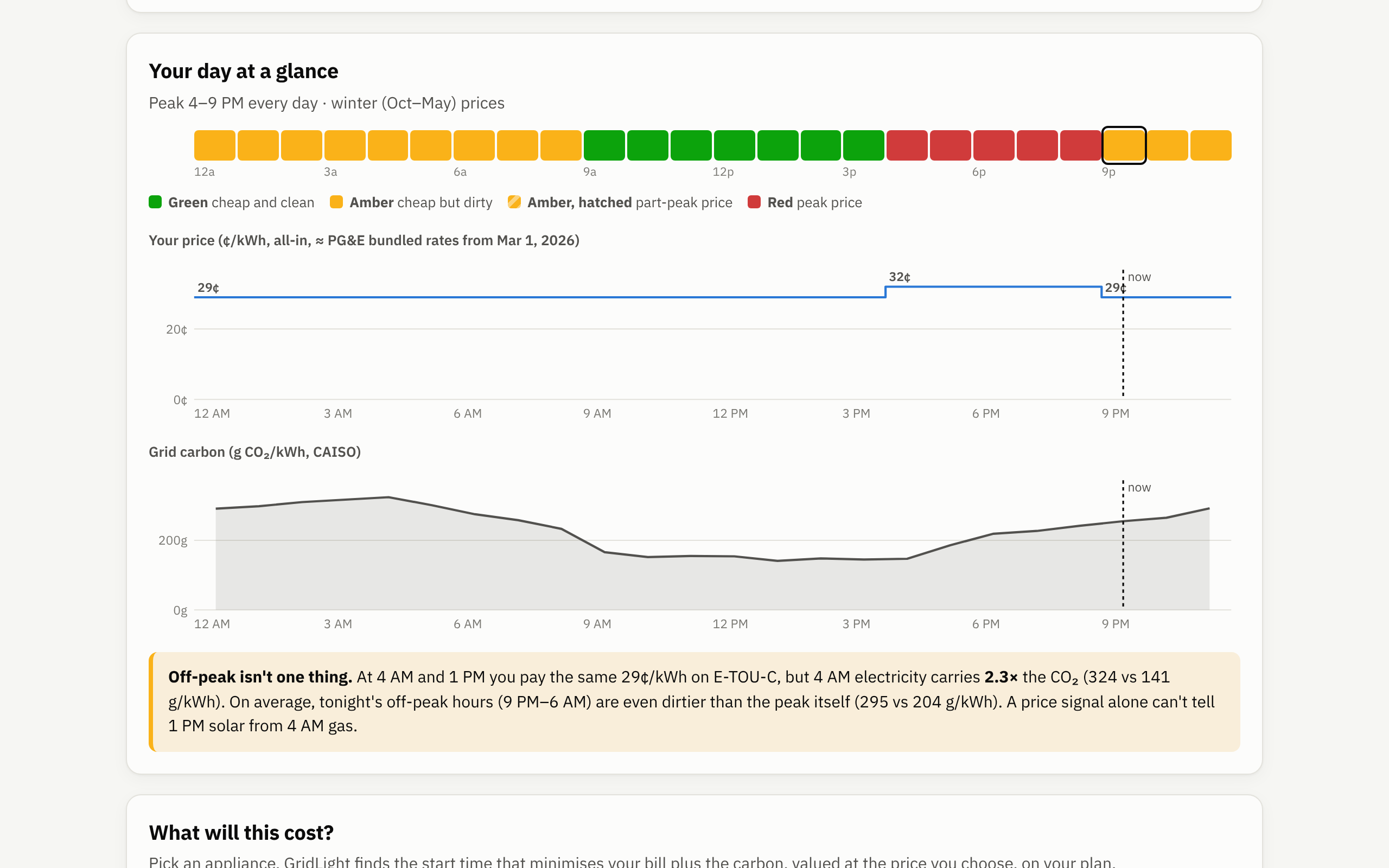
- Creativity: one traffic light that merges price and hourly carbon, built on a finding: off-peak isn't one thing (4 AM vs 1 PM on E-TOU-C, same 29¢, 2.3× the CO₂).
- Technical: a working app that combines CAISO emissions data, PG&E TOU tariffs, SVCE's hourly dynamic-pricing pilot API and Green Button parsing, all client-side and tested with Playwright.
- Scale: no hardware and no sign-up; it uses data every PG&E customer can already download. A program view gives SVCE MW out of the evening peak, t CO₂ and savings for N homes.
Inspiration
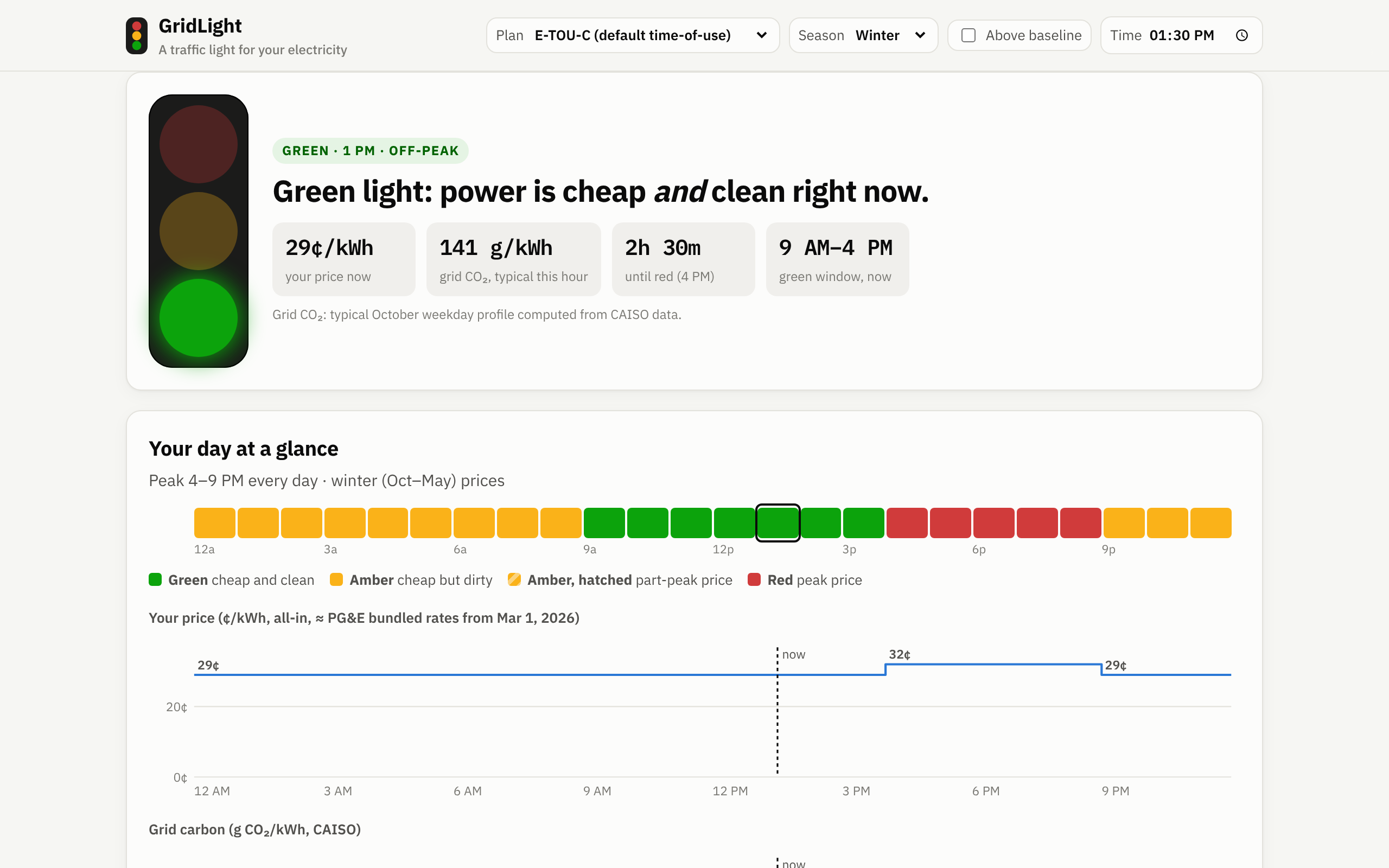
Most customers in PG&E's territory, SVCE's included, are on time-of-use rates, and "avoid 4–9 PM" is all most of them know. When we looked at the data, the bigger problem was that the price signal and the carbon signal disagree. On E-TOU-C, every hour outside 4–9 PM costs the same. The grid does not work that way.
| October 2026 weekday | E-TOU-C price (winter, within baseline) | CAISO grid CO₂ (average) |
|---|---|---|
| 1 PM (solar) | 29¢/kWh | 141 g/kWh |
| 4 AM (gas + imports) | 29¢/kWh | 324 g/kWh (2.3×) |
| 4–9 PM peak, average | 32¢/kWh | 204 g/kWh |
| 9 PM–6 AM, average | 29¢/kWh | 295 g/kWh |
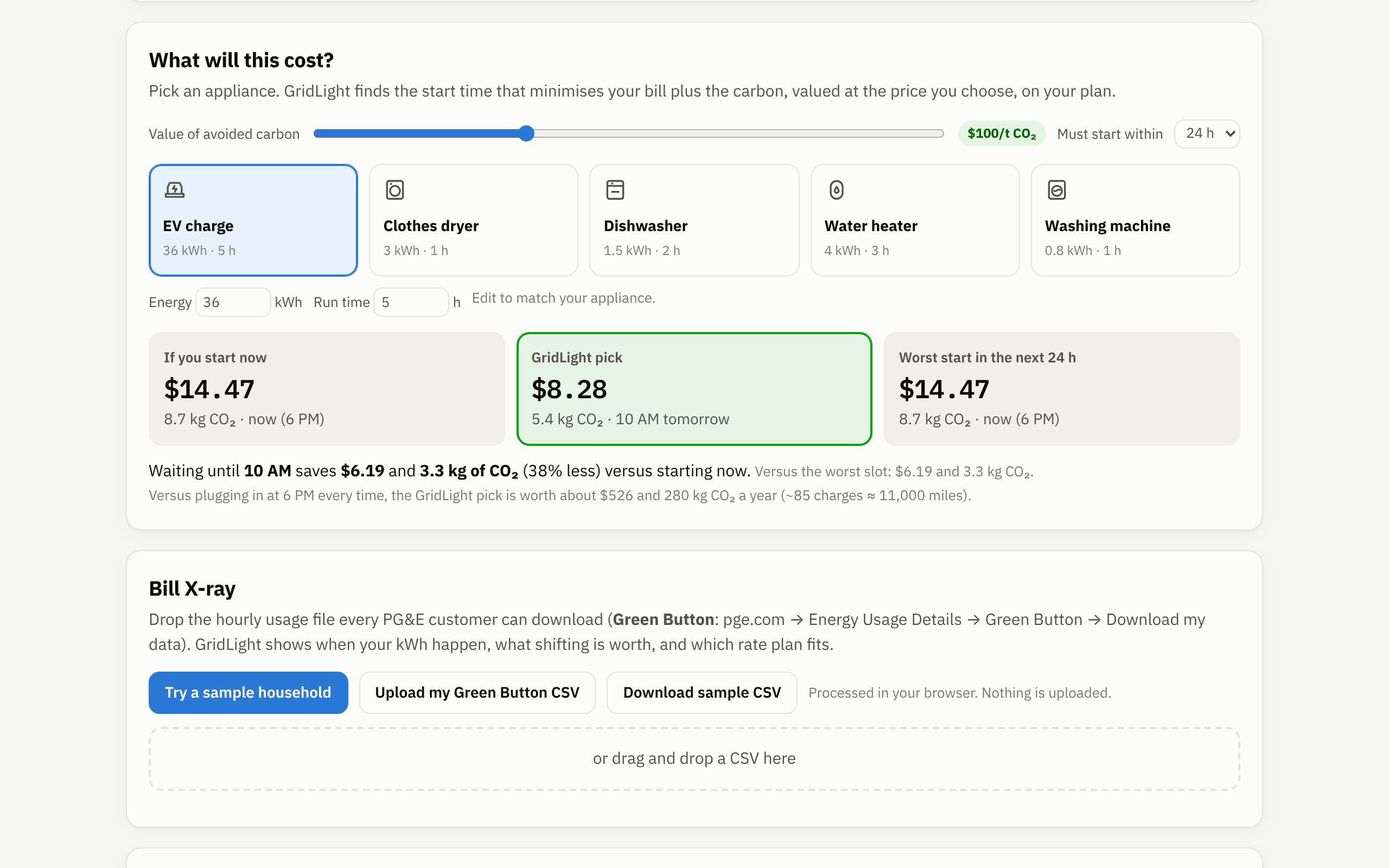
"Run it after 9 PM" saves 3¢/kWh in winter and moves the load into the night, whose average intensity is higher than the peak's. Even EV2-A, the EV plan, prices 10 AM and midnight the same: a 5-hour, 36 kWh charge costs $8.28 either way, but emits 5.4 kg CO₂ from 10 AM vs 11.1 kg from midnight. A price signal alone can't tell 1 PM solar from 4 AM gas.
What it does
GridLight is a traffic light for your electricity, built on the customer's own rate plan (E-TOU-C, E-TOU-D, EV2-A, E-ELEC; summer and winter):
- Right now: green (cheap and clean), amber (cheap but dirty, or part-peak) or red (peak), with your price, grid CO₂, a countdown to the next change and the next green window.
- Your day at a glance: a 24-hour strip with price and carbon on aligned charts, and the day's insight in plain words.
- What will this cost? For an EV charge, dryer, dishwasher, water heater or washer: $ and kg CO₂ if you start now, at the best time and at the worst. The pick minimises bill + carbon valued at $/t (default $100/t, adjustable), within the hours the user can wait.
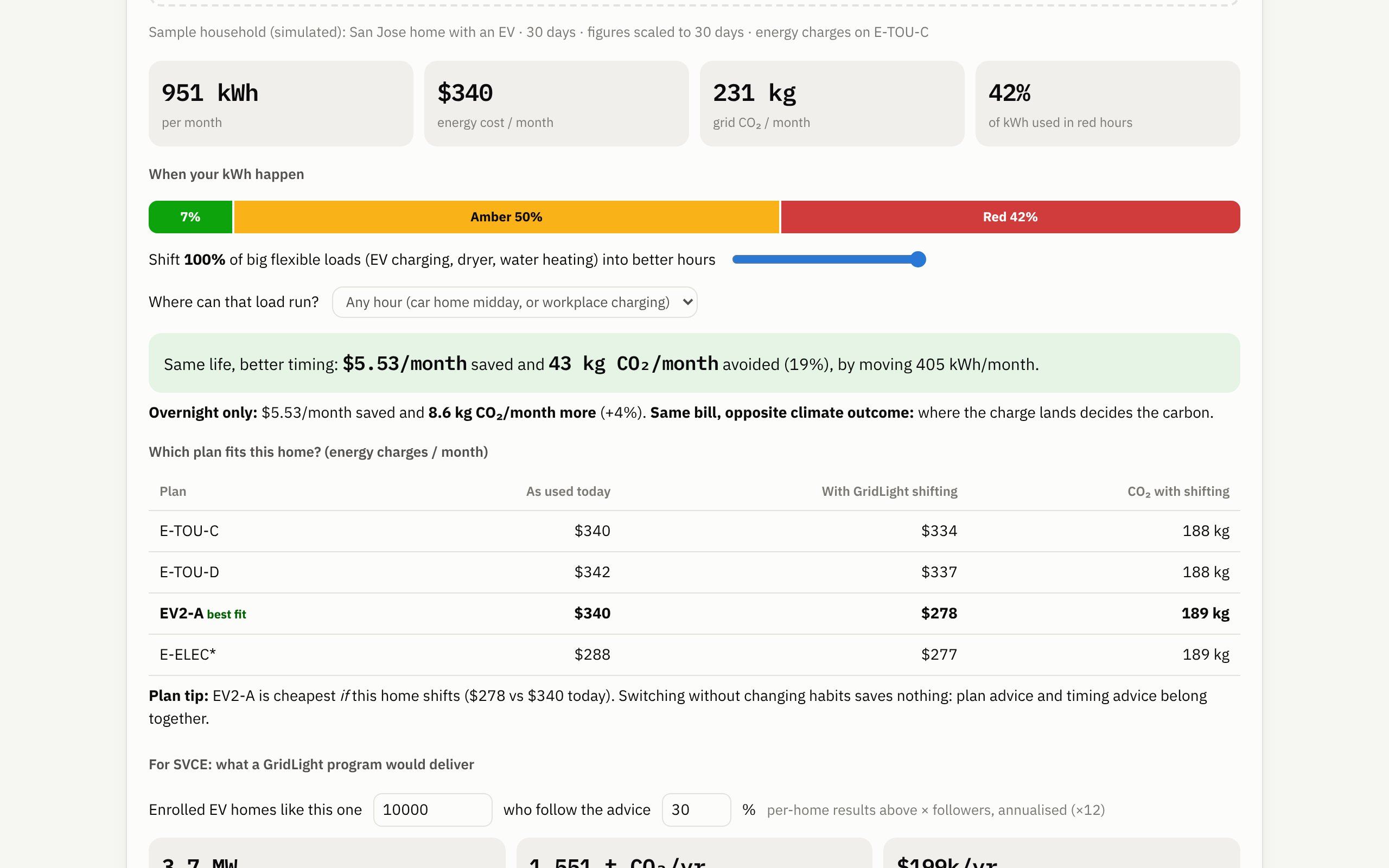
- Bill X-ray: drop the Green Button CSV every PG&E customer can download. GridLight shows when your kWh happen, what shifting big flexible loads is worth, and which plan fits. It runs 100% in the browser, so no data is uploaded.
- For SVCE: a program view that turns per-home results into MW moved out of the evening peak, t CO₂/yr and customer savings, for N enrolled homes and the share who follow the advice.
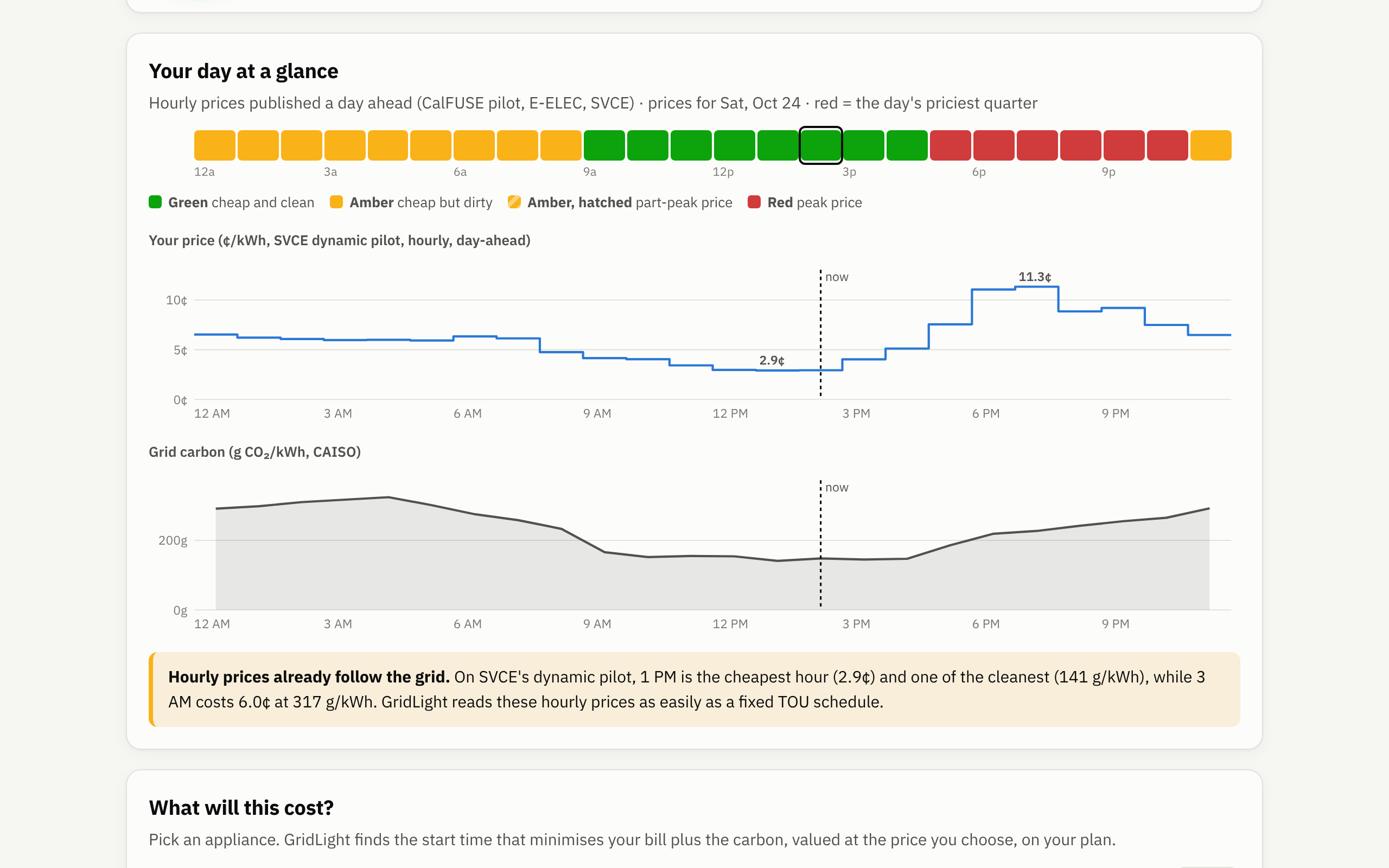
- Dynamic prices: pick SVCE's hourly dynamic pilot price (CalFUSE, published a day ahead), and the light, planner and nudges follow it hour by hour. On Oct 24, 2026, the pilot's cheapest hour is 1 PM (2.9¢/kWh) while 3 AM costs 6.0¢: hourly prices already point where the grid does, and GridLight makes that visible.
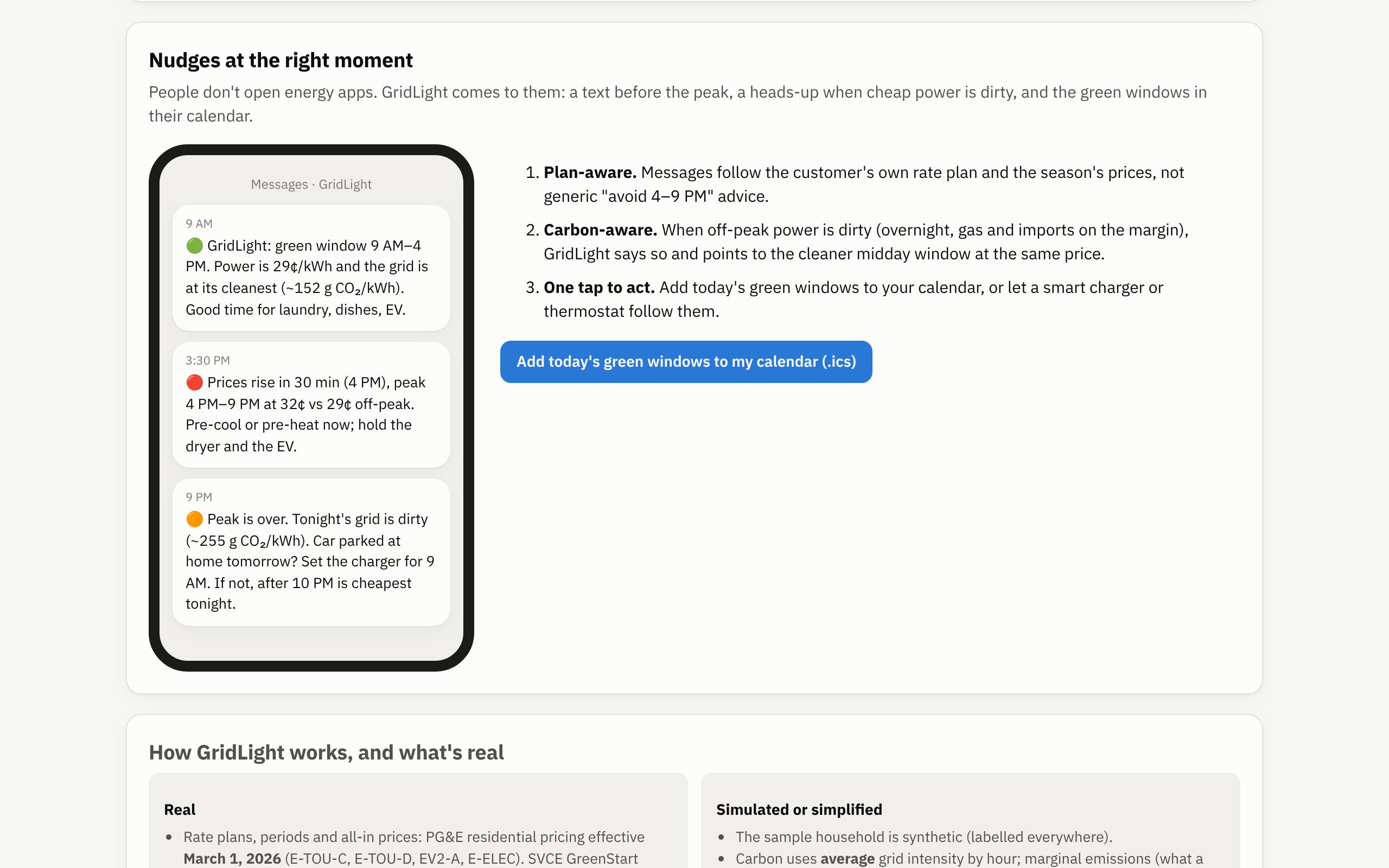
- Nudges: plan- and carbon-aware text messages ("Peak is over, but tonight's grid is dirty: car home tomorrow? Set the charger for 9 AM") and a one-click calendar file of today's green windows.
What the Bill X-ray found in our simulated San Jose EV home (951 kWh/month): on E-TOU-C, perfect timing saves just about $5.50/month. Money alone won't move this customer. On EV2-A, the same shift saves $62/month ($340 → $278), while switching to EV2-A without changing habits saves nothing. But where the charge lands decides the carbon: shifted to midday, the home's grid CO₂ falls 18% (232 → 189 kg/month); shifted to an overnight timer, it rises 7% (to 247 kg). Same bill, opposite climate outcome.
How we built it
- Rates: PG&E residential all-in time-of-use prices effective March 1, 2026, for four plans and both seasons, used as a proxy for SVCE customers: GreenStart average E-TOU-C bills are within 0.3% of PG&E's ($159.32 vs $159.76, PG&E's SVCE rate comparison). SVCE's own per-period generation + PCIA prices are a drop-in data swap. E-TOU-C's baseline is modelled as a daily credit.
- Carbon: SVCE GreenStart is carbon-free on an annual accounting basis. We use hourly CAISO average intensity because that is what the timing of a kWh changes (the 24/7 view). Source: CAISO Today's Outlook CO₂-by-source and demand files; intensity = Σ CO₂ (t/h, imports in, exports out) ÷ demand (MW) × 1000 = g/kWh. Winter = mean of three October 2026 weekdays (16, 19, 22); summer = Jul 15, 2026. Marginal emissions would favour midday even more.
- Dynamic pricing: SVCE's CalFUSE hourly pilot prices from the GridX pricing API (price curve SVCE-CalFUSE-EELEC-SECONDARY). Oct 21–25, 2026 are embedded, and today's prices are fetched live when the browser allows it.
- App: a static, dependency-free web app (vanilla JS, hand-built SVG charts, light and dark mode, mobile layout). It has a Green Button parser (hourly and 15-minute, solar import/export, gas rows skipped), a shifting model that conserves kWh and caps at a 7.2 kW charger, midday vs overnight scenarios, and an .ics export.
- QA: Playwright tests for the math (kWh conserved, CSV round-trip, calendar export), independent judge-style reviews of the app and of this text, and screenshot checks on desktop, phone, light and dark. The demo video was recorded headless from the real app.
Challenges we ran into
- Making one honest light out of two signals that disagree. We kept red strictly for price, so following GridLight never costs more, and used amber for "cheap but dirty".
- Average vs marginal emissions: we use average hourly intensity and say so.
- Realism: an EV that is away by day can't charge at noon, so the X-ray compares midday and overnight-only shifting instead of assuming the best case.
Accomplishments that we're proud of
- An insight a rate designer can act on: off-peak isn't one thing, and the cheapest hours are not always the cleanest.
- A working tool, not slides: real rates, real CAISO data, real Green Button parsing, privacy by design.
- Advice that pairs plan choice with timing, because one without the other can cost customers money or carbon.
What we learned
On E-TOU-C in winter, peak and off-peak differ by 3¢/kWh (about 10%), while same-price hours differ 2.3× in CO₂ (141 vs 324 g/kWh on October weekdays). Price alone won't move behaviour; plan advice and carbon timing have to come together.
What's next
- SVCE per-period generation rates and PCIA, and the SGIP GHG marginal-emissions signal for the PG&E DLAP in place of average intensity.
- More customers: multifamily (unit-level Green Button), small businesses on B-1, and solar + storage homes (net-load-aware advice; the parser already reads import/export).
- Delivery through SVCE's channels: SMS, voice (ElevenLabs), and smart chargers and thermostats following the green windows, so GridLight works with or without automation, plus workplace-charging partners for daytime EV charging.
- A pilot with SVCE EV customers to measure kWh moved into the 9 AM–4 PM solar window.


Log in or sign up for Devpost to join the conversation.