-
-
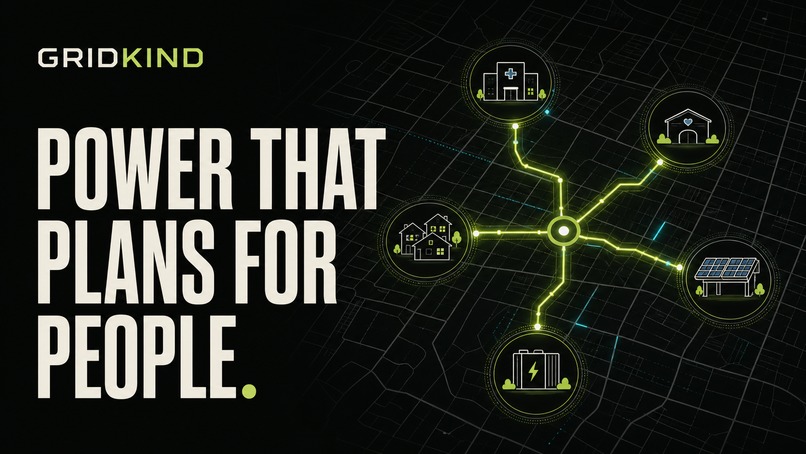
GridKind maps a neighborhood microgrid and explains who remains protected across baseline, heatwave, and island-mode scenarios.
GridKind — Power that plans for people
Inspiration
A blackout is not only an energy shortage. It is a decision about who remains protected. A clinic may need refrigeration, a cooling shelter may be filling during a heatwave, and homes may contain vulnerable residents. GridKind lets a community rehearse that decision before the outage happens.
What it does
GridKind is an interactive resilience decision twin for a neighborhood with solar generation, community storage, a clinic, a cooling shelter, and homes. It validates telemetry, calculates the available physical energy, and marks a plan CURRENTLY SAFE only when every defined life-safety load is supplied at 100%. Otherwise it returns NO SAFE PLAN instead of weakening the constraint.
When the current resources cannot reach a selected 90%, 95%, 99%, or 100% readiness target, GridKind calculates minimum additional storage or emergency supply, applies that intervention virtually, and reruns the identical 1,920 futures. TARGET VERIFIED appears only if the measured result reaches the selected target.
What makes it different
The same incident, telemetry, demand, storage, and loss model are evaluated under proportional shedding, critical-first dispatch, and GridKind. Each policy’s life-safety SAFE or UNSAFE state is shown before secondary trade-offs. GridKind is not forced to win every metric.
Sensor Lab rejects missing, stale, spiking, and out-of-range simulated telemetry and enters DEGRADED or FALLBACK operation. The physical ledger accounts for solar, grid, 90%-efficient battery discharge, conversion loss, and conservation residual. Every decision produces a deterministic proof that can be replayed; deliberately changing the result triggers TAMPER DETECTED.
Closed-loop example
For the frozen 99% readiness scenario, the actual engine calculates:
85.78% → +36.31 kWh → same 1,920 futures rerun → 1,901/1,920 SAFE → 99.01% TARGET VERIFIED
Verification
- 354/354 categorical acceptance checks
- 4/4 readiness closed-loop target verifications
- 3,960/3,960 hard-constraint stress cases
- 270/270 adverse three-policy cases
- False SAFE = 0
- Hard-constraint violations = 0
How we built it
GridKind uses React, TypeScript, Vinext, and Vite. Open-Meteo provides current Melbourne weather with a labelled offline fallback. A deterministic Life-Safety Guarantee Engine, physical energy ledger, multi-seed uncertainty engine, Minimum Intervention Solver, and replayable Decision Proof share one calculation path across the UI and exported JSON.
Challenges and lessons
The hard part was making a strong safety claim fail closed. We replaced a composite resilience score with explicit SAFE / NO SAFE PLAN semantics, kept weak outcomes visible, and required interventions to prove themselves against the same future set rather than displaying a predicted improvement.
Accuracy boundary
GridKind is decision-support software, not a live electrical controller or certified power-flow model. Life-safety profiles, loads, storage, and infrastructure values are prototype scenario assumptions. Sensor Lab uses simulated ESP32-shaped telemetry. No physical ESP32, real grid actuation, facility certification, or field validation is claimed.
What’s next
Operational use would require facility-validated critical-load profiles, calibrated asset data, electrical-network constraints, cybersecurity controls, engineering review, and field validation.
Built With
- cloudflare-workers
- css
- digital-twin
- energy
- iot
- react
- smart-cities
- typescript
- vinext
- vite

Log in or sign up for Devpost to join the conversation.