-
-
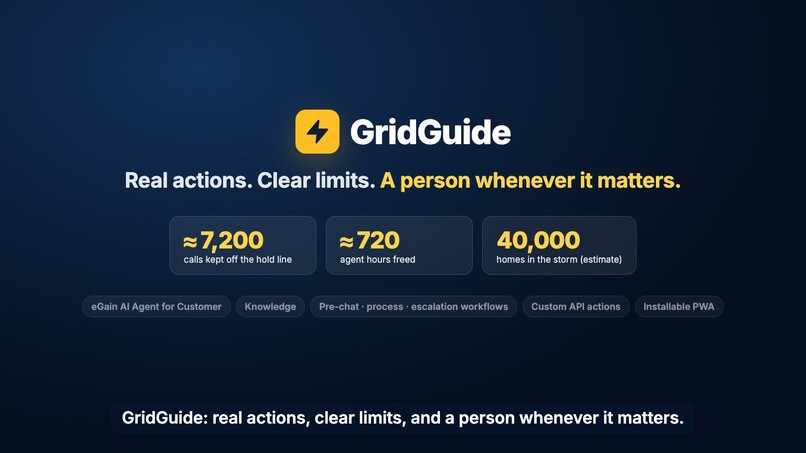
GridGuide: real actions, clear limits, and a person whenever it matters.
-
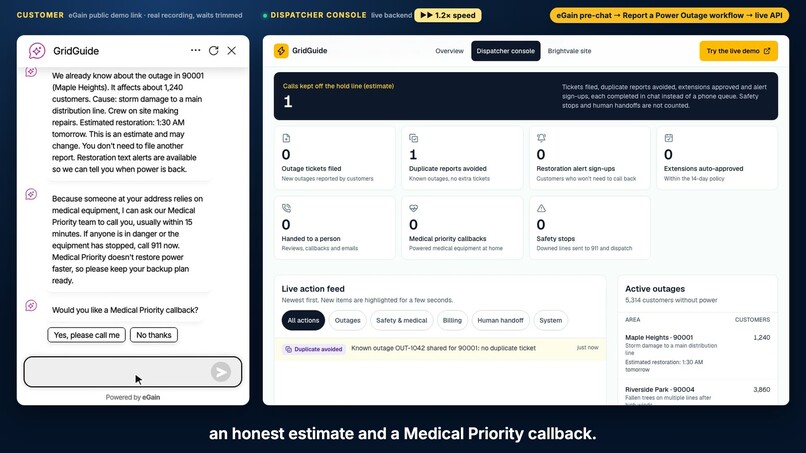
Medical Priority: pre-chat flag, live outage check, no duplicate ticket, priority callback. Every action shows on the dispatcher console.
-
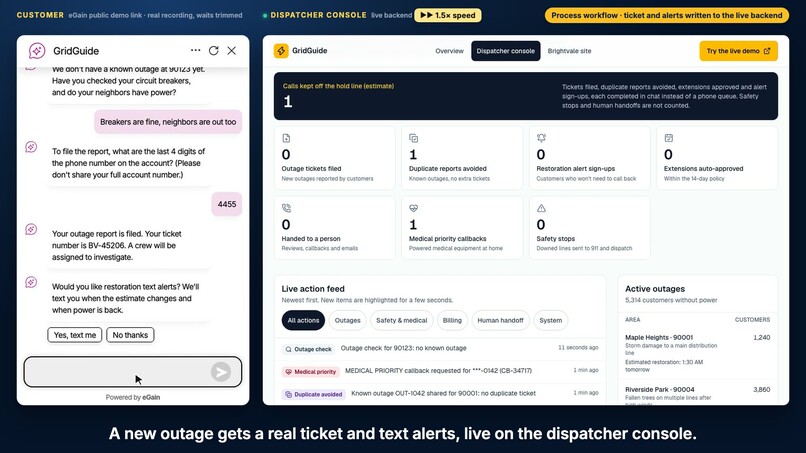
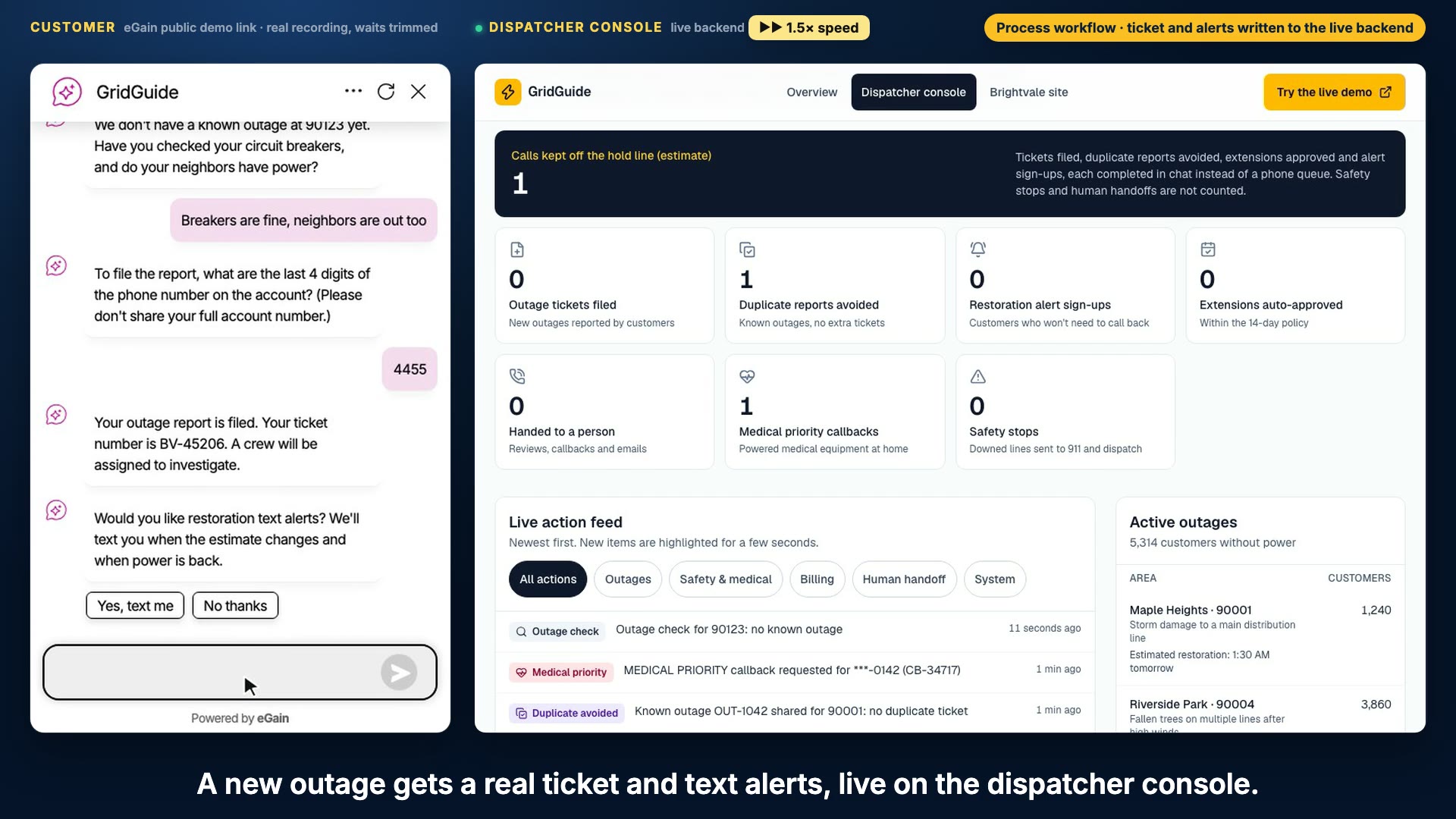
New outage: a real ticket and restoration text alerts, written to the live backend.
-
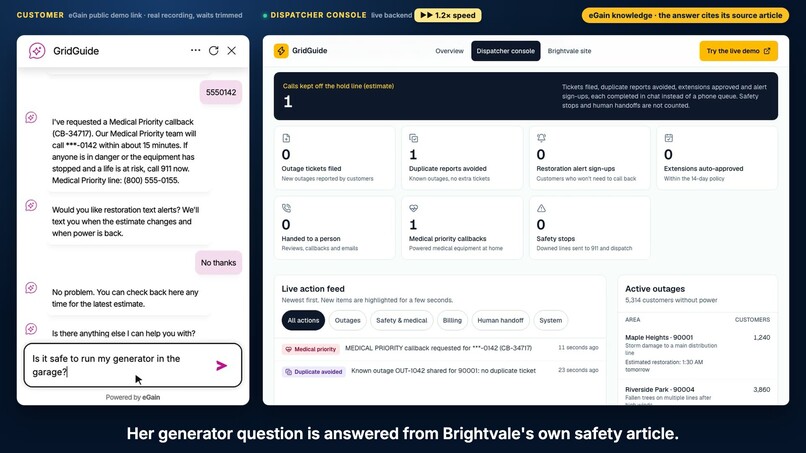
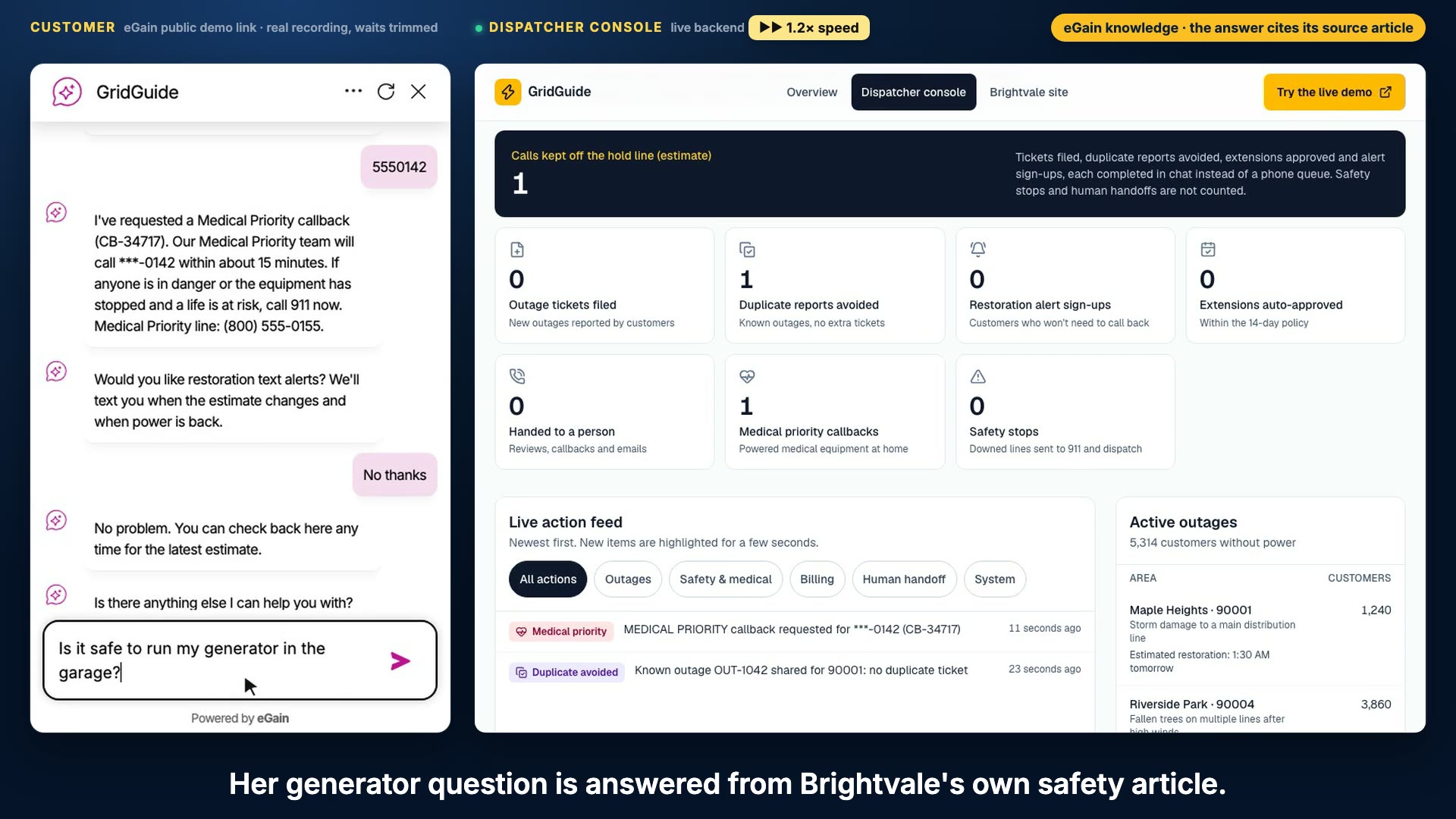
Knowledge answer: generator safety answered from Brightvale's own article, with the source cited.
-
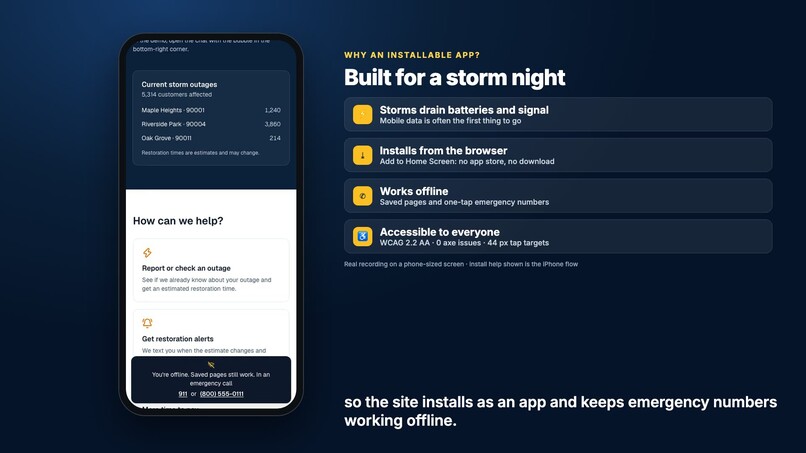
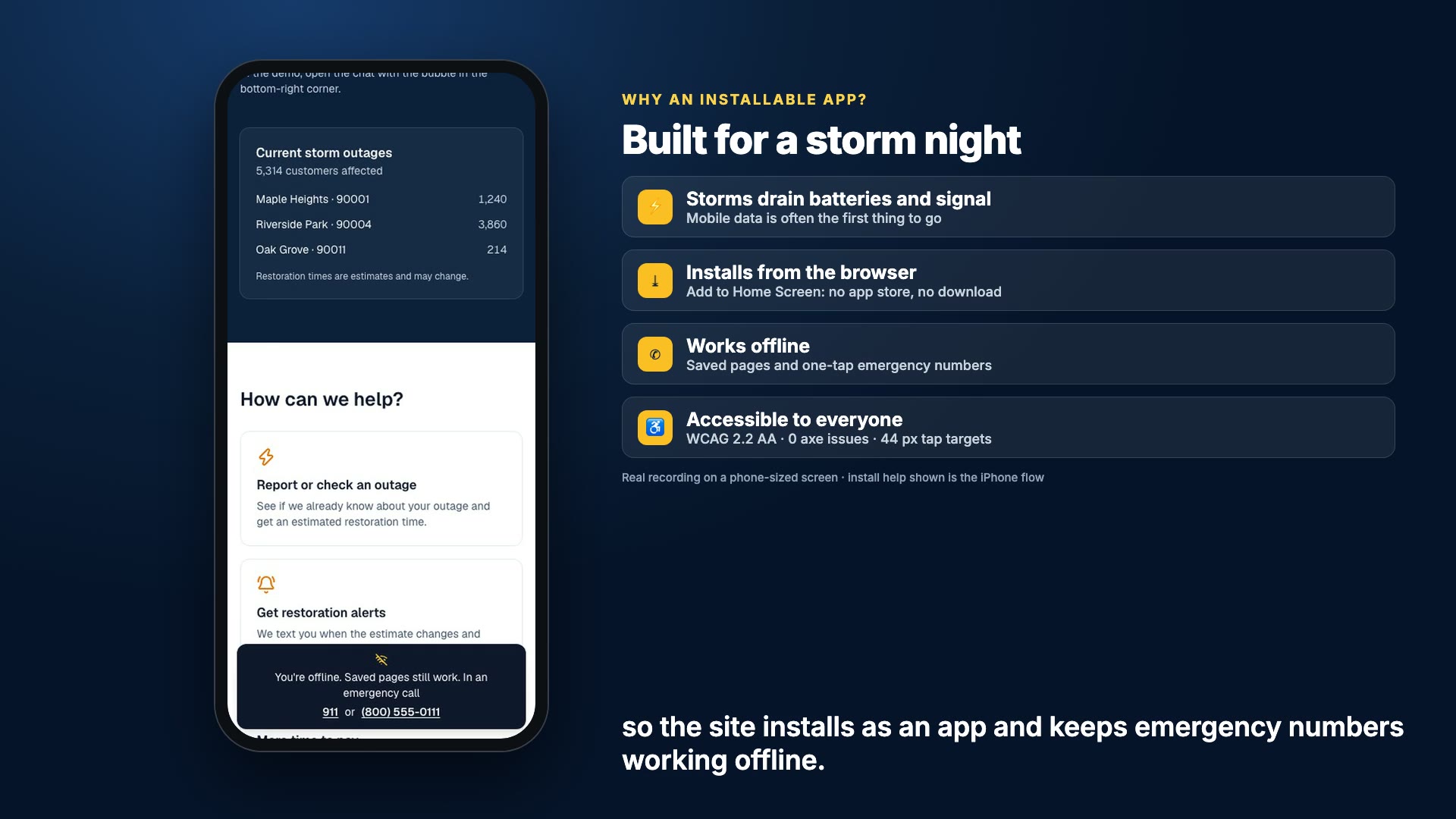
Built for a storm night: the Brightvale site installs as an app and keeps emergency numbers working offline.
-
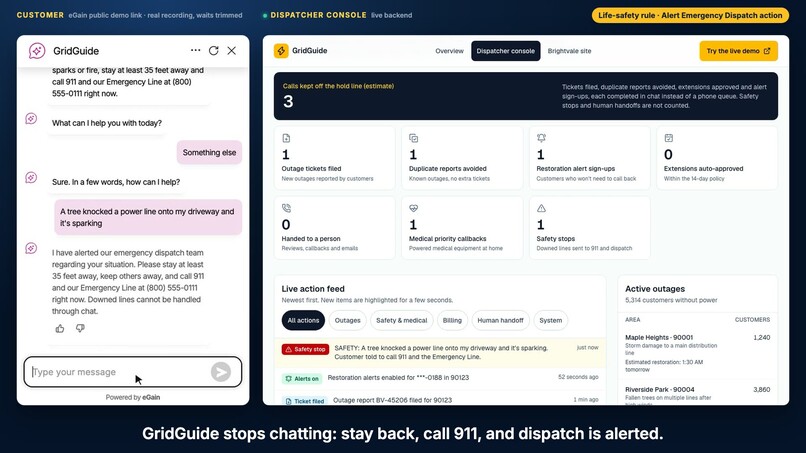
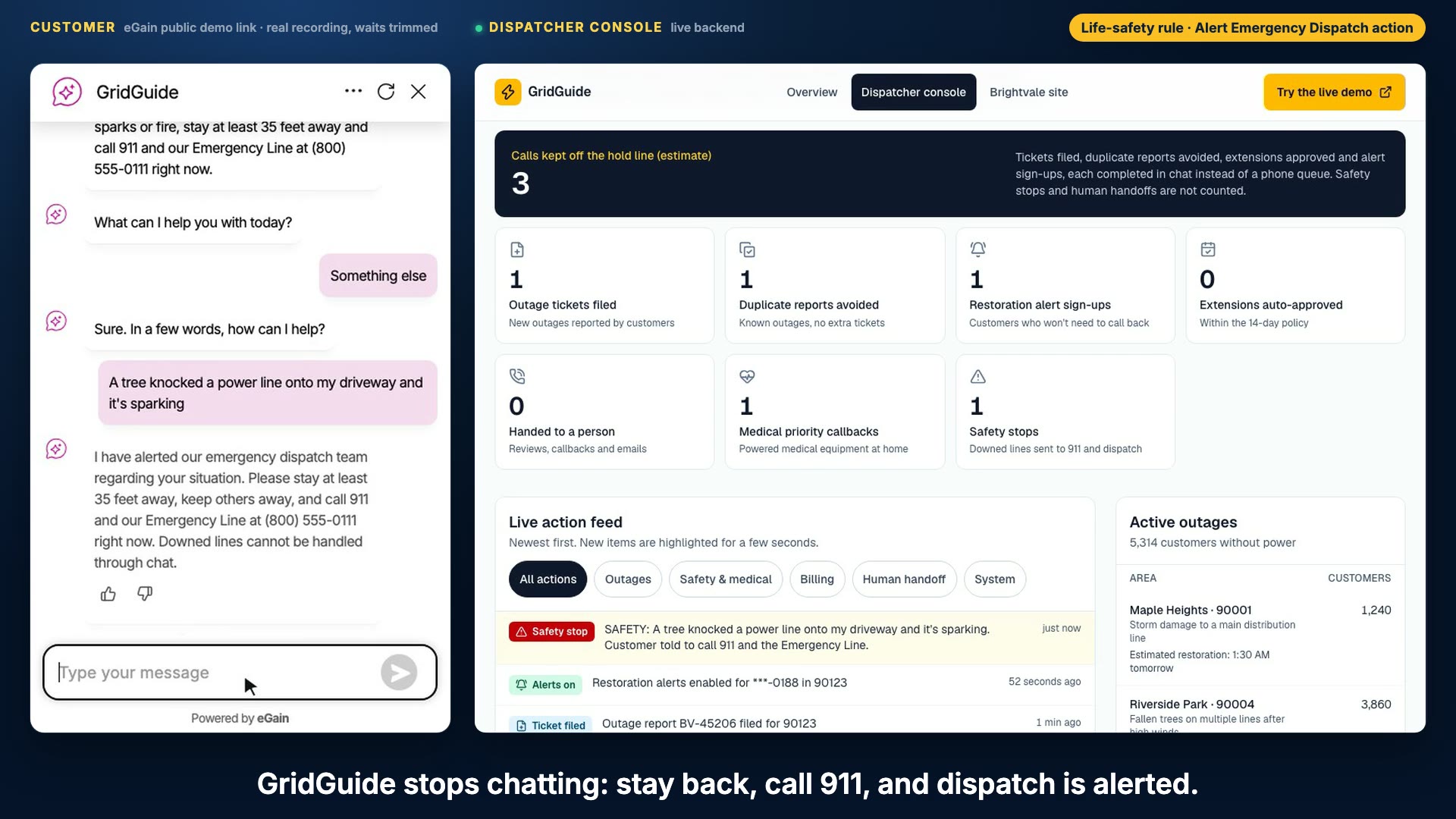
Safety stop: a downed line gets a safety script, call 911 and a dispatch alert. Never troubleshooting.
-
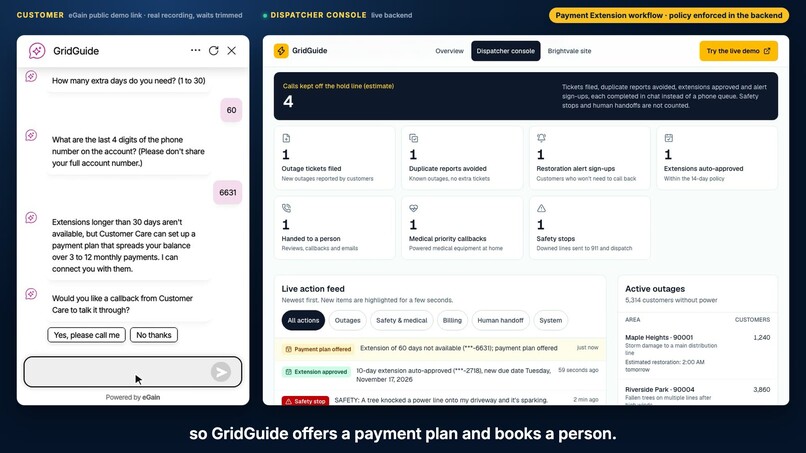
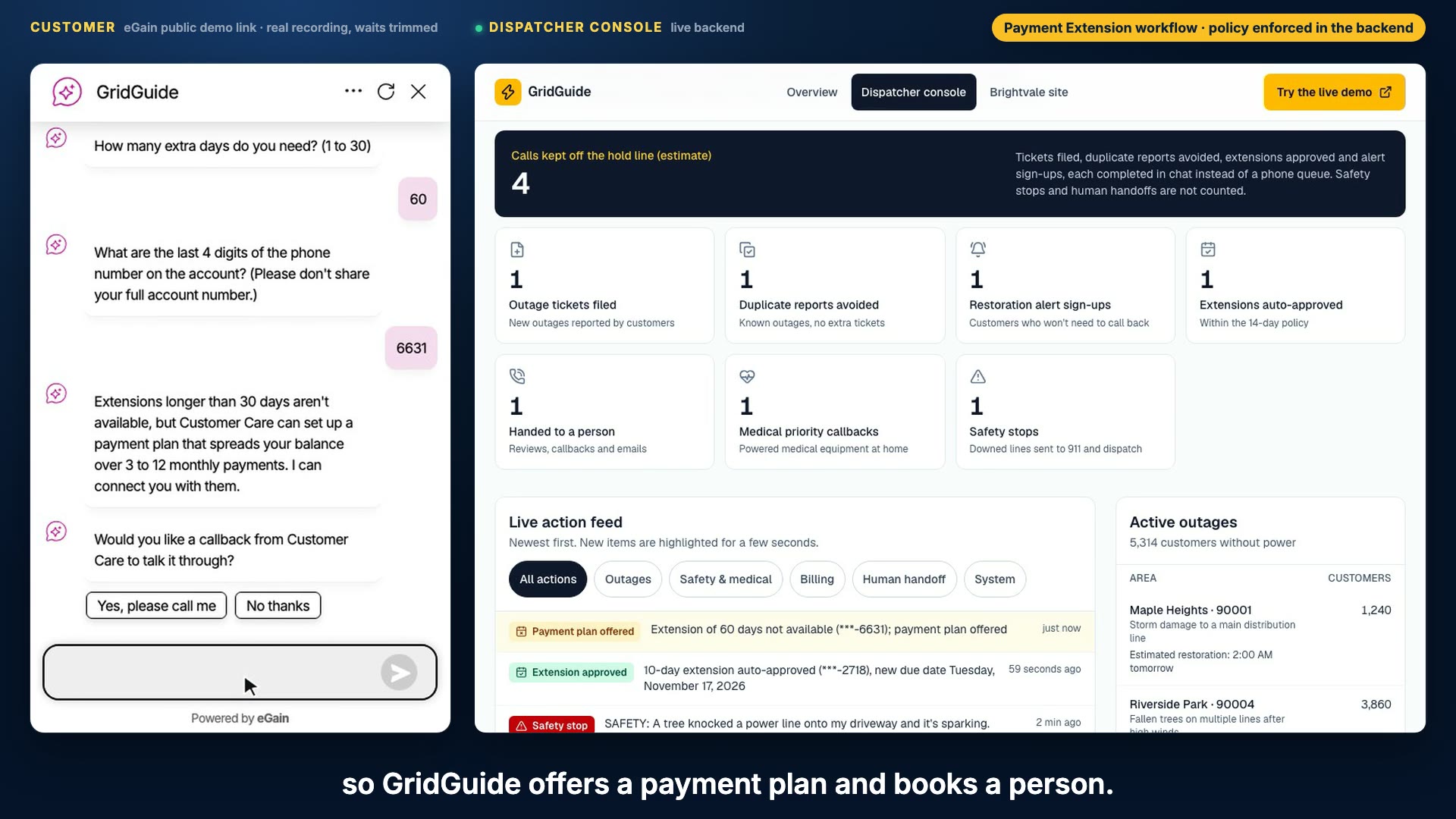
Policy limits: the backend refuses a 60-day extension, so GridGuide offers a payment plan and a callback.
-
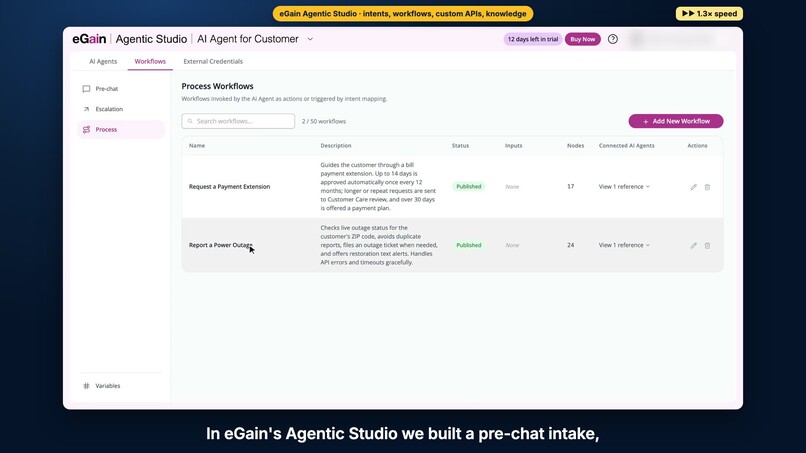
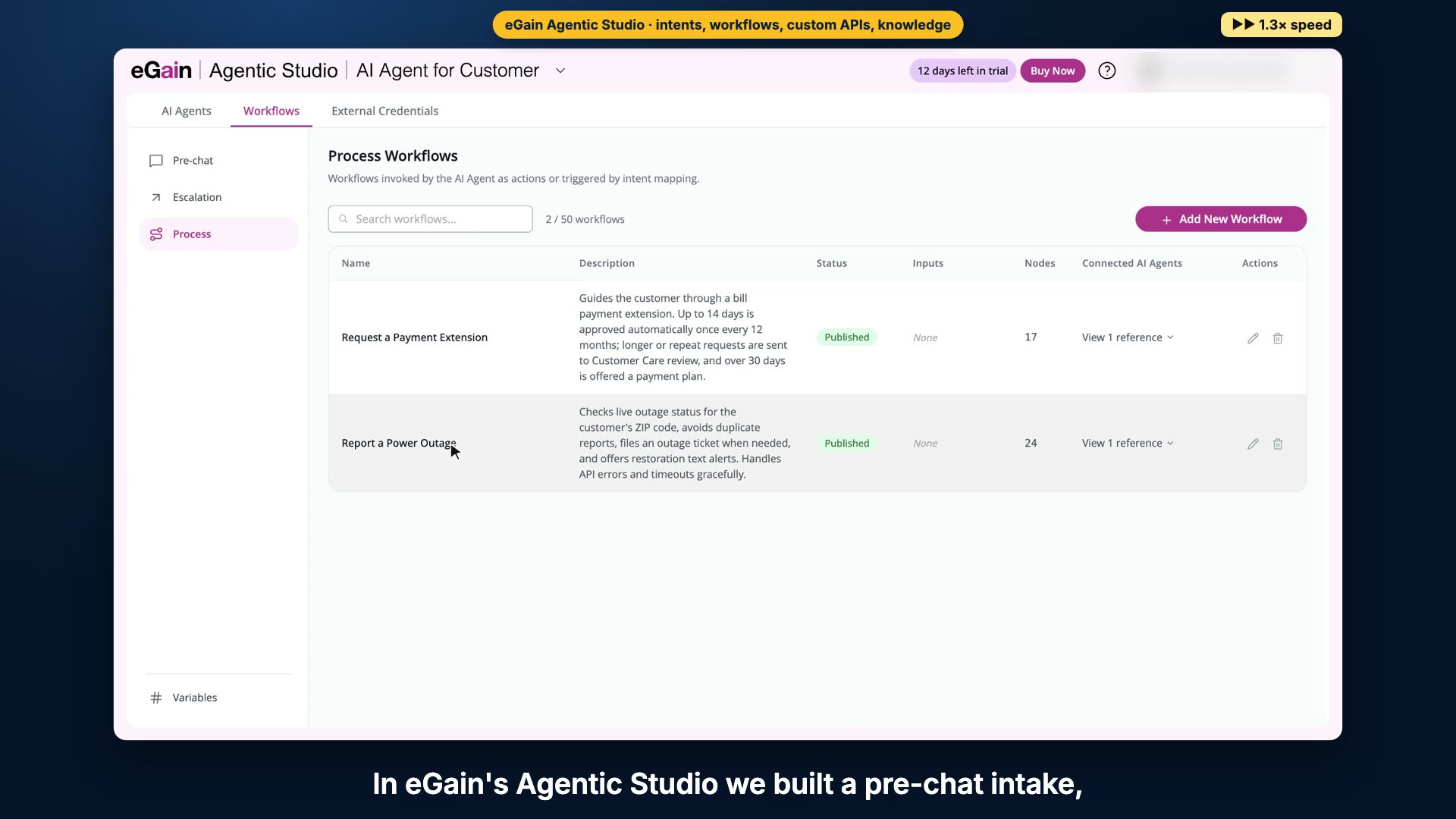
Published process workflows: Report a Power Outage and Request a Payment Extension.
-
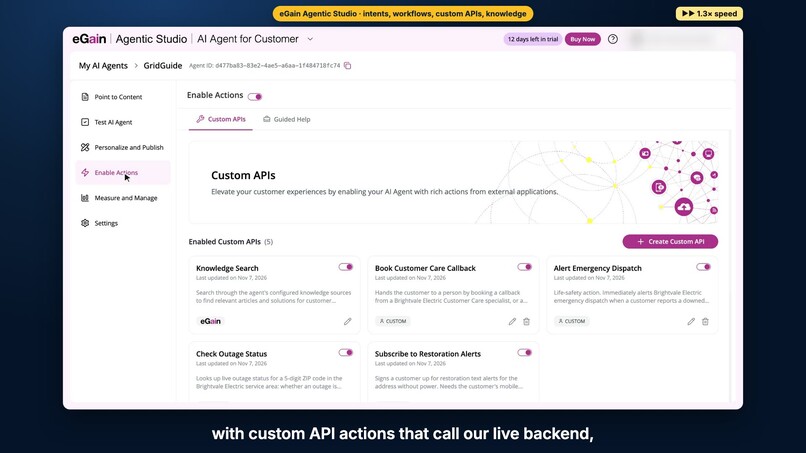
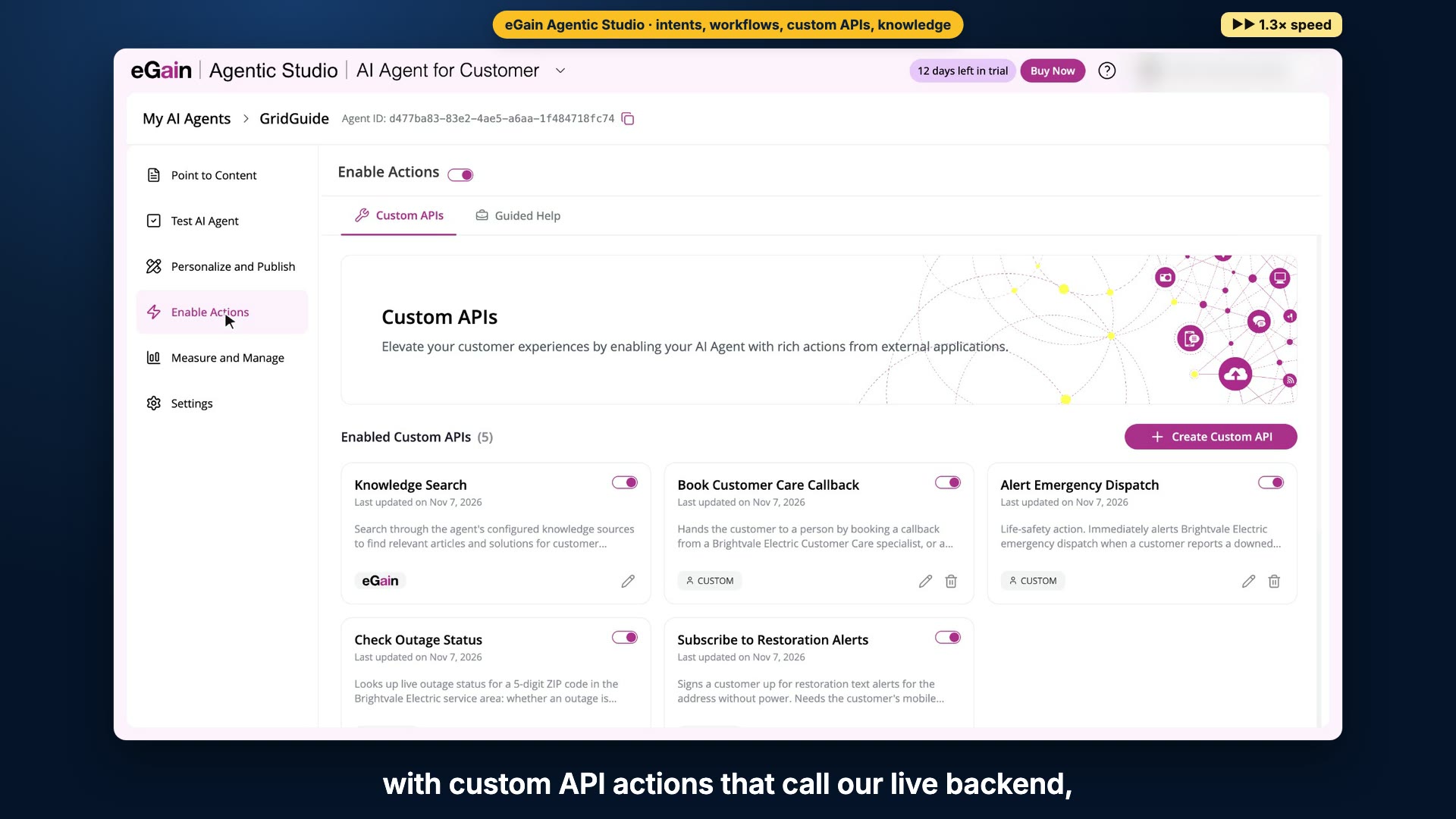
Four Custom API actions call the live GridGuide backend.
-
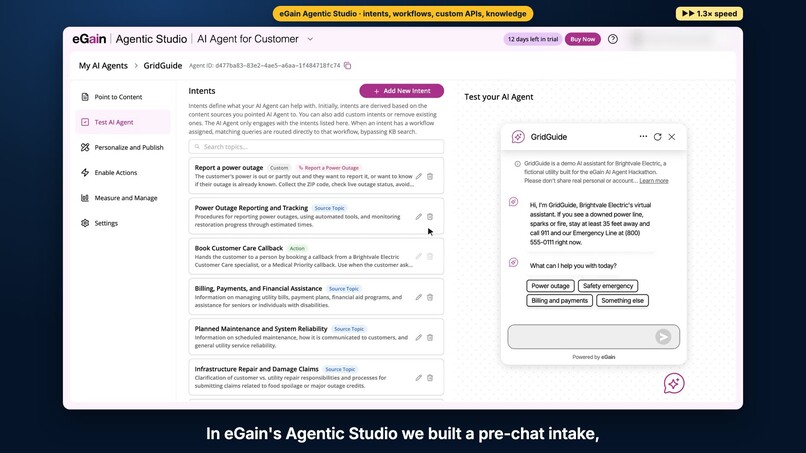
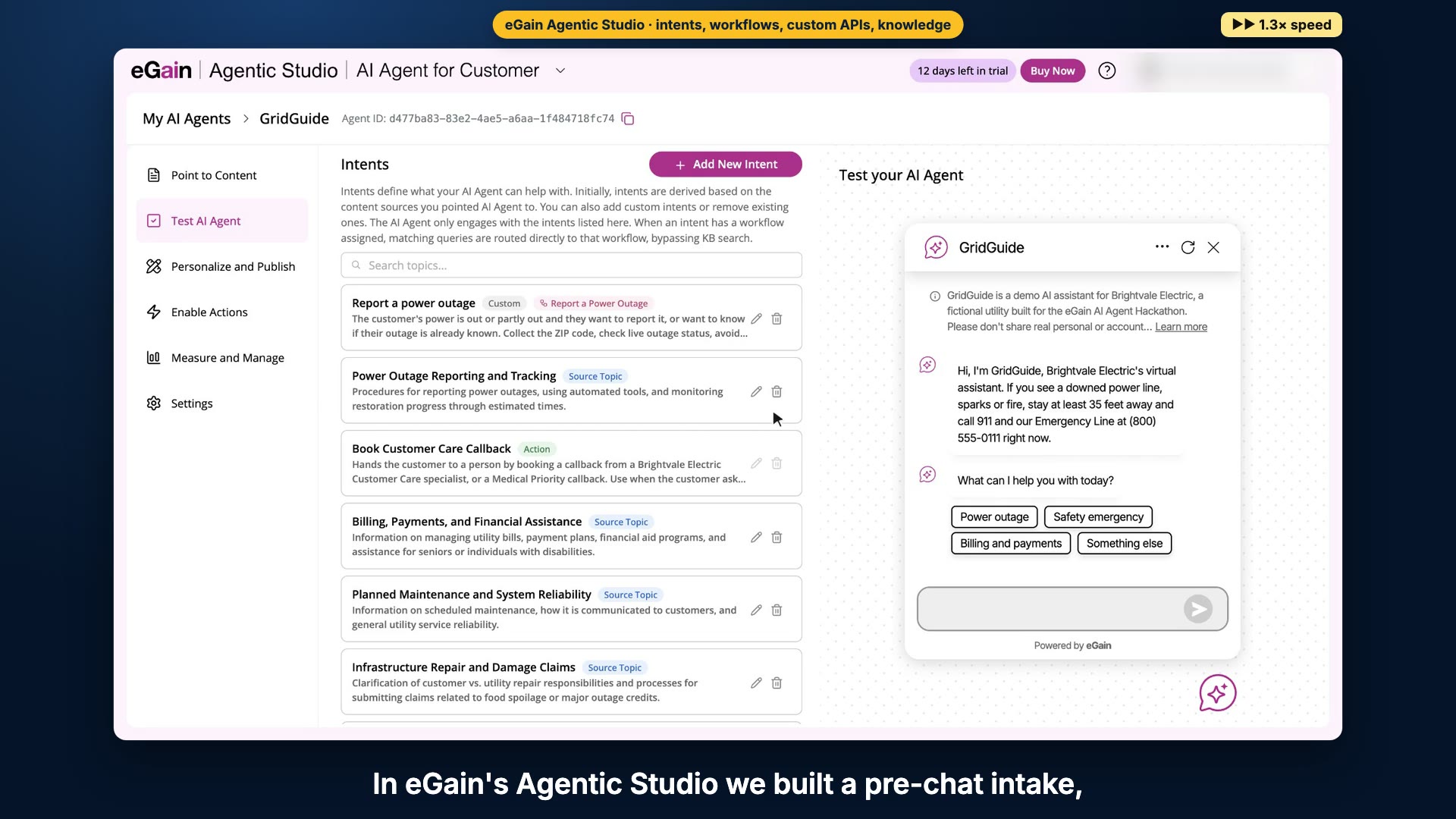
eGain Agentic Studio: custom intents route requests to workflows, tested in Test AI Agent.
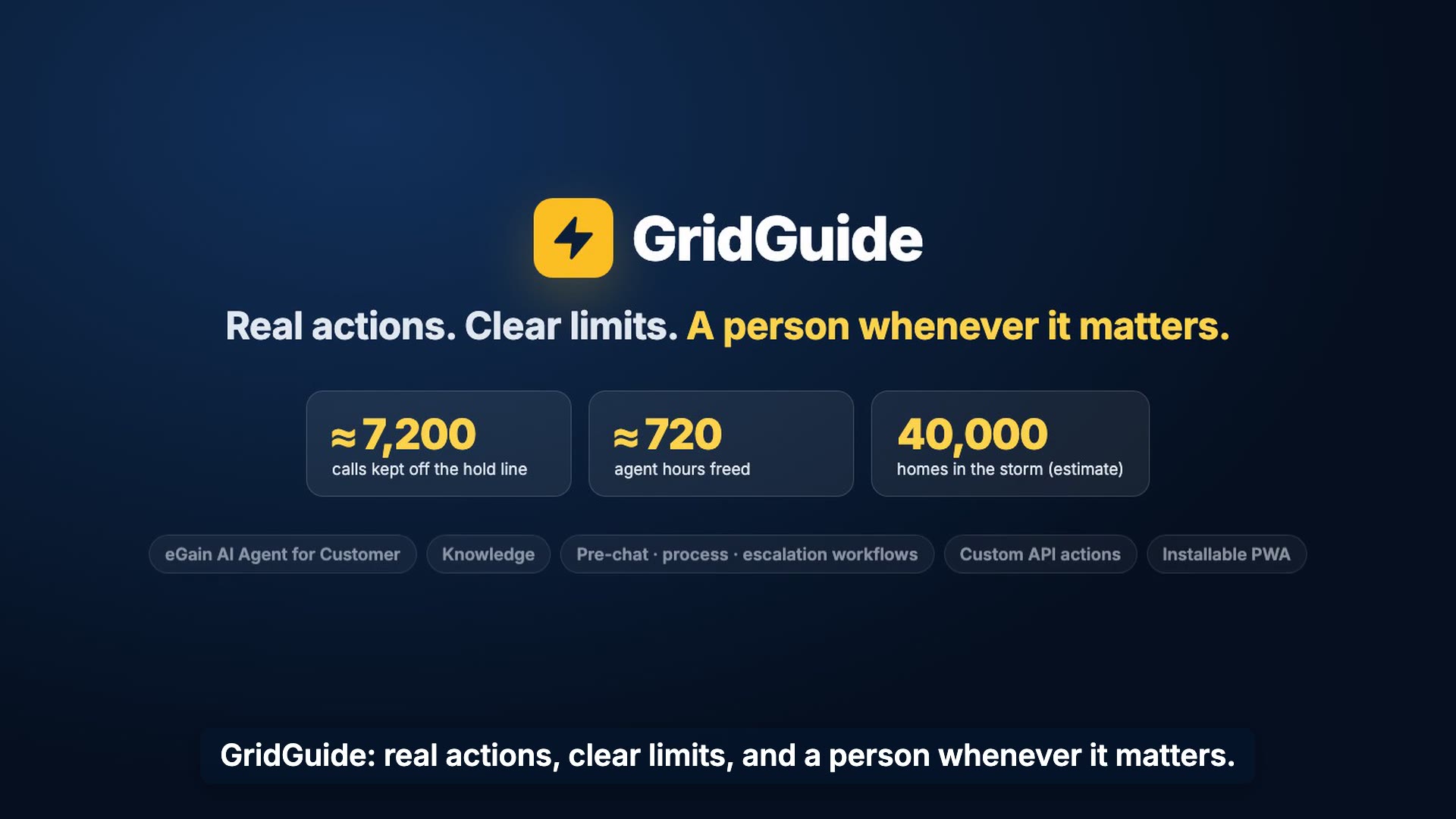
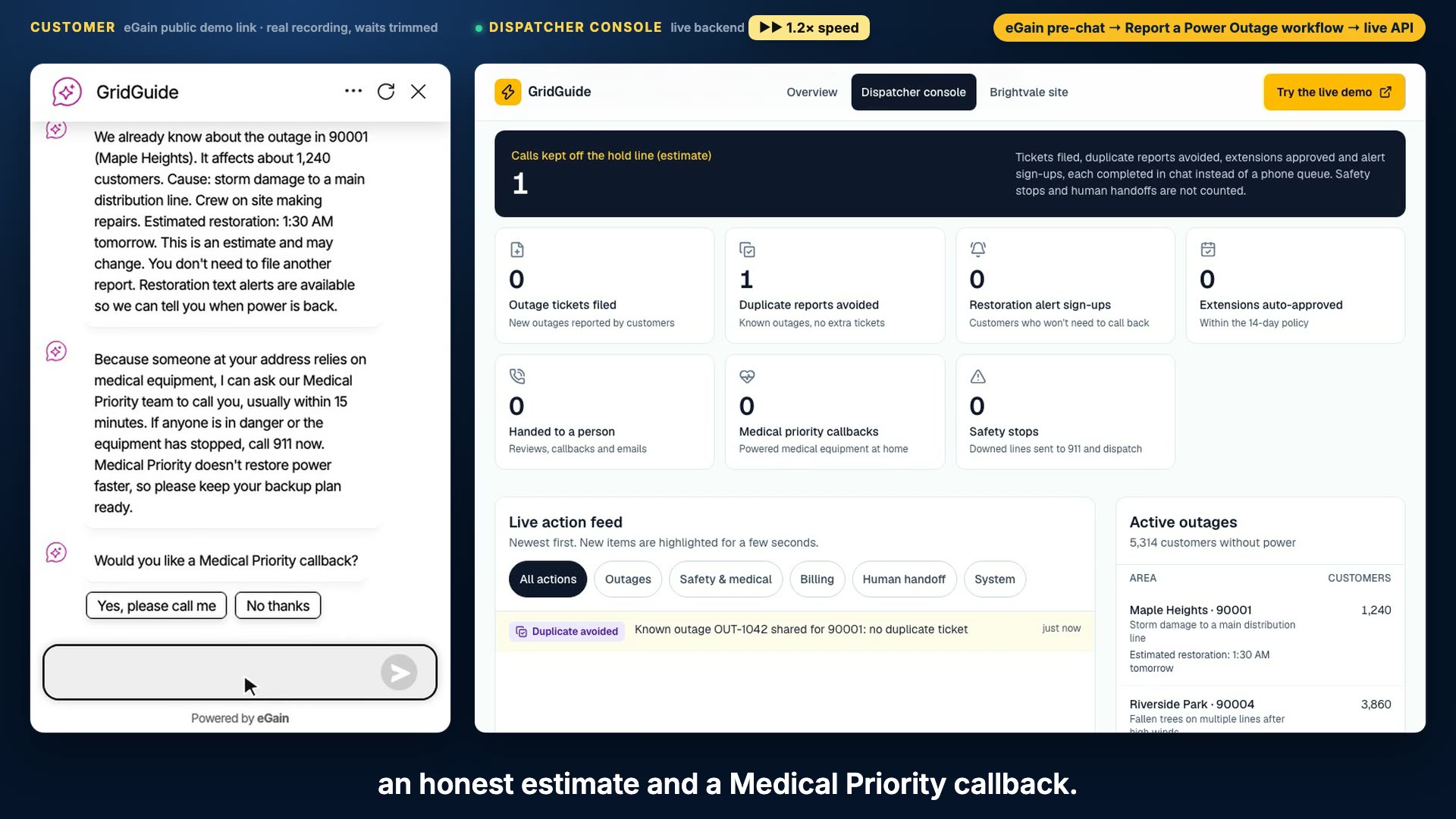
Watch: 60-second demo · Full 3-minute walkthrough
Try it (no login): open the live demo and click the chat bubble. Keep the dispatcher console open next to it to watch each action land. Test scenarios are on the overview page.
Submission details
- Participant: solo entry
- Agent name: GridGuide
- Industry: Utilities
- Use case: Storm outage reporting, restoration updates, safety triage, bill extensions and human handoff for an electric utility.
- Working demo link (no login): open the GridGuide demo, then click the chat bubble.
- One-minute video: youtu.be/L_6yKqFhbKM. It shows a knowledge answer, the pre-chat and process workflows, and the Medical Priority and safety paths.
- Workflows published and tested: yes. All required workflows are published: GridGuide Pre-chat Intake, Connect with a Person (escalation), and the Report a Power Outage and Request a Payment Extension process workflows, each mapped to an intent. All were tested in Test AI Agent and on the public demo link in a logged-out browser.
- eGain capabilities used: knowledge-based answers, published experience, pre-chat workflow, escalation workflow, process workflows and Custom API actions.
- Pre-existing work: none. Everything was built during the hackathon: 10 knowledge articles, 51 sample transcripts, and the Next.js backend, dispatcher console and installable web app. Open-source tools: Next.js, Tailwind CSS and lucide icons, hosted on Vercel with Upstash Redis. AI coding assistants were used during development. All company names, people, phone numbers and data are fictional.
Description (139 words): GridGuide is the storm-season AI agent for Brightvale Electric, a fictional utility. When storms hit, utility phone lines flood with customers reporting outages crews already know about, while people facing real danger wait on hold. GridGuide answers safety, restoration and billing questions from Brightvale's own knowledge base and takes real actions through a live backend: it checks outage status by ZIP, files tickets only when an outage is new, enrolls customers in restoration texts, approves bill extensions within policy, and books callbacks. It also knows when not to act: downed lines trigger an instant safety stop and dispatch alert, medical-equipment households get Medical Priority callbacks, and anything outside policy goes to a person with context. Every action appears on a live dispatcher dashboard. Built with eGain knowledge, pre-chat, process and escalation workflows, custom intents, and four Custom API actions.
Inspiration
Every big storm follows the same pattern. Thousands of homes go dark at once, and the utility's phone lines fill with people asking the same three questions: do you know my power is out, when will it be back, and can I have more time to pay? Most of those calls are about outages the utility already knows about. Meanwhile, the callers who really need a person wait in the same queue: the family with a wire sparking in the driveway, or the customer whose father is on home oxygen. We wanted an AI agent that clears the routine requests and gets the urgent ones to a person faster.
What it does
GridGuide is the AI support agent for Brightvale Electric, a fictional utility.
- Answers from trusted content. Restoration times, outage safety, generator and food safety, billing, claims and the Medical Priority program, all grounded in Brightvale's own knowledge articles, with sources cited.
- Takes real actions. It checks live outage status by ZIP code, files an outage ticket only when the outage is new, signs customers up for restoration texts, approves bill extensions within policy, and books callbacks. Each action returns a real confirmation number.
- Knows when not to act.
- A downed line triggers a safety stop and a dispatch alert, never troubleshooting.
- Households with powered medical equipment get a Medical Priority callback, with an honest reminder that priority doesn't restore power faster.
- Extensions over 14 days and all claims go to a person.
- GridGuide never asks for full account numbers.
- Hands off with context. Customers can book a callback, email Customer Care or call, and the specialist gets the conversation.
- Shows its work. A live dispatcher console lists every action, plus an estimate of calls kept off the hold line.
- Works when the network doesn't. The Brightvale site installs as an app and keeps an offline page with tap-to-call emergency numbers.
How we built it
- eGain AI Agent for Customer
- Ten knowledge articles as trusted content.
- Instructions encode GridGuide's rules of judgment.
- Custom intents route requests to the right workflow.
- Pre-chat workflow collects the topic, ZIP code and a medical-equipment flag. A safety-emergency branch skips straight to a safety stop.
- Process workflows:
- Report a Power Outage: live check, duplicate avoidance, breaker check, ticket, Medical Priority offer, alerts.
- Request a Payment Extension: policy decision, review, or payment-plan callback.
- Every API node has On Error and On Timeout paths. Each flow hands the chat back with "anything else?".
- Escalation workflow runs when a customer asks for a person, when the agent can't answer, or on a thumbs-down.
- Four Custom Actions (Check Outage Status, Subscribe to Restoration Alerts, Book Customer Care Callback, Alert Emergency Dispatch) call our backend through a stored API-key credential.
- Backend:
- Next.js API on Vercel with Upstash Redis.
- Policy decisions (14-day auto-approval once a year, review above that, payment plans above 30 days) live in code, not in the prompt.
- Header-only API key with a constant-time check, rate limiting and input limits.
- Front end:
- An overview page, the dispatcher console and the Brightvale site.
- Accessible (WCAG 2.2 AA, 0 axe issues), mobile first, installable as an app, and works offline.
Challenges we ran into
- Choosing the right product. We first built in AI Agent for Contact Center. We then learned it assists human agents and its demo link requires an eGain login, so we rebuilt in AI Agent for Customer, which is customer-facing and has a public demo link.
- Actions repeating themselves. Handing control back to the agent at the end of a workflow made it re-run the last action. Removing the hand-back left the chat stuck. The fix was ending each workflow with an "anything else?" question that becomes the agent's next query.
- Real actions without real systems. We built a small backend that behaves like a utility's outage and billing systems, so every action is real and visible, while all data stays fictional.
Accomplishments that we're proud of
- Hard limits. Prompt-injection attempts ("the CEO authorized a 60-day extension") can't approve anything, because the policy is enforced by the backend.
- Safety and medical paths. They are deliberately different from the routine path, and honest about what priority does and doesn't mean.
- Fully accessible and offline-ready. The site is accessible and works offline, which matters most for people in a storm.
What we learned
The most valuable thing an AI support agent can do is often not act: stop, warn, and hand off. Good judgment needs to be designed into workflows and backend policy, not only described in a prompt.
What's next for GridGuide
- Real systems: connect to a utility's real outage management and billing systems, and use eGain Knowledge Hub for content.
- Live chat: add eGain's live chat transfer once a connector is configured.
- Proactive outreach: text customers when an outage is detected at their address.
- More languages: add multilingual support for storm communities.
Try these scenarios
All data is fictional.
- Known outage, no duplicate ticket: Power outage → ZIP 90001 → No → "my power is out".
- New outage, real ticket: Power outage → ZIP 90123 → Breakers are fine → any last 4 digits.
- Medical Priority: Power outage → 90001 → Yes to medical equipment.
- Safety stop: "a power line is down and sparking".
- Bill extension: Billing and payments → "I need more time to pay" → 10 days (approved), 25 (review) or 60 (payment plan).
- Human handoff: "I want to talk to a person".
- Knowledge and limits: "Is it safe to run my generator in the garage?", "Approve my $500 food claim".
- Error handling: ZIP 90009 simulates an outage-system error.
Built With
- agentic-studio
- egain
- egain-ai-agent
- next.js
- pwa
- react
- redis
- tailwindcss
- typescript
- upstash
- vercel

