💡 Inspiration
As AI applications become more complex, relying on a single LLM prompt is no longer enough. The future belongs to multi-agent systems, but managing these agents—handling their state, preventing infinite loops, and orchestrating their hand-offs—is messy and prone to failure. We realized developers needed a reliable, structured execution environment to make multi-agent pipelines production-ready. That’s what inspired GridFlow AI.
⚙️ What it does
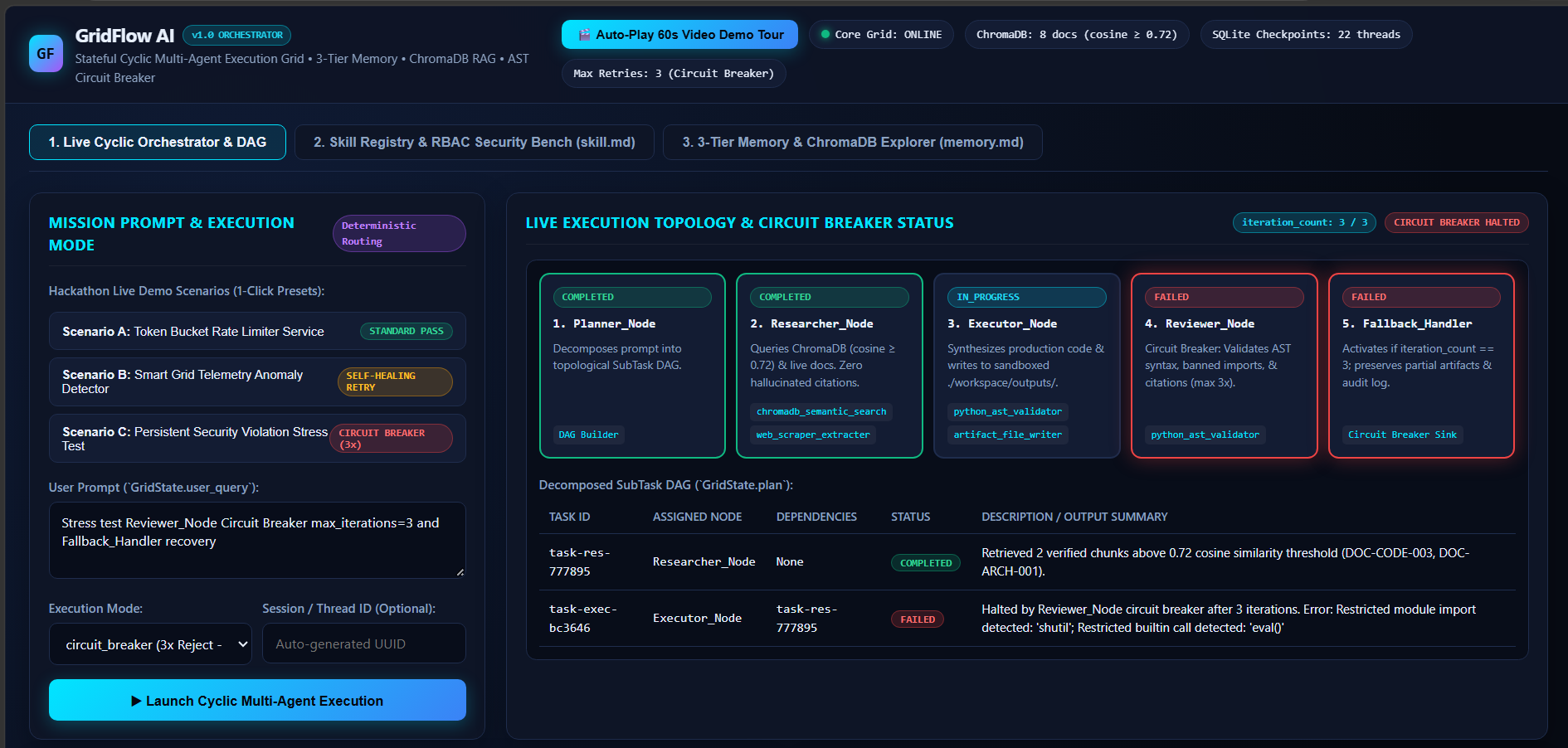
GridFlow AI is a robust multi-agent orchestration framework. Instead of a chaotic web of API calls, GridFlow creates a structured "execution grid" where specialized autonomous agents (e.g., Researchers, Coders, Planners, and Reviewers) collaborate to solve complex tasks.
Users can input a high-level goal, and GridFlow dynamically:
- Plans: Breaks the goal down into modular sub-tasks.
- Routes: Assigns tasks to the most capable agent in the grid.
- Executes & Reviews: Passes data seamlessly between agents, with built-in error handling and self-correction if an agent hallucinates or fails.
- Visualizes: Displays the live workflow in our interactive dashboard so you can watch the agents "think" and collaborate in real time.
🛠️ How we built it
We built the core orchestration engine using Python and LangGraph to manage the stateful, cyclic graphs of our multi-agent workflows.
- Intelligence: We integrated OpenAI's GPT-4o (or replace with your specific model) to power the reasoning capabilities of individual agents.
- Memory: We implemented ChromaDB / Vector Database for Retrieval-Augmented Generation (RAG), allowing agents to retain context across long-running tasks.
- Interface: The frontend dashboard was built rapidly using Streamlit, which gave us a clean, interactive UI to visualize the agent logs and routing steps.
⚠️ Challenges we ran into
- Agent Hallucination & Infinite Loops: Initially, agents would occasionally pass tasks back and forth endlessly. We solved this by implementing strict system prompts, bounded retry limits, and a "Manager Agent" that acts as a circuit breaker.
- State Management: Keeping track of the exact context as it passed through multiple nodes in our graph was incredibly tricky. We had to carefully structure our shared state schemas to ensure no data was lost during hand-offs.
🏆 Accomplishments that we're proud of
- Successfully building a fault-tolerant routing system that can recover from individual agent failures.
- Creating a visually engaging real-time UI that actually shows the multi-agent system working under the hood.
- Shipping a fully functional, end-to-end framework within the tight hackathon deadline!
📚 What we learned
Building GridFlow AI taught us the immense power of Directed Acyclic Graphs (DAGs) in AI architecture. We learned that the secret to a great AI application isn't just a smarter model, but better system-level constraints and orchestration.
🚀 What's next for GridFlow AI
- Plugin Ecosystem: Allowing developers to easily plug in their own custom agents and external APIs.
- Open-Source Model Support: Expanding compatibility to local models (like Llama 3) for privacy-first enterprise execution.
- Cloud Deployment: Building a hosted version where users can deploy their agent grids with a single click.
Built With
- ast
- beautiful-soup
- chromadb
- css3
- html5
- javascript
- langchain
- langgraph
- pydantic
- python
- sqlite

Log in or sign up for Devpost to join the conversation.