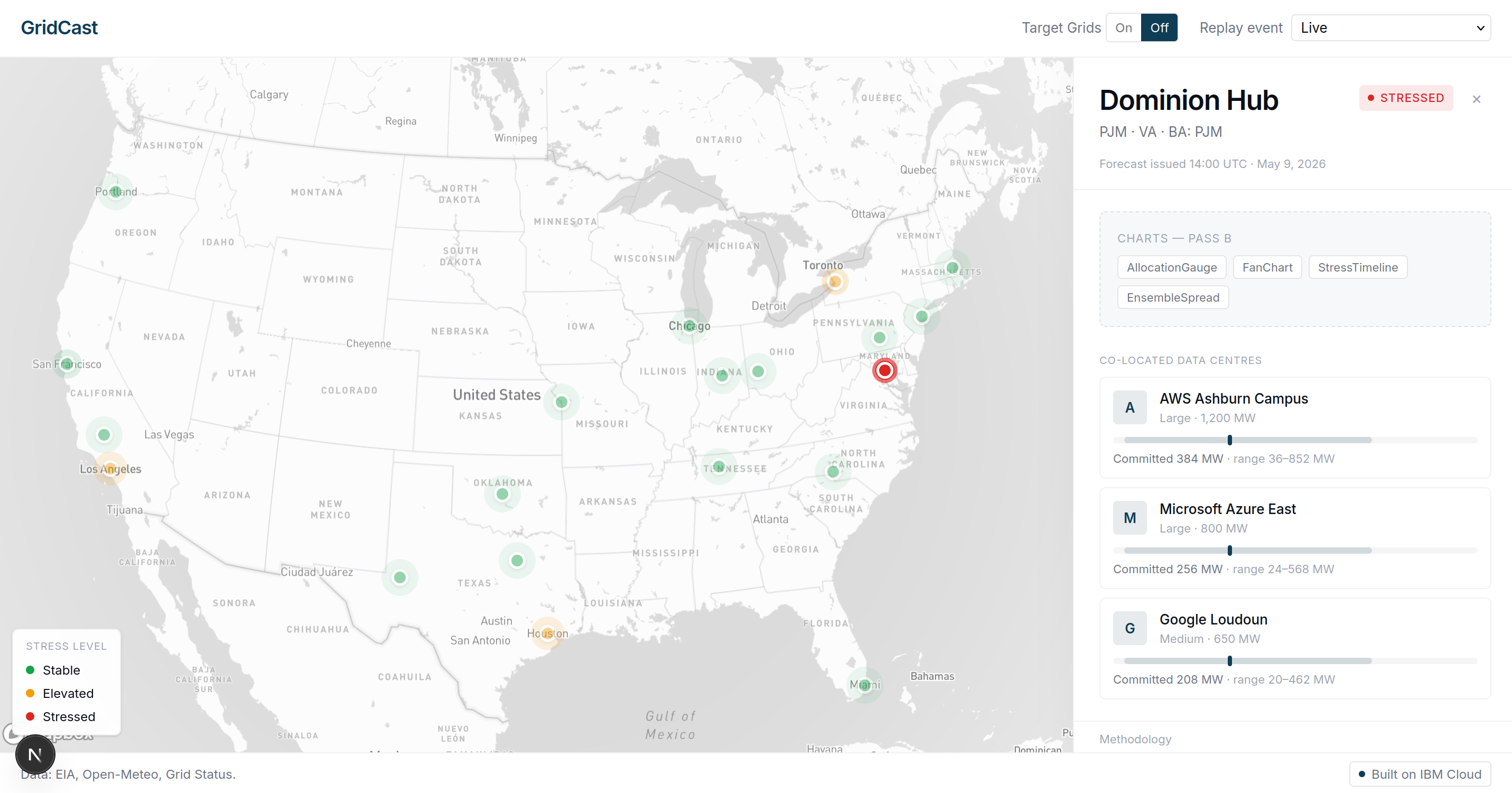
GRIDCAST was inspired by a simple realization: the power grid often does not lack power, it lacks certainty. Utilities maintain massive reserve margins because weather and electricity demand are difficult to predict accurately, leaving large amounts of infrastructure underutilized. As AI adoption and data center demand continue to grow, we saw an opportunity to improve how existing grid capacity is used instead of only focusing on building more generation.
We built GRIDCAST as an AI-powered infrastructure intelligence platform that combines probabilistic weather forecasting, grid analytics, and node-level stress prediction to help operators make more confident power allocation decisions. By reducing forecast uncertainty, utilities can lower unnecessary reserve margins and reduce imbalance costs caused by inaccurate demand predictions.
Conceptually:
Usable Capacity=Total Capacity−Safety Margin
If forecasting improves, the required safety margin decreases, allowing more existing capacity to be safely utilized.
One of the biggest challenges we faced was understanding the complexity of grid systems and translating technical concepts like reserve margins, probabilistic forecasting, and imbalance pricing into something intuitive and actionable. We also had to balance technical realism with long-term vision, since infrastructure systems require extremely high reliability and trust.
Through this project, we learned how deeply weather impacts modern infrastructure and how even small forecasting improvements can unlock enormous economic value across the energy sector.


Log in or sign up for Devpost to join the conversation.