-
-
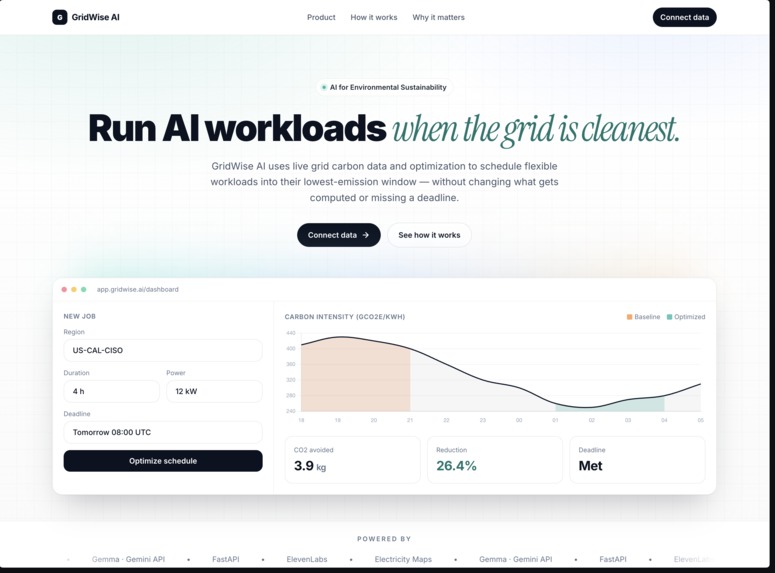
Home Screen
-
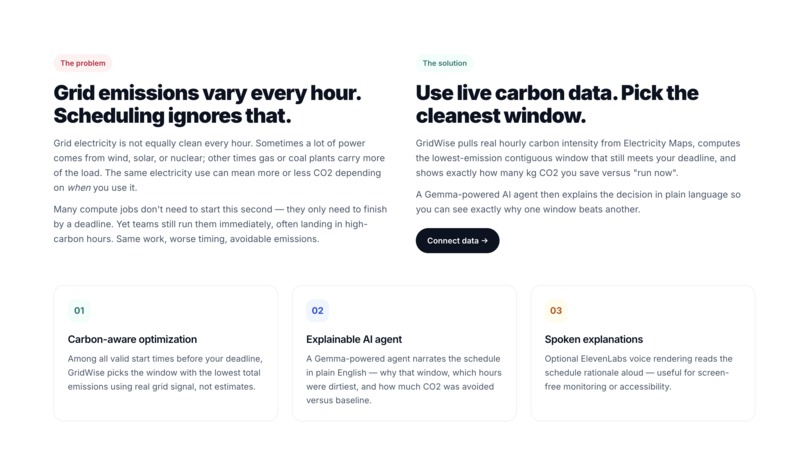
Home Screen
-
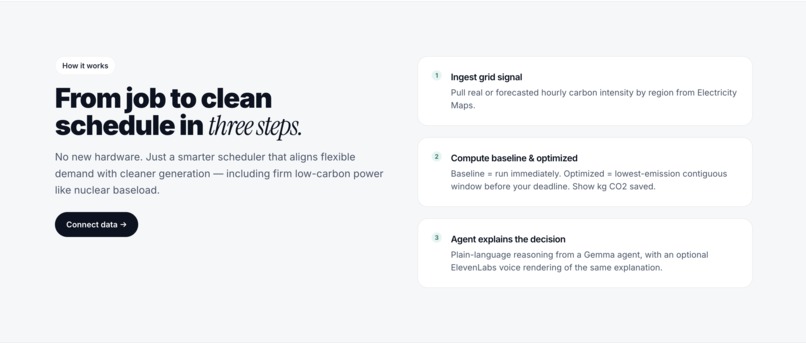
Home Screen
-
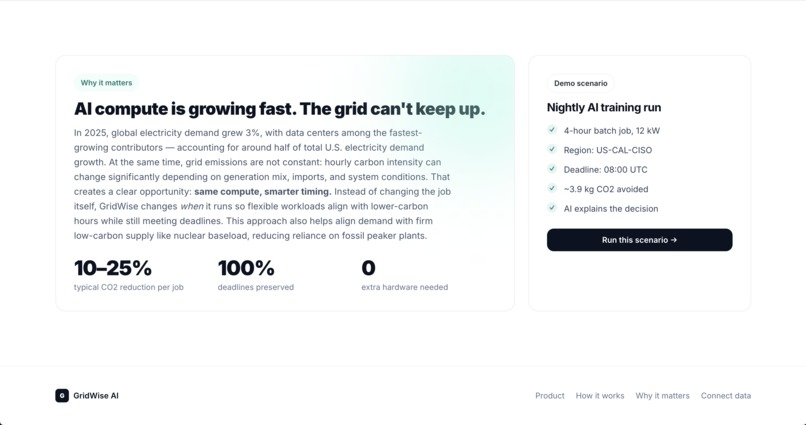
Home Screen
-
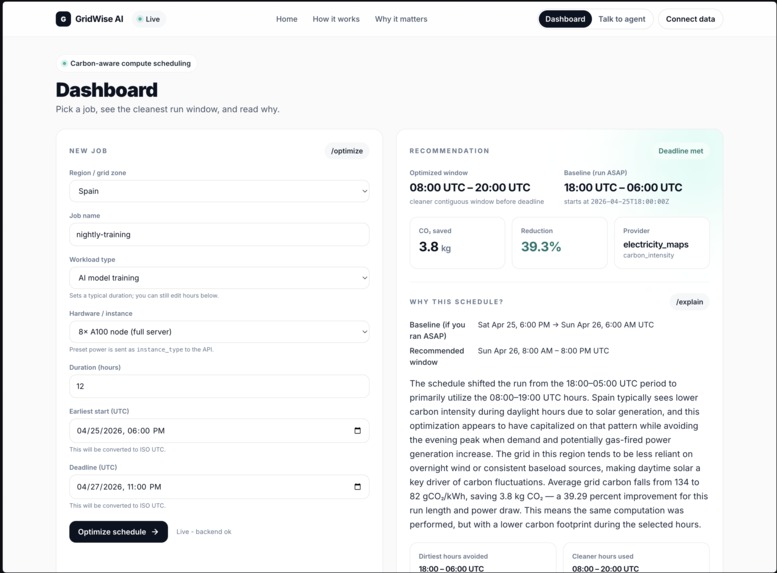
Dashboard
-
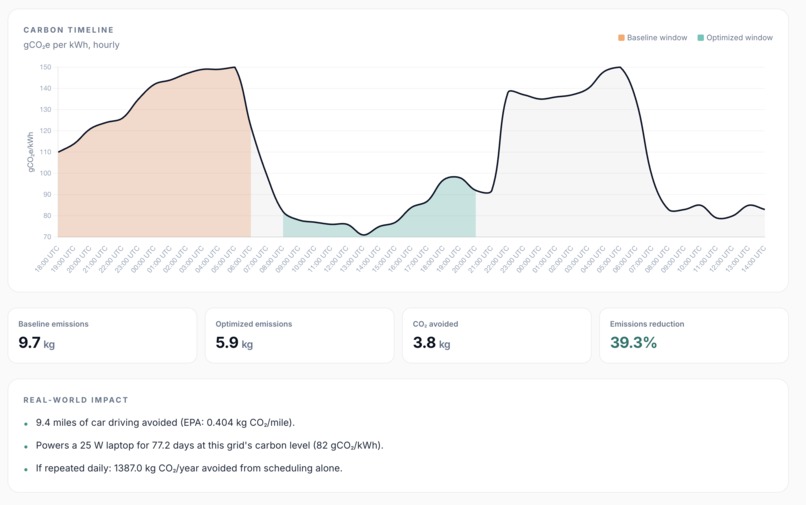
Dashboard
-
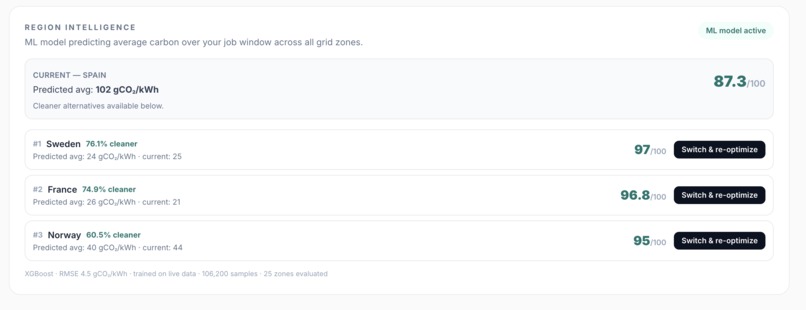
Dashboard
-
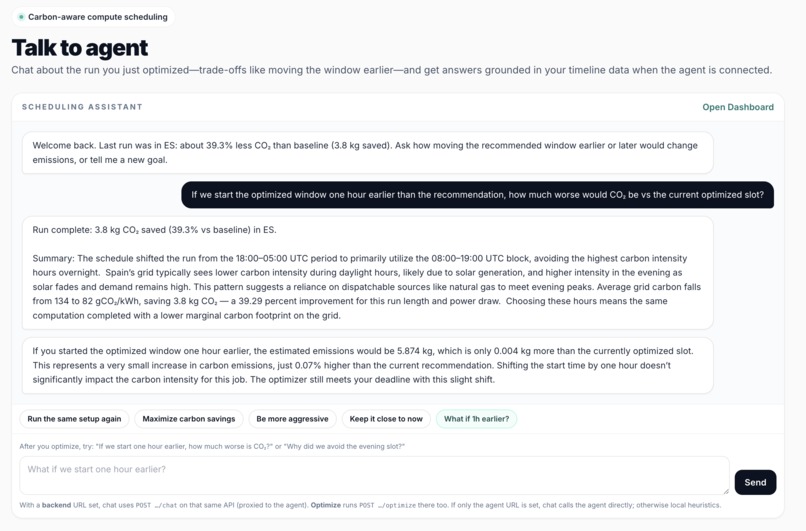
Talk to agent
Inspiration
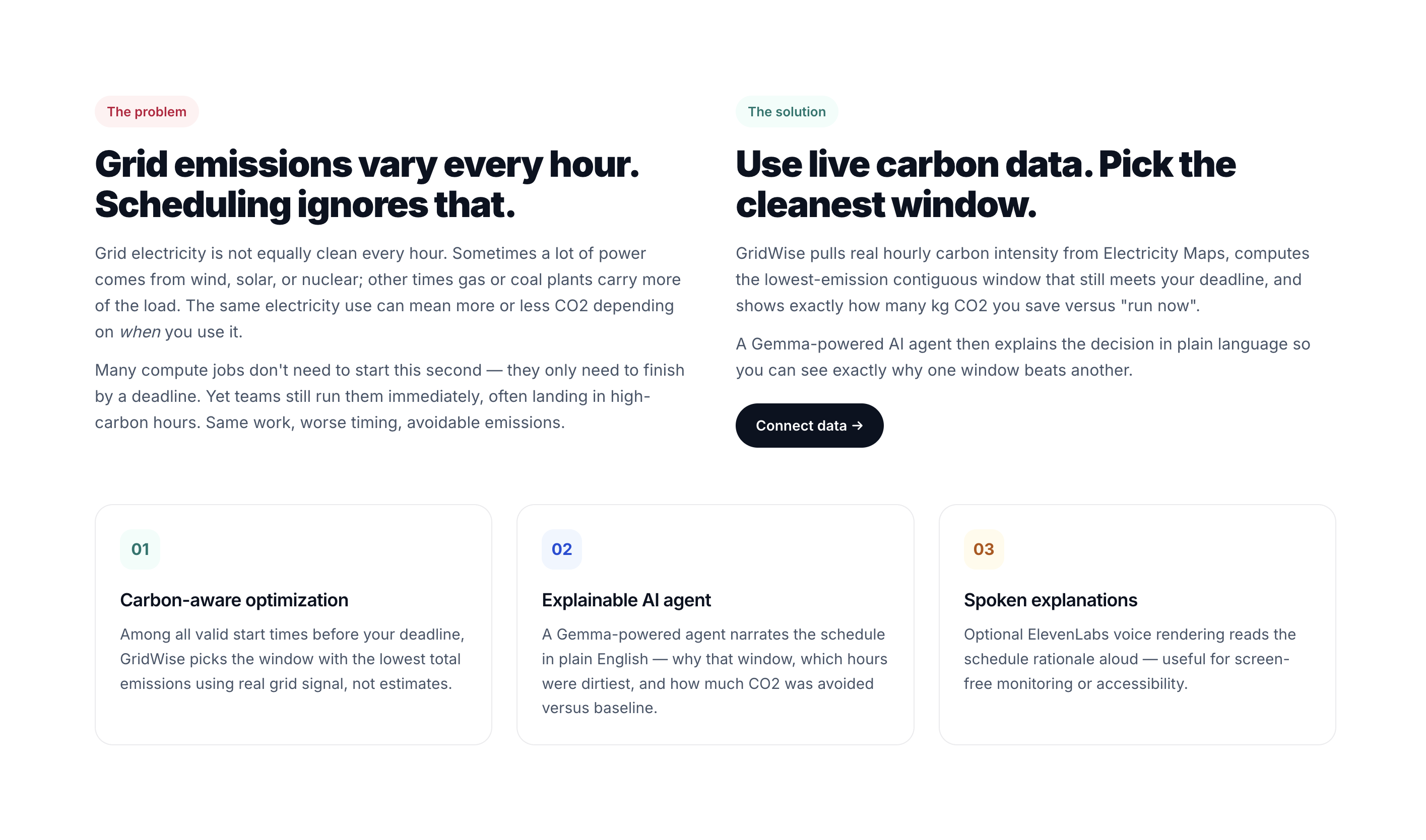
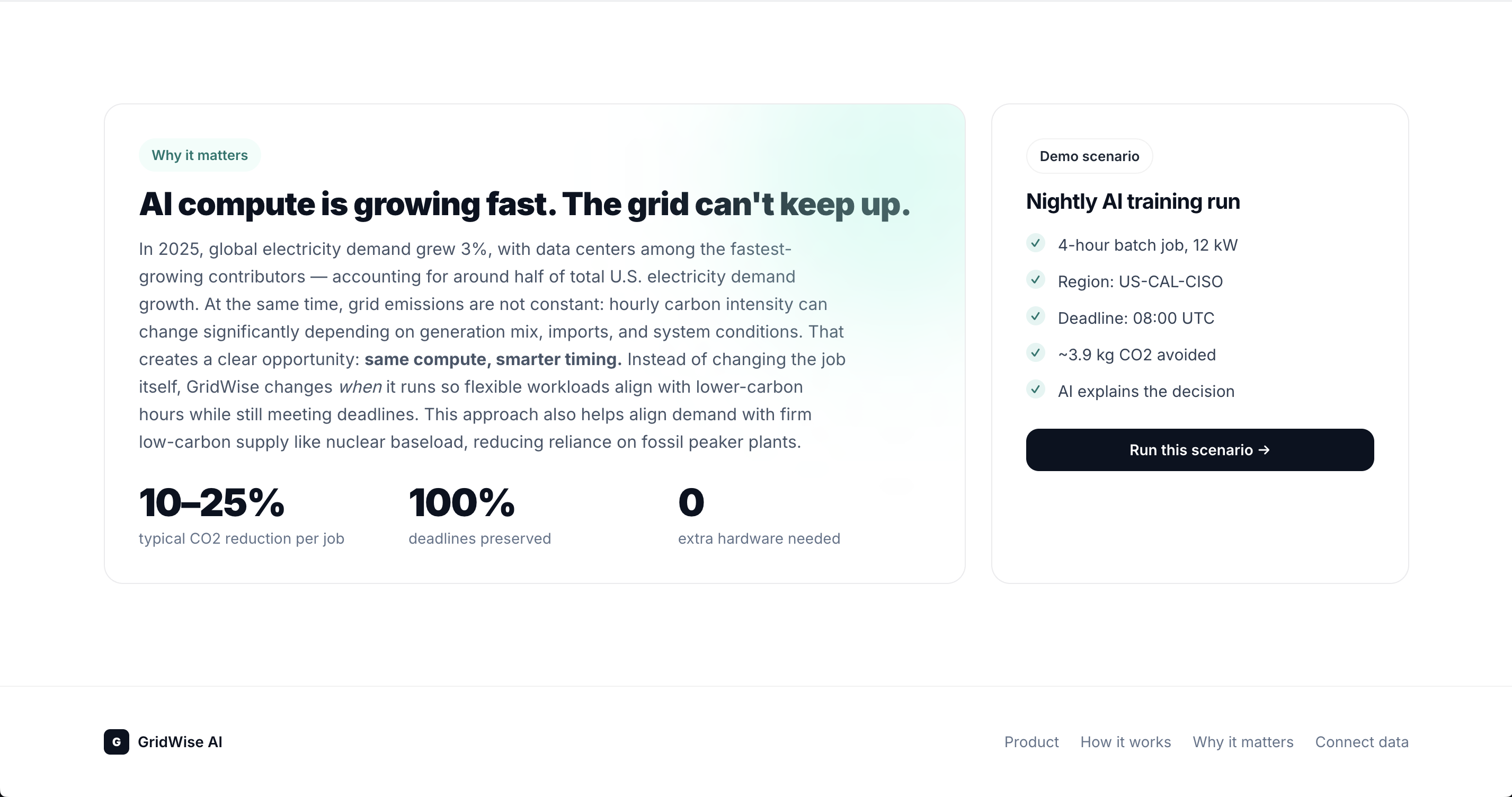
As AI and cloud computing continue to grow, so does their environmental impact. Many compute-heavy workloads such as model training, rendering, data pipelines, and batch jobs run without considering how clean or dirty the electricity grid is at that moment.
We were inspired by one simple idea:
$$ \text{Same Compute Job} = \text{Same Carbon Footprint} $$
The exact same workload can run at different times or in different regions and create very different emissions.
We wanted to build a platform that makes carbon-aware compute scheduling as easy as selecting a cloud region.
What GridWise AI Does
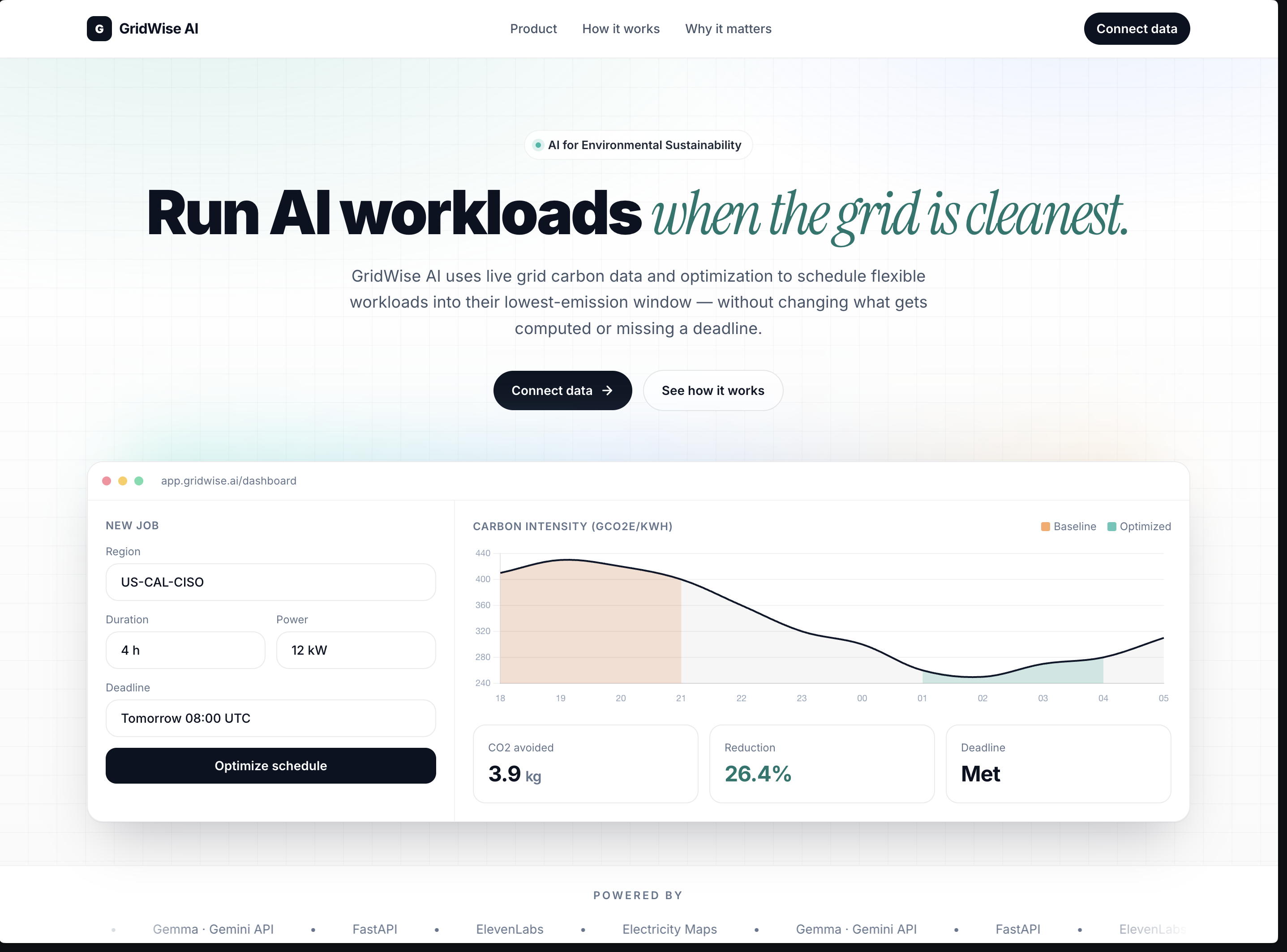
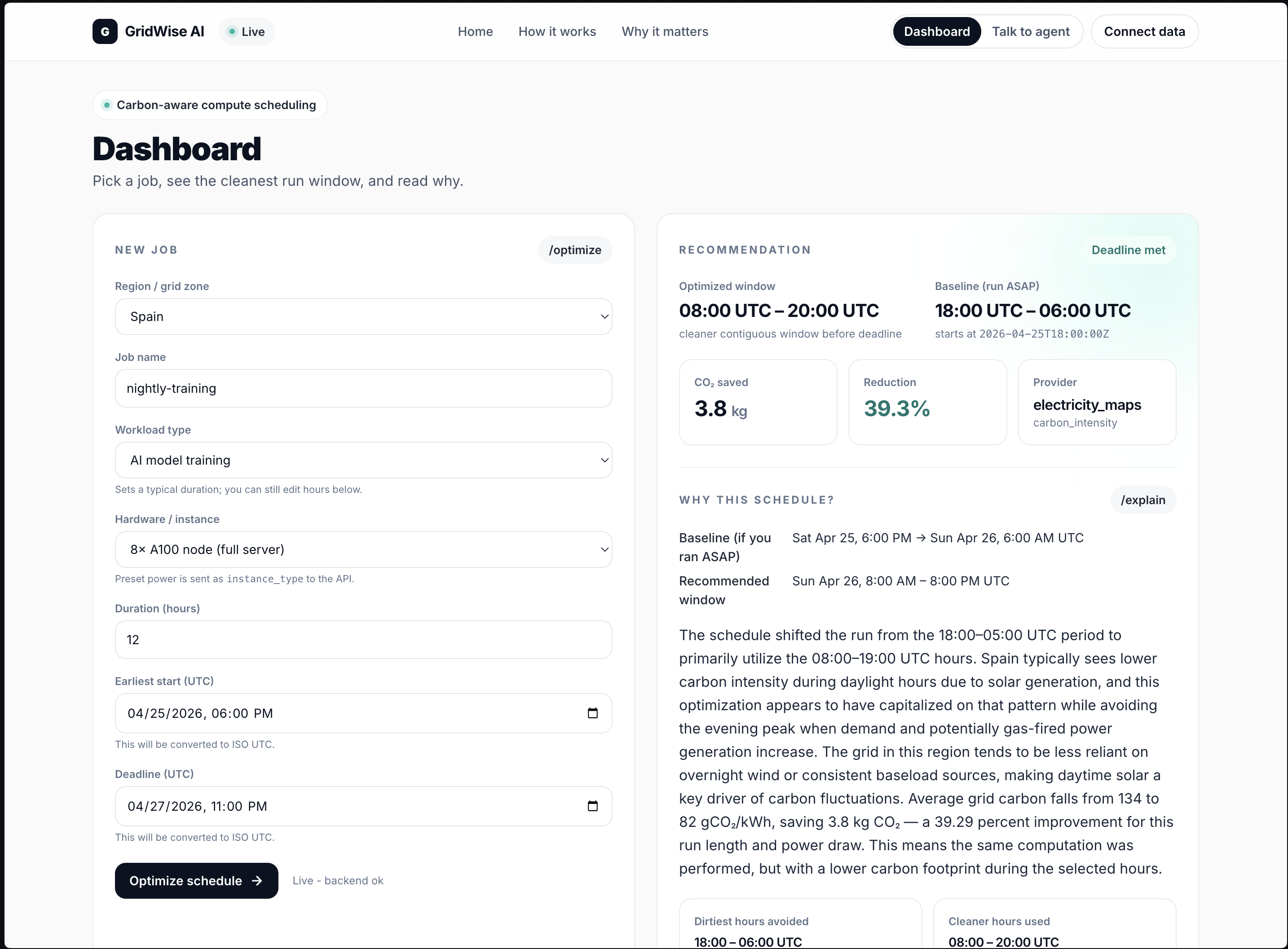
GridWise AI helps users run flexible compute workloads at the cleanest possible time and location.
Users enter:
- Region / Grid Zone
- Hardware Type
- Job Duration
- Earliest Start Time
- Deadline
GridWise then:
- ✓ Finds the cleanest run window
- ✓ Compares against running immediately
- ✓ Calculates CO₂ savings
- ✓ Explains why the schedule is cleaner
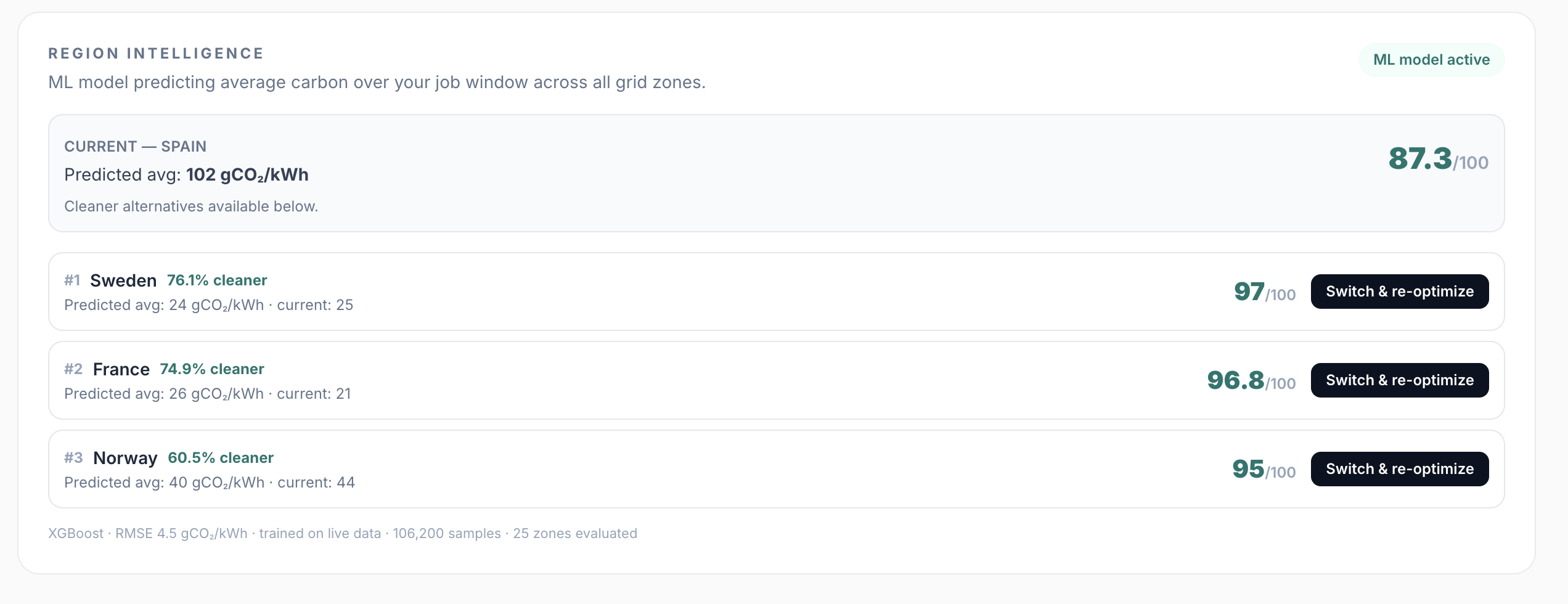
- ✓ Suggests better global regions
- ✓ Provides AI chat assistance
How We Built It
We built GridWise AI using three major systems:
1. Backend (FastAPI)
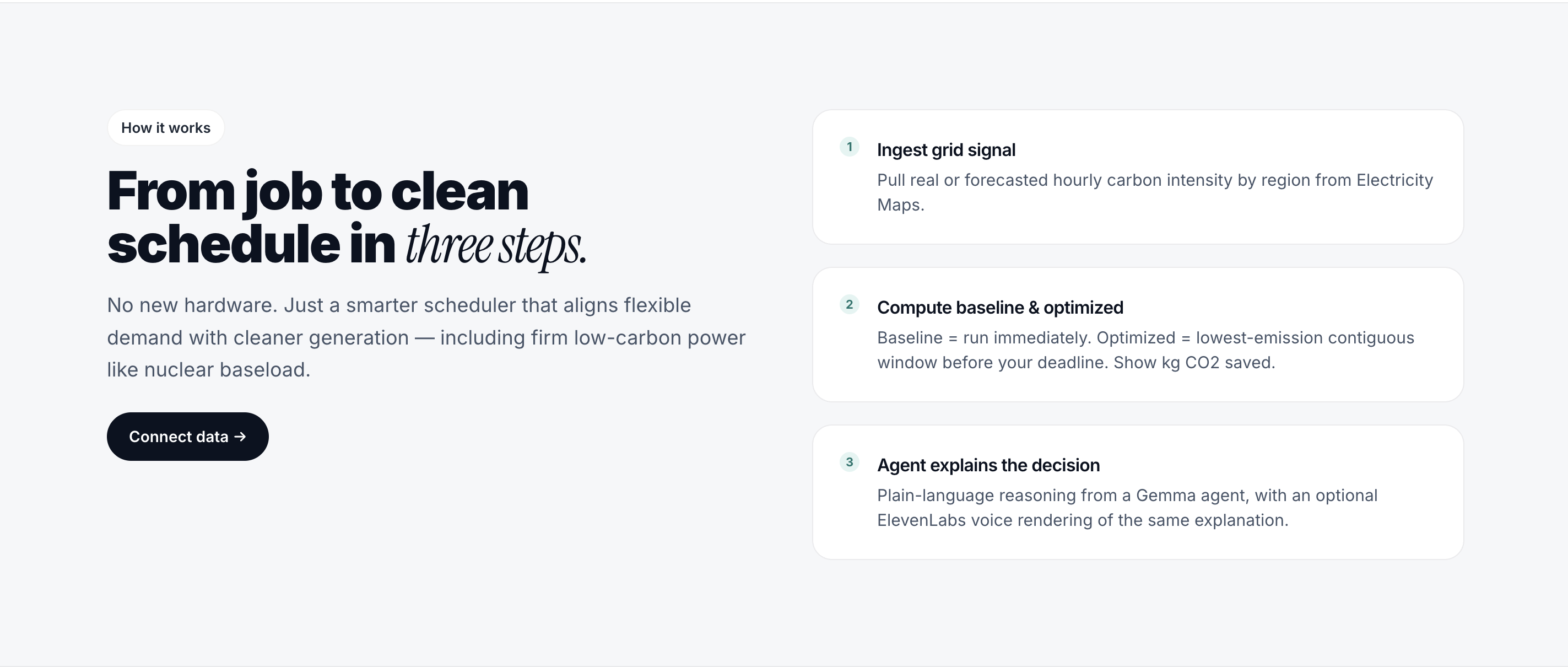
Our backend connects to Electricity Maps live grid data and runs the optimization engine.
For a workload lasting n hours:
$$ \text{Best Window} = \underset{i}{\arg\min} \sum_{i=1}^{n} \text{CarbonIntensity}_i $$
This means we evaluate every valid time window before the deadline and choose the one with the lowest total emissions.
2. AI Agents Layer
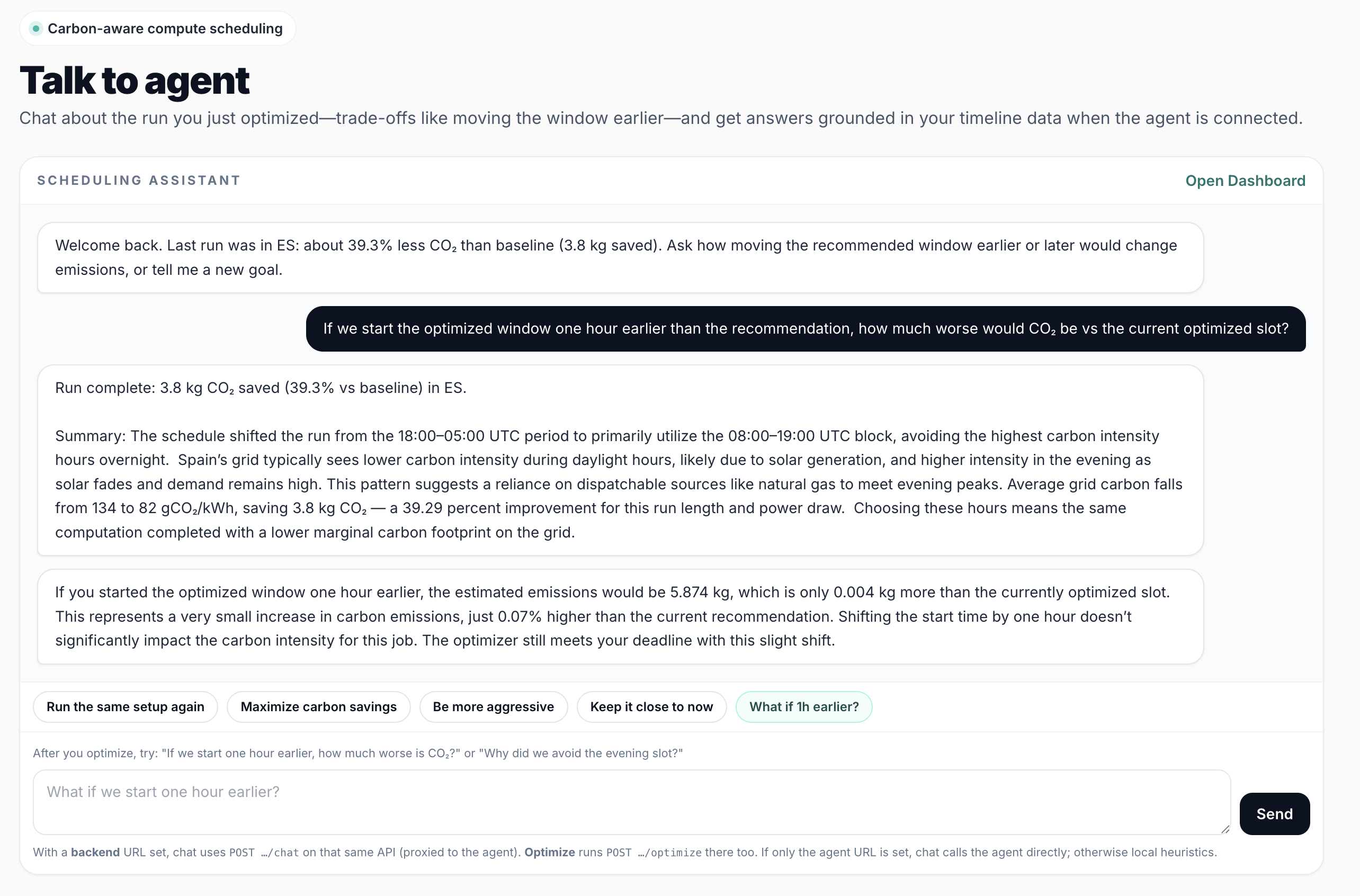
We built a separate AI service powered by Gemma. Users can ask:
- "Why did it choose this time?"
- "What if we start one hour earlier?"
- "Explain this simply"
- "Compare baseline vs optimized"
The AI uses the real optimization output as context.
3. Frontend
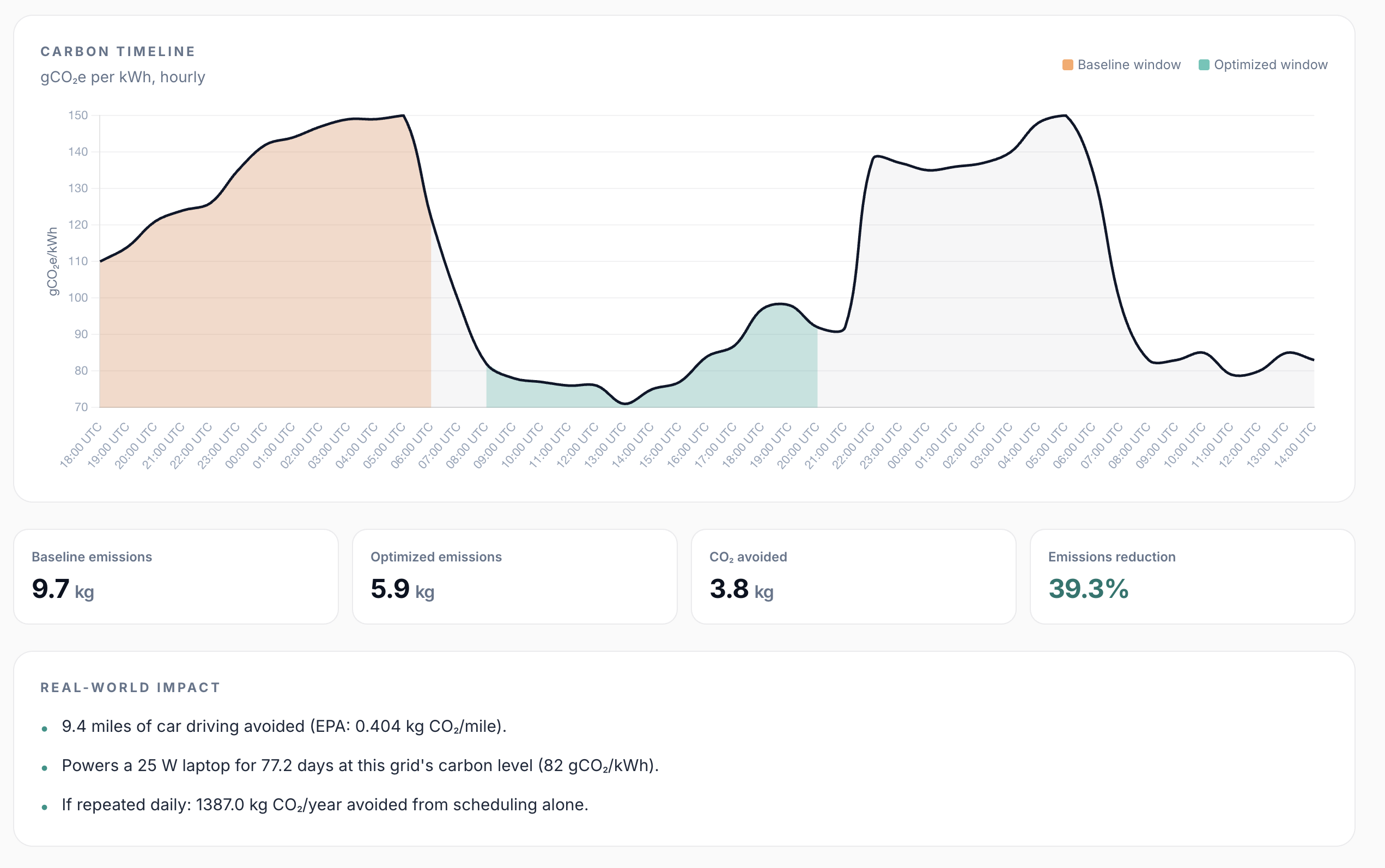
We built an interactive dashboard using JavaScript + HTML/CSS + Chart.js.
The frontend displays:
- Carbon timeline charts
- CO₂ savings metrics
- Region recommendations
- Real-world impact figures
- AI assistant chat
Machine Learning Model
We created Region Intelligence, an ML model that predicts the cleanest region for a workload.
We trained an XGBoost regressor on 106,000+ real-world samples across 25 global grid zones.
The model predicts: Average Carbon Intensity Over Job Window
This helps answer: Not only when should I run but where should I run?
Challenges We Faced
1. Live API Issues
We initially used the wrong API version, which returned missing data. We had to redesign our data ingestion pipeline.
2. CORS Deployment Problems
Our frontend and backend were deployed on different domains. Browsers enforce CORS (Cross-Origin Resource Sharing) — without proper configuration, the frontend could not call the backend API. We fixed this by explicitly allowing our frontend domain in backend settings.
3. ML Deployment
Training locally was easy. Production deployment required solving:
- Python environment mismatches
- XGBoost dependency issues
- Model file loading
- Memory limits
4. Chat Routing
We had to teach the system to distinguish between a question about a previous run vs. a request for a new optimization.
What We Learned
- More than coding — Building production systems requires: APIs + ML + Deployment + Networking + UX
- Data Matters More Than Fancy Models — Good features + good live data often outperform complex models.
- Sustainability Must Be Easy — If reducing emissions is difficult, users ignore it. If it is one click, users adopt it.
Accomplishments We're Proud Of
- ✓ Fully deployed full-stack platform
- ✓ Real live sustainability data
- ✓ ML region recommender
- ✓ AI assistant with context awareness
- ✓ Measurable CO₂ reductions
- ✓ Strong user experience
What's Next for GridWise AI
1. Cost + Carbon Optimization
$$ \min(\alpha \cdot \text{CO}_2 + \beta \cdot \text{Cost}) $$
2. Automatic Scheduling
Nightly jobs automatically run during clean windows.
3. Kubernetes / CI Integrations
Use GridWise in real cloud workflows.
4. Continuous Retraining
Weekly retraining as grid conditions evolve.
5. Carbon Dashboards
Track avoided emissions across teams.
Final Vision
GridWise AI becomes the sustainability layer for cloud computing.
Same Workload. Smarter Scheduling. Lower Emissions.
Built With
- chart.js
- css
- electrictymapsapiv4
- fastapi
- gemma3
- github
- html
- httpx
- javascript
- joblib
- numpy
- pydantic
- python
- render
- scikit-learn
- xgboost


Log in or sign up for Devpost to join the conversation.