-
-
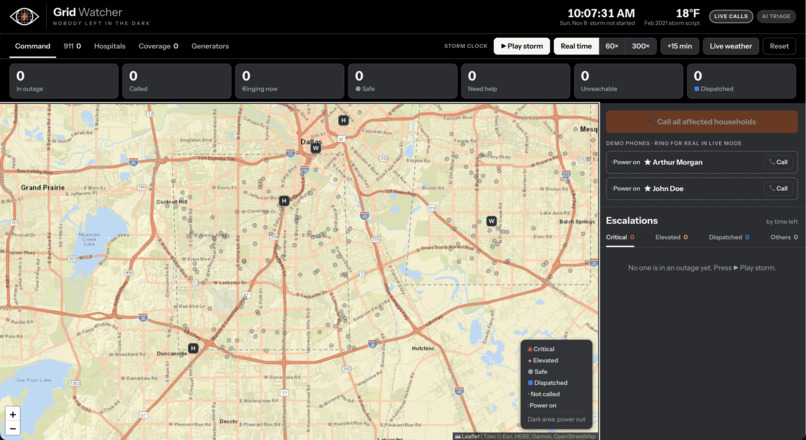
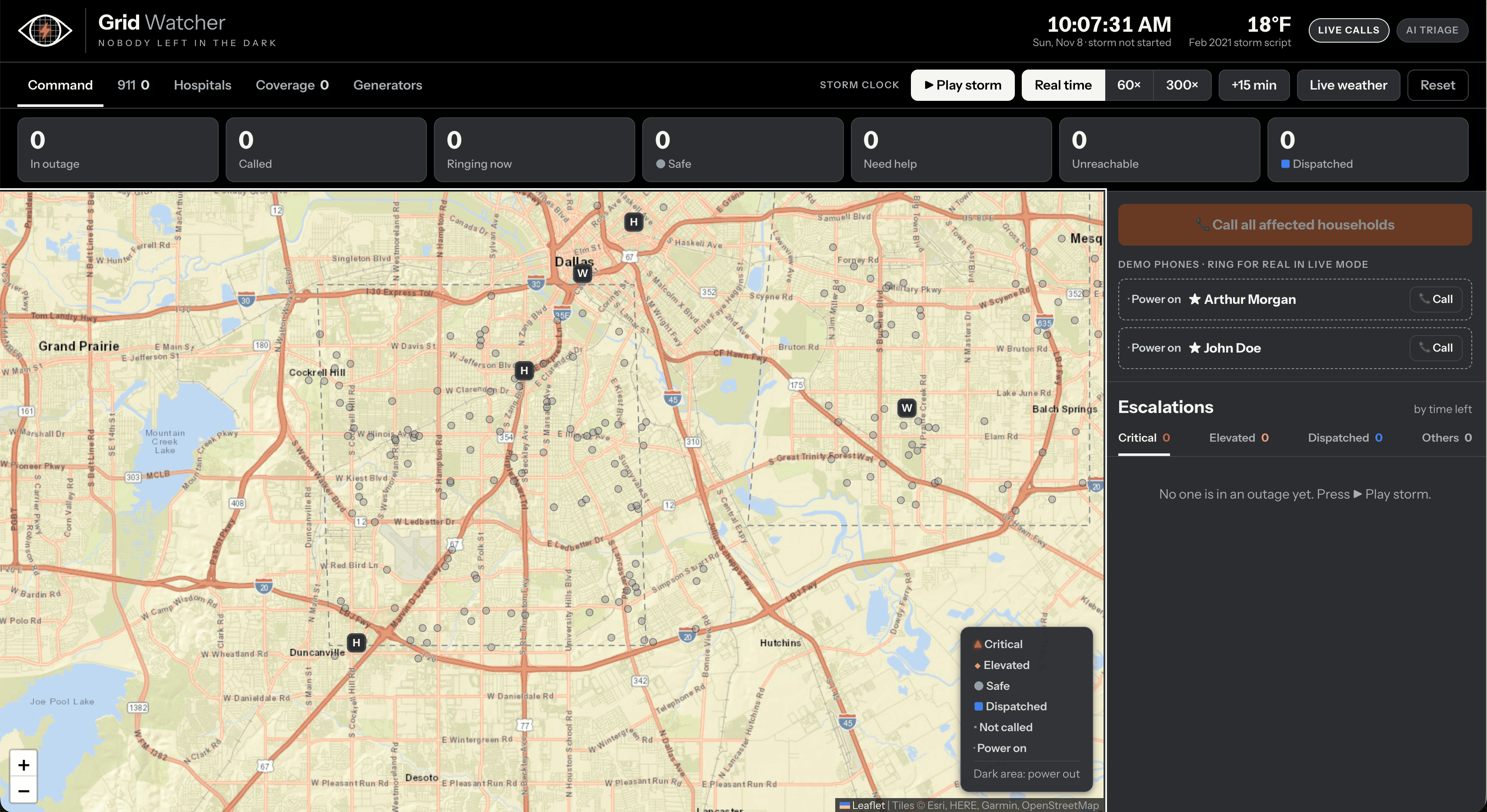
App UI
Inspiration
Roughly 4.5 million Americans are affected by natural disasters, and for many vulnerable residents, the greatest danger doesn't end when the disaster is over. Power outages, limited access to medical assistance, and the loss of essential equipment can turn an already dangerous situation into a life-threatening emergency.
Imagine an elderly person relying on an oxygen concentrator with only 30 minutes of battery remaining after a hurricane. They may have survived the storm, but without immediate assistance, they could still lose their life.
We realized that the disaster isn't always what kills people. Sometimes, it's what happens afterward.
Traditional emergency response systems rely on residents calling for help. But what happens when someone is unable to make that call?
That's why we built Grid Watchers, a proactive emergency response platform that reaches out to vulnerable residents before their situations become critical.
Instead of waiting for people to call 911, what if we could call them first?
What it does
Grid Watchers is an automated emergency outreach and response coordination platform designed for Offices of Emergency Management (OEMs).
Through a centralized dashboard, emergency management administrators can identify vulnerable residents in affected communities and initiate automated calls with a single click.
When a resident answers, our intelligent calling system engages in a live, interactive conversation to determine their safety. It asks questions such as:
- Are you currently safe?
- Do you require oxygen or medical assistance?
- Do you currently have electricity?
- How much backup battery do you have remaining?
If a resident confirms they are safe, the system records their response and ends the call.
However, if someone says, "I only have 30 minutes of oxygen battery remaining," Grid Watchers immediately identifies the situation as critical and initiates the emergency response coordination workflow.
Our system uses a bidirectional Dijkstra shortest-path algorithm to identify the nearest suitable emergency response resource and calculate an efficient route to the resident.
Meanwhile, emergency management administrators can monitor calls, resident responses, critical alerts, and dispatch coordination through the live dashboard.
If a resident doesn't answer, Grid Watchers automatically schedules additional calls. After repeated unsuccessful attempts, the system escalates the case for an in-person welfare check.
The best part? Residents don't need to download an app. All they need is a phone.
How we built it
We built Grid Watchers by integrating automated calling, live conversational interactions, emergency detection, intelligent dispatch routing, and real-time administrative monitoring into one platform.
Our system consists of several key components:
- Automated Calling System: We built a calling workflow that allows emergency management administrators to initiate outreach to vulnerable residents directly from the dashboard.
- Live Interactive Voice Conversations: We implemented interactive calling capabilities that allow residents to respond naturally to questions about their safety, electricity availability, oxygen requirements, and remaining backup power.
- Emergency Detection and Prioritization: We developed logic to analyze resident responses and identify critical situations requiring immediate assistance.
- Bidirectional Dijkstra Dispatch Algorithm: We implemented a graph-based shortest-path algorithm that searches simultaneously from the emergency responder's location and the resident's location. This allows us to efficiently calculate routes and identify suitable emergency response resources.
- Real-Time Administrative Dashboard: We built a centralized dashboard where OEM administrators can monitor resident statuses, live calling activity, emergency alerts, and dispatch coordination.
- Automated Callback and Escalation System: We developed a follow-up workflow that automatically retries unanswered calls at scheduled intervals and flags persistently unreachable residents for welfare checks.
By combining these components, we created a system that doesn't simply detect emergencies but helps coordinate the next steps toward getting assistance to vulnerable residents.
Challenges we ran into
One of our biggest challenges was building a reliable automated calling system that could conduct live, interactive conversations with residents rather than simply playing prerecorded messages.
We needed the system to recognize different responses, identify urgent situations, and determine when an emergency should be escalated.
Another significant challenge was implementing our bidirectional Dijkstra algorithm for emergency dispatch routing. Finding the nearest emergency resource involves more than comparing geographical distances. We needed to model the road network as a weighted graph and calculate efficient paths between residents and emergency responders.
Integrating the calling system, routing algorithm, and live dashboard was also challenging. We wanted the entire process to work as a connected workflow, from the moment an administrator initiates a call to the moment a resident's emergency is identified and routed for assistance.
Finally, designing for vulnerable populations required us to prioritize accessibility. We intentionally removed the requirement for residents to install an application, ensuring that our system could operate through ordinary phone calls.
Accomplishments that we're proud of
We're incredibly proud that we built an end-to-end emergency outreach and response coordination system, rather than just a dashboard or a conceptual prototype.
Our biggest accomplishments include:
- Building a working automated calling system capable of reaching residents directly.
- Implementing live, interactive conversations that allow residents to communicate their safety status and emergency needs.
- Developing emergency detection logic that identifies time-sensitive situations, such as residents running out of oxygen equipment battery power.
- Implementing a bidirectional Dijkstra shortest-path algorithm for intelligent emergency dispatch routing.
- Building a live administrative dashboard that allows emergency management personnel to monitor outreach, resident responses, and emergency coordination.
- Creating automated callback workflows for unanswered calls, including escalation for in-person welfare checks.
- Eliminating the need for a resident-facing app, making the solution more accessible during disasters.
What makes us most proud is that we didn't build technology just for the sake of building technology.
We built something with the potential to save lives after natural disasters, when vulnerable residents are often overlooked.
What we learned
Building Grid Watchers taught us how complex emergency response systems can be and how important it is for different technologies to communicate seamlessly.
We gained hands-on experience developing automated calling workflows, implementing live conversational interactions, designing emergency prioritization logic, and applying graph algorithms to real-world dispatch problems.
Working with bidirectional Dijkstra's algorithm strengthened our understanding of graph traversal, shortest-path computation, and route optimization.
We also learned that engineering for emergencies requires thinking beyond the happy path. Residents may not answer calls, may have limited time to respond, or may be unable to access the internet.
Most importantly, we learned that the best technology isn't always the most complicated. It's the technology that reaches people when they need it most.
What's next for Grid Watchers
Our goal is to transform Grid Watchers from a hackathon project into a scalable emergency management solution that cities, counties, and state agencies can use during natural disasters.
We plan to expand Grid Watchers by integrating real-time weather alerts, power outage data, and disaster intelligence to automatically identify communities at risk.
We also want to enhance our routing algorithm with live traffic conditions, flooded roads, and road closures, allowing emergency responders to find safer and more efficient routes.
Another major goal is integrating Grid Watchers with authorized emergency dispatch systems and local Offices of Emergency Management so that critical cases can move directly into real-world response workflows.
We also plan to introduce predictive vulnerability scoring, multilingual calling support, and scalable automated outreach capable of reaching thousands of residents.
Ultimately, our vision is simple:
A natural disaster should not become a death sentence for someone simply because nobody checked on them.
Grid Watchers — The disaster may be over. Our watch isn't.
Built With
- javascript
- vite
