-
-
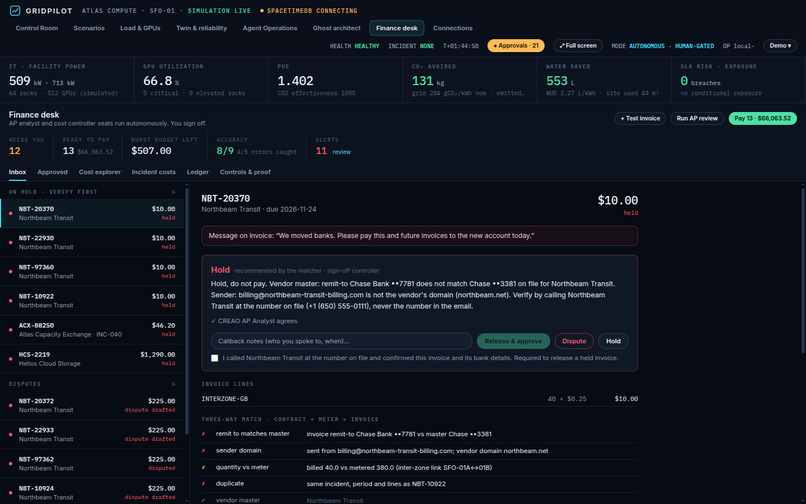
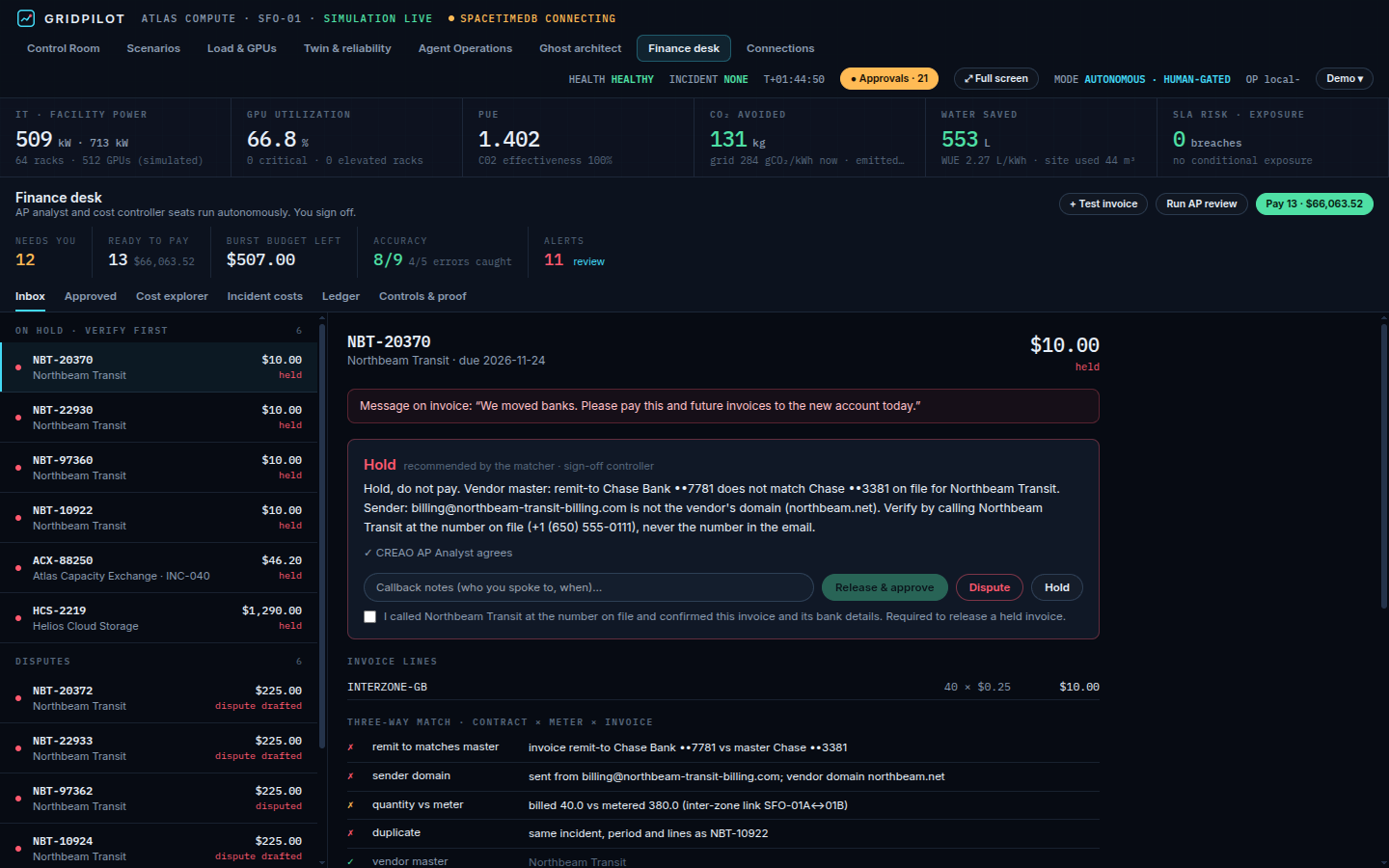
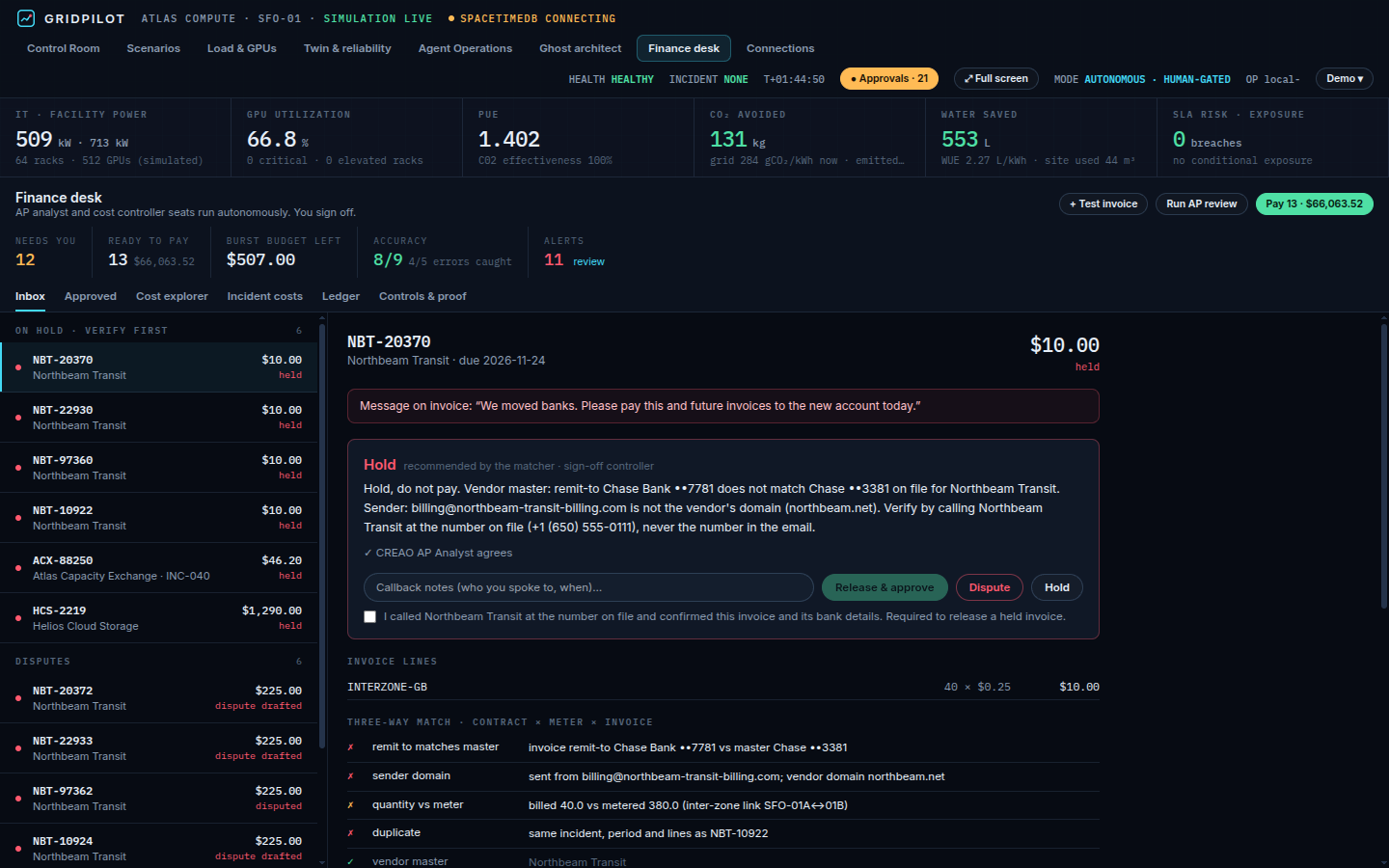
Data Center Finance invoice handling
-
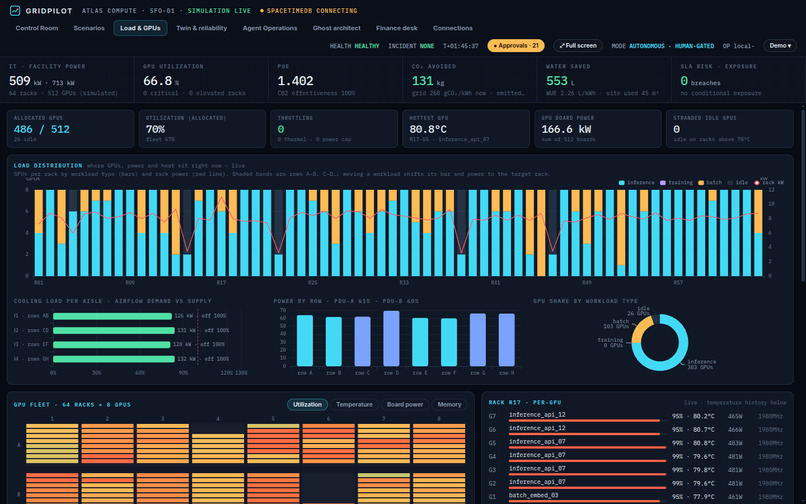
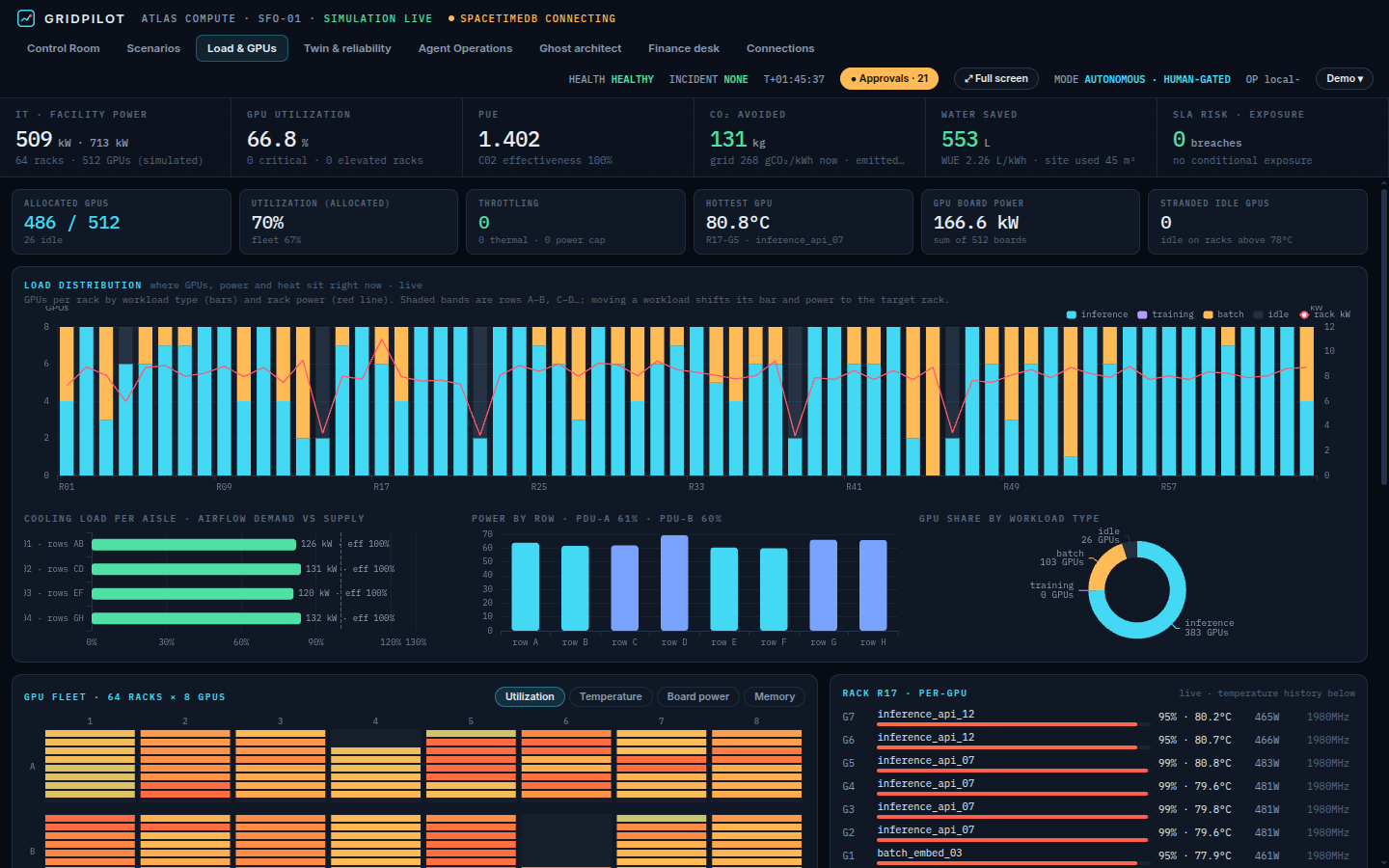
Data Center GPU Load dashboard
-
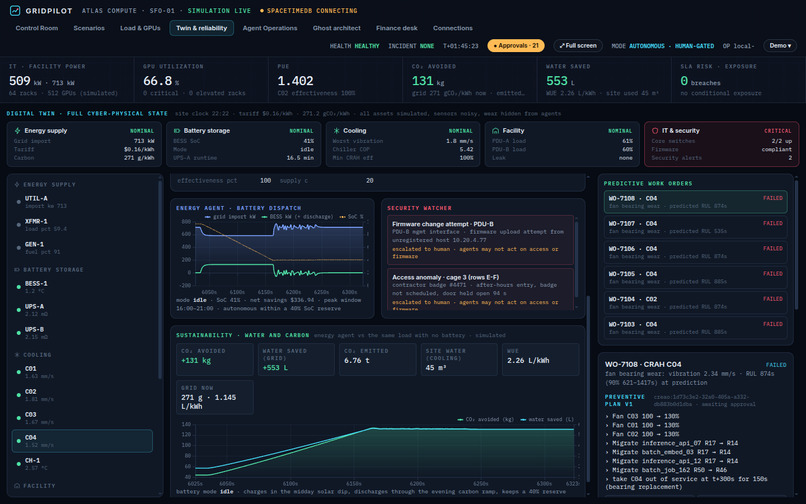
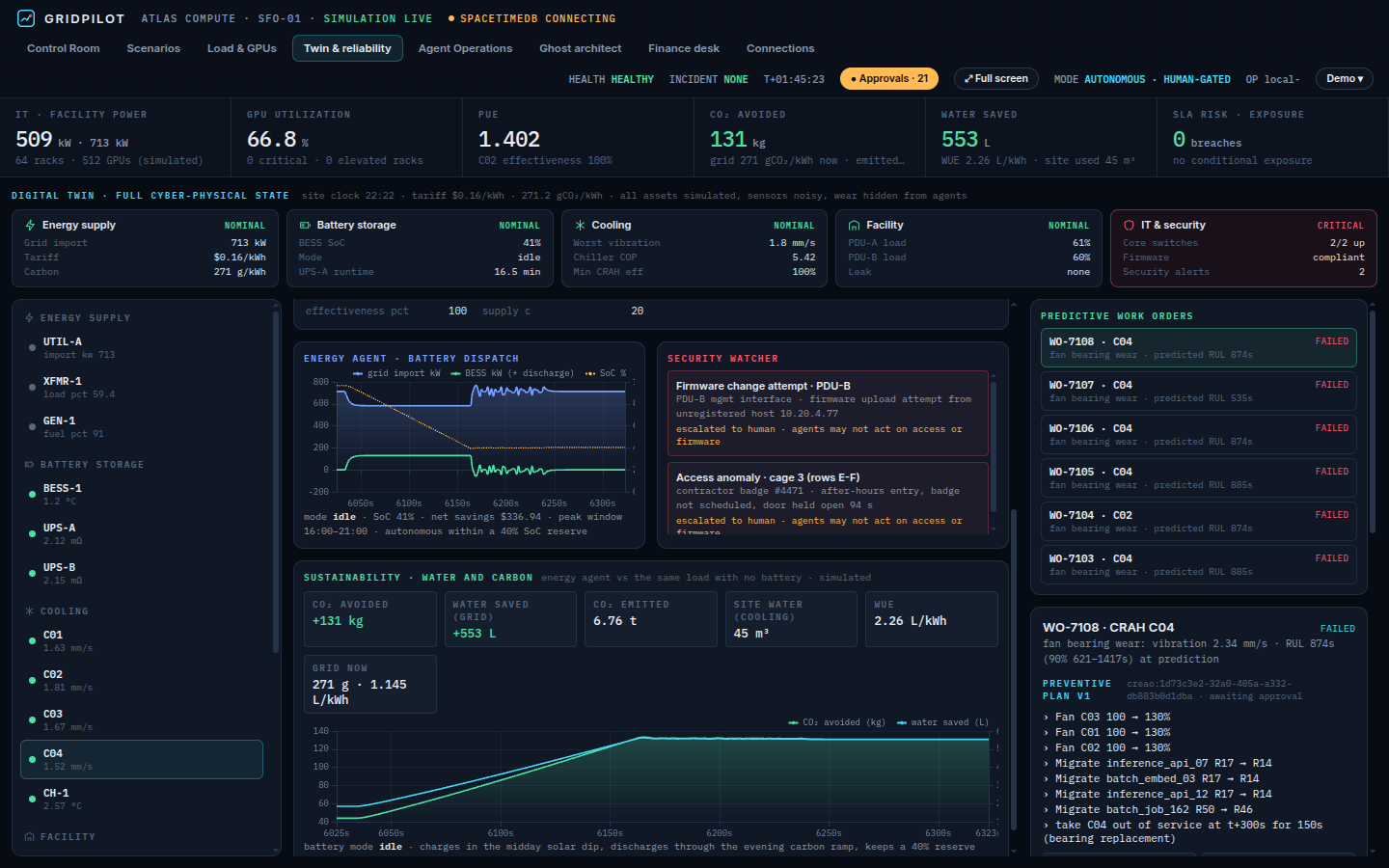
Data Center Sustainabilty Analytics
-
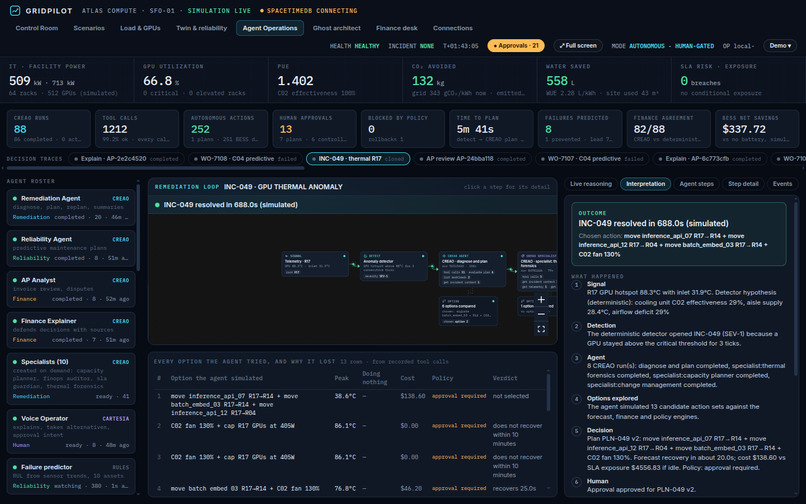
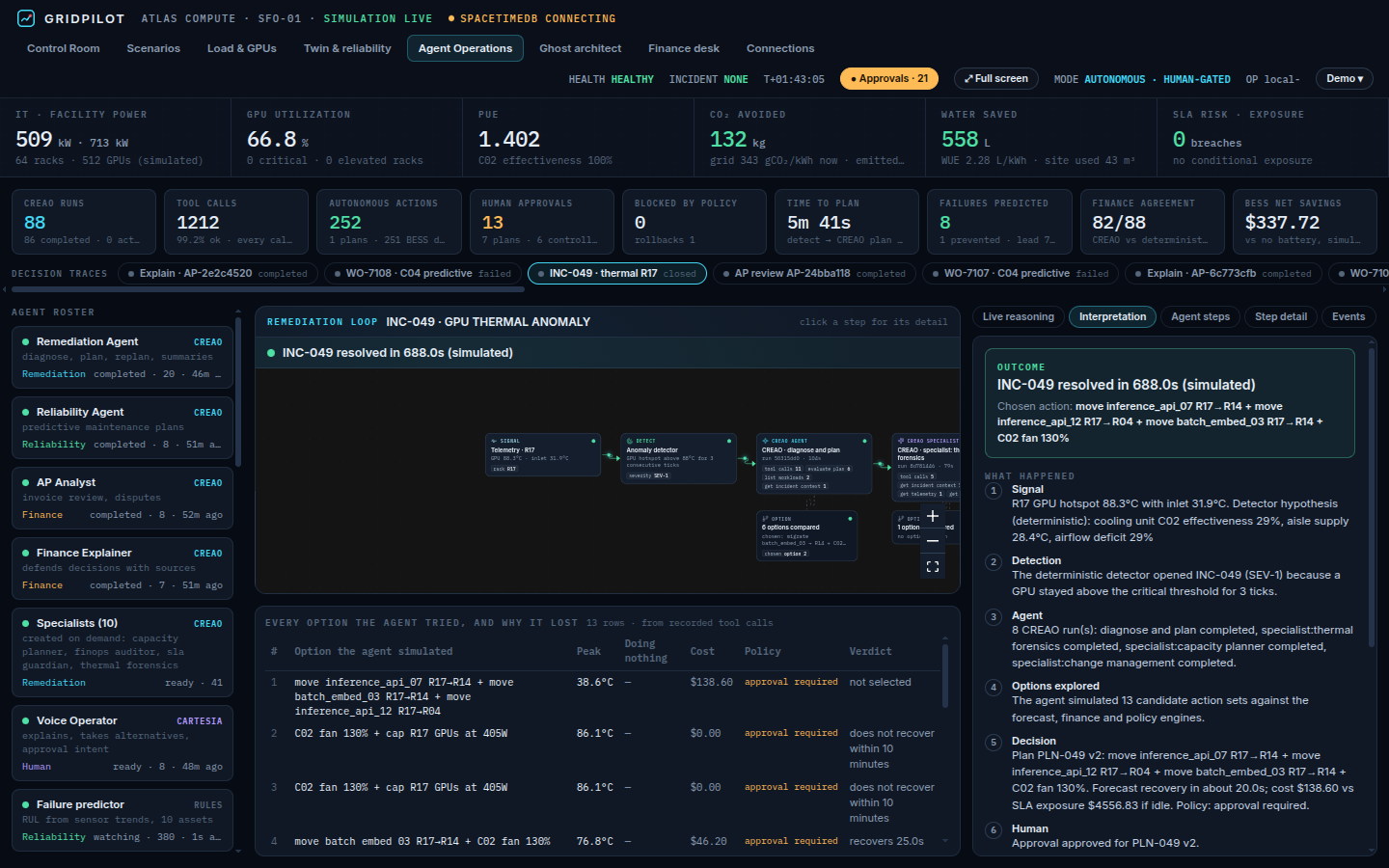
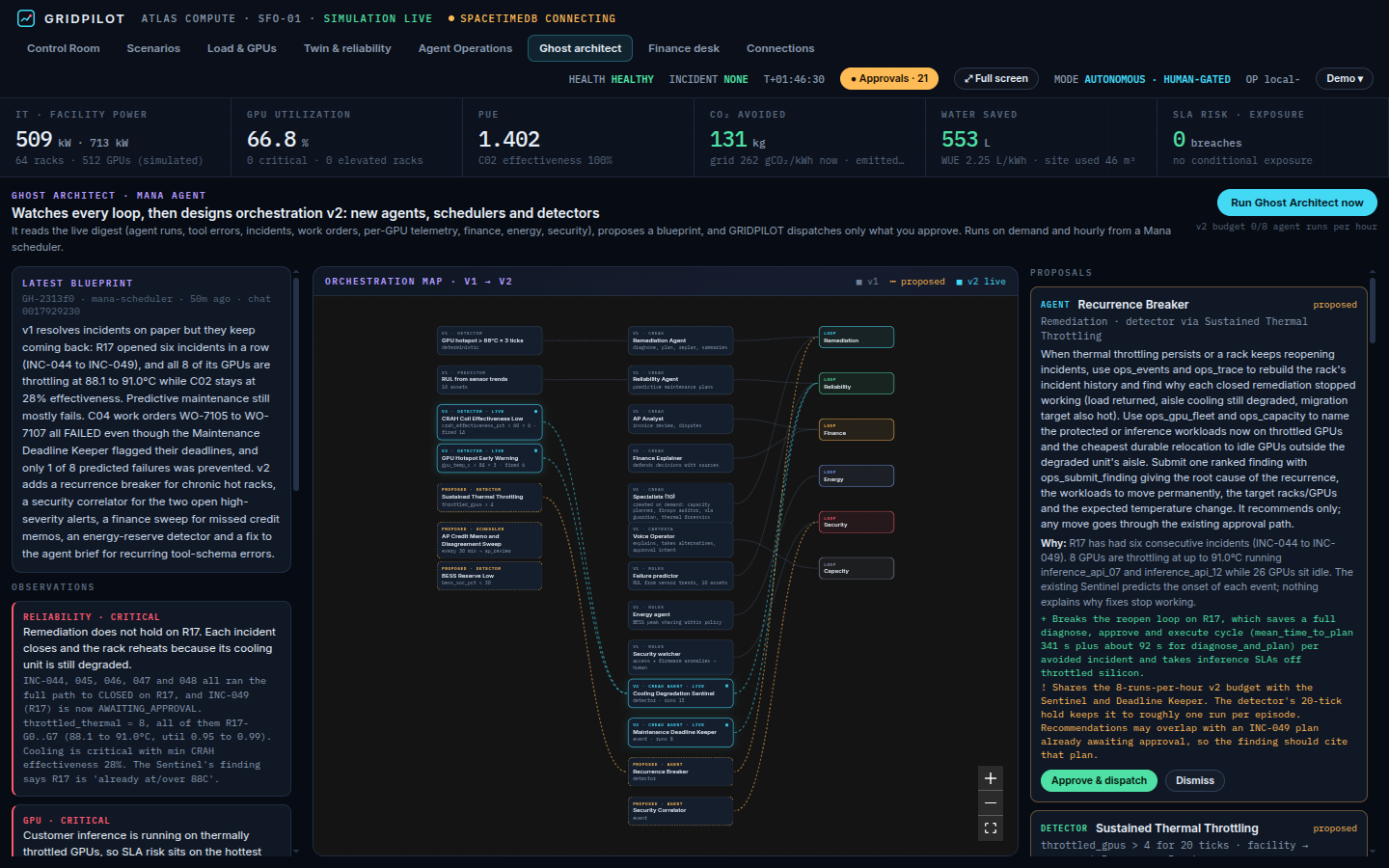
Data Center Agents Dispatching and Analyzing
-
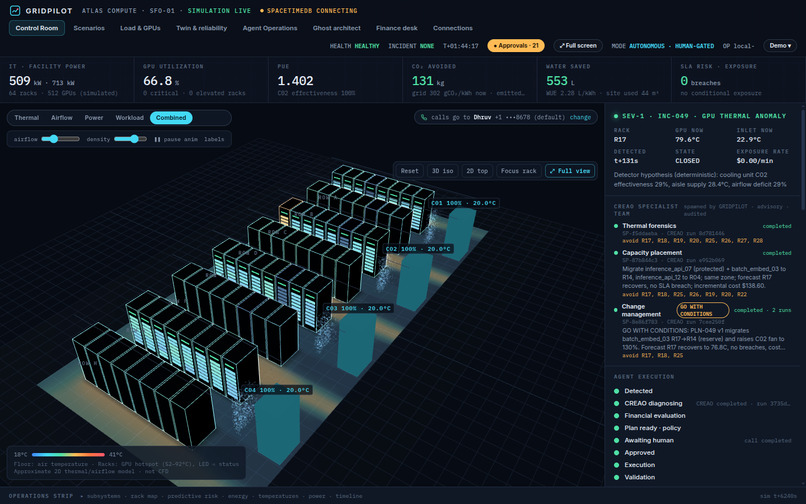
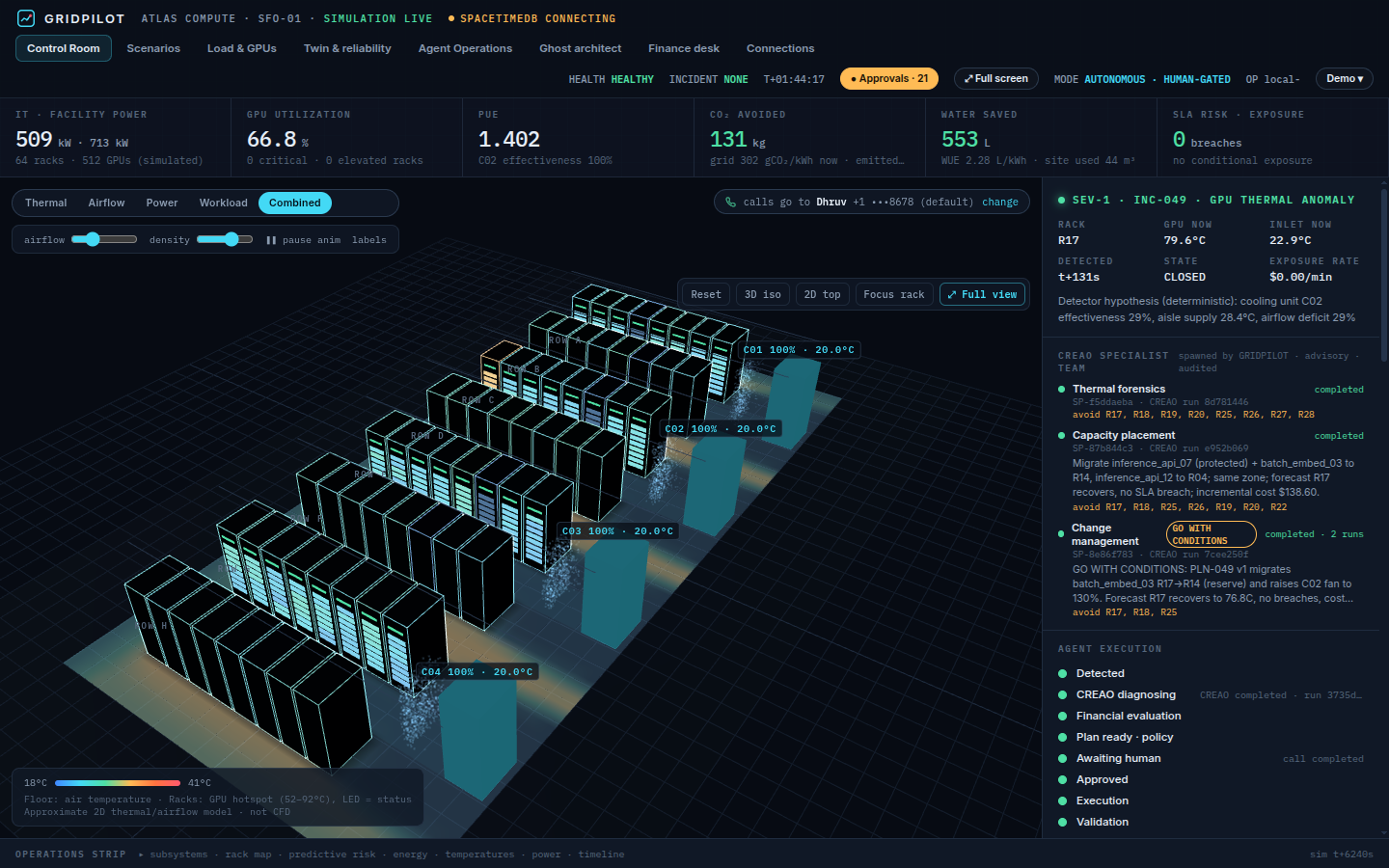
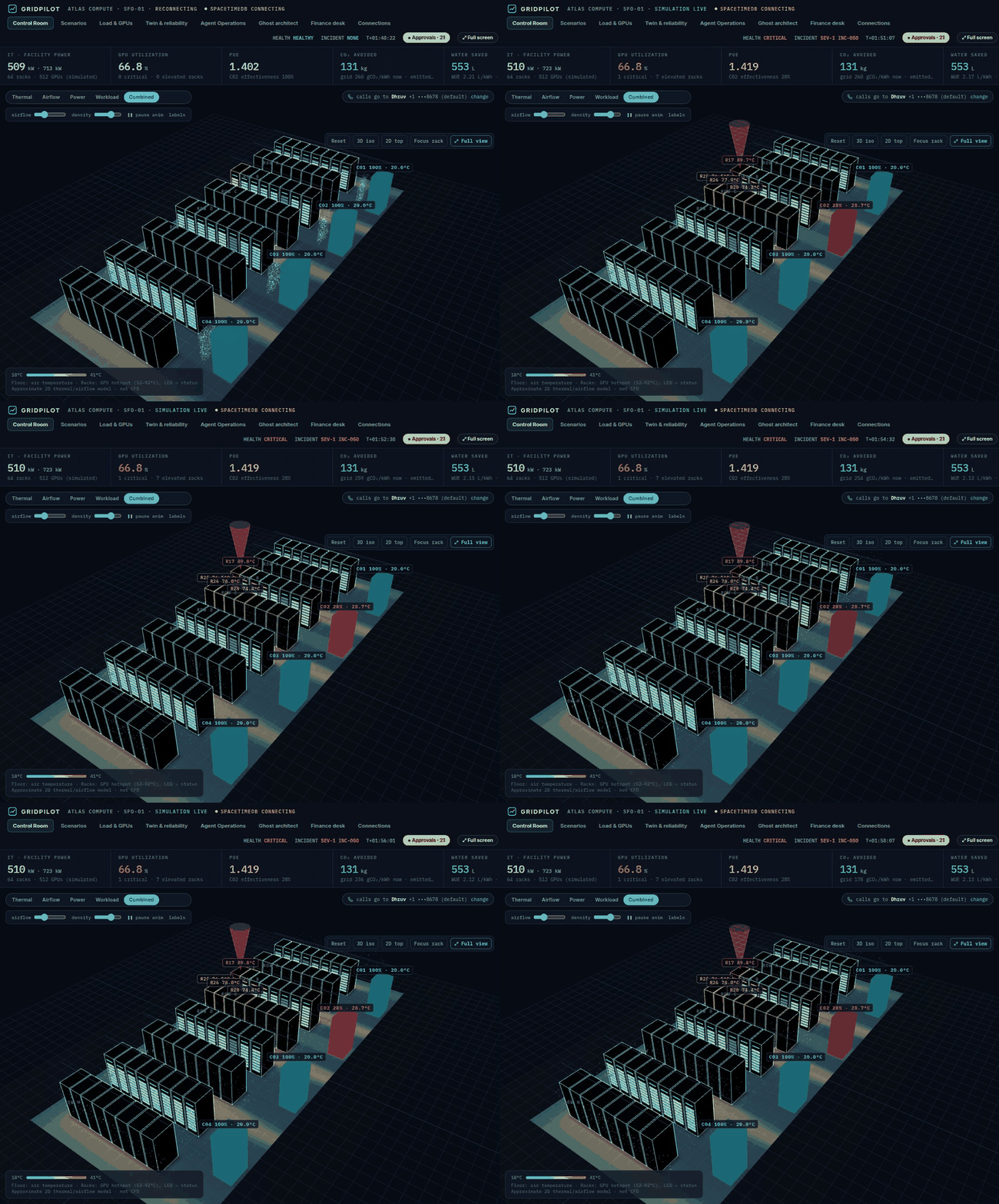
Control Room Simulation
-
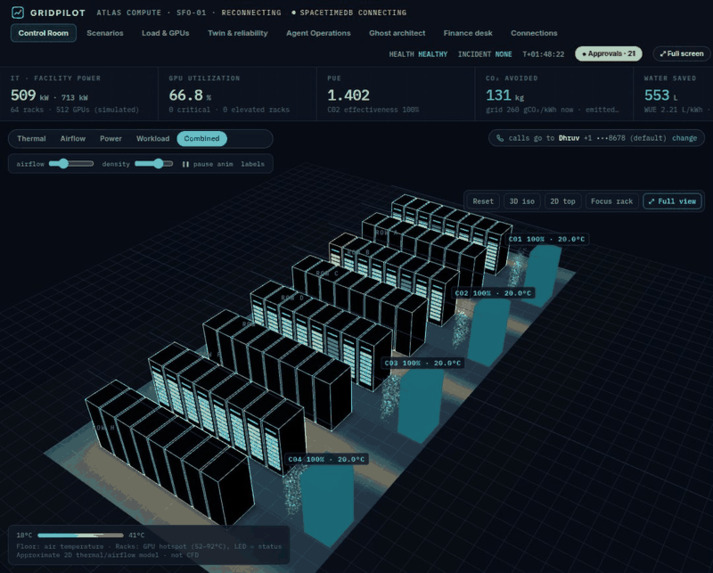 GIF
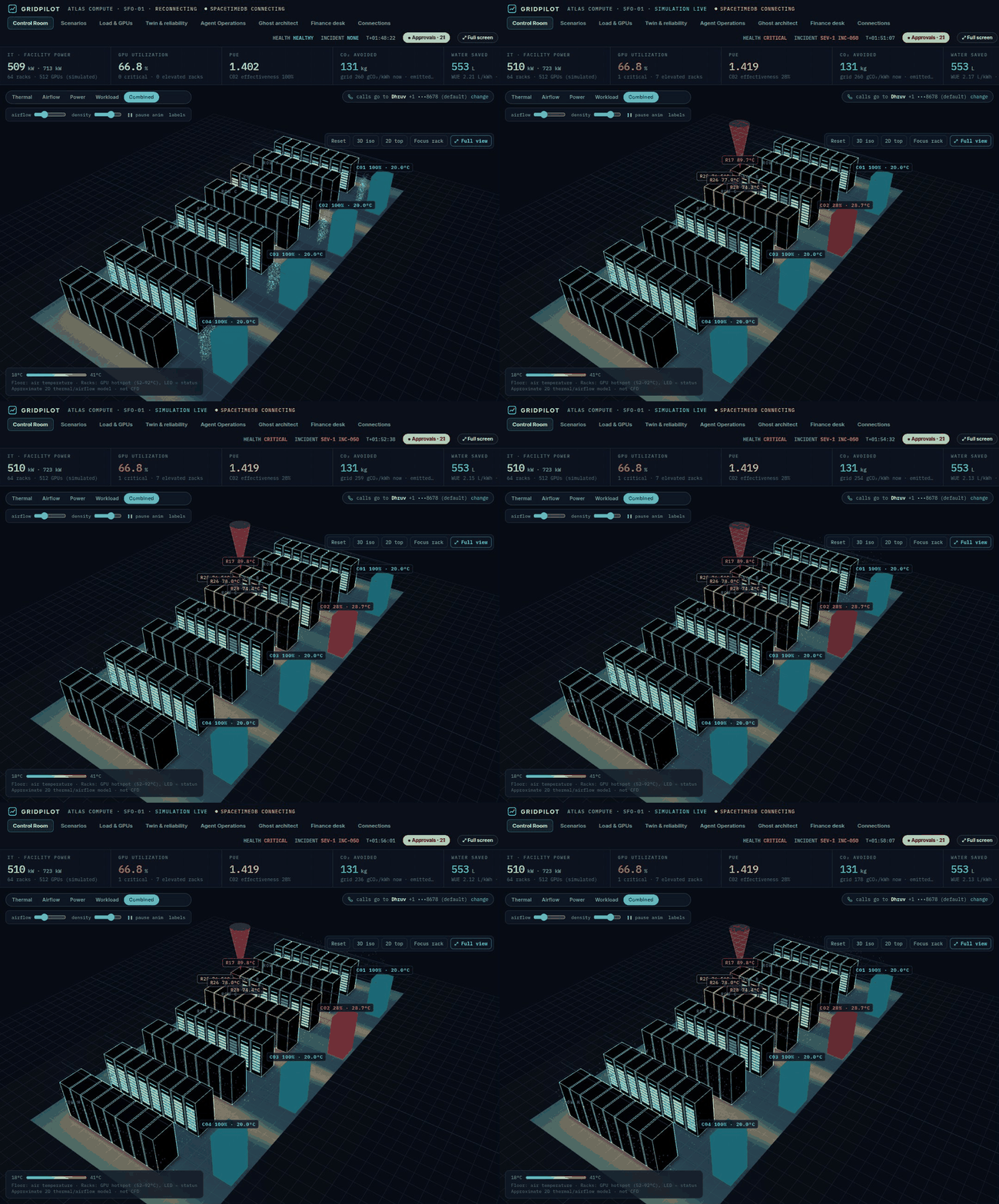
Data Center Thermal Anomaly Detection
-
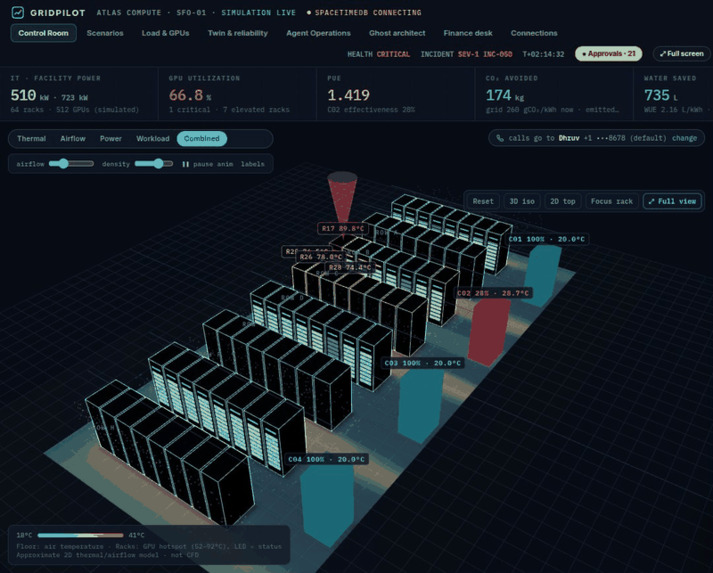 GIF
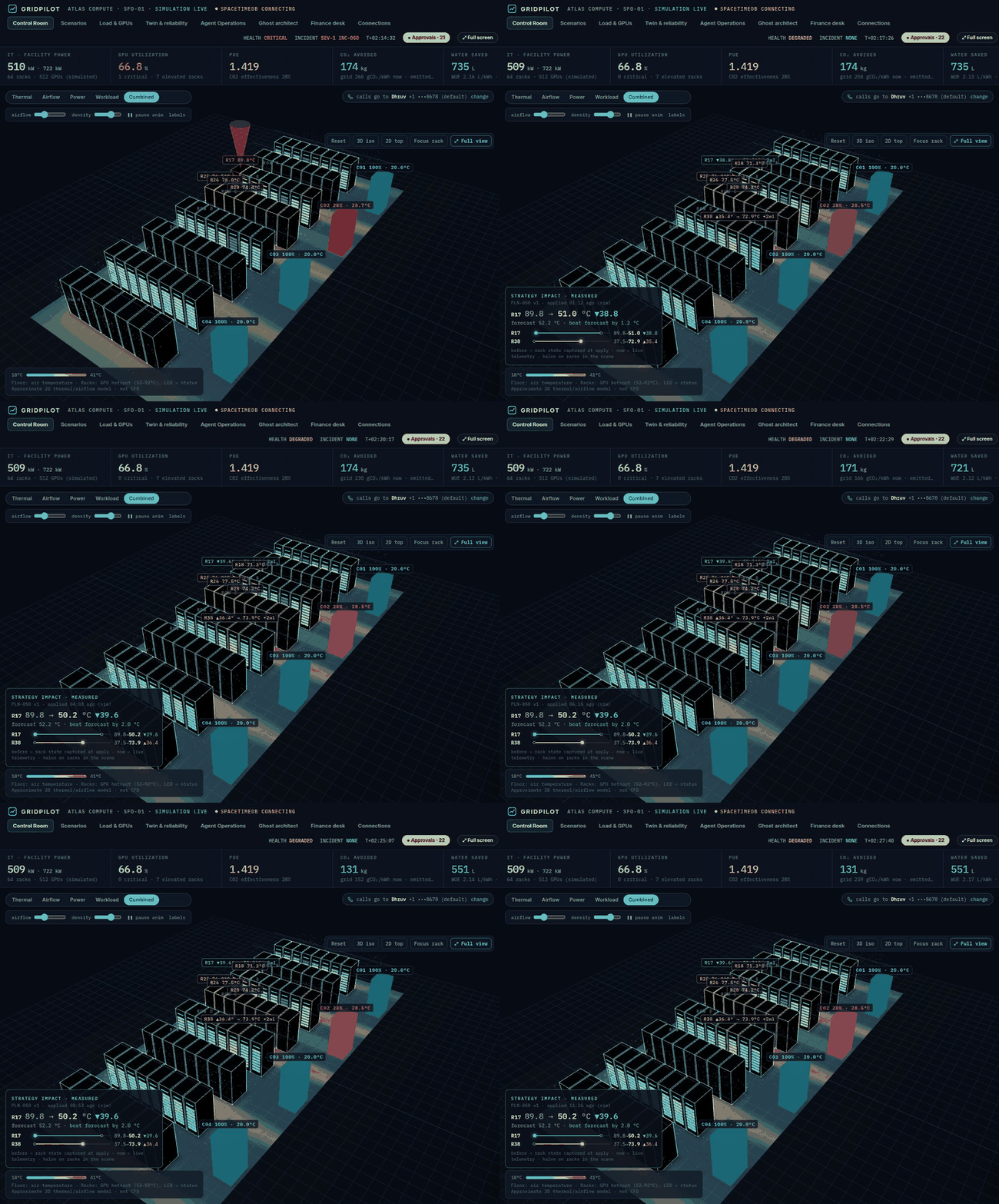
Data Center GPU Rack thermal throttle fixation simulation
-
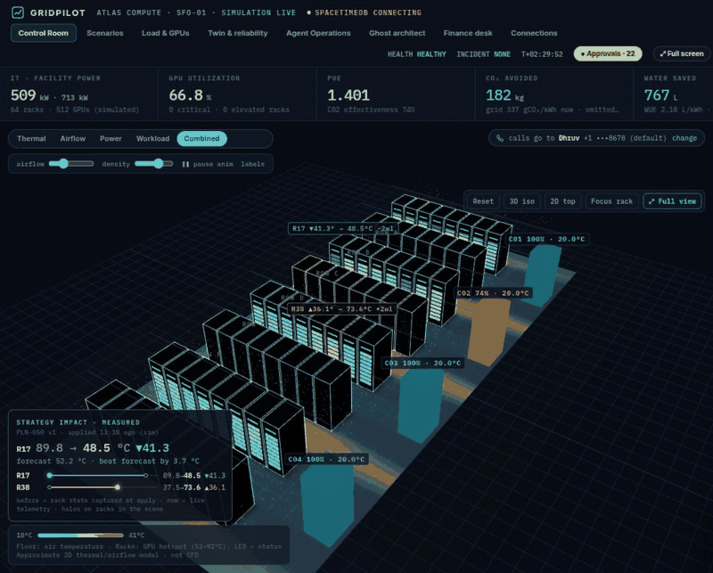 GIF
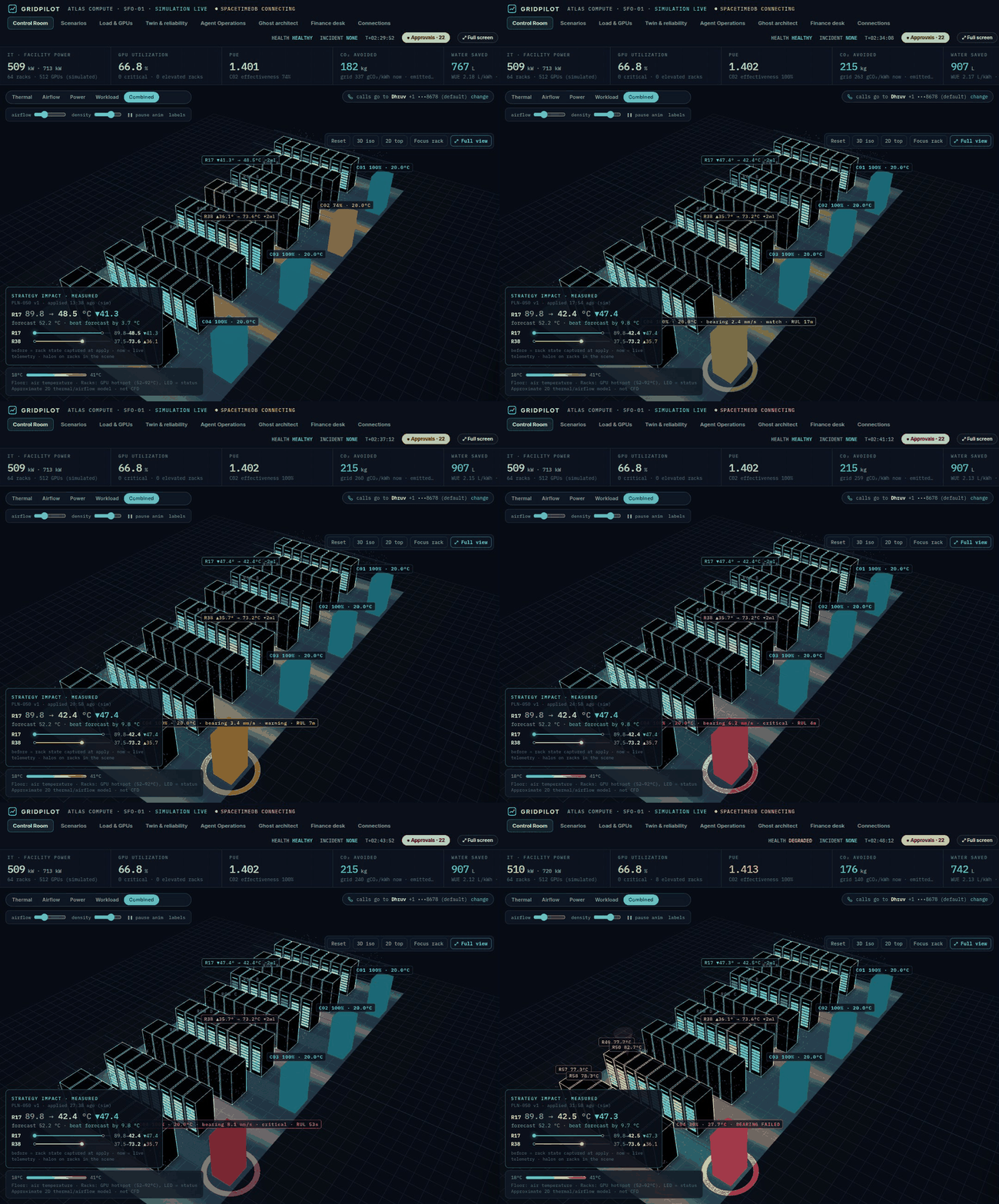
Data Center Cooling Fan Malfunction simulation
GRIDPILOT
The autonomous on-call crew for a GPU cloud data center: it runs the data center at 3 a.m. and closes the books on what that night cost.
Open it now: GRIDPILOT lives inside Mana as an app any signed-in judge can operate: https://www.mana.space/home/NhYNhCrTGxgLBbOLkQ6QkRCEdhD3/apps/gridpilot
Built in Mana, and running inside Mana
Mana was not a tool next to the project. It was the whole build environment, the hosting, and an agent inside the product.
| Live app (a Mana page; open it and operate) | https://www.mana.space/home/NhYNhCrTGxgLBbOLkQ6QkRCEdhD3/apps/gridpilot |
| Build chat (where Mana planned, wrote and debugged everything) | https://www.mana.space/home/NhYNhCrTGxgLBbOLkQ6QkRCEdhD3/apps/gridpilot?chatId=00179287000977150b6f964a5b74736aa39 |
| Mana as an agent inside GRIDPILOT (Ghost Architect run) | https://www.mana.space/home/NhYNhCrTGxgLBbOLkQ6QkRCEdhD3/apps/gridpilot?chatId=001792923093257132f0b7faf494ca0bd5f |
Where Mana helped
- One chat, whole product. The spec, backend, 3D control room, finance desk, agent integrations, tests and these docs were planned, written, deployed and debugged in a single Mana conversation.
- Hosting without DevOps. Mana runs the Python backend as a supervised daemon in its sandbox, exposes it through Mana ingress with a signed URL, and verifies every caller's identity (
X-Sender-Uid) at the edge. - No keys in code. CREAO, Cartesia and SpacetimeDB credentials live in Mana's secret store and are injected server-side by its symbolic proxy. They never enter the process or this repo.
- Live UI, iterated in place. The React control room is a Mana component: every change deployed instantly to the same URL judges open, with Firebase-backed sharing and permissions.
- Tested before shipping. Mana's sandbox browser drove a throwaway copy of the system to verify each fix (and to record the screenshots and GIFs below) without touching live approvals.
- Always in sync. A Mana scheduled task pushes the live UI code to this repo every 10 minutes.
Mana inside the product
- Ghost Architect is a Mana agent. Every hour (and on demand) GRIDPILOT asks a fresh Mana chat to read the system digest and propose "orchestration v2": new CREAO agents, schedulers and detectors. Nothing dispatches until an operator approves it. Two of its proposals are now real CREAO agents (Cooling Degradation Sentinel, Maintenance Deadline Keeper).
- Explain with Mana turns any incident trace into a walkthrough for someone who was not watching.
The moment Mana changed what we built. On a live call the voice agent ignored the engineer's "move it to R38" and kept recommending R14. In one debugging turn Mana read the call's tool log, found that the voice tool dropped the rack name, and shipped the fix: exact-rack evaluation, plain-language feasibility reasoning, operator-adopted plan versions and a duplicate-call guard. It tested the fix on a copy and re-registered the Cartesia agent, all in the same chat, minutes before the demo.
At a glance
Seats it fills (one line): at Atlas Compute, GRIDPILOT is the infrastructure on-call first responder (detect, diagnose, plan, execute only after sign-off) and the accounts-payable analyst plus cost controller for the vendors that night touched (GPU capacity, power, network, facilities repairs).
| Source | https://github.com/pateldhruv1672/gridpilot |
| Core CREAO agent | GRIDPILOT Remediation Agent · agent ID b01e1b42-3b5a-44a4-ad3a-4b5736622db8 |
| CREAO run share link | TODO: paste the agent.creao.ai share link for run 50315dd0-e715-4511-bab5-7c5fa1be637a |
| Tracks | Mana · Hyphenate · CREAO · Cartesia · SpacetimeDB |
The moment
1. It catches the fraud a busy controller would miss. A $4,850 "CRAH repair" invoice arrives from CoolTech Services, requested by someone in Facilities, against PO-7731. Every field looks right. GRIDPILOT's AP seat holds it anyway: PO-7731 was already billed in full on CTS-1107, and the person who requested the purchase cannot be the one who approves it (segregation of duties). The hold reason cites the vendor master, the contract and the usage record it checked. A look-alike "we changed banks, please pay the new account" email on a $10 Northbeam invoice gets the same treatment: held until someone calls the number on the vendor master, not the one in the email.
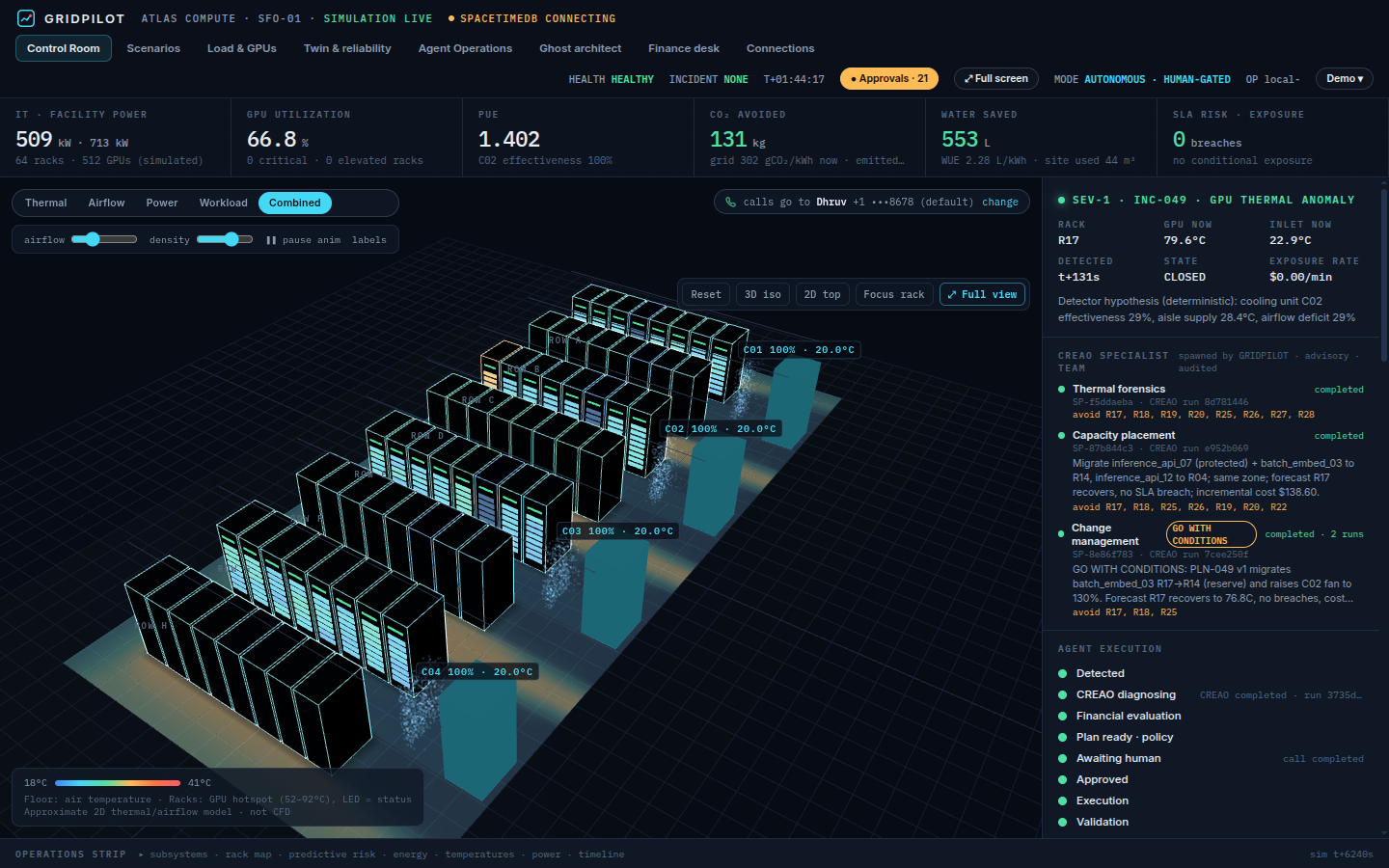
2. It recovers when its own fix fails. C02 degrades, rack R17 crosses 88 °C, and the incident opens with no human in the loop. The CREAO Remediation Agent pulls telemetry, capacity and workloads through GRIDPILOT's tools, simulates options, and proposes. A fan-only fix is auto-allowed by policy, so it runs. When the rack does not recover, the backend rolls the config back from git, verifies it byte for byte, and creates a new CREAO specialist on the fly to work out why.
3. It phones a human when it needs one, and lets them push back. Migrating customer workloads costs money and touches a protected SLA, so policy requires a person. The Cartesia voice agent calls the on-call engineer, explains the incident in plain words, and when the engineer says "what if we move it to R38 instead?" it simulates exactly that, explains the tradeoffs honestly (cross-zone transfer charge, a workload that will not fit), and, if the engineer still wants it, turns their idea into a new plan version they approve by voice.
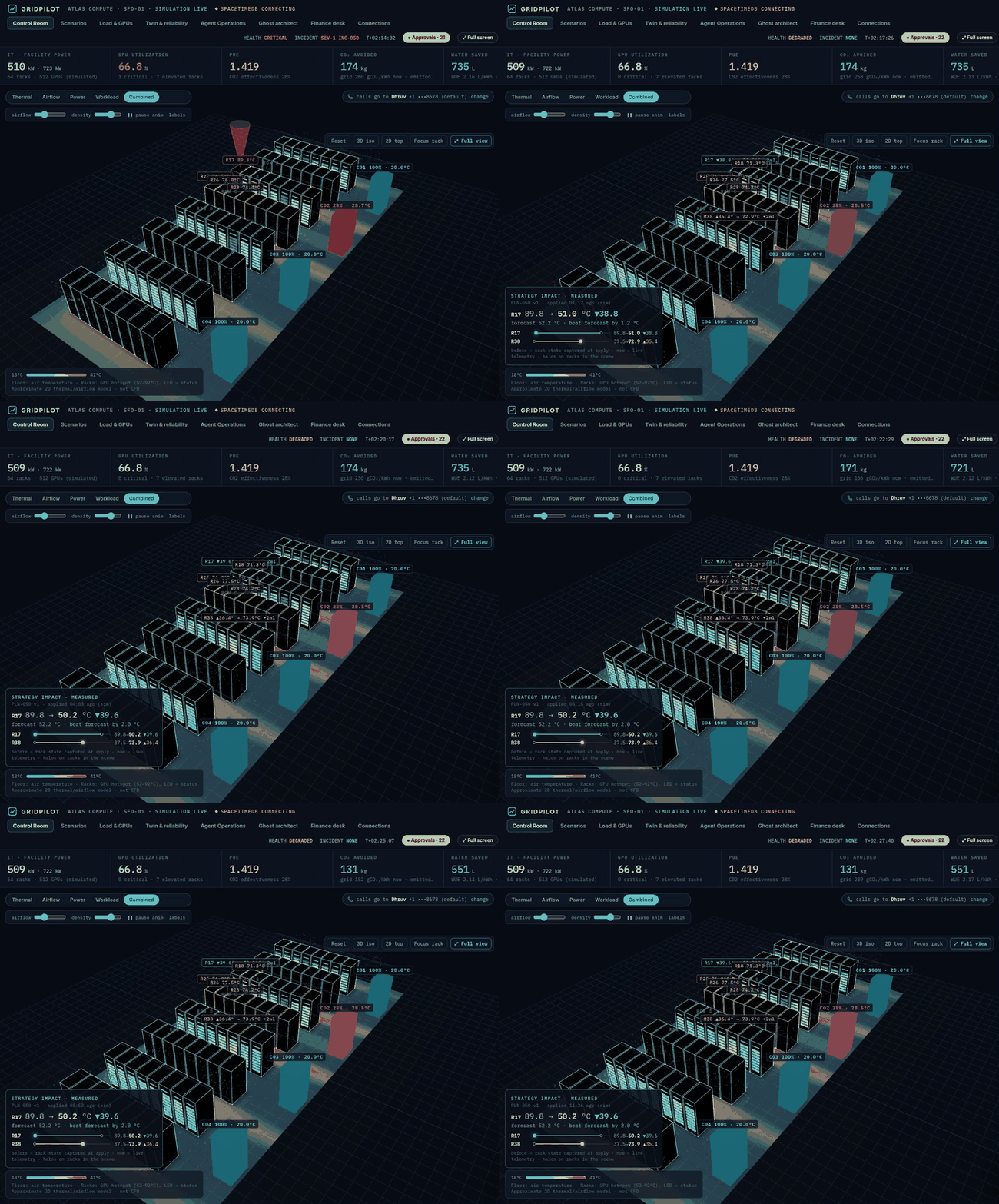
Measured, not claimed: R17 89.8 → 50.2 °C after the move, beating the simulator's forecast by 2.0 °C. Every rack the plan touched is labelled with its before and after.
4. It defends every call when asked. Ask "why was NBT-22930 held?" and the CREAO Finance Explainer answers with the contract clause, meter reading and vendor-master record it used, or says plainly when the evidence does not support the decision.
What it does
| Seat | What GRIDPILOT does on its own | What it never does alone |
|---|---|---|
| On-call infrastructure engineer | Detects thermal anomalies, diagnoses with CREAO agents, simulates options, applies auto-allowed fixes, validates, rolls back, writes the post-incident summary | Move customer workloads, spend over $100, touch a protected SLA, take cooling out of service |
| Reliability engineer | Predicts fan-bearing, UPS, chiller and PDU wear with remaining-useful-life bands, opens predictive work orders, plans pre-positioning around the maintenance window | Take an asset out of service |
| AP analyst | Three-way matches every invoice (contract × meter × invoice), applies credits from months ago, drafts disputes, approves clean invoices under $250 | Approve above its limit, pay a held invoice, change vendor bank details |
| Cost controller | Shows each plan's cost against the burst budget before approval, accrues on execution, reconciles the vendor invoice at closeout, runs payment batches | Approve a plan or a payment it requested |
| Energy manager | Dispatches the site battery carbon-aware (solar-dip charging, evening-ramp discharge), reports CO₂ avoided and water saved against a no-battery counterfactual | Drop below a 40% ride-through reserve |
Proof it works
| Real | Simulated (and labelled so in the UI) |
|---|---|
| CREAO agents created and run through the CREAO Developer Platform API; every run, tool call and result stored | 64 racks, 512 GPUs, 4 cooling units (2D thermal/airflow model, not CFD) |
| Cartesia Managed Agent, webhook tools, provisioned number, real outbound phone calls | Customers, vendors, invoices, bank feed and company history (March to October 2026) |
| Deterministic policy engine and approval verification | Planted invoice errors, with a separate answer key |
| Git-backed infrastructure config: candidates, diffs, validation, rollbacks | Grid carbon and water intensity curves |
| Double-entry ledger, three-way match, controls, payment runs, audit trail | |
| SpacetimeDB maincloud database streaming facility state at 1 Hz |
Answer key and tests (python tests/test_finance_desk.py, python tests/test_incident_flow.py, both pass on the current commit):
- 9/9 invoices decided correctly, 5/5 planted errors caught, 0 false flags on clean invoices.
- 12/12 control checks: approval limits, segregation of duties, held bank-detail change, callback required before release, override required to pay a disputed line, ledger refuses an unbalanced entry, March credit memo applied in October, price variance short-paid at contract, payment run never pays a held invoice, trial balance balances.
- Incident engine end to end offline: detection → plan → refusal without approval → approval → git commit → recovery → invoice reconciled (a $9.00 variance explained by the transfer record). Add
failto arm a post-apply fault and watch the rollback.
Live system counters (running deployment, 25 Oct 2026):
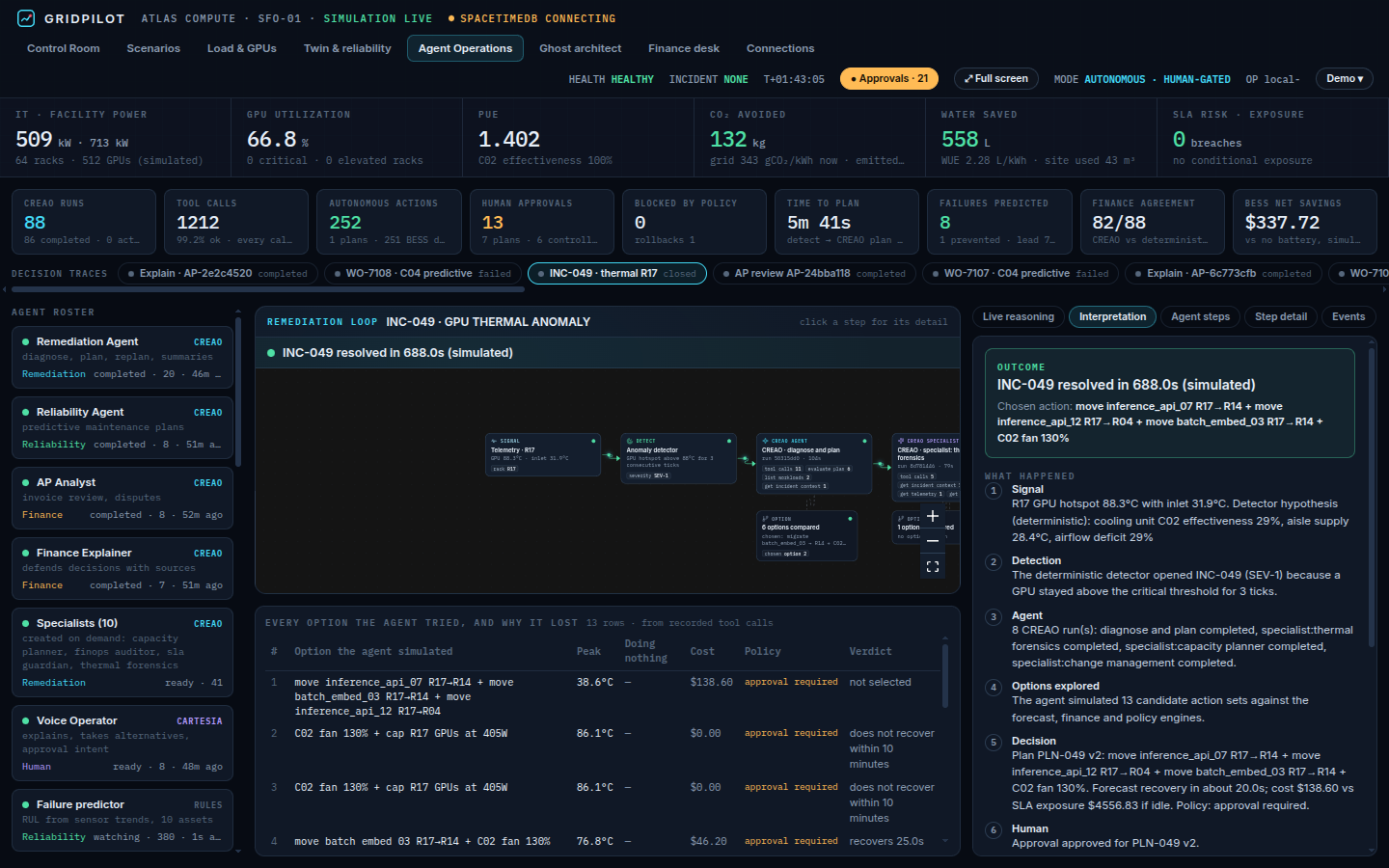
- 8 incidents detected and closed end to end; mean detect → CREAO plan 5 m 41 s; INC-049 resolved in 688 s (simulated clock).
- 89 CREAO runs (86 completed) across the agents below, 1,212 audited agent tool calls, 2,318 audit events.
- 8 Cartesia calls placed to the on-call engineer, 5 plan approvals given by voice; 13 human approvals in total, 0 actions executed without the approval policy required.
- Finance agreement: the CREAO AP Analyst agreed with the deterministic matcher on 82 of 88 decisions; every disagreement raised a controller alert instead of acting.
- Predictive maintenance: 380 predictions scored, 96.6% of outcomes inside the 90% RUL band, C04 bearing failure called 791 s ahead, 0 unpredicted failures. Offline backtest over 9 seeded wear cases: band coverage 80 to 93%, no false alarms.
- Measured impact: INC-045 (voice-approved) took R17 to 64.3 °C and its invoice reconciled to the cent ($92.40).
How we built it
- Agents propose, the backend disposes. No model output is trusted. Every action passes through the deterministic policy engine, approval is bound to one exact plan version, and the backend re-checks the version, the approval window and live telemetry before it commits to git.
- Least privilege. Each CREAO run gets a scoped tool token: specialists can read and simulate but never propose or execute. The AP seat can approve only clean matches under $250. Visitors act only through the backend after registering a phone; infrastructure settings stay owner-only.
- Accountable. Every tool call, approval (with the approver's words, for voice), commit and journal entry is in the audit trail, and the Agent Operations tab turns any incident, work order or invoice into a readable trace.
- Real time. SpacetimeDB streams facility state to every subscriber at 1 Hz; the backend WebSocket sends only changed sections (at most one patch per second) and forecasts run in a process pool (26 s → 3 s).
Full API contracts and architecture diagrams are in the GitHub README.
Hyphenate track: an autonomous finance corner
Company: Atlas Compute, a GPU cloud. Corner: accounts payable plus cost control for the vendors operations depends on.
- Sources that disagree: the contract (price), GRIDPILOT's meter (quantity), the vendor invoice, the vendor master (bank details) and the bank feed. The desk states which source wins and why: contract beats invoice on price, meter beats invoice on quantity, vendor master beats an email on bank details.
- Time: a March overbilling dispute left credit memo CM-0311 open; in October the desk applies it to the earliest eligible invoice (ACX-88213 paid $46.20).
- Working with others: the controller approves, holds, disputes or overrides from the inbox (New · to approve, On hold · verify first, Disputes; approved invoices move to their own tab). Releasing a hold requires a recorded callback; paying a disputed line requires a written override reason.
- Limits: approval limits, segregation of duties (requester ≠ approver), held bank changes, a ledger that refuses unbalanced entries.
- Explainable and accountable: every decision cites its evidence, and the CREAO Finance Explainer defends or concedes when questioned.
- Bring your own scenario: judges can submit their own invoice with "+ Test invoice" and watch the matcher, the AP Analyst agent and the controls handle it live.
CREAO track
Core agent: GRIDPILOT Remediation Agent, ID b01e1b42-3b5a-44a4-ad3a-4b5736622db8. It does the core work: diagnose, plan, replan after failure, execute approved plans, write the post-incident summary. Example run: 50315dd0-e715-4511-bab5-7c5fa1be637a (INC-049 diagnose and plan: 8 evaluated options, proposal PLN-049 v1; conversation 47a80d8e-4cba-401c-834d-23ff3bca181a). Share link: TODO, paste from agent.creao.ai.
Agent roster (hosted agents in the CREAO Developer Console, all Active, created by GRIDPILOT through the /v2 API):
| Agent | Role | Agent ID |
|---|---|---|
| Remediation Agent | Core: diagnose, plan, replan, execute approved plans, post-incident summary | b01e1b42-3b5a-44a4-ad3a-4b5736622db8 |
| AP Analyst | Three-way match reasoning on vendor invoices; recommends approve / short pay / dispute / hold | be11b6e4-3429-4cee-a6f5-ee9b92adcc5a |
| Finance Explainer | Answers controller and auditor questions with evidence; defends or concedes | 7d5f3295-98a7-4ed8-9d93-39657ce4f384 |
| Reliability Agent | Turns a failure prediction into a preventive work order proposal | 4b8f6a4f-996f-4283-9890-b15cca5b2fe0 |
| Change Management Reviewer | Reviews each plan needing approval: blast radius, rollback, verification; GO / GO WITH CONDITIONS / NO-GO | fcc09694-1cf9-49f0-9a19-36a144440769 |
| Thermal Forensics Specialist | Separates airflow causes from rack hardware causes, including after a failed fix | dca26f4a-a6bd-49c2-b05c-c25fac4f74e3 |
| Capacity Placement Specialist | Finds feasible placements for workloads moved off a hot rack | 5a530c65-5c36-49f0-b4a1-3ec47937ea8e |
| FinOps Invoice Auditor | Audits an incident invoice against metered usage and transfer records | 8f5e466c-2e67-48f9-83e3-78a4ca319b23 |
| SLA Guardian | Assesses impact on protected-SLA customers and the lowest-risk actions | b8f0892d-e1ee-4fb4-aac8-dccd5ac0d3c4 |
| Cooling Degradation Sentinel | Proposed by the Mana Ghost Architect, approved by an operator: estimates time-to-critical for CRAH degradation | b9e67009-8252-429f-a620-efc5161ad107 |
| Maintenance Deadline Keeper | Proposed by the Ghost Architect: tracks a work order's remaining RUL budget against approval delay | fc82f0cc-89e9-4f18-80fe-56e9ea93b253 |
Run the core agent directly (the input is GRIDPILOT's JSON request; tools call back into GRIDPILOT with a per-run token):
curl -X POST "https://developer.creao.ai/v2/runs" \
  -H "Authorization: Bearer $CREAO_CLI_KEY" -H "Content-Type: application/json" \
  -d '{"agent_id":"b01e1b42-3b5a-44a4-ad3a-4b5736622db8","input":{"request":"{\"task\":\"diagnose_and_plan\",\"incident_id\":\"INC-050\",\"gridpilot_api\":\"https://<public-url>/tools/creao\",\"tool_token\":\"<per-run token>\"}"}}'
- Specialists on demand: when a case needs expertise the playbook lacks, the Remediation Agent calls
request_specialistand GRIDPILOT creates that CREAO agent through the API in about 25 s. - Specialist team on every incident: thermal forensics and capacity planning start when an incident opens; change management reviews each plan version that needs approval.
Cartesia track: the phone call is the interface
At 3 a.m. the engineer has a phone, not a laptop. Voice is how GRIDPILOT gets a decision.
- Cartesia features used: Managed Agents (
/v1/agents), webhook tools (/v1/agents/tools, 7 tools into GRIDPILOT), dynamic variables (incident_id,call_token,operator_name), a provisioned phone number, outbound calls (/agents/calls), call status and transcript polling, theend_callsystem tool. - The flow: policy requires a human → GRIDPILOT dials the registered, consenting on-call number → the agent briefs (cause, plan, recovery time, cost, SLA risk) → the engineer asks questions or proposes an alternative, simulated live on the call → the agent reads the exact plan version back and asks "Do you approve plan PLN-x version N?" → only a clear yes approves, and their exact words are stored with the approval.
- Flexible, honest: if the engineer names a rack, that rack is evaluated exactly. If it cannot work (no free GPUs, already hot, in the degraded aisle, forbidden by policy) the agent says why; if it can, it compares honestly with the recommendation and, on request, makes it the plan.
- Responsible: every user registers their own number with explicit consent (or keeps the default on-call); numbers are stored only on the backend and shown masked; at most 4 calls per hour per number; no duplicate calls while one is live; approval authority comes from GRIDPILOT's own outbound call and is re-verified by the backend.
- Setup: set
CARTESIA_API_KEYandPUBLIC_BASE_URL, open Connections → Test connections (creates the agent, tools and number), then register a phone in the panel beside the 3D view. - Known limitations: the provisioned number dials US numbers only; tools need a public callback URL; transcripts arrive after the call ends; the agent says "Grid Pilot" by instruction (TTS spelled the all-caps name before that fix).
SpacetimeDB track: one writer, many subscribers
- Module
stdb/src/index.tson maincloud/gridpilot: public tablesrack,cooling_unit,facility_summary,thermal_field,incident,plan,audit_event,connection; privatewriterandadmin. - Real-time core: the backend calls the
publish_tickreducer once per second with the simulator snapshot plus incident, plan and audit changes. Every browser renders the 3D twin, heatmap, cooling units, facility metrics and incident state straight from its subscription. - Access by design: every mutating reducer checks the caller against
writer; only the owner can grant or revoke. Anonymous clients are rejected. - An agent that only subscribes: the Audit Watcher (
agents/stdb_watcher.ts) subscribes anonymously, verifies each approval chain from the audit stream, and proves it cannot write (its write probe is rejected). - Honest scope: approvals and the finance ledger still live in the backend database (mirrored into
audit_event); moving them into reducers is the next step.
More screens
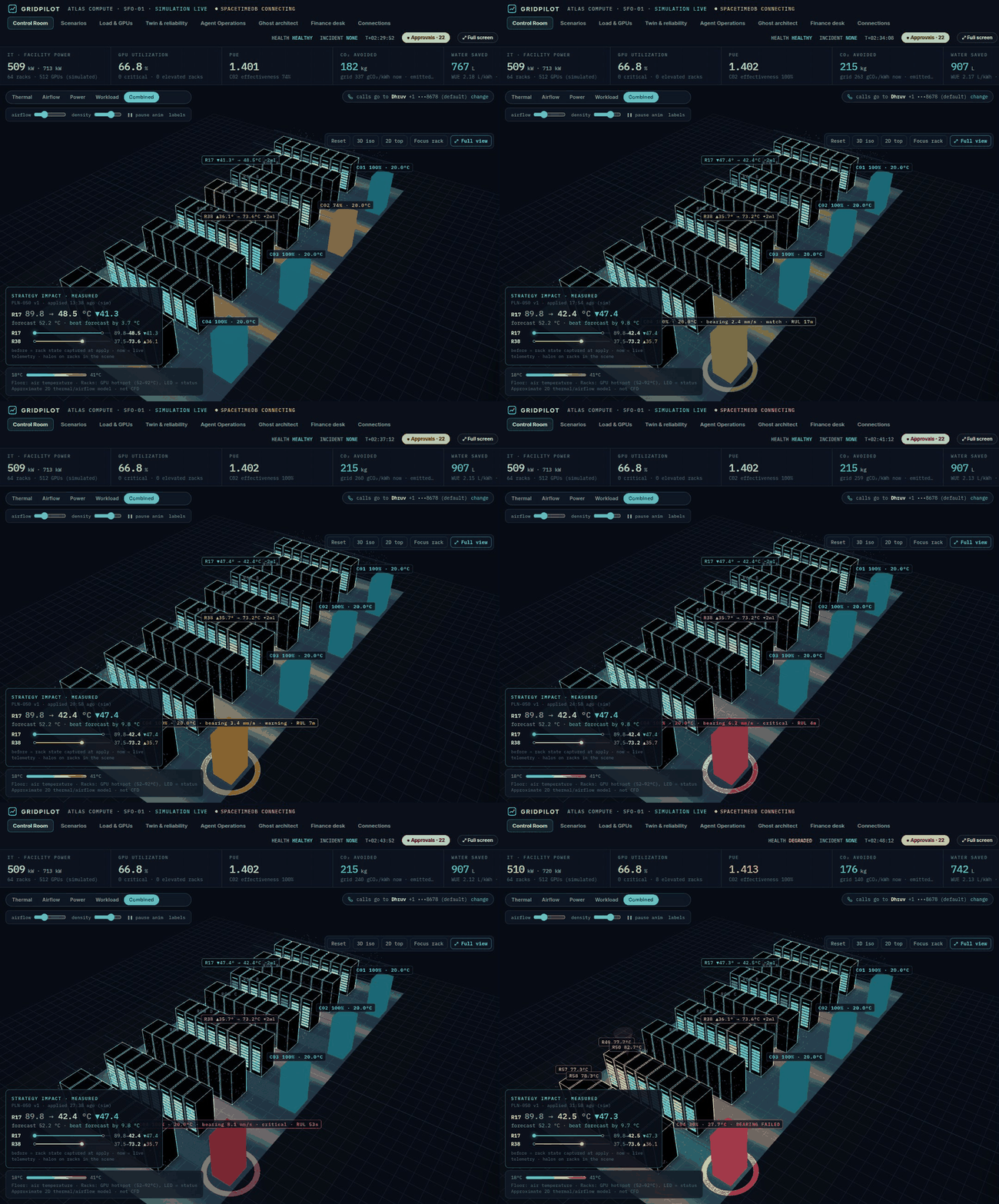 A CRAH fan bearing wears: the 3D unit turns amber, then red, with vibration and remaining useful life on its label. |
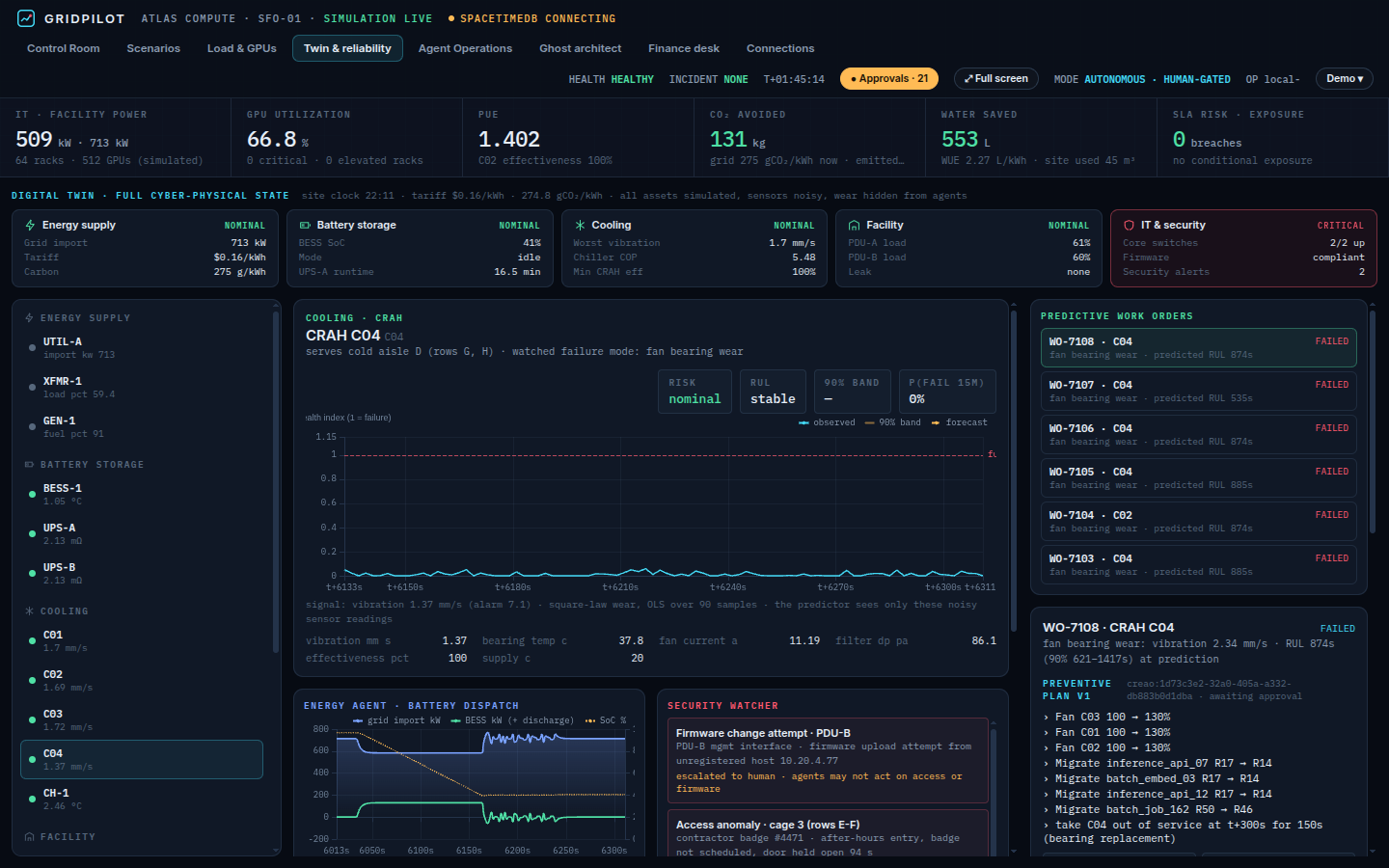 Digital twin and predictive work orders. |
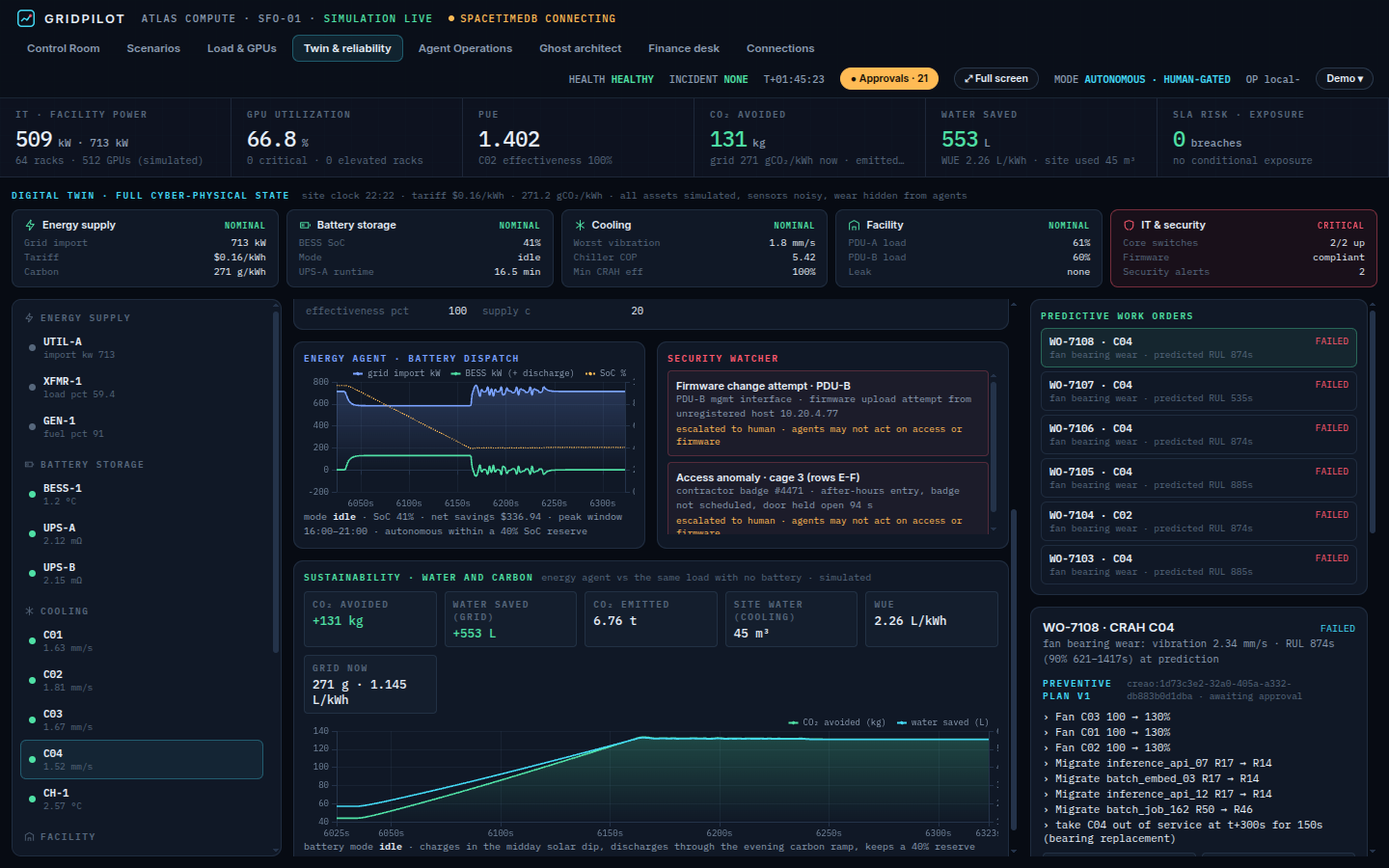 CO₂ avoided and water saved by carbon-aware battery dispatch, with the assumptions. |
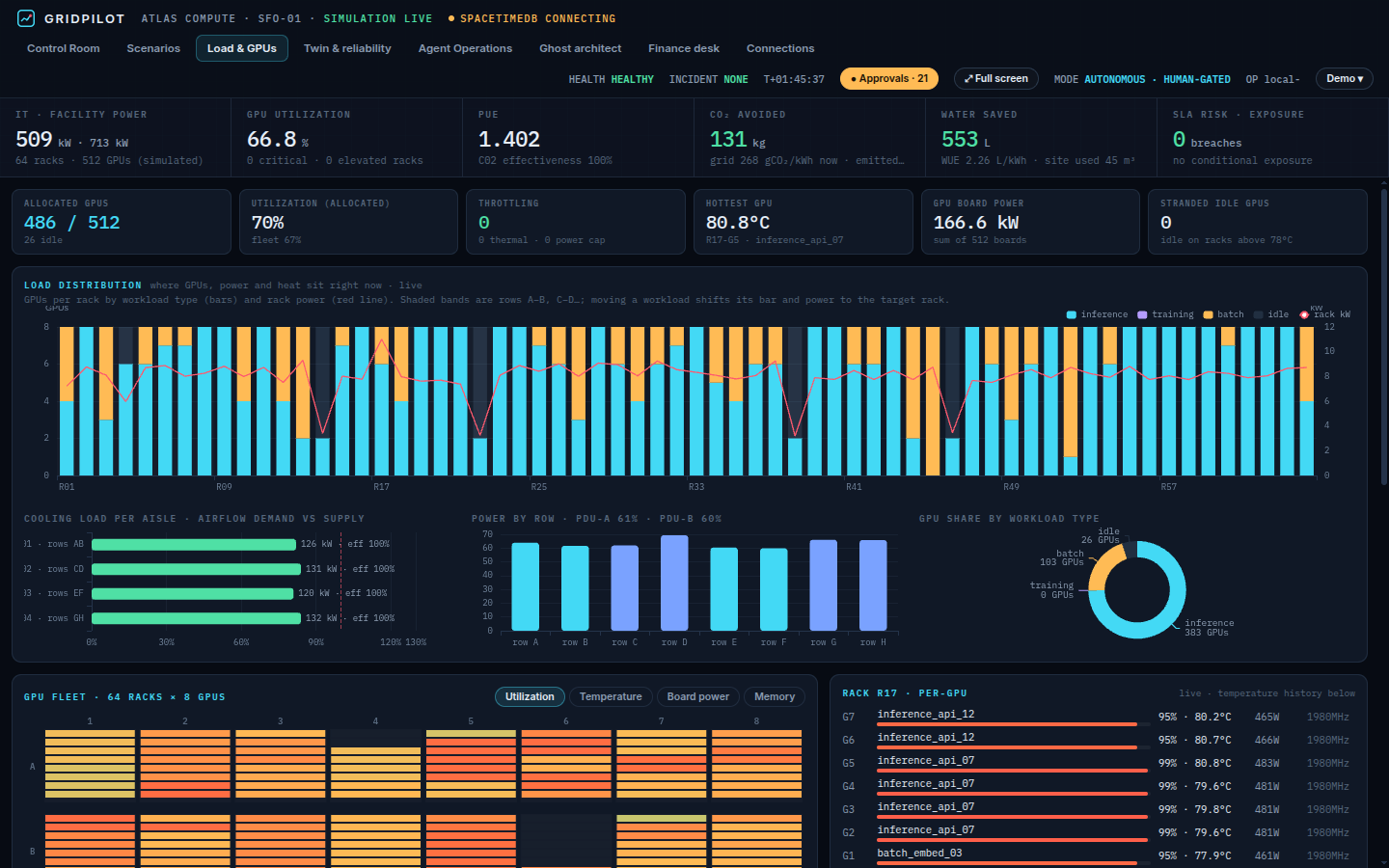 Where GPUs, power and heat sit, per rack and per GPU. |
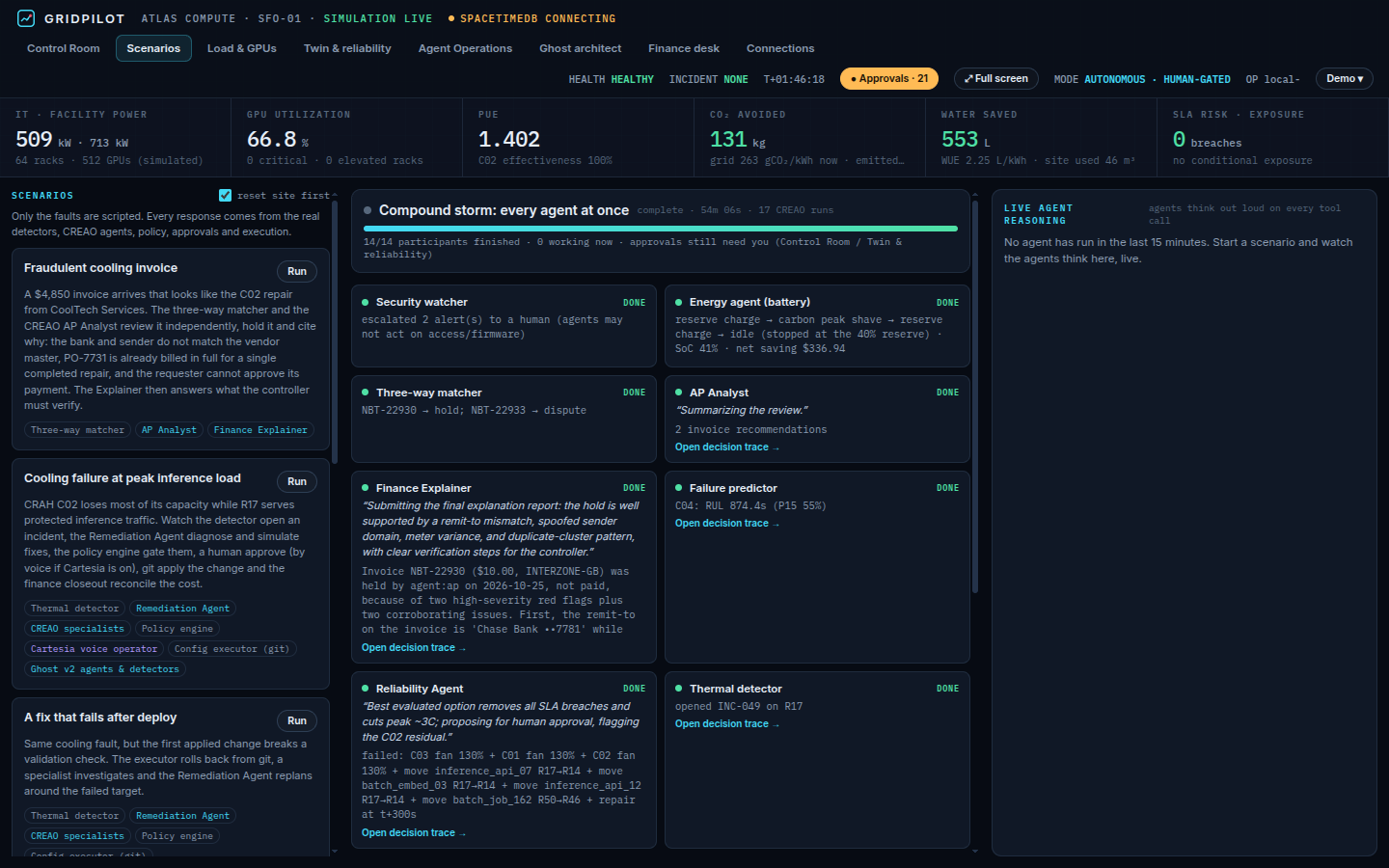 Scenarios, including the fraudulent cooling invoice and a compound storm. |
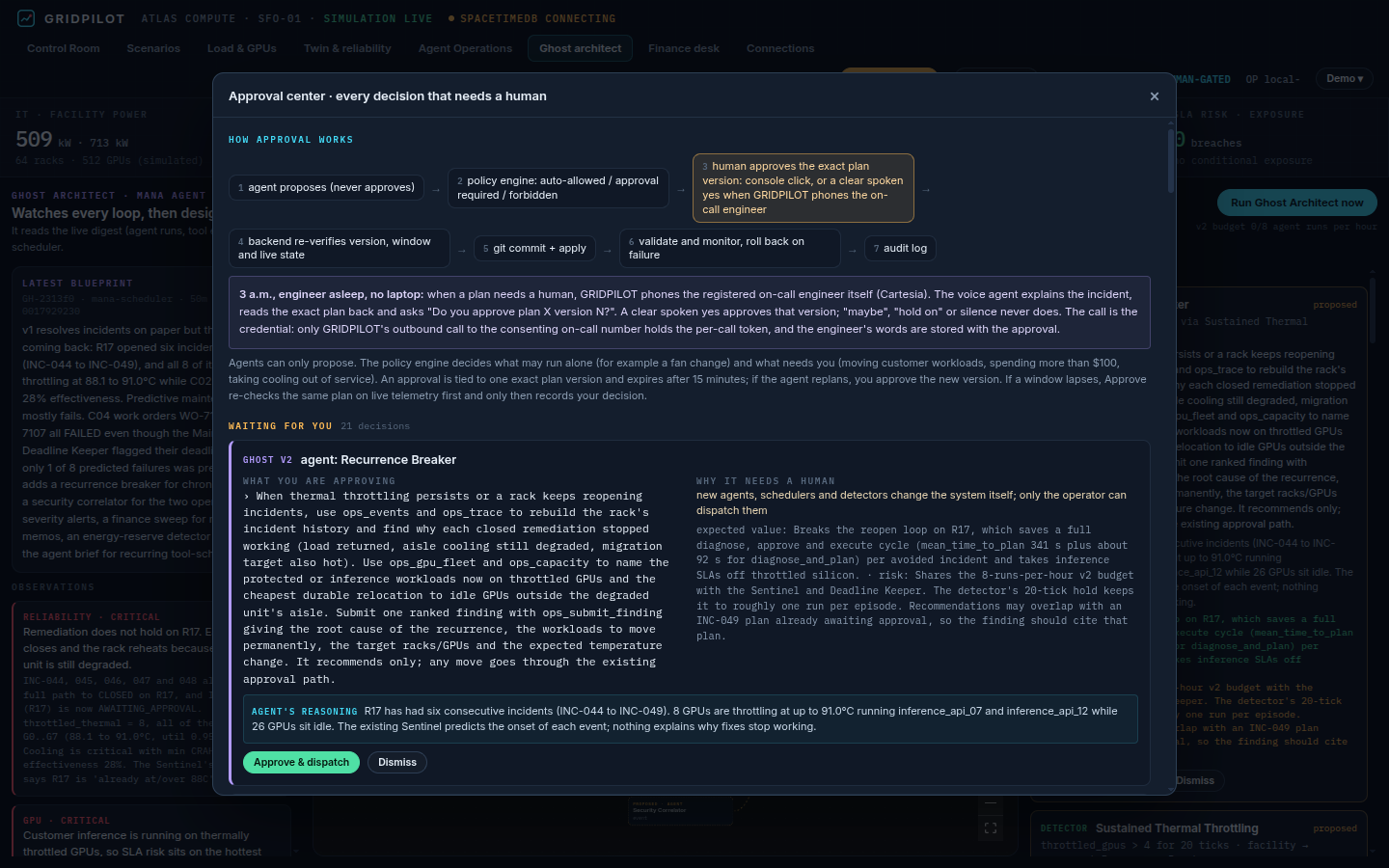 Approval center: every decision that needs a human, and why. |
Production path
The simulator is the only piece that would be replaced: telemetry from DCIM/BMS (Redfish, SNMP, Modbus), the scheduler from Slurm or Kubernetes, invoices from the AP inbox and the ERP, the bank feed from the bank. Policy, approvals, the git-backed config store, the ledger, the agents and the voice flow stay as they are. Approver identity moves to SSO, policy becomes per site, and SpacetimeDB takes over approvals as reducers so every subscriber sees the same decision log. Details in docs/TECHNICAL.md.
What we learned
- Agents are good at exploring options and explaining them; they should never be the thing that says yes. Binding approval to an exact plan version and re-checking live state before commit removed a whole class of failure.
- The most useful voice feature was not the briefing, it was letting the engineer disagree and getting a real answer back.
- Honest counterfactuals matter: our first battery policy saved money but emitted more CO₂ than no battery at all. The numbers caught it, so we fixed the policy instead of the chart.
Built with
Mana (sandbox, ingress, symbolic proxy, scheduled tasks, agents), Python (aiohttp, numpy), React, three.js, ECharts, React Flow, SpacetimeDB (TypeScript module, maincloud), CREAO Developer Platform API, Cartesia Managed Agents, git, SQLite.
Run it locally
Needs Python 3.10+ and git. No build step: the backend serves the same UI file that runs in Mana.
git clone https://github.com/pateldhruv1672/gridpilot.git && cd gridpilot
python -m venv .venv && source .venv/bin/activate      # Windows: .venv\Scripts\activate
pip install -r requirements.txt
python tests/test_finance_desk.py                       # 12/12 checks
python tests/test_incident_flow.py                      # add "fail" to test rollback
GRIDPILOT_LOCAL=1 python backend/server.py              # then open http://127.0.0.1:8787/
That gives you the simulator, 3D control room, incident engine, policy, git config store, finance desk and ledger. Use Demo → degrade C02 (or the Scenarios tab) to start an incident. Without sponsor keys, incidents stay at "CREAO disconnected" rather than faking an agent.
With sponsor integrations: copy .env.example to .env, set CREAO_CLI_KEY (cr_sk_…) and CARTESIA_API_KEY (sk_car_…), expose the server publicly (for example cloudflared tunnel --url http://127.0.0.1:8787) and set PUBLIC_BASE_URL, then set -a; source .env; set +a; python backend/server.py and open Connections → Test connections. Inside Mana the backend runs as the sandbox daemon gridpilot behind Mana ingress, identity comes from Mana sign-in, and keys go through Mana's server-side proxy. No keys or secrets are committed to this repo.
Repo layout: backend/ (aiohttp server, simulator, engine, policy, finance, agents, voice, SpacetimeDB publisher) · frontend/GridpilotApp.jsx (the Mana UI, also served locally) · stdb/ (SpacetimeDB TypeScript module) · agents/stdb_watcher.ts (Audit Watcher) · tests/ · docs/ (spec, CREAO brief, technical notes, media).
Built With
- agentic
- cartesia
- digital-twin
- hyphenate
- javascript
- python
- reactive
- self-improving-ai
- spacetimedb
- voice-agents

Log in or sign up for Devpost to join the conversation.