GridLock
Inspiration
Imagine two utilities spending millions on neighboring projects, hiring separate crews, securing separate permits, and staging separate equipment, never realizing they're only miles apart.
Now multiply that inefficiency across an entire region.
That is the problem GridLock was built to solve.
The Sperry Tech GridLock Challenge highlighted a real issue facing the power industry today: neighboring utilities often plan major transmission projects independently, even when those projects are geographically close and scheduled within similar timeframes. This lack of visibility can lead to duplicated effort, unnecessary costs, inefficient resource allocation, and missed opportunities for collaboration.
We wanted to create a platform that turns isolated planning into regional coordination.
What It Does
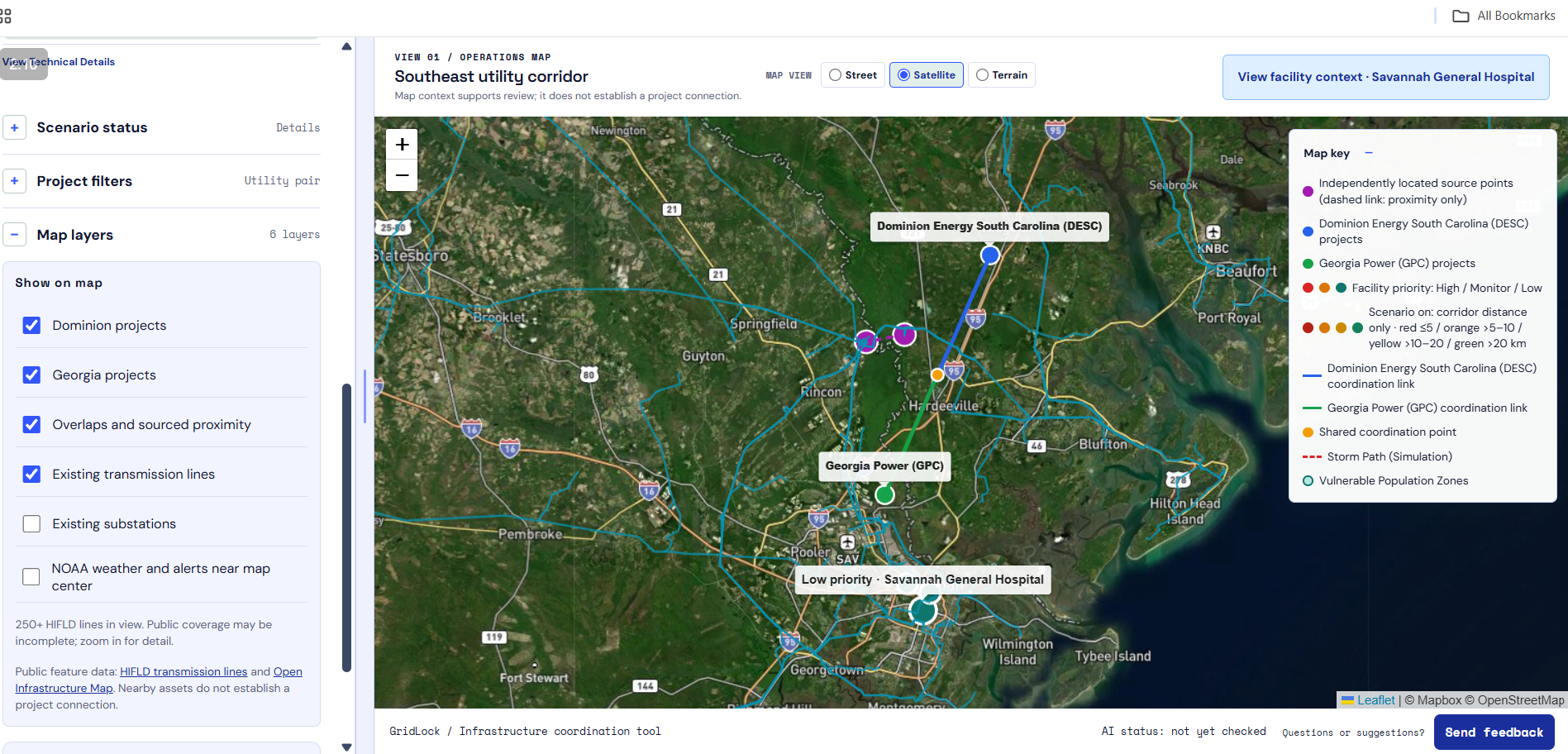
GridLock is a utility coordination platform that helps power companies identify overlapping transmission projects and discover opportunities to collaborate.
GridLock:
- Maps utility infrastructure projects from multiple utilities
- Detects geographic overlap opportunities
- Identifies timeline alignment between projects
- Ranks coordination opportunities
- Estimates potential cost savings
- Generates coordination reports
- Provides resilience and storm-planning insights
- Highlights nearby critical infrastructure
Instead of asking utilities to manually compare hundreds of pages of planning documents, GridLock automatically surfaces the projects that matter most.
How We Built It
We combined publicly available transmission planning data from Dominion Energy South Carolina and Georgia Power and transformed it into a unified planning experience.
Core components include:
- Interactive mapping and infrastructure visualization
- Geographic overlap detection using distance calculations
- Opportunity ranking and prioritization
- Cost savings estimation models
- Storm and resilience planning views
- Coordination reporting tools
- Executive-facing dashboards
The platform was built using modern web technologies and designed to be easy enough for planners, executives, and regulators to understand without requiring a technical background.
Challenges We Ran Into
One of the biggest challenges was turning utility planning documents into usable geographic data.
Transmission plans often contain project descriptions, names, and timelines but not always precise coordinates. We had to match infrastructure locations, validate project information, and determine meaningful overlap opportunities.
Another challenge was designing the experience itself.
We initially focused heavily on data, maps, and technical details. However, we quickly realized that decision-makers don't need more data, they need better decisions.
This led us to redesign the platform around coordination opportunities, cost savings, shared resources, and actionable recommendations rather than raw GIS information.
What We Learned
Throughout this project, we learned that infrastructure planning is as much a communication problem as it is an engineering problem.
Even when utilities have similar goals, coordination becomes difficult when information is fragmented across organizations.
We also learned the importance of translating technical analysis into clear business outcomes. Identifying an overlap is useful, but explaining how that overlap can reduce costs, improve project delivery, and strengthen resilience is where the real value exists.
What's Next
Our vision for GridLock extends far beyond a hackathon.
Future versions could include:
- Multi-state utility coordination
- Real-time outage awareness
- Automated resource-sharing recommendations
- Shared planning workspaces
- Regional resilience modeling
- Utility-to-utility collaboration workflows
- FERC 1920 planning support
GridLock's mission is simple:
Help utilities see what they can't currently see, coordinate what they can't currently coordinate, and build a stronger, more resilient grid together.
Built With
- api


Log in or sign up for Devpost to join the conversation.