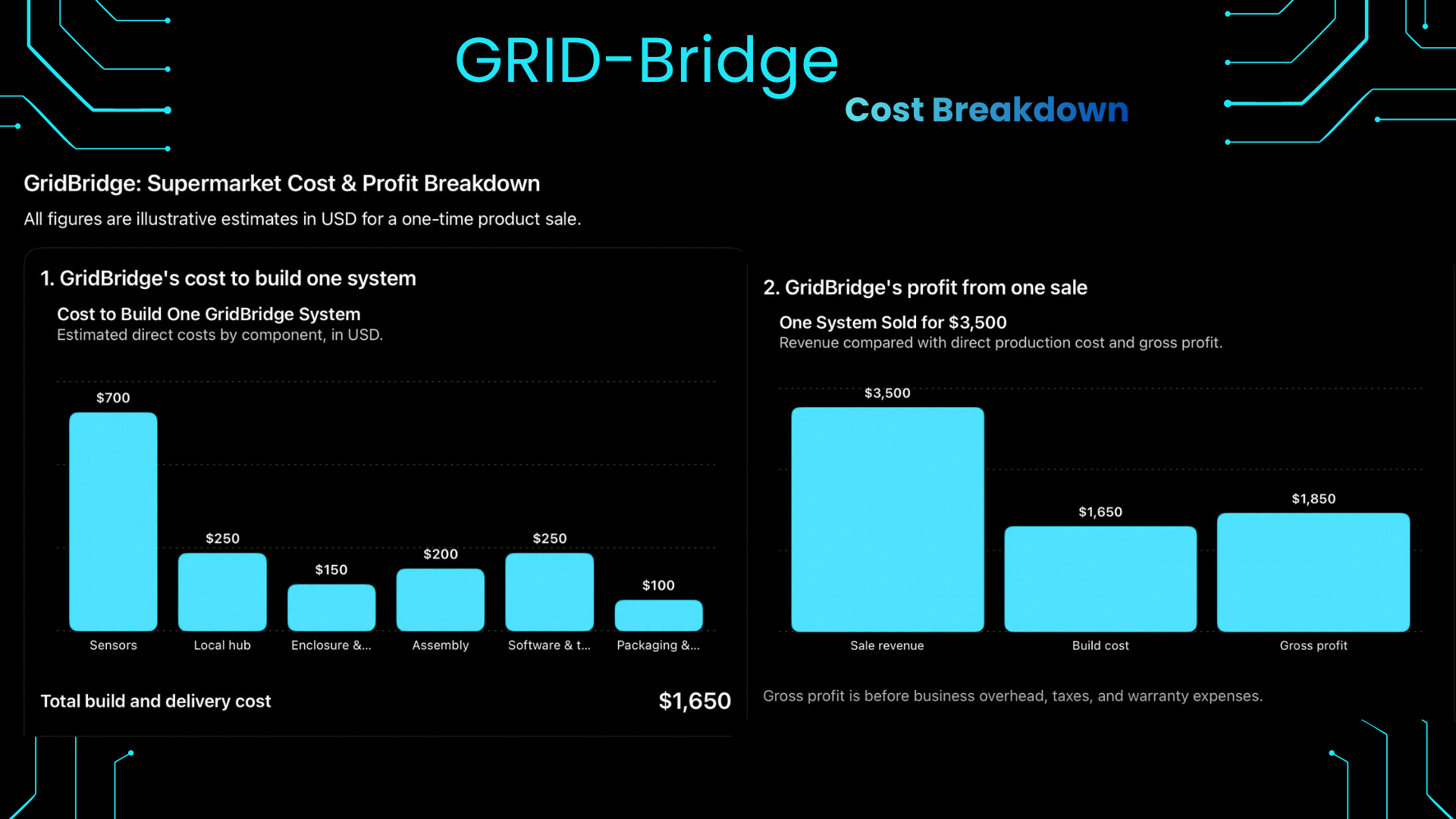
Back in 2019 a disastrous meteorological phenomenon called Hurricane Durian took the lives of 74 individuals who lived in the Bahamas, specifically on the islands of Grand Bahama and Abaco, 1 death in Puerto Rico and 4 indirect deaths in The United States. Despite these astronomical numbers, there is no guarantee of the actual death toll, as thousands of people were displaced and hundreds were initially and still are listed as missing. These deaths could’ve been prevented, but sadly due to gaps in how warnings and emergency information reached people, limited access to media, damaged infrastructure and intermittent communications that made it difficult for families to contact loved ones and for emergency responders to identify people needing assistance, lives were lost.
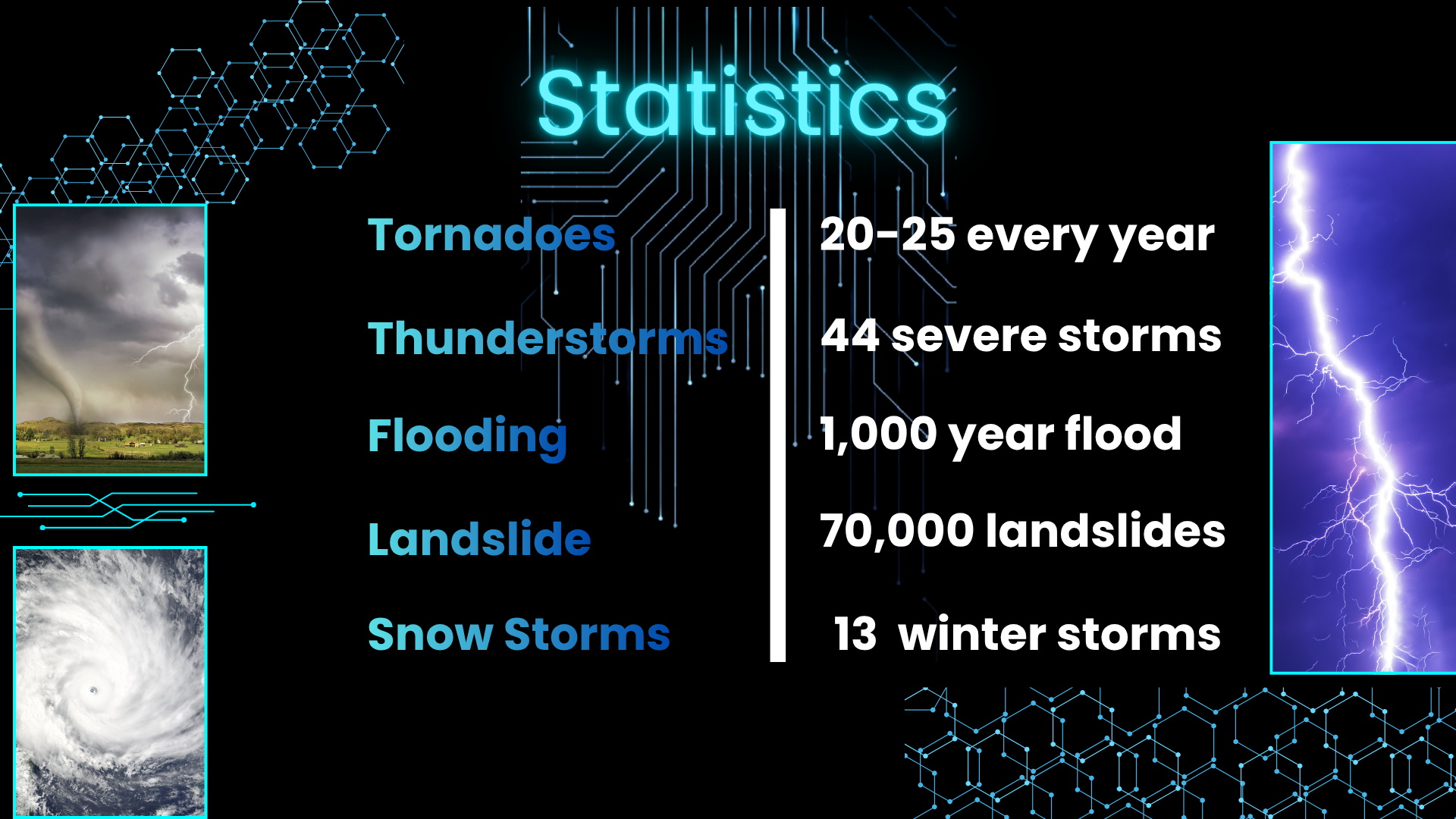
According to the Center for Disaster Philanthropy, as of October 2024, 44 U.S. floods had each caused at least $1 billion in damage. These events caused at least 738 deaths, and the average annual cost associated with them was reported as $4.5 billion. All because warnings didn’t arrive in time and communication channels are limited, people were confused on the right measures to take and simply because often the warning arrives late, leaving very little time to react.
When lives and billions of dollars are being lost, all because our infrastructure crumbles under the pressure of storms and floods. All because of poor information distribution. In this age of modernization, where the ability to learn and produce a plethora of technological advancements is at our fingertips, it is crucial to utilize our resources to solve problems and improve our communities. This is when GRID-Bridge comes into play!
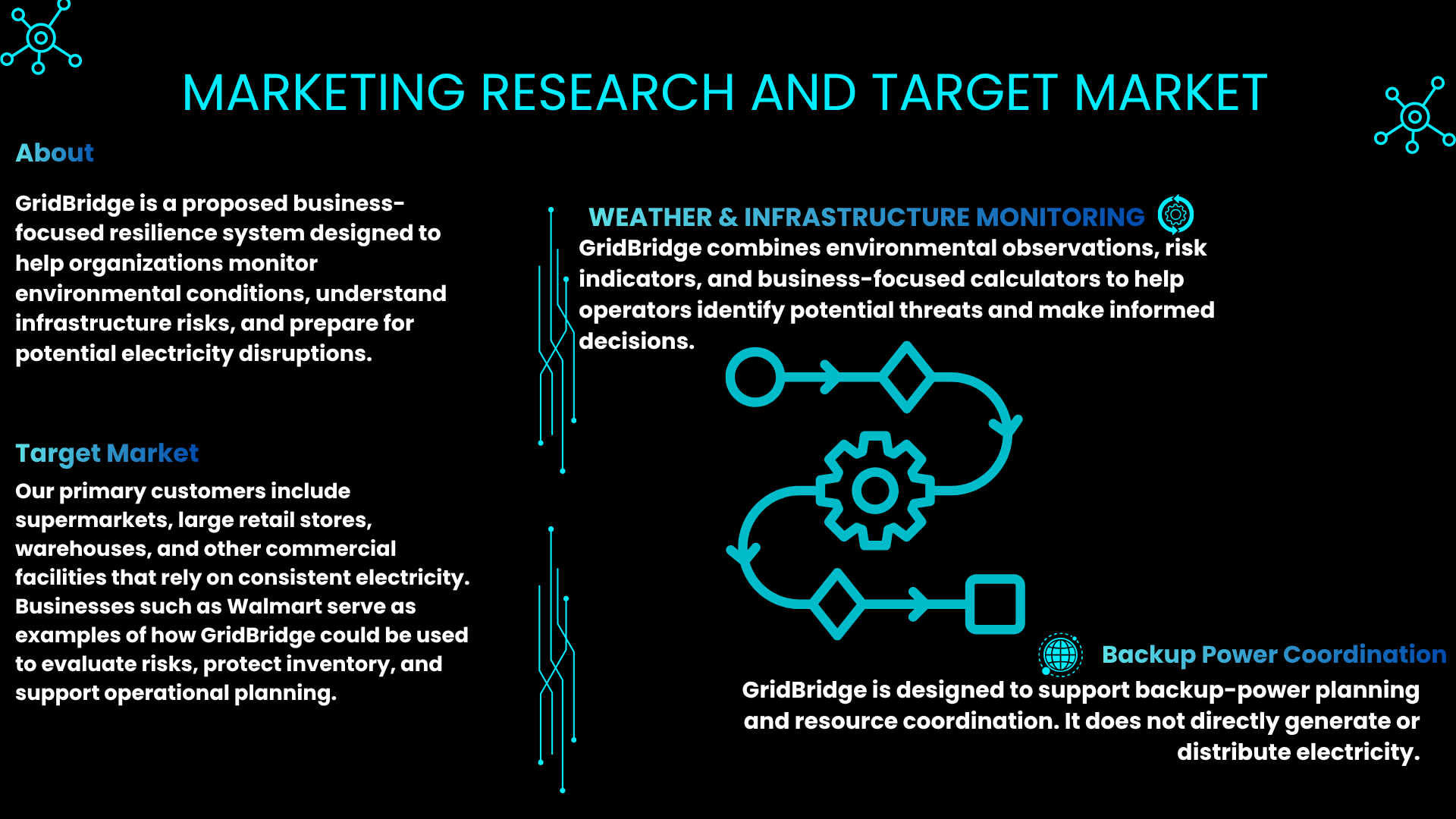
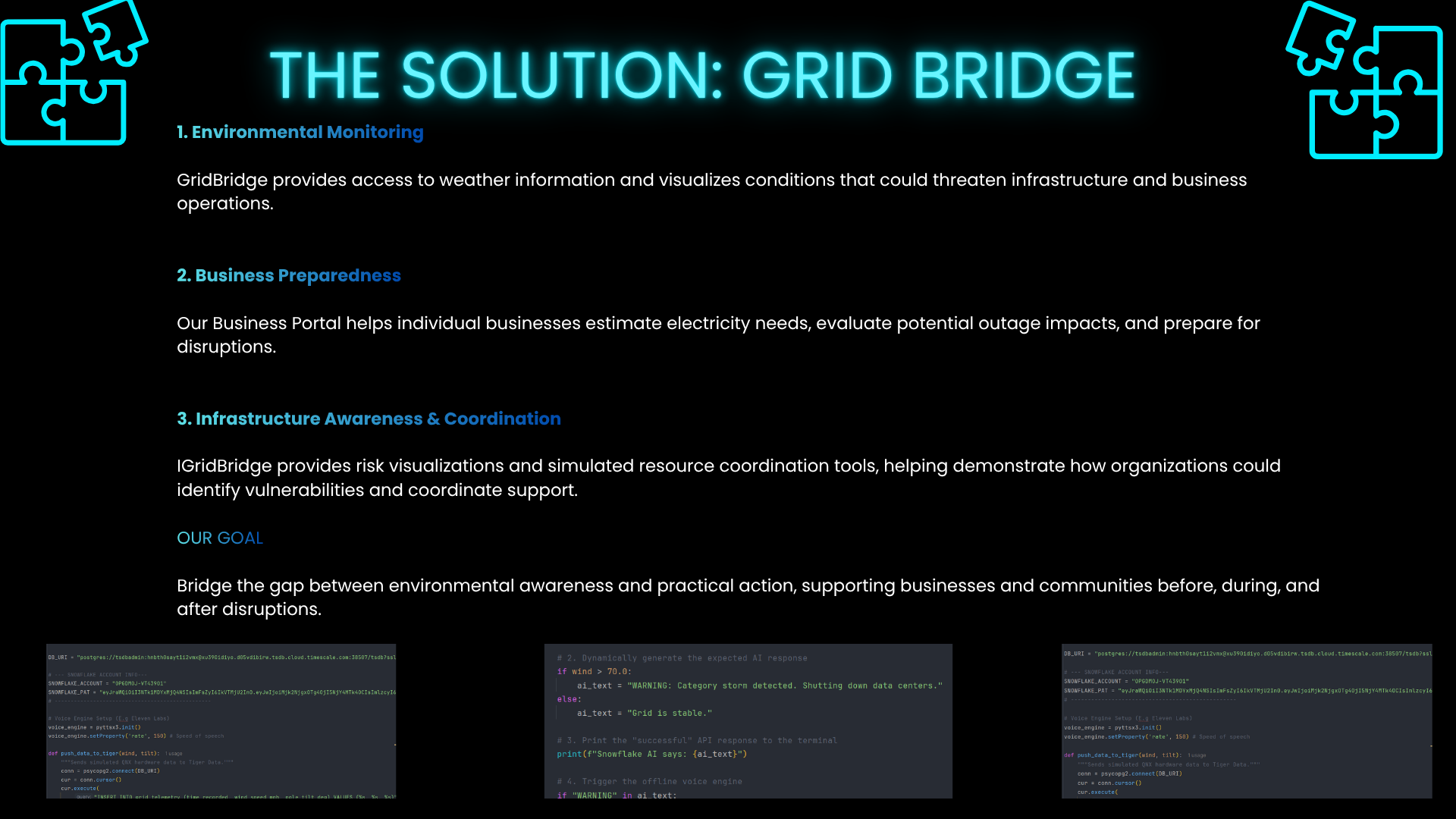
GRID-Bridge is an interconnected network that utilizes collected data from sensors placed in meteorological stations to monitor weather and notify individuals of potential threats. It also provides a built in chatbot assistance to connect communities with local reinforcements and emergency services. In the case of power outages to essential infrastructure needed to support rescue efforts, the second pertinent feature of GRID-Bridge takes center stage.
We call it the electricity management protocol. In this instance, Infrastructure registered in the system will be assigned a corresponding ID, and based on exposure ratings to storms and Backup power storages be supplied the power needed to maintain it’s operations despite power outages. A generator doesn't automatically mean resilience. During flooding, backup power may itself be exposed to hazards. GRID-Bridge distinguishes between available capacity, verified safe operability, and actual service continuity, while flagging unknowns for human assessment. Our goal isn't simply to keep the power on, it's to help protect the critical services communities depend on.
The app makes its determination on which infrastructure to power is primarily based on the following mathematical equations and functions:
R= 0.30E+0.25C+0.15B+0.20S+0.10A Where every factor is scored from 0–100, with higher values meaning greater concern.
Factor Weight What it measures:
E — Exposure 30% Exposure to flooding, storm surge, wind, or other hazards C — Criticality 25% How essential the facility is to the community B — Backup vulnerability 15% How limited its backup duration is S — Safe-operability risk 20% Whether backup equipment and electrical systems are verified safe to operate A — Access vulnerability 10% Whether roads and access routes are clear, uncertain, or blocked
Backup vulnerability (B): Keep your existing duration scale: Estimated backup duration: (B) 0–4 hours 100 5–8 hours 75 9–12 hours 50 13–24 hours 25 More than 24 hours 0
Safe-operability risk (S): This is the factor that accounts for the electrical hazard.
Verification status: (S) Qualified personnel verified equipment is safe to operate 0 Safety concerns identified; assessment required 75 Equipment confirmed unsafe to operate 100 Unknown or not assessed Unknown — flag for review
Example: Harbor Medical Center
Exposure =90 Criticality =100 Backup vulnerability =75 Safe-operability risk =75, assuming a safety concern has been identified Access vulnerability = 50
R=0.30(90)+0.25(100)+0.15(75(+0.20(75)+0.10(50)= 81.25/100
Illustrative risk score 81.25 / 100 High-priority review candidate under this prototype's scoring method. The score helps prioritize assessment; it does not authorize switching electrical equipment on or off. A qualified facility operator must determine whether equipment is safe to use.
Once given the access needed, the backup power stored in one the power storage units that utilize natural forms of power (solar, hydropower and wind) will be triggered, and allow power to flow through the infrastructure needed, hence keeping operations open.
GRID-Bridge was designed around one central idea: communities need more than warnings that a storm is approaching; they need a way to understand which risks require attention first and how to coordinate an effective response. To address this, we developed a concept that brings together weather monitoring, infrastructure risk assessment, emergency information, and backup-power management within one interconnected platform.
The system uses a proposed network of meteorological and environmental sensors to monitor conditions such as rainfall, flooding, and other potential hazards. The collected information can be presented through a centralized dashboard, allowing users to identify affected areas and receive relevant alerts. We also incorporated a chatbot concept intended to help users access emergency information and connect with local assistance.
A second major component is our electricity management protocol. Each registered critical facility is assigned an identification number and assessed according to its exposure to hazards, importance to the community, backup-power vulnerability, electrical safety status, and accessibility. These factors contribute to a weighted risk score that helps identify facilities requiring urgent assessment.
Rather than treating every facility equally, GRID-Bridge aims to provide a more structured approach to prioritizing limited resources. Renewable energy sources, including solar and wind, may support backup-power systems where appropriate, while hydropower may be relevant to suitable installations. However, backup activation and electrical switching must depend on verified equipment compatibility, safe operating conditions, and authorization by qualified personnel.
By bringing these functions together, GRID-Bridge aims to bridge the gap between detecting a disaster-related threat and taking informed action to protect the services communities depend on.
One of our biggest challenges was determining how to prioritize critical infrastructure when several facilities may require assistance simultaneously. During a hurricane, hospitals, communication towers, emergency shelters, supermarkets, and water facilities can all experience disruptions. However, available resources may not be sufficient to address every problem at once.
To approach this challenge, we developed a weighted risk-scoring method that considers environmental exposure, community importance, backup-power limitations, electrical safety, and accessibility. Determining appropriate weights was difficult because each factor has different implications for public safety. We recognized that the resulting score is a prototype decision-support tool, not a scientifically validated prediction or an automatic authorization to distribute electricity.
Another challenge was accounting for uncertainty. Sensor data may be incomplete, communications may fail, and infrastructure conditions may change rapidly during a storm. A facility might have backup power available but lack safe access, or its electrical equipment might be exposed to flooding. Consequently, GRID-Bridge must distinguish between information that has been verified and information that remains unknown.
We also recognized that connecting communities with emergency services is not simply a software problem. The usefulness of a chatbot depends on reliable information, current contact details, functioning communication channels, and coordination with legitimate emergency organizations. These challenges reinforced the importance of designing GRID-Bridge to support human decision-making rather than replace trained emergency personnel.
One of our most important accomplishments was developing a unified concept that addresses several connected aspects of disaster preparedness rather than treating weather warnings, infrastructure monitoring, and emergency coordination as separate problems.
We are particularly proud of the electricity management protocol. By considering not only how important a facility is but also its hazard exposure, backup duration, electrical safety, and accessibility, the system offers a structured way to identify locations that may require further assessment.
We are also proud of establishing a clear mathematical framework for the prototype’s risk-scoring process. Its weighted formula makes the factors contributing to a facility’s score visible and explainable, helping users understand why one location may be prioritized for review over another.
Most importantly, GRID-Bridge is built around a community-centered objective. The ultimate purpose is not simply to collect more data or introduce another technological platform. It is to help communities make better-informed decisions, protect essential services, and potentially reduce preventable losses during hurricanes and floods.
Developing GRID-Bridge helped us understand that disaster resilience requires more than advanced technology. A sensor can detect a dangerous condition, but its value depends on whether the information reaches the right person, whether that person understands the warning, and whether a safe and effective response is possible.
We also learned that prioritization systems must balance urgency with uncertainty. A high risk score can identify a facility that deserves immediate review, but it cannot independently determine which facility should receive electricity or authorize personnel to operate potentially hazardous equipment. Reliable decisions require verified information, qualified human judgment, and clear safety procedures.
Another important lesson was the need to distinguish between a proposed capability and a demonstrated result. Our weighted scoring formula provides a starting point for organizing risk information, but its effectiveness must be tested against real or appropriately simulated scenarios. Similarly, the effectiveness of our alerting and coordination features will depend on communication reliability, data quality, and the availability of local emergency resources.
Ultimately, we learned that technology is most valuable when it translates complex information into practical decisions. GRID-Bridge seeks to do precisely that by making disaster-related risks easier to understand and response priorities easier to communicate.
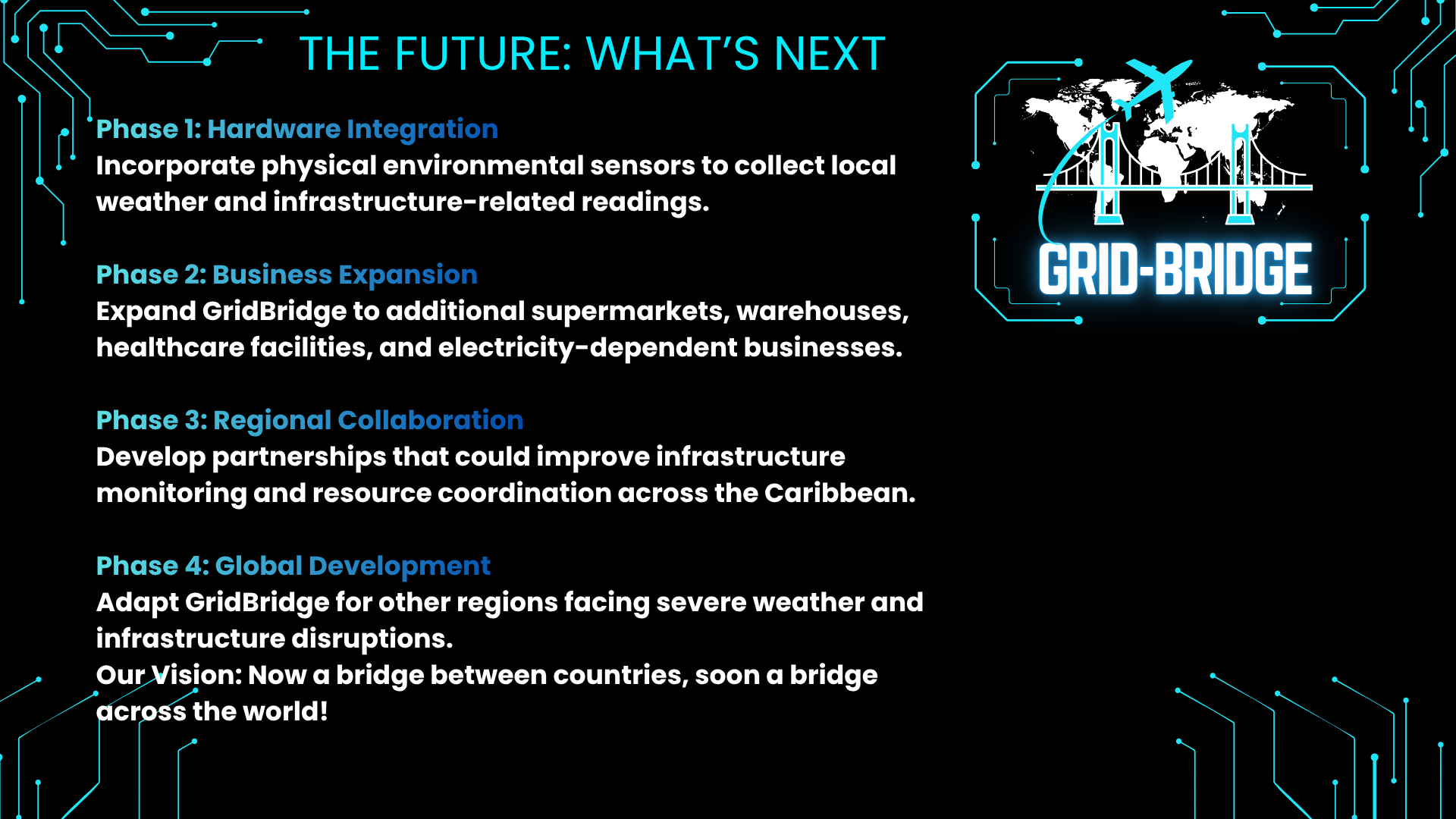
Our next step is to transform the GRID-Bridge concept into a working prototype that demonstrates how its components operate together. We plan to develop a centralized dashboard displaying registered facilities, simulated or real sensor readings, hazard alerts, backup-power status, and explainable risk scores. Simulated information will be clearly identified so that users can distinguish demonstrations from verified real-world data.
We also intend to develop and test the emergency-assistance chatbot, focusing on providing dependable information, directing users toward appropriate local resources, and communicating limitations when internet or other communication services become unavailable.
For the electricity management protocol, future development will focus on testing the scoring method against different disaster scenarios, refining the weighting of its factors, and incorporating explicit verification of backup-power availability and safe operability. Any physical power-management functionality would require appropriate engineering design, protective controls, and qualified professional oversight before deployment.
Beyond the prototype, we hope to collaborate with supermarkets, hospitals, hotels, emergency-management organizations, utility providers, and Caribbean communities to understand their needs and evaluate the system in realistic conditions. These partnerships could help us determine whether GRID-Bridge improves response times, prioritization consistency, information accessibility, and preparedness.
Our long-term vision is to create a scalable and practical disaster-resilience platform that helps communities prepare before a storm, coordinate their response during an emergency, and recover more effectively afterward.
GRID-Bridge is founded on a simple principle: we may not be able to prevent hurricanes, but we can work toward ensuring that communities are better informed, critical services are better prepared, and decisions are made with safety and resilience in mind.

