-
-
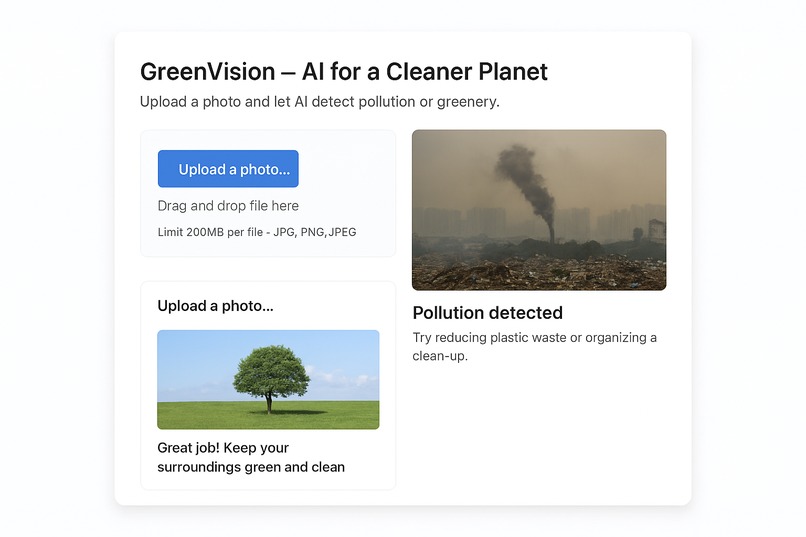
GreenVision in action Upload a photo and our AI detects pollution or greenery, providing eco-friendly tips to help keep the planet clean.
Inspiration
Inspiration
The idea for GreenVision came from observing how cities and communities often overlook visible signs of pollution — piles of waste, smoky skies, and disappearing greenery. While technology is advancing rapidly, environmental awareness still lags behind. So I thought — what if AI could literally “see” pollution and help people act on it? That’s where GreenVision was born — an AI tool that detects pollution or greenery from images and offers simple, eco-friendly suggestions to make our planet cleaner.
🧠 What It Does
GreenVision allows users to upload a photo — of a street, park, or any environment — and instantly analyzes it using AI. It classifies the image into polluted or green categories and provides actionable eco-tips such as:
“Organize a local clean-up drive”
“Avoid single-use plastic”
“Keep planting trees in your area”
This makes sustainability interactive and visual — turning awareness into daily action.
🛠️ How We Built It
The project was built using:
🐍 Python as the core programming language
⚙️ Streamlit for building a simple, responsive AI dashboard
🤖 Pre-trained CNN (ResNet/YOLO) model for image feature detection
📁 OpenCV + PIL for image handling and preprocessing
💾 NumPy, TensorFlow (lite) for lightweight AI processing
All of this is combined into a local web app where users can test images, see results instantly, and learn eco-friendly actions.
💡 AI in Action
The AI model uses computer vision to analyze image patterns such as:
High color noise, smoke, or trash = pollution indicators
Green pixels, trees, or clean surfaces = greenery indicators
The model then maps results to a recommendation engine, which displays short eco-tips to promote awareness and positive behavior.
🧩 Challenges We Faced
Building GreenVision wasn’t easy. Some major challenges included:
🧪 Finding or simulating an accurate dataset for pollution detection
⚙️ Integrating AI smoothly within Streamlit’s real-time interface
🧠 Making AI predictions explainable to non-technical users
⏱️ Managing limited time before the hackathon deadline 😅
Despite that, every challenge led to learning — from model optimization to designing a clean and intuitive UI.
📚 What We Learned
How to integrate AI models into real-time web apps
The importance of balancing accuracy vs. speed in image classification
That even a simple AI can inspire massive environmental awareness
And most importantly — teamwork, creativity, and fast prototyping in hackathon environments
🌍 Future Plans
In the next phase, I plan to:
Add real-time camera detection for live monitoring
Integrate geo-location tagging to map polluted areas
Train on specialized environmental datasets (e.g., TrashNet, GreeneryNet)
Launch GreenVision as a mobile app for public use
❤️ Conclusion
GreenVision isn’t just an AI demo — it’s a reminder that technology can drive change when used with purpose. With GreenVision, I hope to make sustainability visible, actionable, and AI-driven. Together, we can build a greener, smarter, and cleaner planet. 🌎💚
What it does
How we built it
Challenges we ran into
Accomplishments that we're proud of
What we learned
What's next for GreenVision – AI for a Cleaner Planet
Built With
- numpy
- opencv
- pil
- python
- scikit-learn
- streamlit
- tensorflow


Log in or sign up for Devpost to join the conversation.