-
-
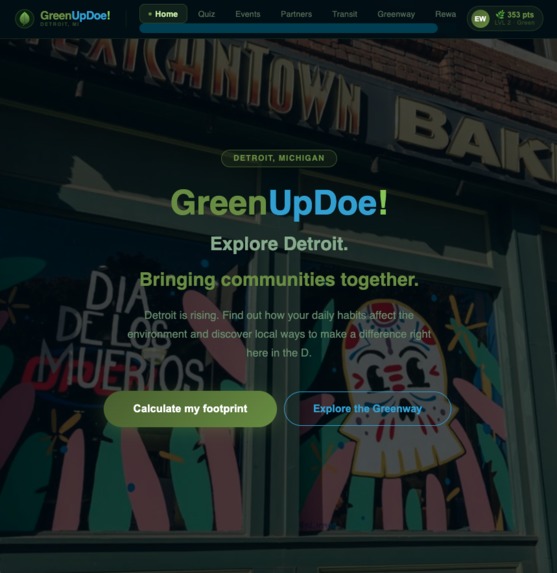
Home Page
-
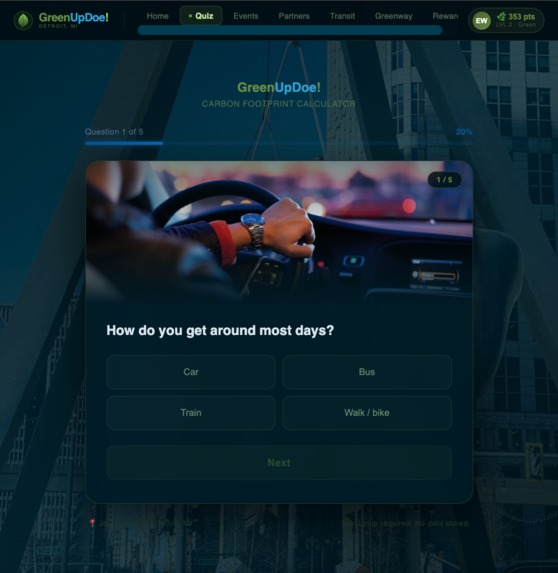
Quiz Page
-
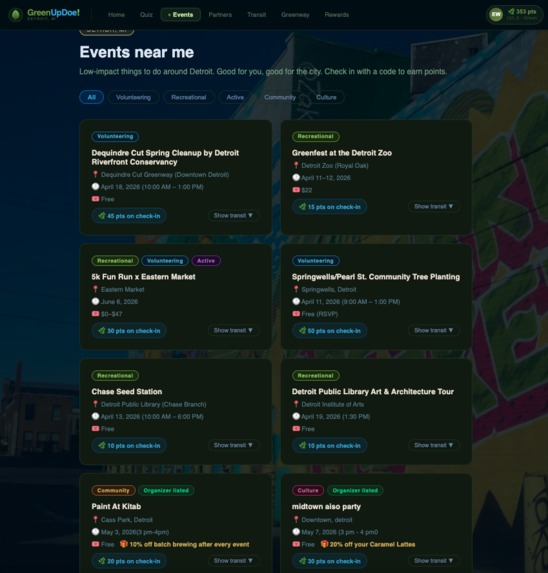
Events Page
-
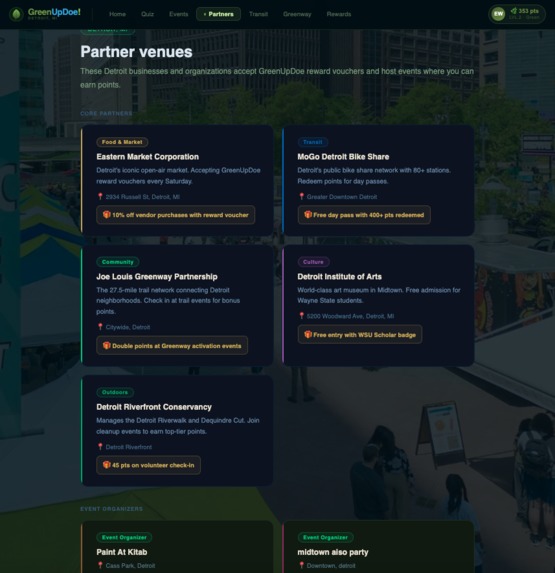
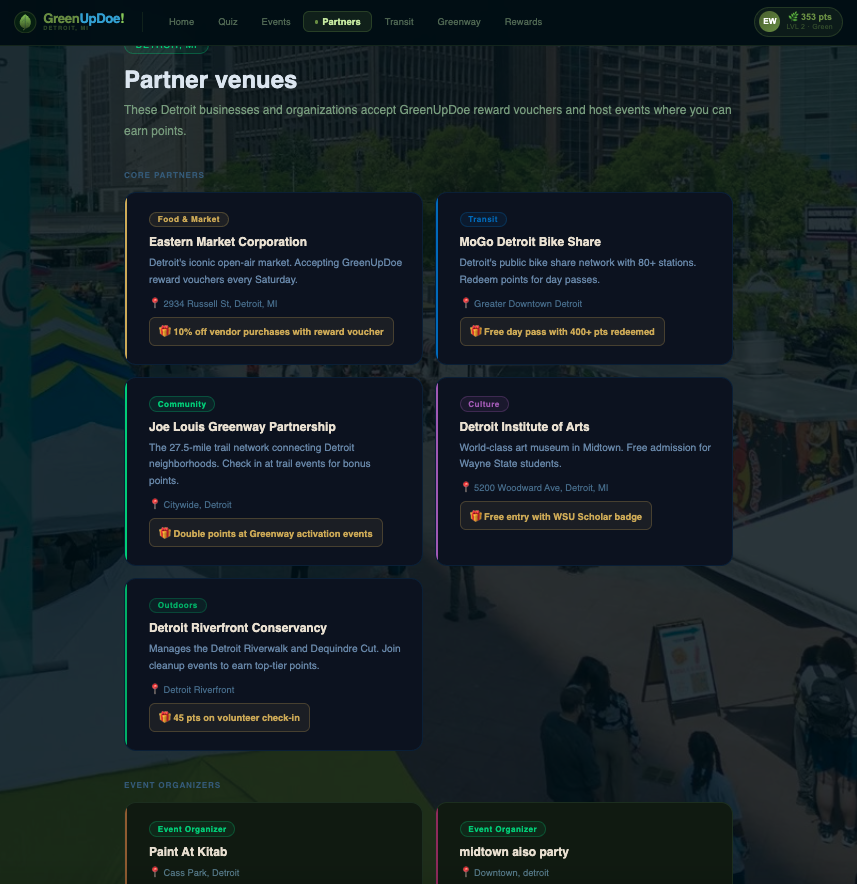
Partner
-
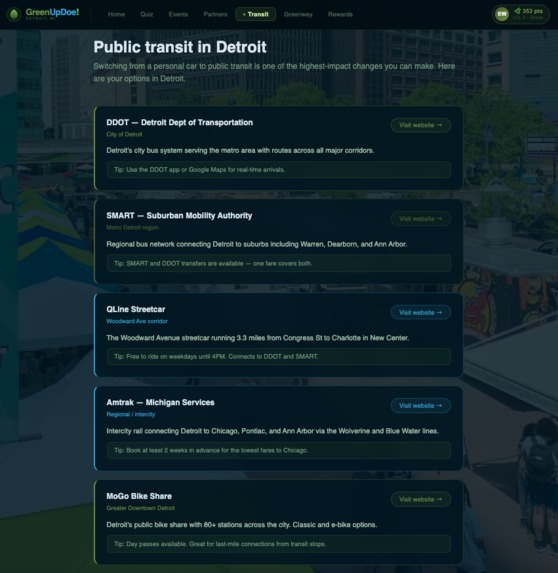
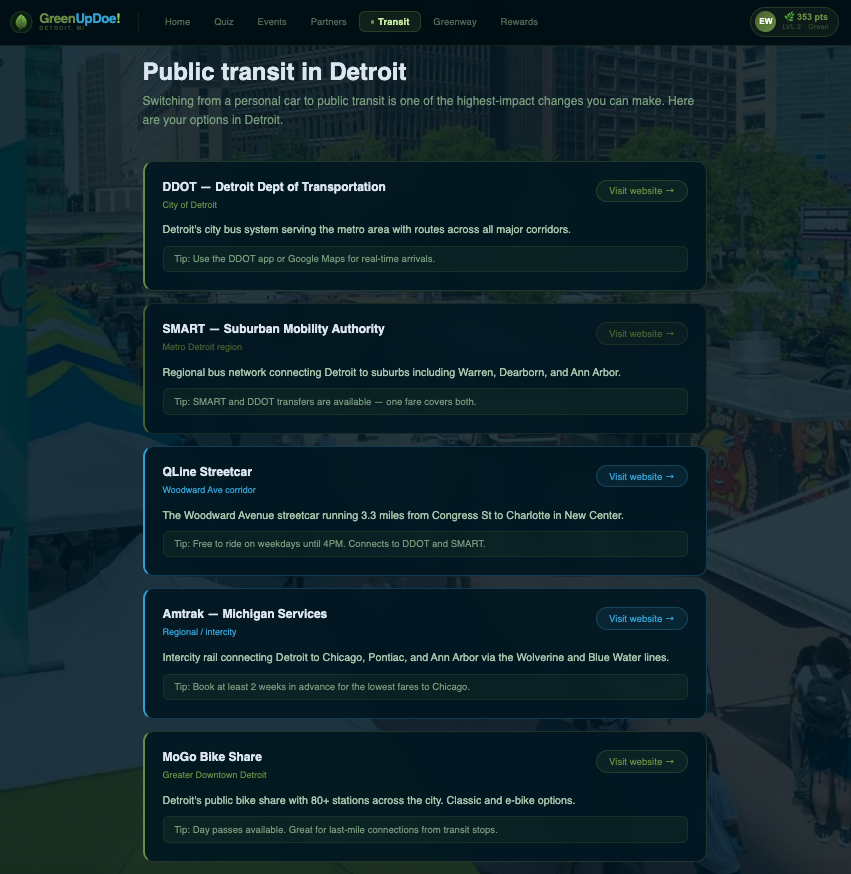
Transit Page
-
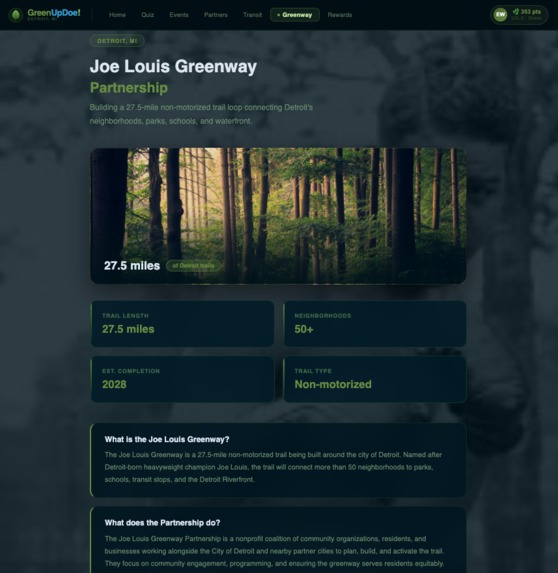
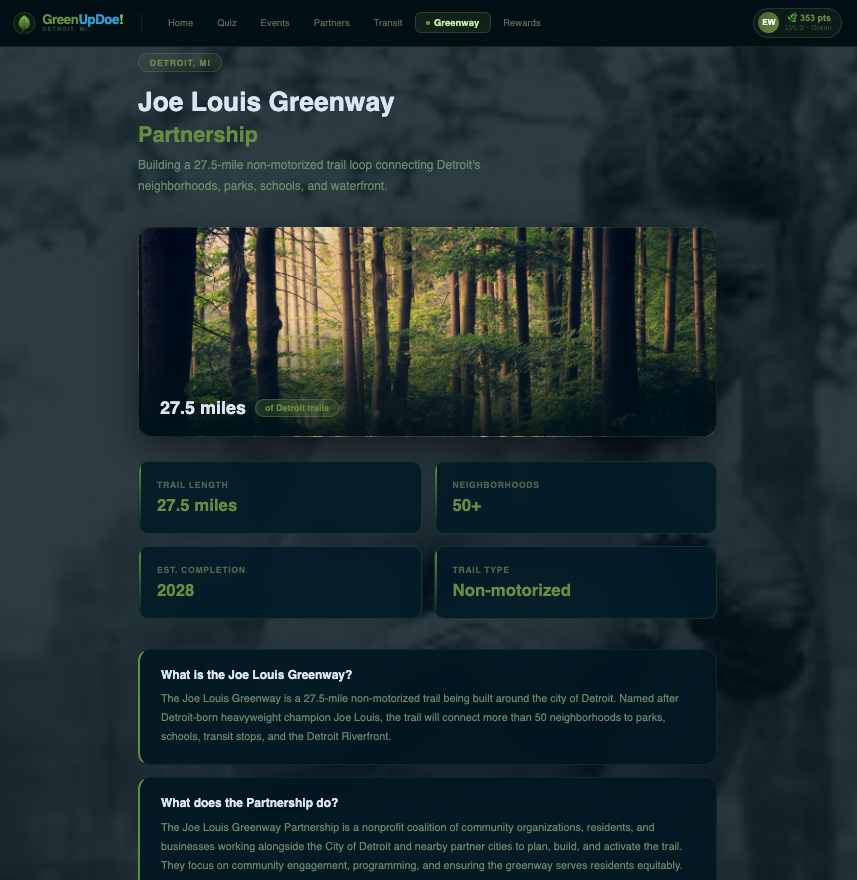
Joe Louis Greenway Page
-
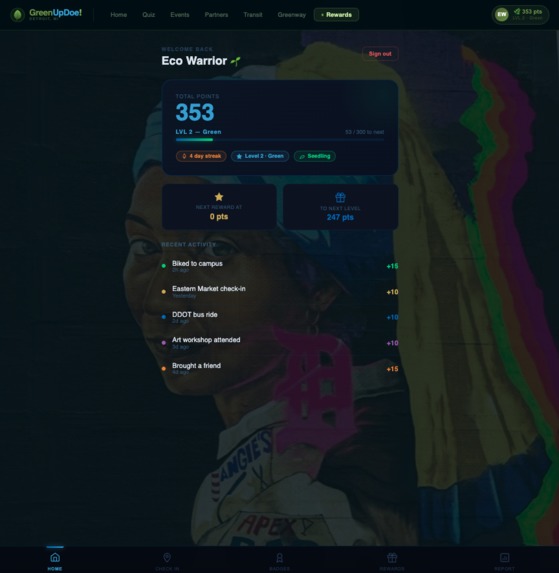
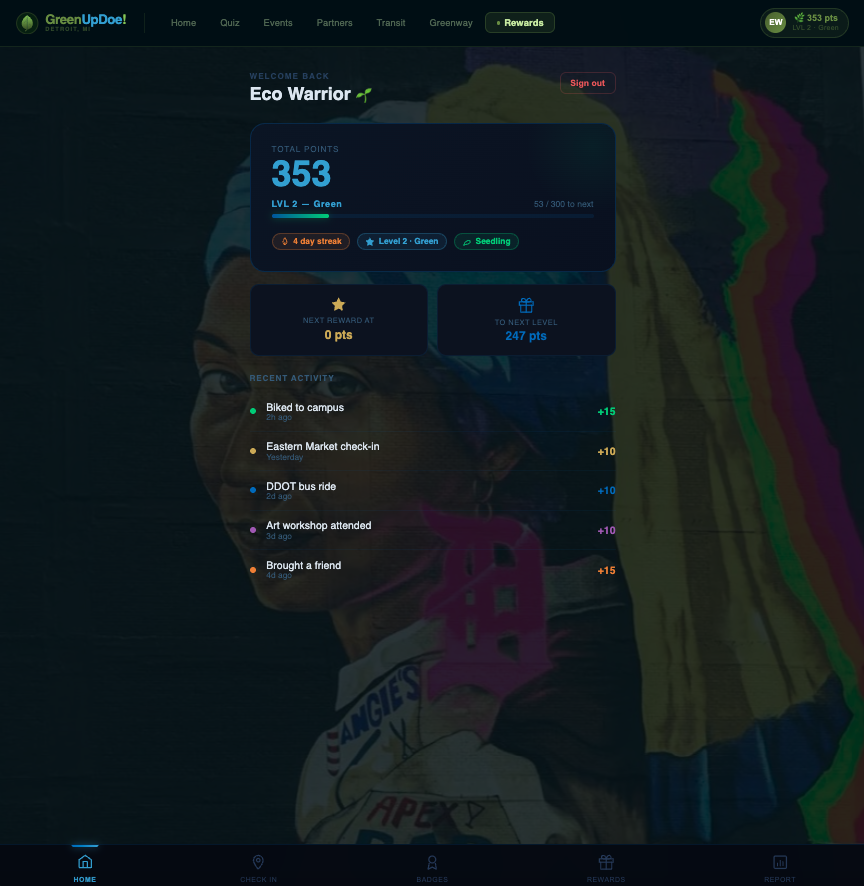
User Rewards Page
-
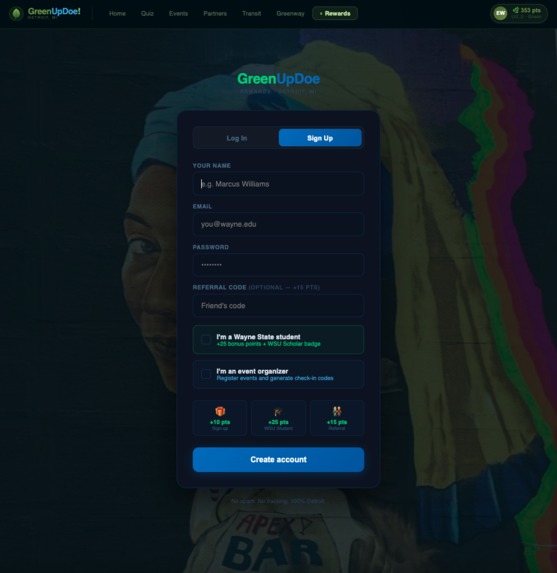
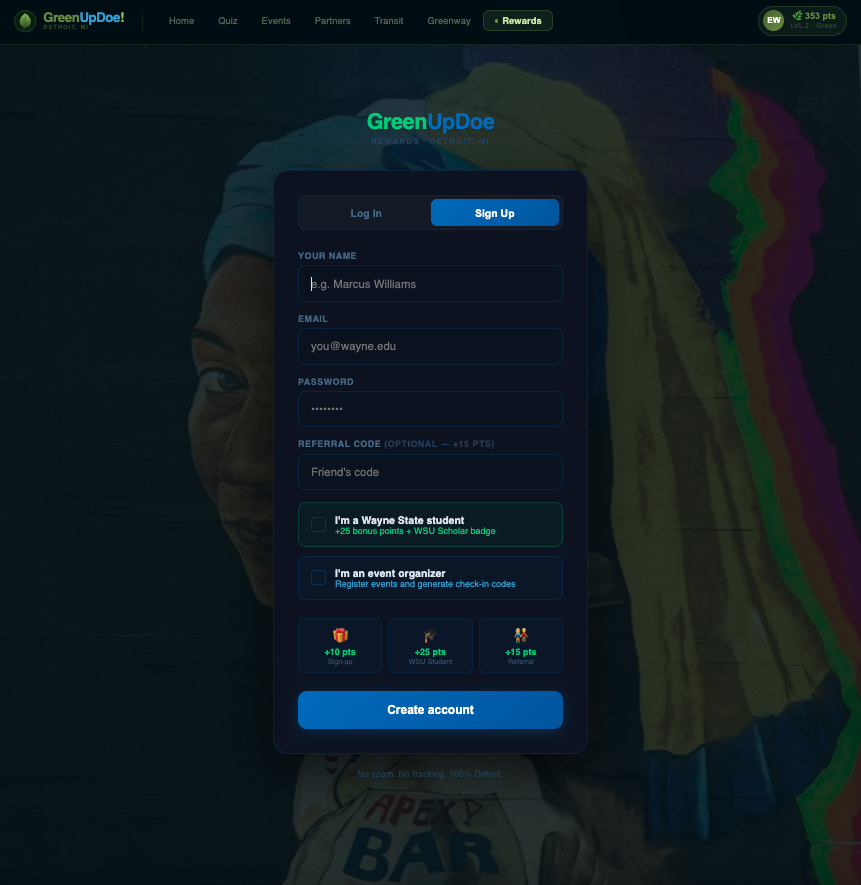
Sign Up Page
-
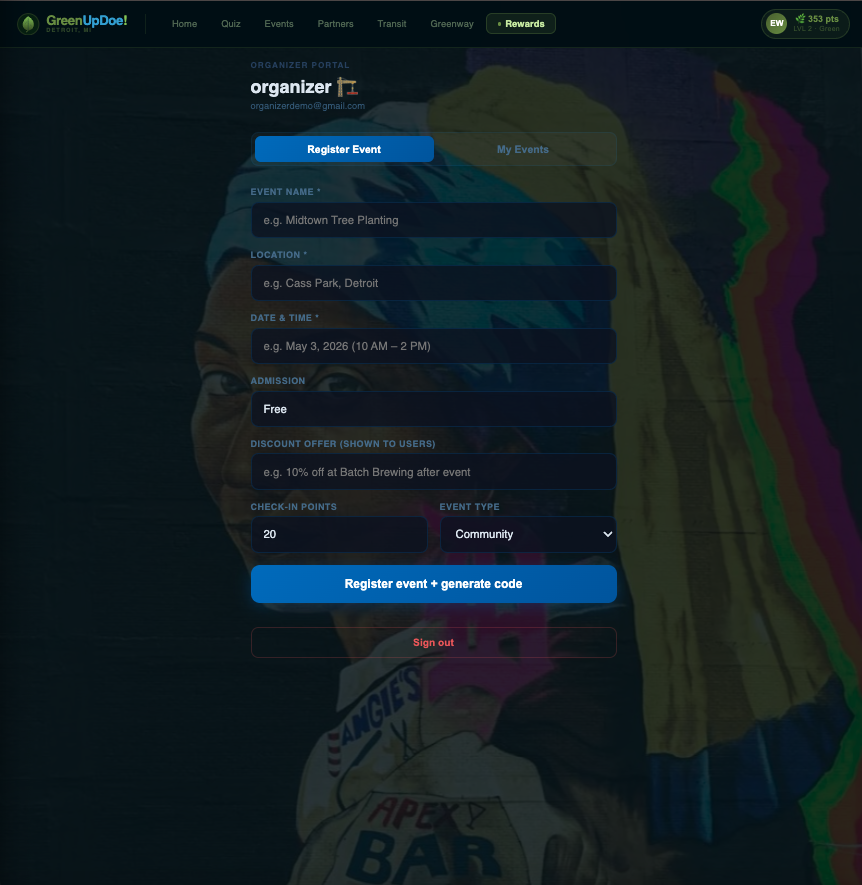
Organizer Portal Page
Inspiration
The Joe Louis Greenway is being built, an addition was recently made to the Riverfront, and we’re seeing a lot of vendor events for local businesses here in Detroit. There's genuine momentum around making the city more livable, sustainable, and community-centered. However, other carbon footprint tools don’t tell us how to make sustainable changes within our own community.
We wanted to build something that felt like it belonged to Detroit. Something that didn't just tell you your footprint but actually pointed you toward the bus route, the bike share station, the cleanup event happening this weekend. The city already has the pieces: DDOT, MoGo, the QLine, and the Greenway, so our goal is to connect these sustainable resources to the individual.
Students here live, commute, and eat in Detroit every day. That felt like the right starting point for something that could eventually grow into a real community tool.
What it does
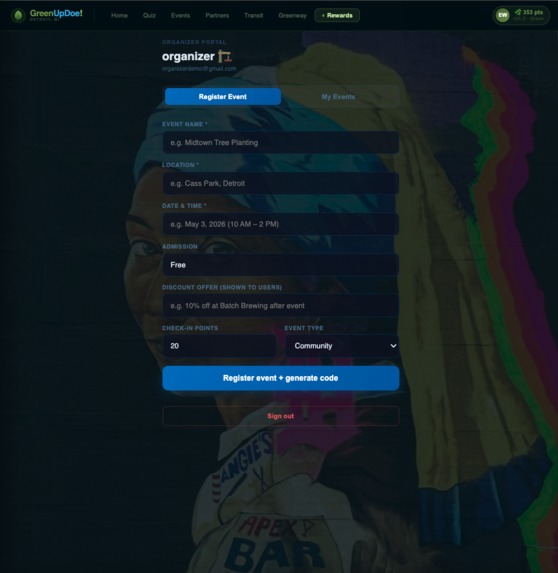
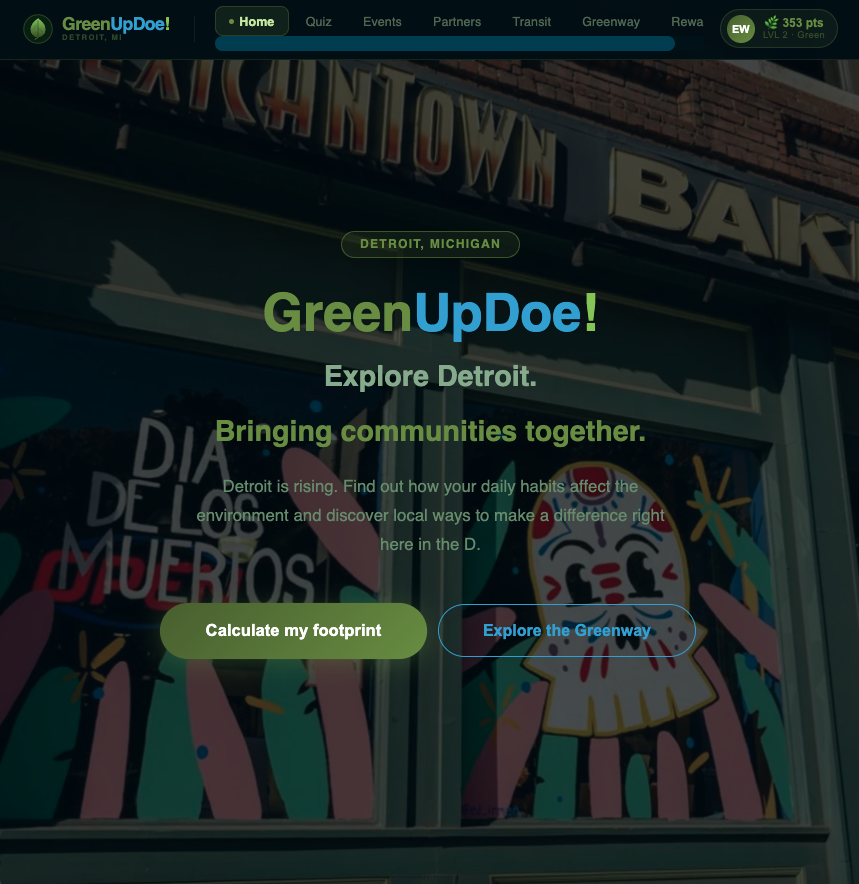
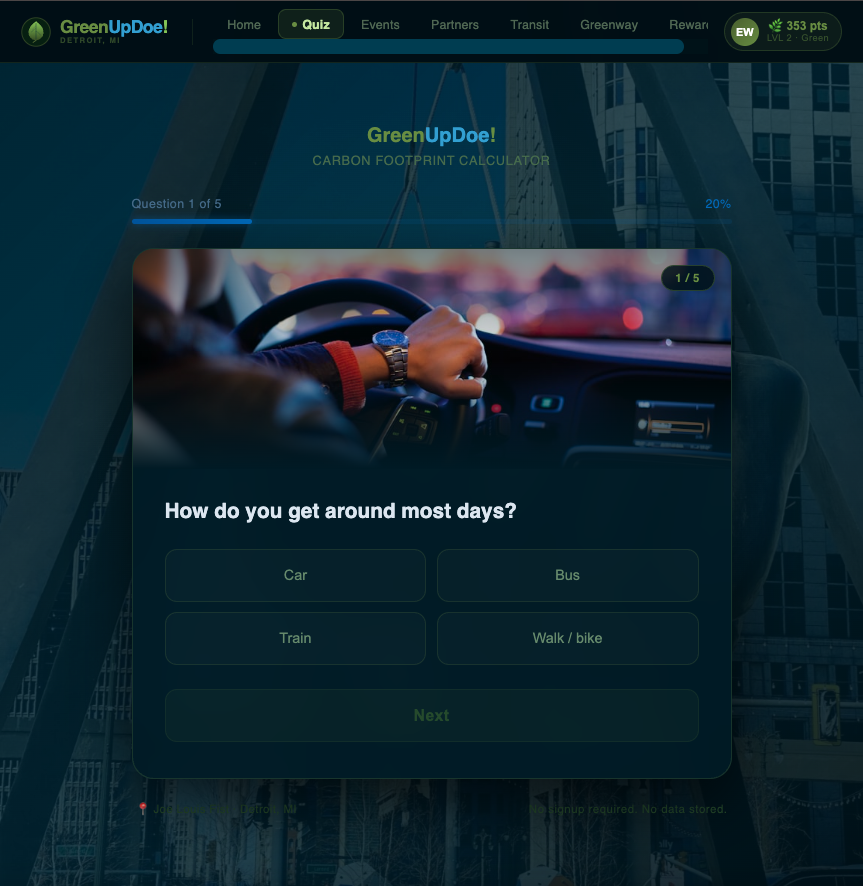
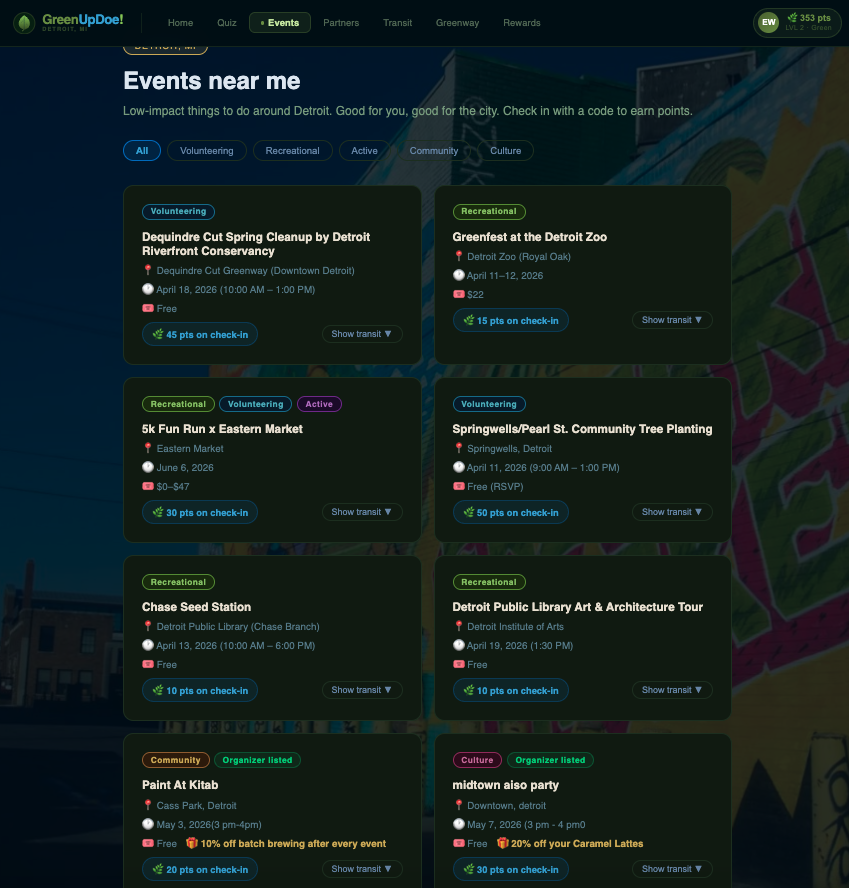
GreenUpDoe is a Detroit-focused sustainability web app that lets you calculate your personal carbon footprint through a quick 5-question quiz. It shows you a breakdown of your emissions by category, transport, diet, energy, and flights, gives you an action plan with tips to reduce them, and connects you to local Detroit events, transit options, and partners where you can actually do something about it. There's also a rewards system where you earn points for attending events and checking in with organizers. Organizers are also able to register their events.
How we built it
We built GreenUpDoe using React for the frontend and a Node.js/Express backend. The quiz collects five answers and sends them to the backend, which runs the emissions math against a JSON file of carbon factors. Results come back instantly with a breakdown and tips pulled from a curated suggestion pool based on your highest-emission categories.
For the rewards and events system, we kept everything in localStorage so users don't need to sign up or log in to use the core features. The check-in flow uses session state to track points and streaks. We used Recharts for the radial score visualization on the results page and React Router to handle navigation across the seven pages.
The whole thing was built during the 24-hour hackathon window using VS Code.
Challenges we ran into
The first challenge we encountered was finding an alternative to using a Gemini AI API, despite being a sustainability-centered web app. We understand the environmental implications of relying on AI to run our application, and we recognized that if we continued with this approach, we would need to be transparent with our users. Ultimately, we moved toward completely eliminating this aspect to stay in line with our mission.
Another problem we considered is that, currently, our app has no concrete way to confirm that users are commuting to events and locations around Detroit through sustainable modes of transportation.
Accomplishments that we're proud of
We’re proud of the fact that we were able to curate a set of real, research-backed tips mapped to each emission category instead of a generative AI API to stay aligned with our mission.
Getting a fully functional full-stack app shipped in 24 hours with a team that came in with mixed experience levels. The carbon calculator actually works; the math is grounded in real emissions data, not made-up numbers, so when someone gets their result, it means something.
We're also proud of how Detroit-specific the web app feels. It's not a generic sustainability app; it references real transit options like DDOT, SMART, and the QLine, real venues like Cadillac Park and the Detroit Riverfront, and real infrastructure like the Joe Louis Greenway, making the demo realistic. The rewards and events system came together better than we expected. The check-in flow, organizer registration, point tracking, and voucher generation all work end-to-end. We kept the scope tight and actually finished it, which honestly felt like the biggest win.
What we learned
We learned what it actually takes to go from an idea to a working product in a single day. That gap is bigger than it sounds.
On the technical side, we got hands-on experience structuring a full-stack app from scratch, setting up the backend, wiring it to the frontend, managing state across multiple pages, and making design decisions under the pressure of time constraints.
Working as a team through the night taught us a lot, too. Communication mattered more than any individual's technical skill. Knowing who was building what, checking in constantly, and not going dark for two hours on a feature nobody else knew about, that stuff determined whether the project came together or fell apart.
Aside from the technical aspects of this project, we learned & put into practice product development. While working on our idea, we had to consider what kind of feedback we would receive from businesses and users, and implement solutions for the problems we encountered into our web app. The entire roadmap of starting with user stories, then defining functional and non-functional requirements, was vital to the app development process.
What's next for GreenUpDoe!
The organizations we built around, the Joe Louis Greenway Partnership, QLine, MoGo, and DDOT, are all contributing to a sustainable future. GreenUpDoe! could slot in as a community engagement layer on top. Imagine the Joe Louis Greenway Partnership using the check-in system to reward trail volunteers, or Eastern Market vendors accepting GreenUpDoe vouchers on Saturdays. The infrastructure for that is already in the app; it just needs real partners behind it.
The next step would be reaching out to these organizations directly, starting with the Greenway Partnership, since the mission overlap is the strongest. A pilot, even just one event with real check-in codes and a handful of users, would prove the concept without needing to rebuild anything. Long term, this could tie into Detroit's sustainability initiatives too, giving students and residents a local, points-based reason to engage with the city beyond campus and outside of their neighborhood.
Built With
- css
- express.js
- html
- javascript
- localstorageapi
- node.js
- react
- react-router
- recharts


Log in or sign up for Devpost to join the conversation.