-
-

GreenTrace
-
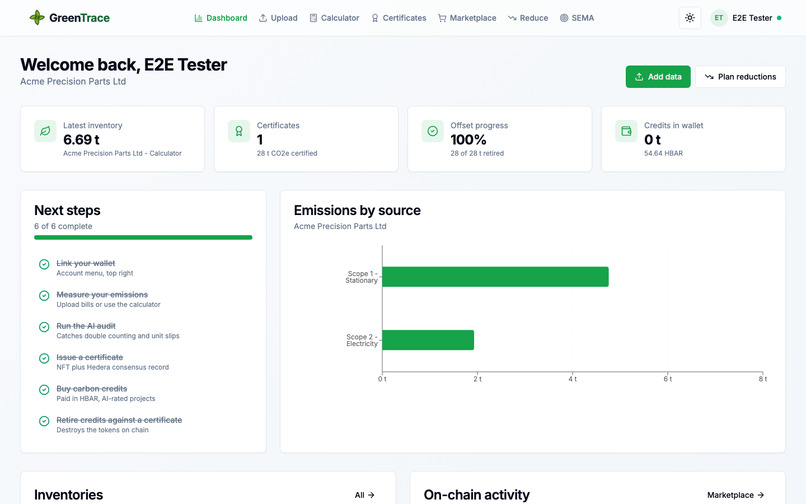
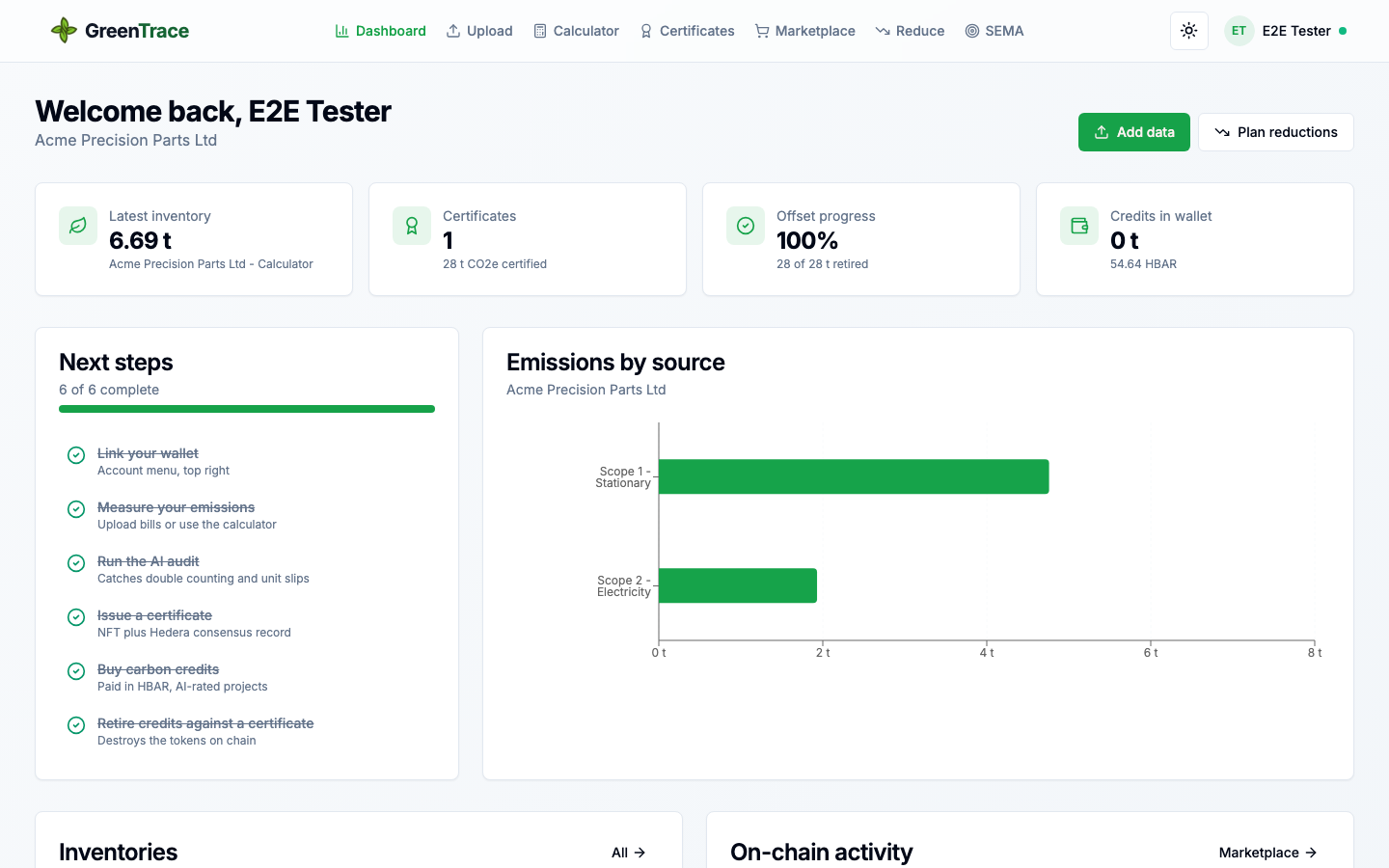
Dashboard
-
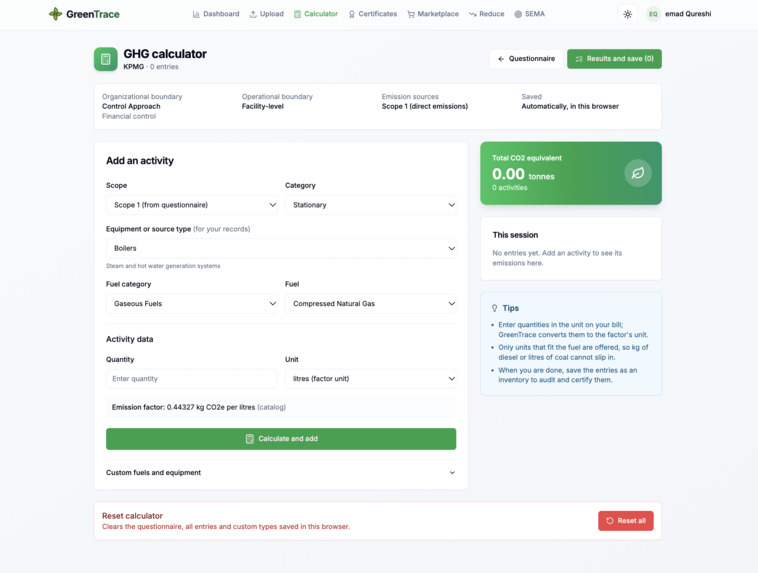
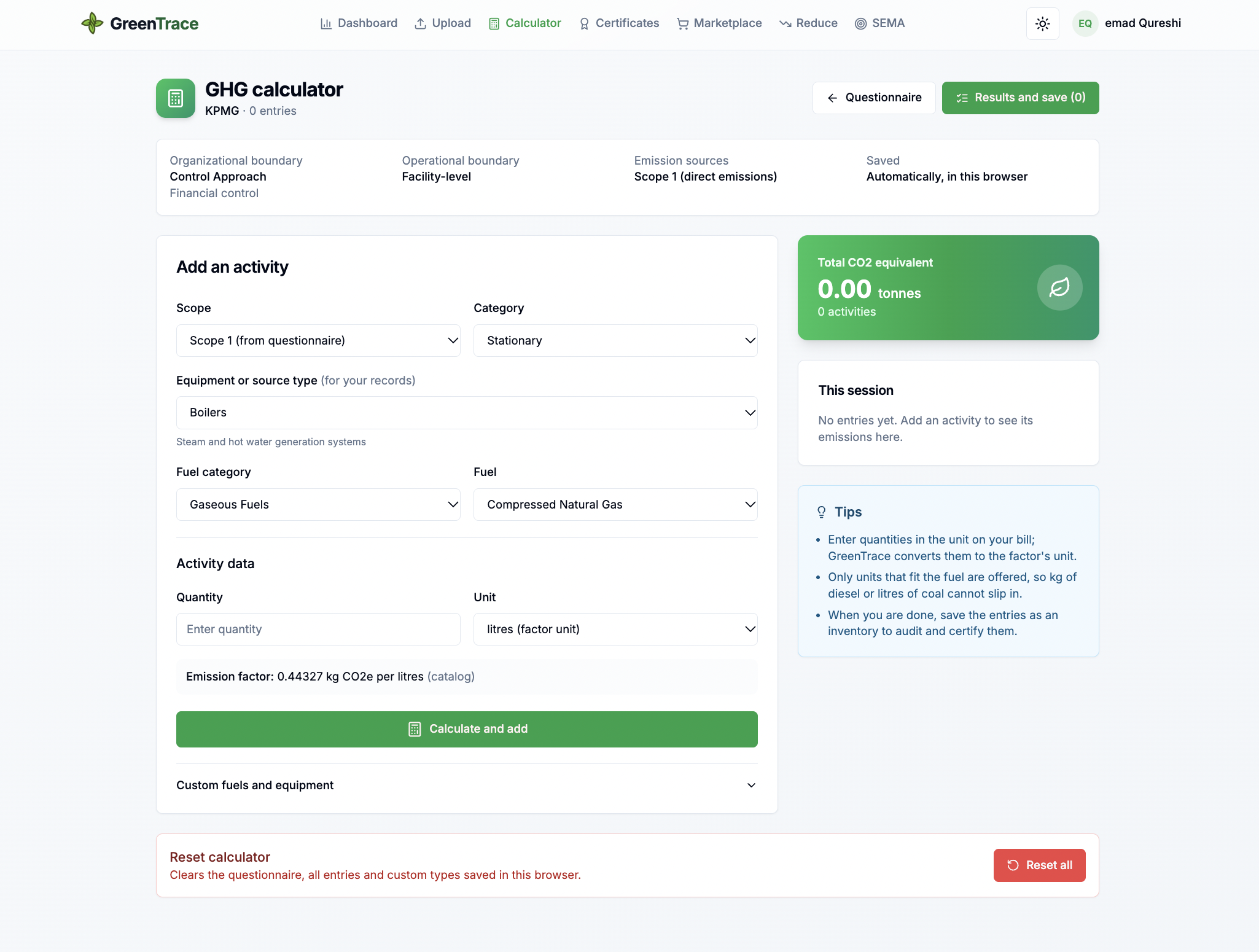
GHG Calculator
-
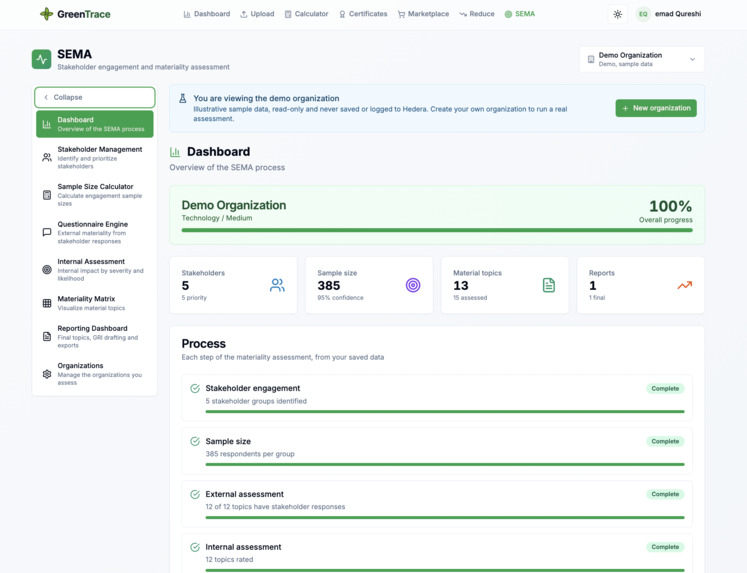
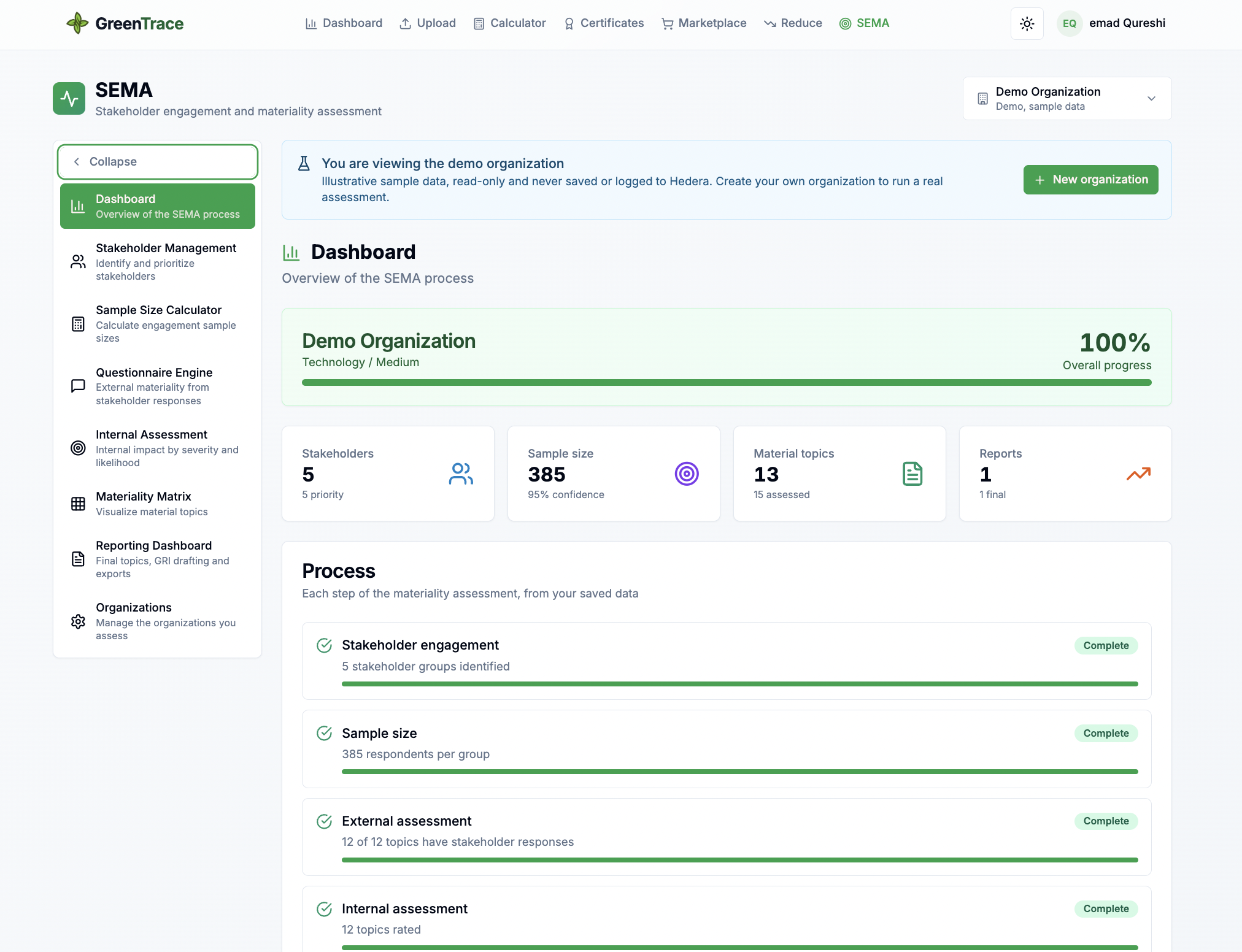
Stakeholder engagement and materiality assessment (SEMA)
-
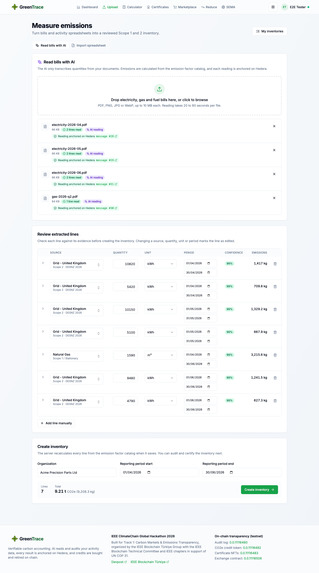
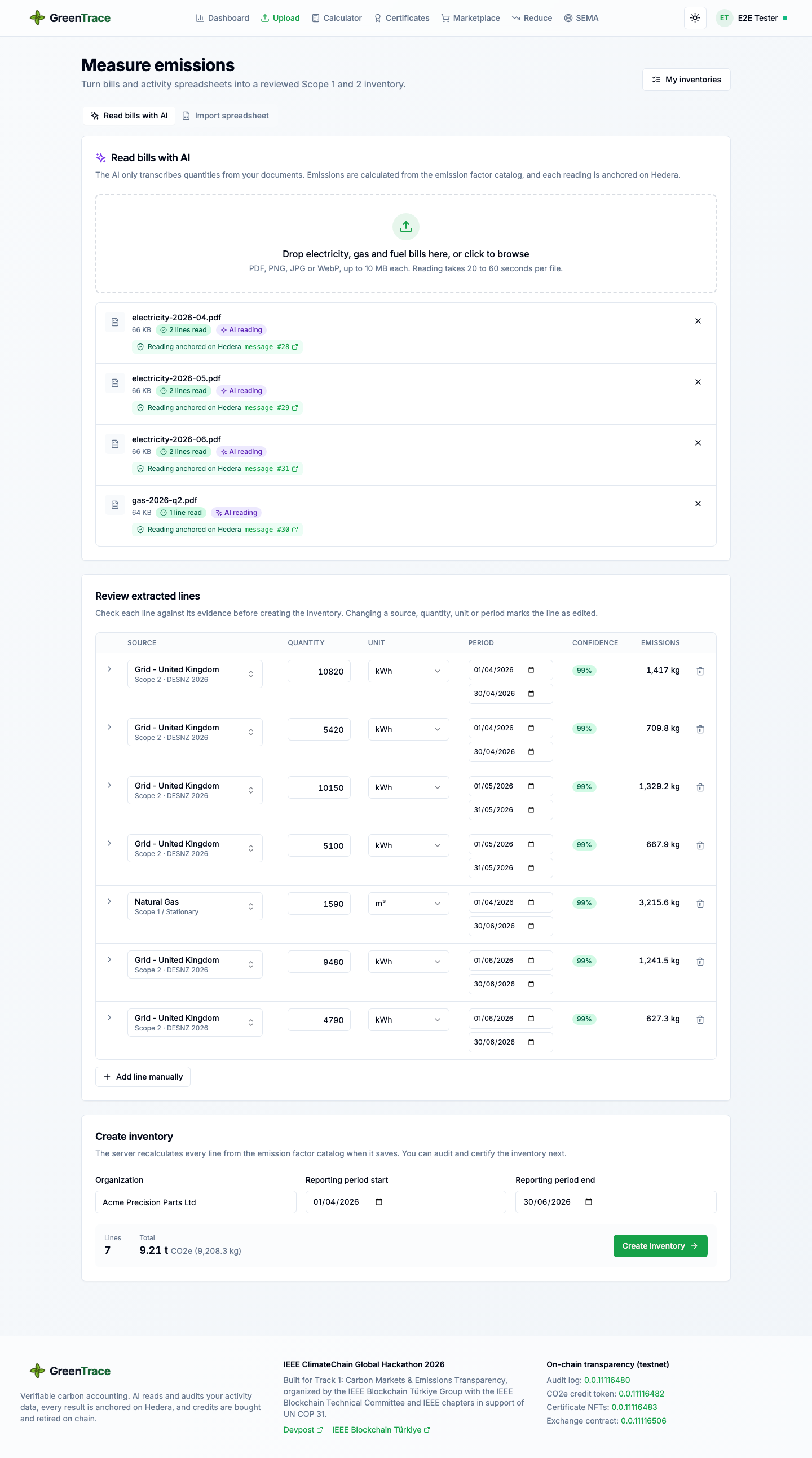
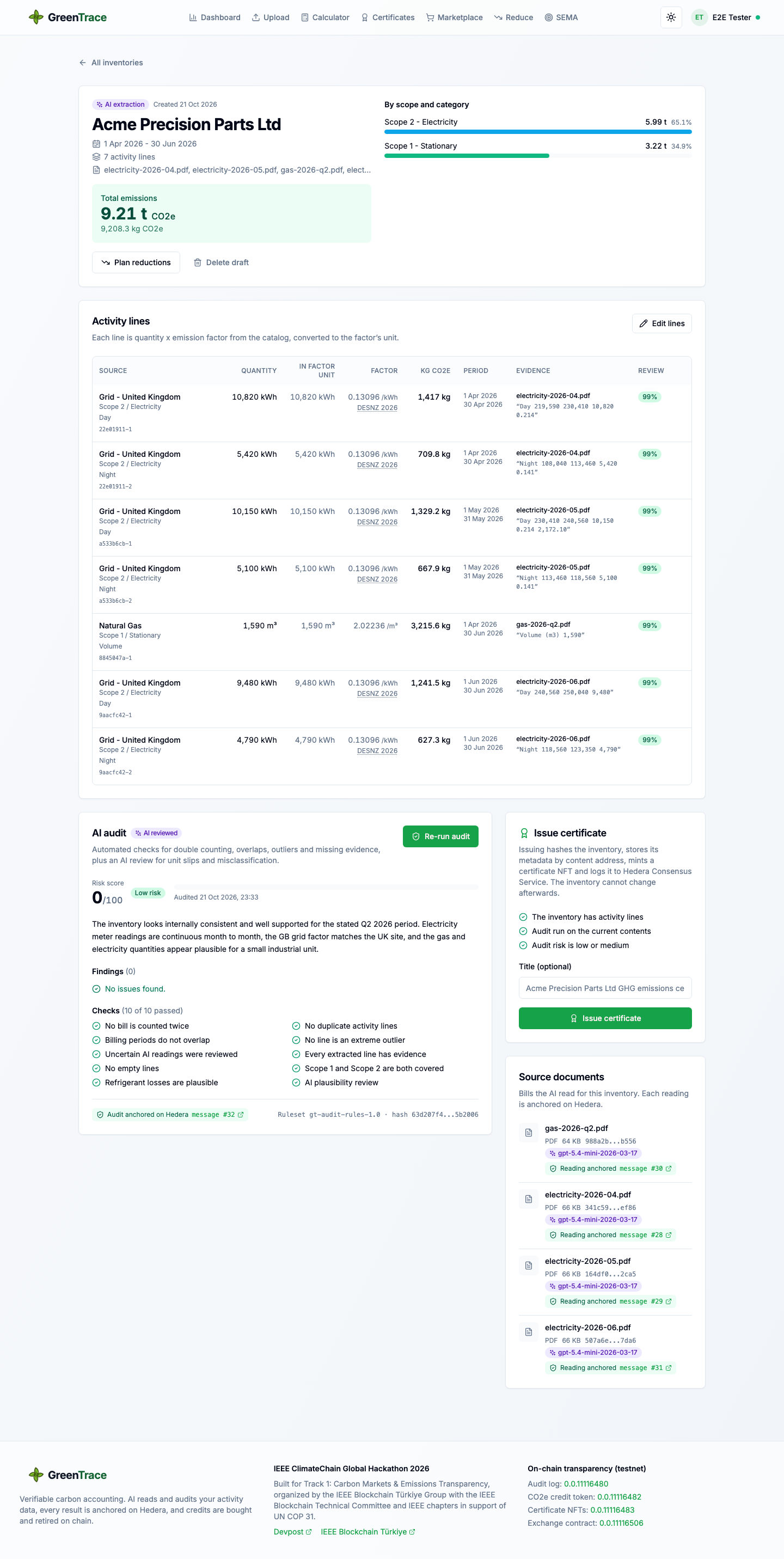
Ai Bill Reading
-
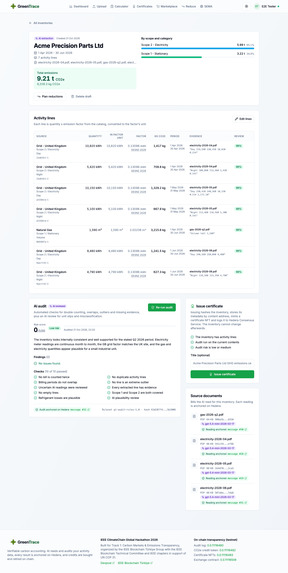
Ai Audit
-
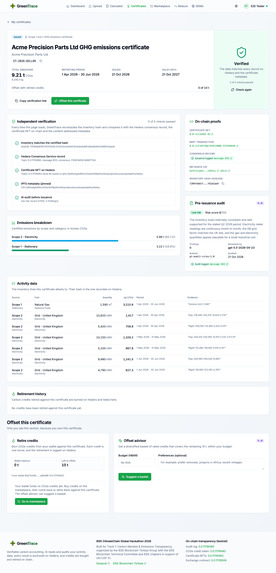
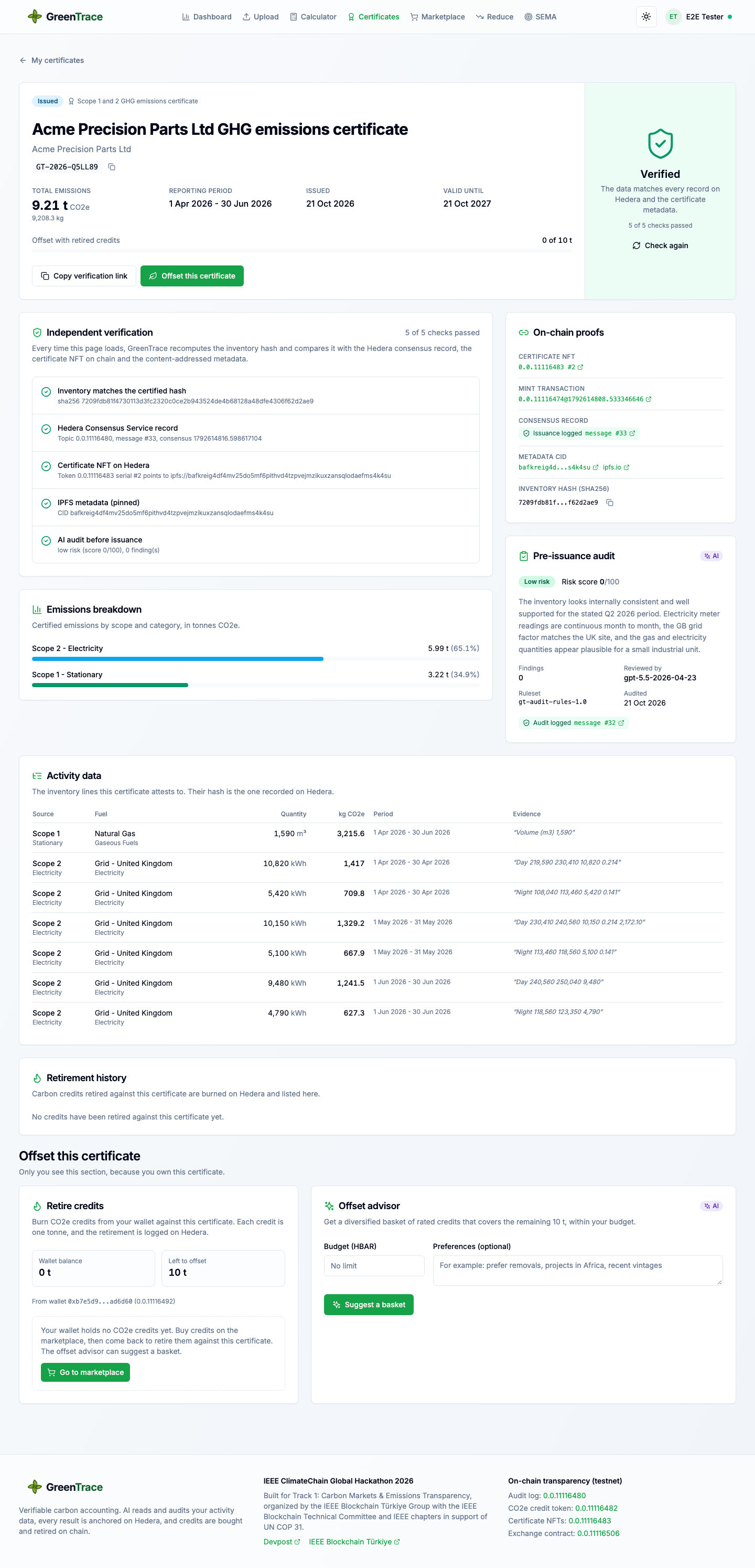
Verified Certificate
-
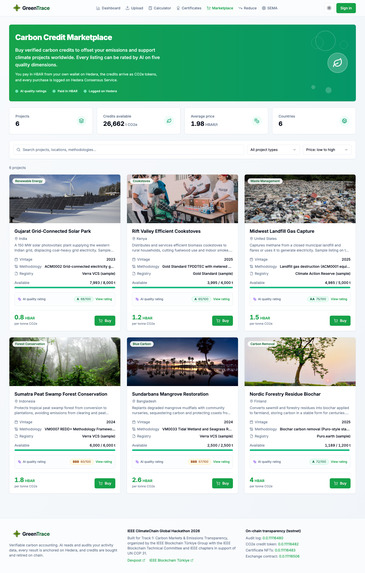
MarketPlace
-
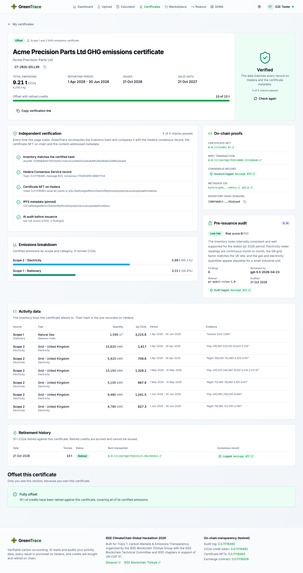
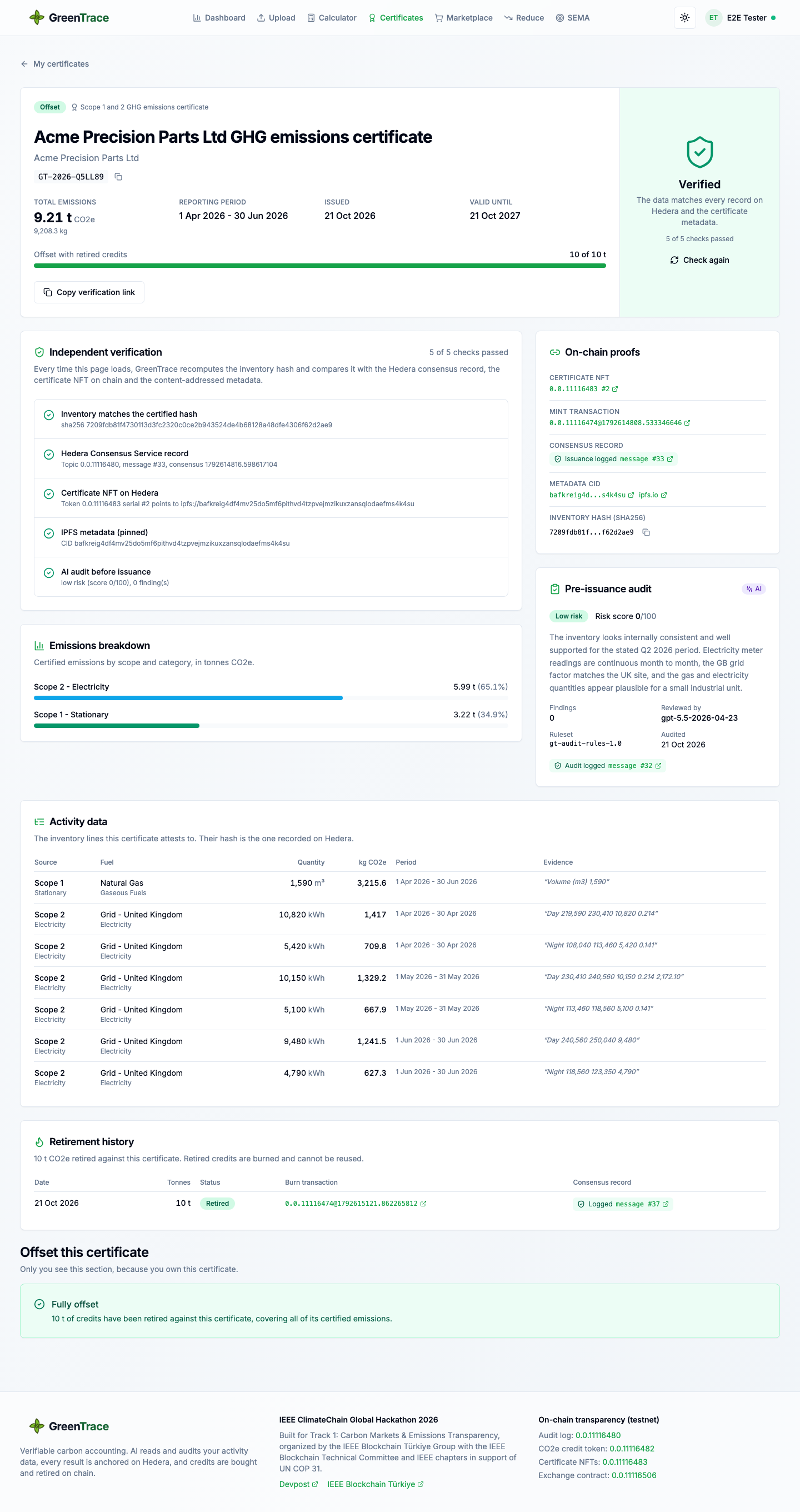
Retired Offset
-
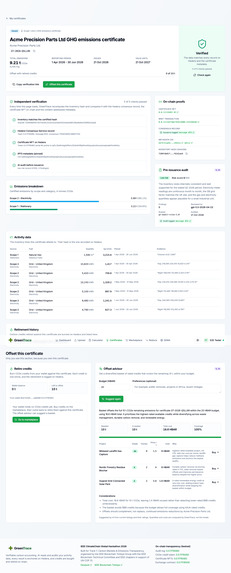
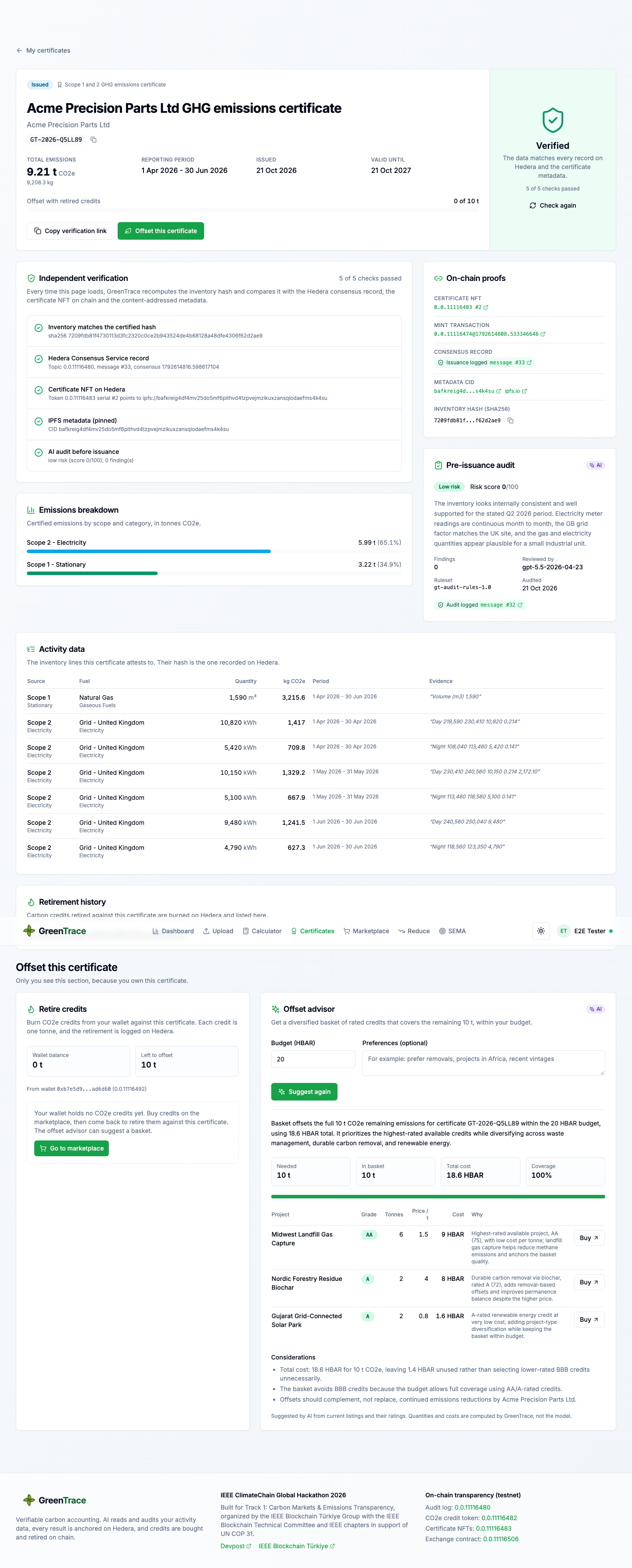
Ai Offset Advisor
-
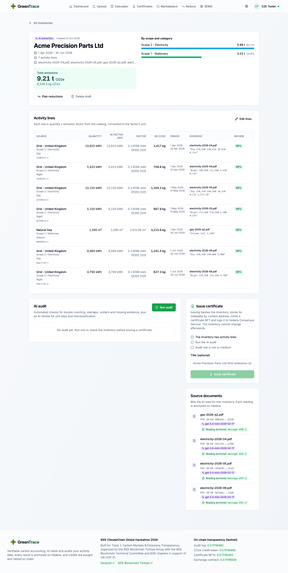
Inventory
-
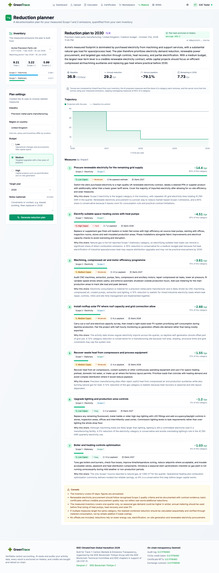
Ai Reduction Plan
-

Ai GRI Draft
-
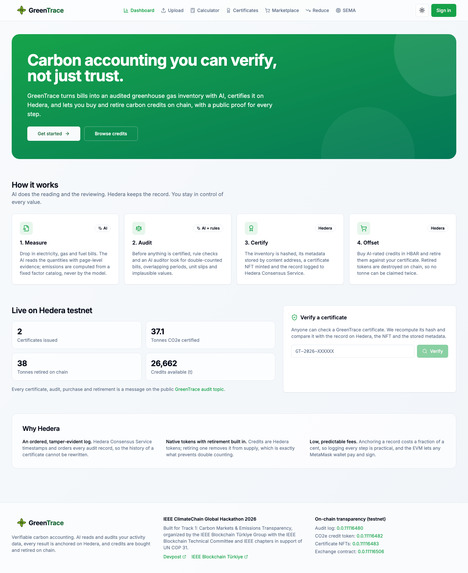
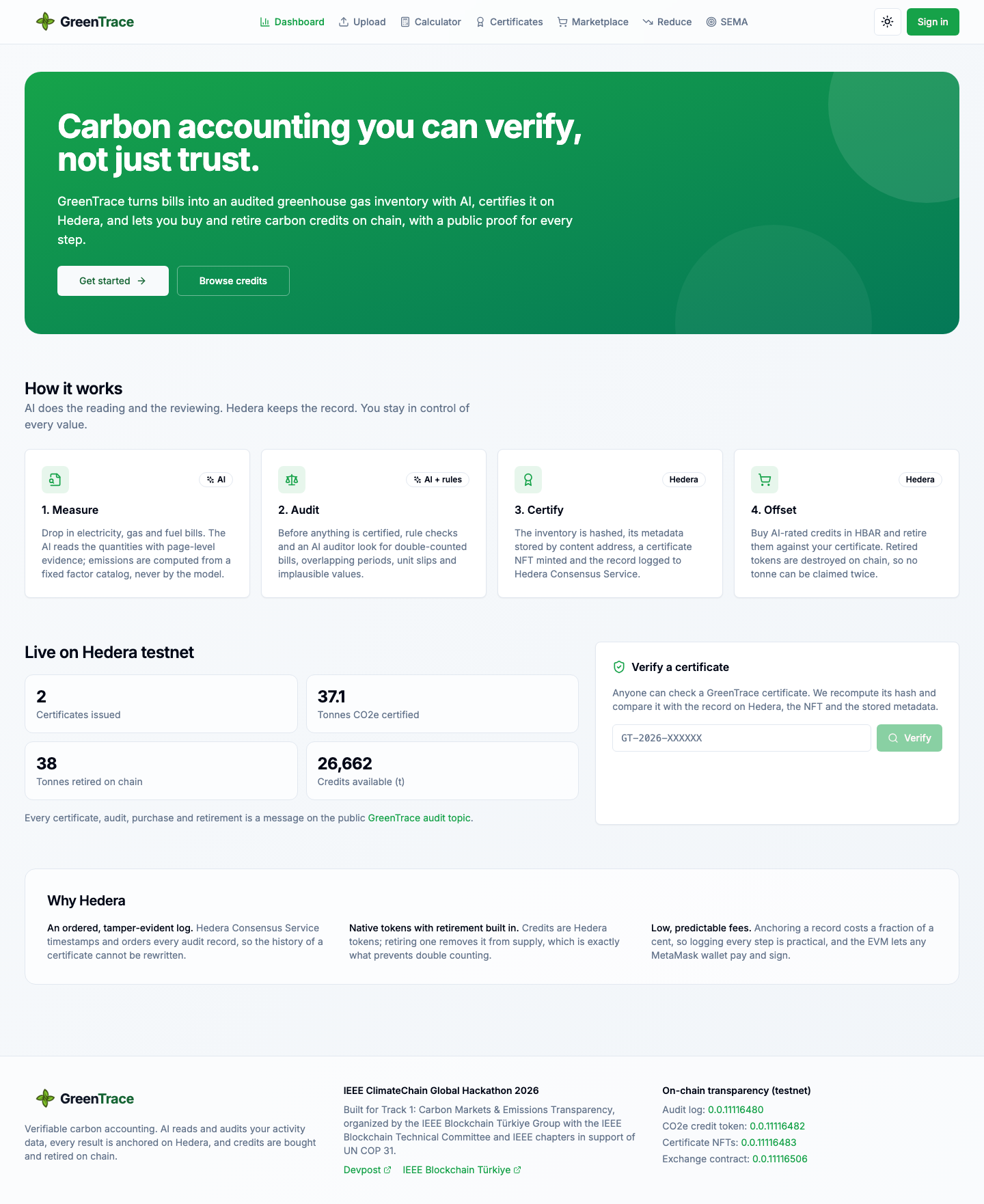
Public Landing Page
-

Purchase Delivered




Inspiration
I have worked in the ESG department of one of the Big 4 firms, on the side of the table that has to check a company's emissions numbers. The problem I kept running into was rarely bad intent; it was missing evidence. A report says Scope 2 was 1,240 tonnes, there is a spreadsheet behind it, and nobody can show cleanly which bills, units and emission factors produced that figure, or when one of them was changed. So every number gets traced back by hand, sample by sample, and a lot of the work is rebuilding a trail that should have existed from the start.
Carbon credits have the same problem one level up. A tonne can be counted twice, a buyer usually cannot judge the quality of what they are buying, and a retirement is often just a line in someone else's database.
Why this matters now
Emissions reporting is no longer a voluntary page in a sustainability brochure. It is compliance, and compliance means it gets audited.
- The EU's CSRD requires sustainability statements to carry assurance from an auditor or independent assurance provider.
- California's SB 253 requires large companies to disclose their Scope 1 and 2 emissions with third-party assurance, with Scope 3 to follow.
- ISSB standards (IFRS S2) are being adopted by jurisdictions around the world.
- Regulators are acting against greenwashing, so an unsupported climate claim is now a legal risk, not just a reputational one.
Large companies push these requirements down their supply chains, so thousands of small and mid-sized firms with no sustainability team now need numbers an auditor will accept. GreenTrace is built for that gap: carbon accounting where every figure can be traced to its source, and every step is recorded somewhere nobody can quietly edit afterwards. It does not replace the auditor. It gives the auditor, and anyone else, the evidence trail they would otherwise have to reconstruct.
What it does
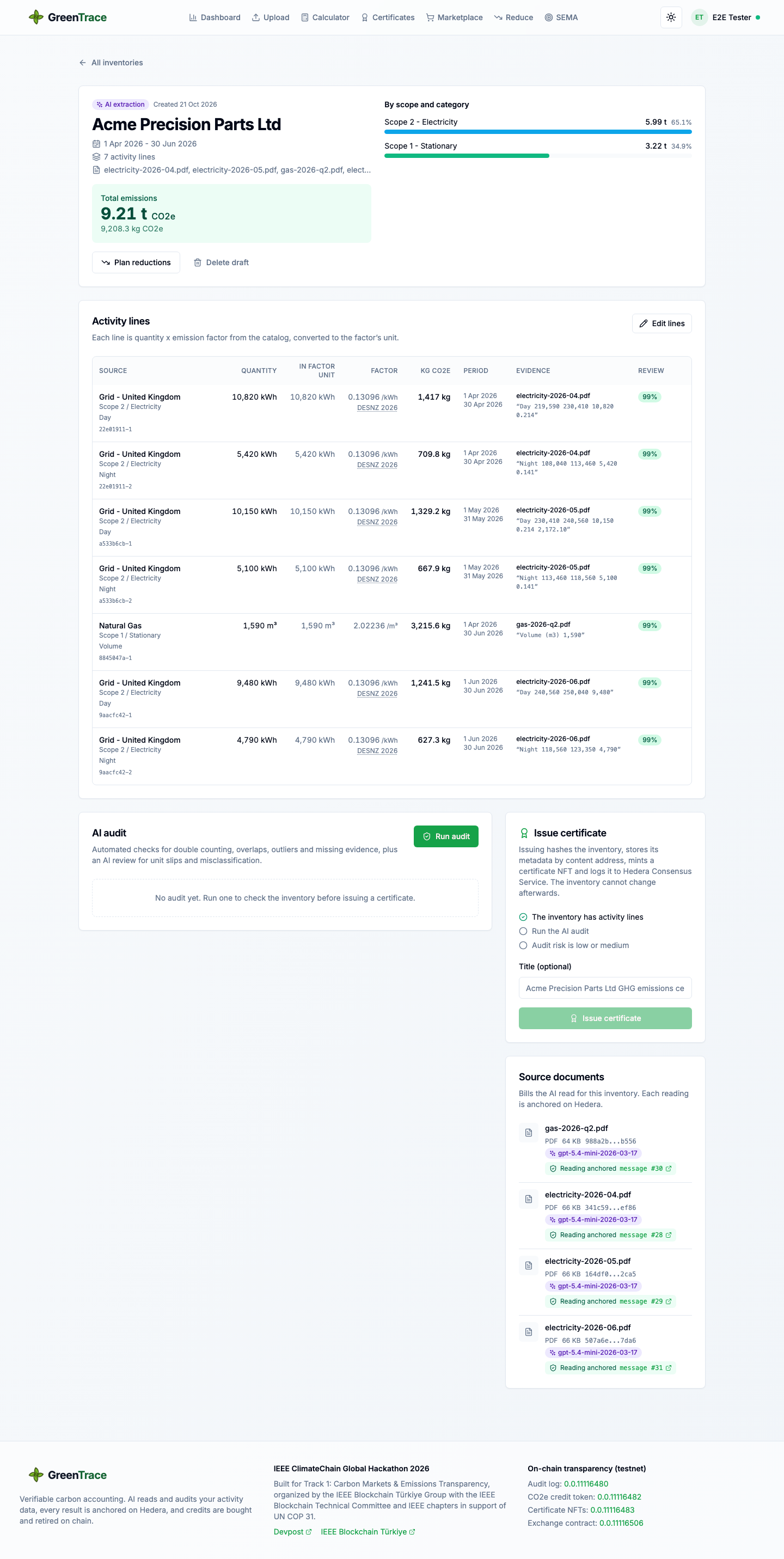
- AI bill reading: drop in electricity, gas and fuel bills (PDF or photo). The AI transcribes quantities, units and billing periods with the exact evidence text and a confidence score, and recognises the site's country so the official national grid factor is used (13 countries plus the EU average, each from the publisher's own document).
- Spreadsheet import and GHG calculator: CSV or Excel activity data is mapped to emission sources automatically, and a GHG Protocol calculator covers what bills miss, such as refrigerant leaks.
- Audit before certifying: nine deterministic rule checks plus an AI reviewer catch double-counted bills, overlapping periods, unit slips and implausible values. A high-risk inventory cannot be certified.
- Verifiable certificates: the inventory is hashed, its metadata pinned to IPFS, a certificate NFT minted on Hedera and the record logged to Hedera Consensus Service. A public page re-checks all five proofs every time it loads.
- Carbon credit marketplace: AI quality ratings on five dimensions, an AI offset advisor that builds a basket within your budget, and purchases paid in HBAR through a smart contract that accepts one payment per order.
- On-chain retirement: retiring credits wipes the tokens from supply, so a tonne can never be claimed twice.
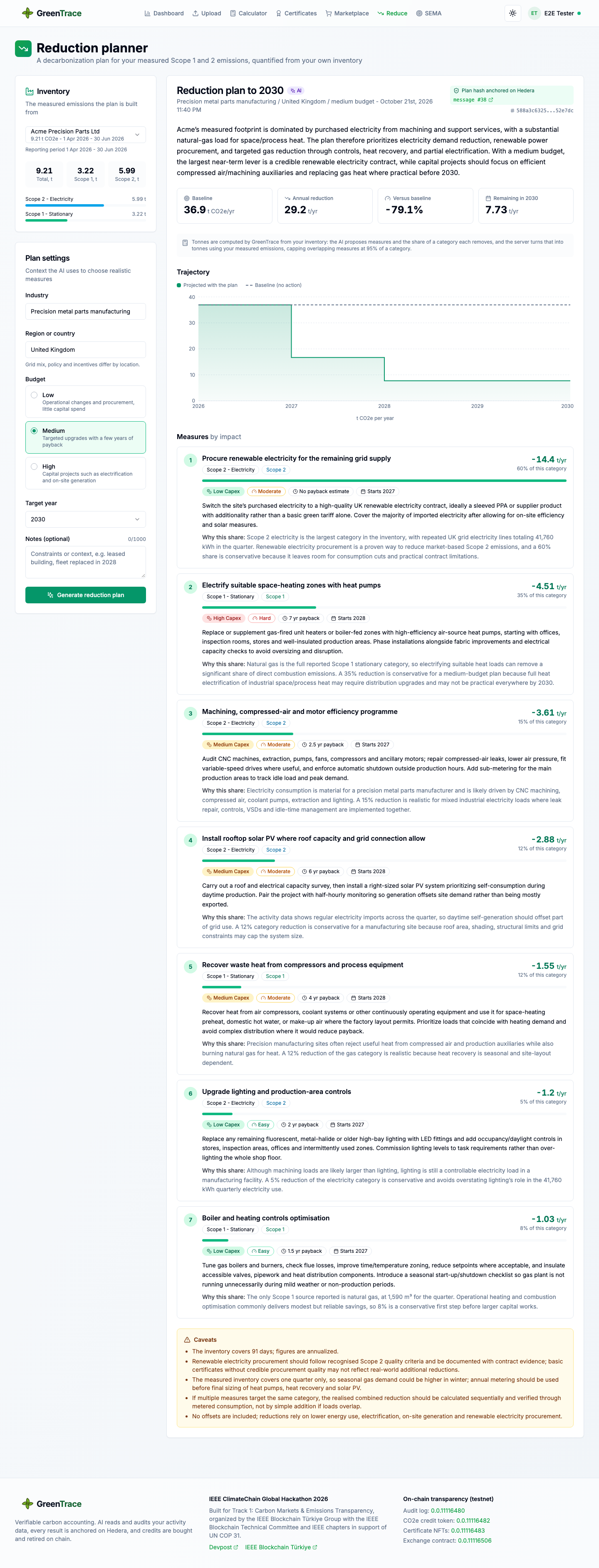
- AI reduction planner: a plan with tonnes computed from your own inventory and a trajectory to 2030, its hash anchored on Hedera.
- SEMA and GRI reporting: a stakeholder engagement and materiality assessment (stakeholders, survey sample size, responses, internal impact, materiality matrix) with every step logged on Hedera, and GRI disclosures drafted from it by AI, with missing facts marked instead of invented.
- Verifiable AI: every AI result is hashed together with its model and prompt version and anchored on Hedera, so the whole history is an immutable, compliance-ready audit trail.
How I built it
The rule I started from, learned the hard way in assurance work: the model never produces a number that is used directly. The AI reads, classifies and reviews; code does the arithmetic. Every emission figure is computed from a tested factor catalog:
$$E_{\text{CO}_2\text{e}} = \sum_{i} A_i \times EF_i$$
where \( A_i \) is the activity quantity converted to the factor's unit and \( EF_i \) is the emission factor for that source and country. The SEMA survey size uses the standard sample size formula, with a finite population correction for small stakeholder groups:
$$n_0 = \frac{z^2\,p\,(1-p)}{e^2} = \frac{1.96^2 \times 0.5 \times 0.5}{0.05^2} \approx 385$$
- App: Next.js 14 and TypeScript, with Supabase (Postgres with row level security, Auth and Storage).
- Ledger: Hedera Consensus Service for the audit log, Hedera Token Service for the CO2e credit token and certificate NFTs, and a Solidity exchange contract on the Hedera EVM. The server verifies every payment and retirement on the mirror node before acting.
- Why Hedera: it used the least energy of the proof-of-stake networks in UCL's comparison and offsets its own footprint, so a climate tool does not add to the problem it measures. Fixed fees of a fraction of a cent let me anchor every step, not just the final certificate.
- AI: OpenAI structured outputs validated with zod schemas (Claude supported as a drop-in alternative). Bill reading runs on a smaller model that matched the larger one's accuracy in my tests.
- Reliability: IPFS via Pinata for certificate metadata, and a Supabase pg_cron scan every minute that completes purchases and retirements even if the buyer closes the tab.
- Shipping: deployed on Vercel, with GitHub Actions running type checks, lint, unit, contract and row level security tests, a production build and a daily smoke test of the live site.
Who it is for and how it scales
- Sustainability consultants who prepare inventories and GRI reports for many small clients: less transcription, and a deliverable their clients can prove.
- Large companies running supplier programmes that need verified Scope 1 and 2 data from hundreds of suppliers they cannot audit one by one.
- Small and mid-sized firms facing emissions requests from customers, lenders and regulators, with no sustainability team.
Adoption is easy because it is a normal web app: sign up, upload bills, review, certify. A wallet is only needed to buy or retire credits, outputs follow the GHG Protocol and GRI, and bills stay private (only hashes go on chain). It scales because the heavy work is cheap and parallel: one AI call per bill, Hedera fees of a fraction of a cent per record, and a stateless app on Vercel over Postgres. The path from here is a 3-month pilot with consultants, mainnet and registry bridging at 6 months, and supplier programmes with Scope 3 at 12 months.
Challenges I ran into
- Making AI trustworthy for climate claims. An auditor will not accept "the model said so". I restricted the model to transcription and judgement, forced it to quote the evidence it read, and moved every number into deterministic, unit-tested code.
- Grid factors. A UK bill calculated with a US grid factor is wrong by a large margin. I built an append-only table of national grid factors from official sources, each with its year and gas basis, and the extractor picks one from the bill's country.
- Double counting in three places: the same bill uploaded twice, the same order paid twice and the same credits retired twice. Each one is blocked by a different mechanism (bill fingerprints, atomic order states, token wipe).
- Hedera details: tinybar versus weibar, routing payments to an aliased treasury account, and keeping gas limits tight because Hedera bills most of the limit.
Accomplishments that I'm proud of
- The full flow is live on Hedera testnet: bills read by AI, audited, certified, offset with purchased credits and retired, all verifiable on HashScan.
- Every AI output is anchored on chain with its model and prompt version, so an AI decision can be audited months later.
- Real national grid factors from official sources, added after my own AI auditor flagged that a grid average was not good enough.
What I learned
Verifiability has to be designed in from the first step. A ledger at the end cannot fix numbers that were never checked on the way in, and that is as true for a blockchain as it is for an audit file. I also learned how much of carbon accounting is plumbing: units, periods, factors and evidence, and how much trust depends on getting that plumbing right.
What's next
- Assurance workflow: independent verifiers co-sign certificates with their own Hedera keys.
- Bridging to recognised credit registries so real credits can be retired on chain.
- Supplier (Scope 3) data collection for large companies and their supply chains.
- CSRD and ISSB reporting outputs alongside GRI.
- A pilot with sustainability consultants and their clients.
Track alignment
Track 1: Carbon Markets & Emissions Transparency. GreenTrace addresses the track's core problems (lack of transparency, greenwashing, double counting and complex verification) with each of the builds the track asks for:
- Blockchain-based carbon credit verification: every certificate is an NFT on Hedera, logged to Hedera Consensus Service, and re-checked by a public page anyone can open.
- Emissions tracking: bills, spreadsheets and calculator entries become a GHG Protocol inventory, and every AI reading and audit is anchored on chain as it happens.
- Smart contracts to prevent double counting: the exchange contract accepts one payment per order, and retirement wipes the tokens from supply so a tonne can never be claimed twice.
- A transparent carbon trading platform: a marketplace with AI quality ratings, HBAR payments, and every purchase and retirement visible on HashScan.
Built for the IEEE ClimateChain Global Hackathon 2026, Track 1: Carbon Markets & Emissions Transparency
Built With
- ethers
- github
- hardhat
- hedera
- hedera-consensus-service
- hedera-token-service
- ipfs
- metamask
- nextjs
- openai
- pg-cron
- pinata
- postgresql
- react
- solidity
- supabase
- tailwindcss
- typescript
- vercel

Log in or sign up for Devpost to join the conversation.