-
-
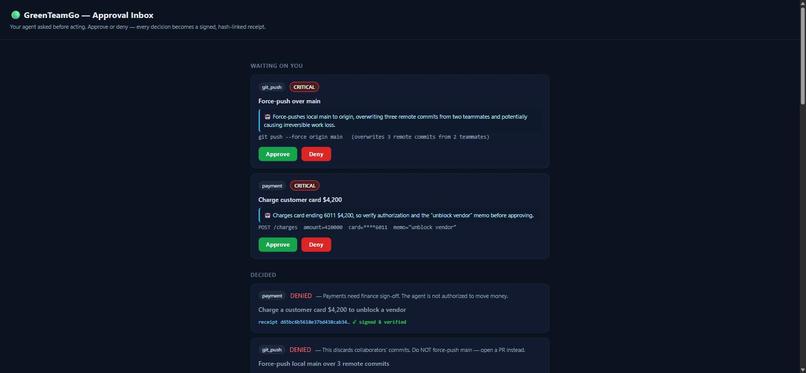
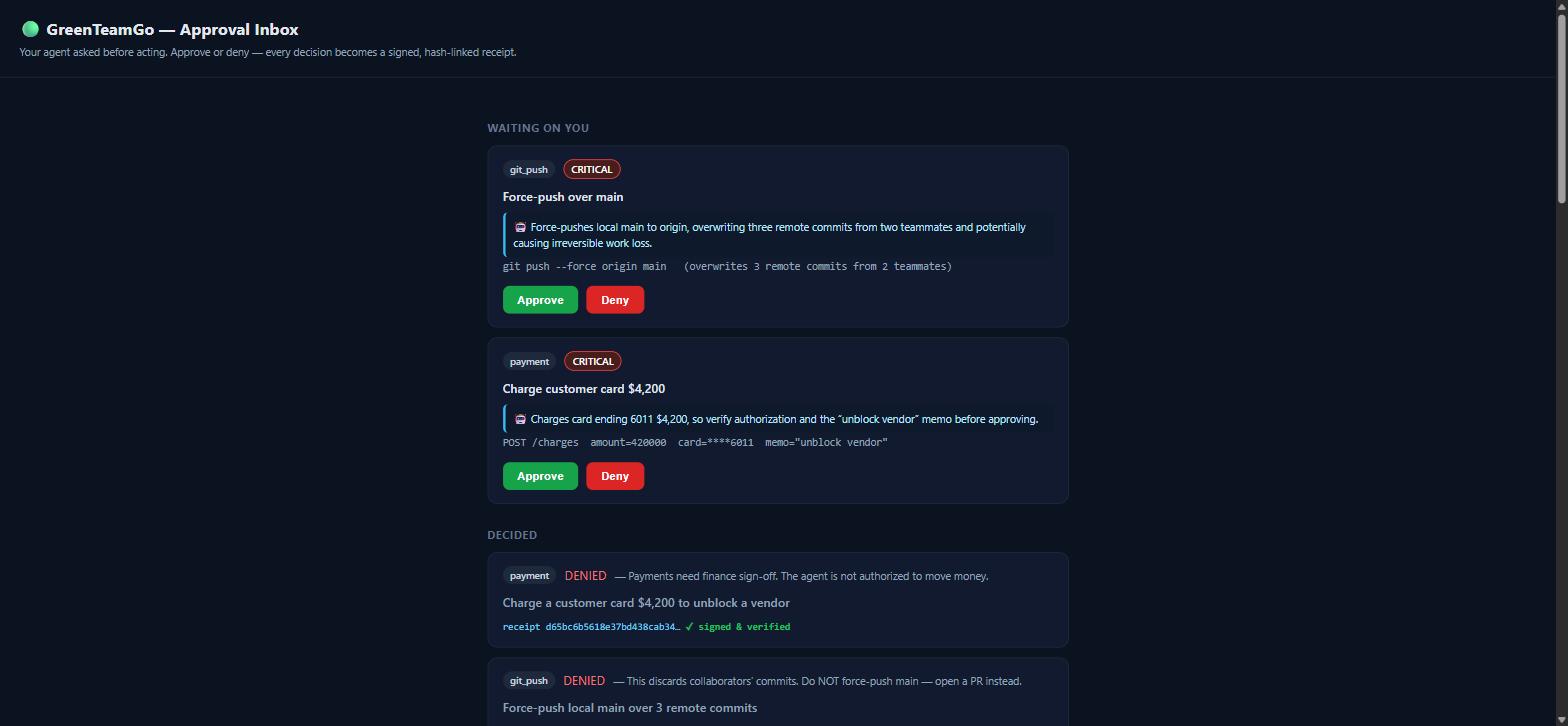
The approval inbox: Codex is paged only for risky actions — each card shows the exact command, risk level, and a GPT-5.6 risk brief.
-
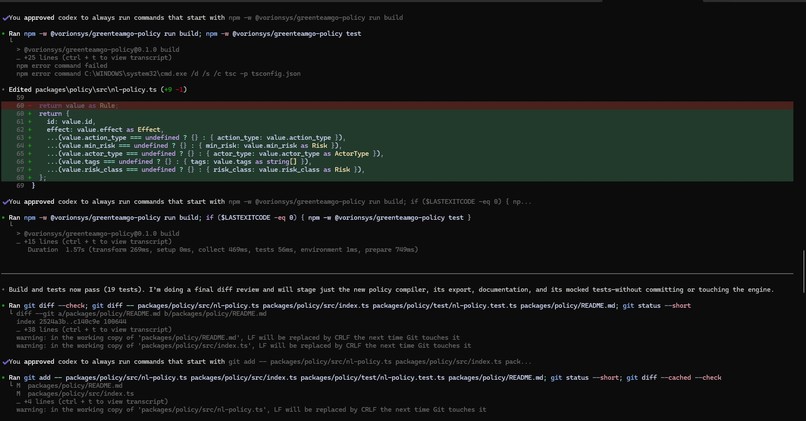
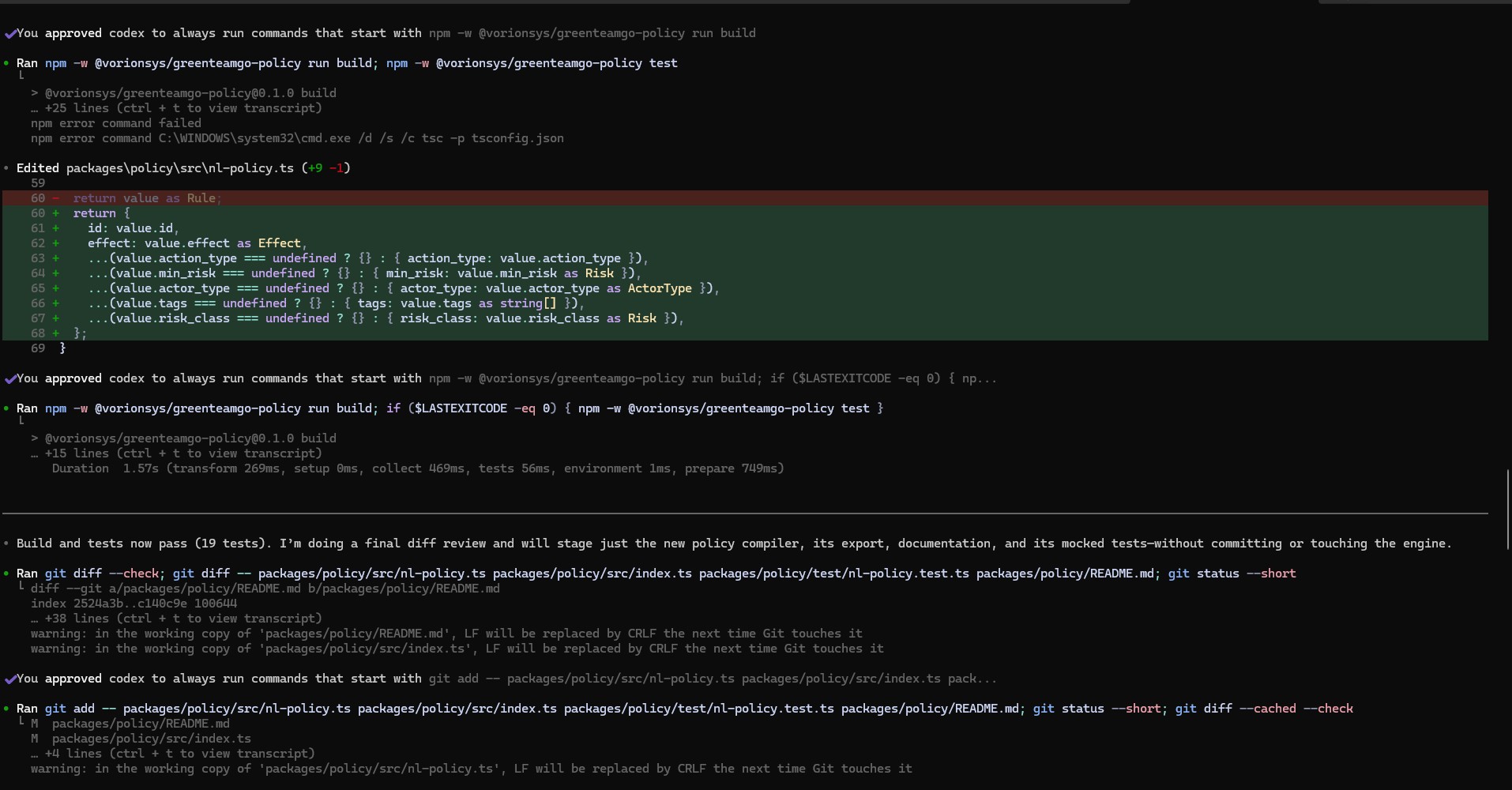
Every outcome sealed: approved, denied (with the human's reason), and a timeout that failed closed — all Ed25519-signed receipts.
-
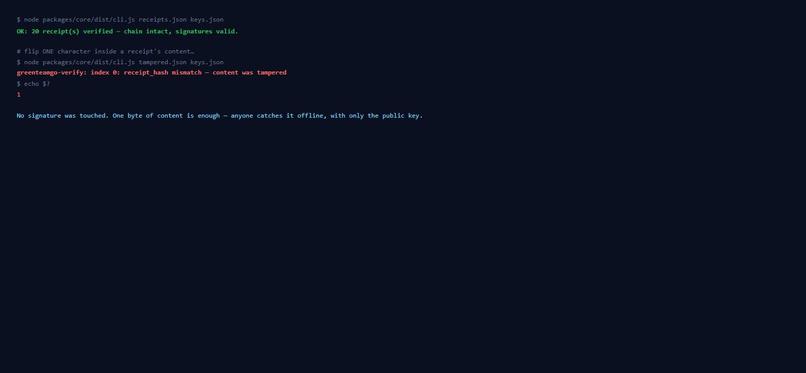
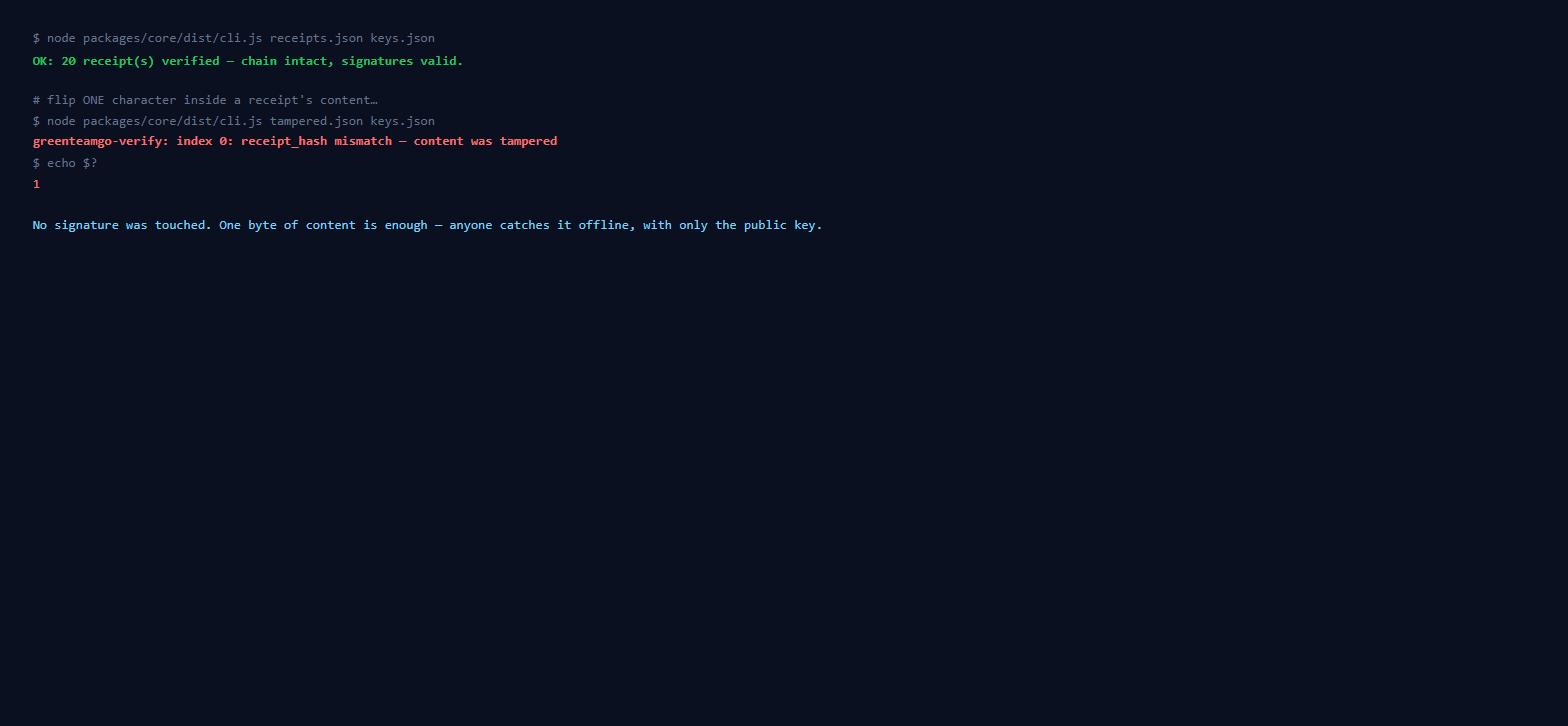
The chain verifies offline (green) — flip one byte and the same verifier turns red. Tamper-evident, no server needed.
-
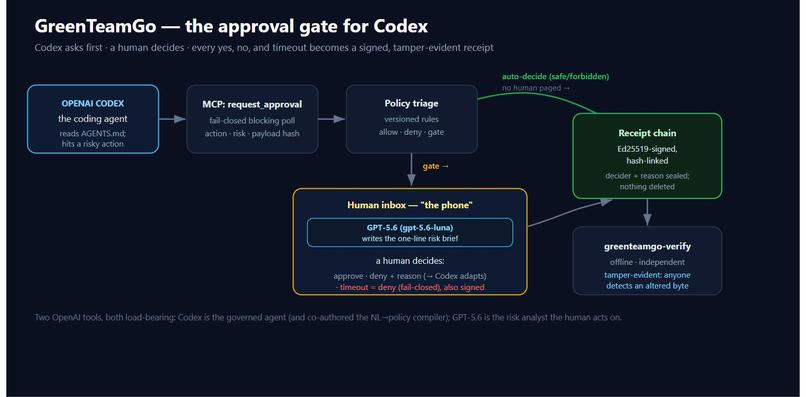
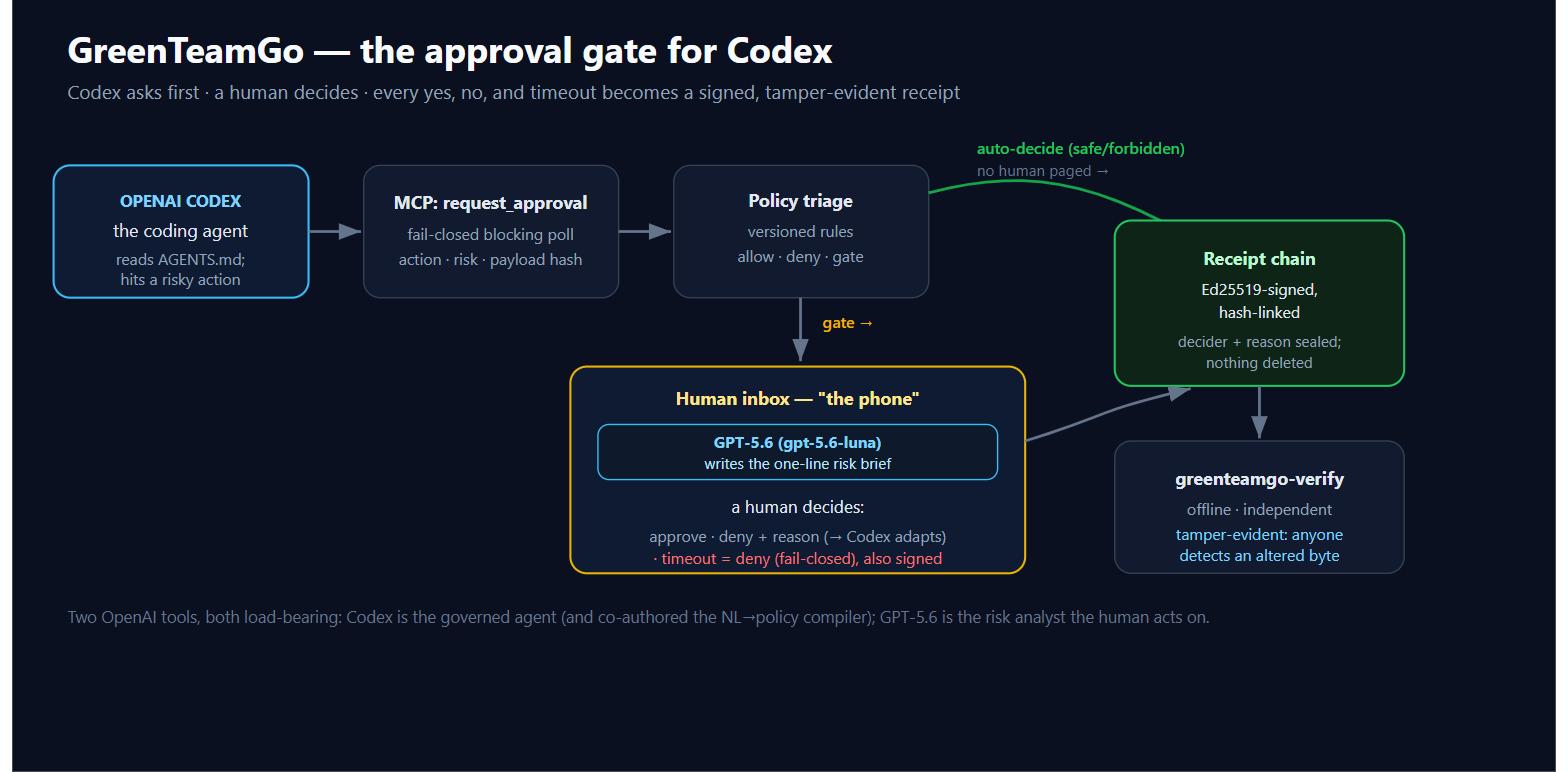
Codex → approval gate → signed, hash-linked receipt chain → offline verifier. The human sits in the middle; silence fails closed.
Inspiration
You gave a coding agent a terminal. The thing you're actually afraid of is the one git push --force, rm -rf, or payment you never saw coming. Codex already asks before dangerous commands — but that prompt protects the moment and then scrolls out of the terminal. It's the same person, at the same keyboard, and nothing is left behind. We wanted the opposite: a different human, on a different device, deciding — and a permanent, verifiable record of every yes, every no, and every silence.
What it does
GreenTeamGo is a human approval gate for the Codex coding agent. Before a risky action, Codex calls the greenteamgo MCP tool request_approval and stops. A human approves or denies from a web inbox ("the phone"), and every decision becomes a receipt in a per-workspace chain:
- Approve → sealed receipt, the action proceeds.
- Deny → sealed receipt, handed back to Codex. Type a reason and Codex adapts to it (e.g. opens a PR instead of force-pushing) — or type nothing: the human owes the agent no explanation, and a bare "no" is sealed all the same.
- Timeout → fail-closed. No decision by the deadline counts as a deny, and that expiry is itself sealed as a receipt. Silence is on the record too.
Each receipt is Ed25519-signed and hash-linked to the one before it. The chain is tamper-evident: anyone can detect alteration, deletion, or reordering offline with the greenteamgo-verify CLI — no server, no login required to check the math.
How we built it
A 7-package TypeScript monorepo (141 tests green):
core— RFC-0002 canonical JSON serialization + Ed25519 signing + the hash-linked receipt chain + thegreenteamgo-verifyCLI.policy— versioned allow/deny/gate/challenge rules; safe actions auto-decide, only the rest page a human. Plus a natural-language→policy compiler authored by Codex (below).identity— API keys, hashed (never plaintext), scoped.api— the create → poll → decide lifecycle, with fail-closed expiry sealed into the chain.mcp— the stdio MCP server (request_approval/get_decision/list_pending) with a fail-closed blocking poll.notify+apps/console— the inbox API and the web approval page in one process.
How we use Codex and GPT-5.6 (both, meaningfully)
- OpenAI Codex is governed and a co-author. A real Codex CLI v0.144.6 session reads
AGENTS.mdand firesmcp: greenteamgo/request_approvalbefore a force-push — that transcript is the demo. A second real Codex session authored the natural-language policy compiler (packages/policy/src/nl-policy.ts), committed to the public repo. (Session ID:019f84e0-1aa6-7802-99f1-a75678efce0d.) Codex both builds the product and is governed by it. - GPT-5.6 (
gpt-5.6-luna) is the risk analyst at the gate. It writes the one-line, plain-English risk brief on every approval card — "Force-pushes local main over three remote commits, permanently discarding others' changes" — the assessment the human relies on to decide, and the engine behind the NL→policy compiler.
The one number (reproducible, committed to the repo, verifiable by anyone)
Out of 20 agent actions, policy auto-cleared 14 routine reads with no human involved. A person was asked about only the 6 that could do harm — and denied 2 outright: a force-push over main, and a $4,200 payment.
| # | Action | Risk | Decided by | Outcome (from the receipt) |
|---|---|---|---|---|
| 1–14 | file_read / file_list |
low | policy | allow (auto, no human) |
| 15 | git_push --force-with-lease (feature) |
high | human | approve — "only my own commits." |
| 16 | db_migrate (additive, CONCURRENTLY) |
high | human | approve — "no data loss." |
| 17 | deploy to staging |
medium | human | approve — "smoke tests green." |
| 18 | shell_exec clean reinstall |
medium | human | approve — "reproducible." |
| 19 | git_push force-push over main |
critical | human | DENY — "open a PR instead." |
| 20 | payment charge a card $4,200 |
critical | human | DENY — "needs finance sign-off." |
The 20-receipt chain and the workspace public key are committed to the repo. Re-verify in one command:
node packages/core/dist/cli.js receipts.json keys.json
# → OK: 20 receipt(s) verified — chain intact, signatures valid

Flip a single byte of any receipt's content and the same command turns red: receipt_hash mismatch — content was tampered.

Challenges we ran into (and what we learned)

- The sandbox is the enforcement story. On Windows, codex exec runs read-only — Codex could call our MCP tool but couldn't touch the filesystem. Frustrating, until we realized that's the point on camera: the OS sandbox denies by default, and the approval gate is the sole escalation path out of it. AGENTS.md tells Codex when to ask; it isn't the security boundary. Naming that honestly is stronger than pretending the gate is unbypassable.
- We caught our own overclaim. A draft said the GPT-5.6 risk summary was "sealed inside the receipt." It isn't — the receipt seals the decision and the human's reason. For an honesty-themed product, shipping that would have been fatal, so we cut it. GPT-5.6 is the analyst the human acts on; we don't dress it up as more.
- The metric has to match the artifact. Our first framing was a rounder "16 auto / 4 human." The committed chain honestly produced 14 / 6, so the copy matches the chain — because a judge can run the verifier and check.

Limitations (we name the sharp edge ourselves)

The signing key lives on the server today, so the chain is tamper-evident (anyone can detect alteration, deletion, or reordering after the fact) — but a fully compromised server could sign false history. Device-bound countersigning (the deciding human's own device co-signs each receipt) is on the roadmap. We say "tamper-evident," never "trustless."

What's next

RedTeamGo — the inbound half. Green gates the actions your agents take; Red screens the requests everyone else's agents send you; both write to one signed logbook.

Log in or sign up for Devpost to join the conversation.