
Visit our website!
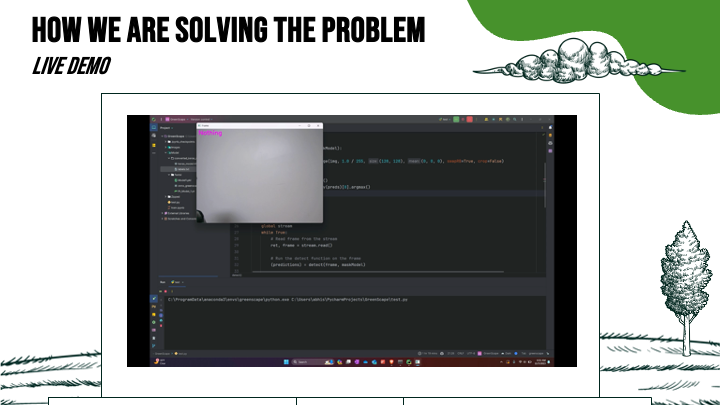
View our demo!
❓ What is our project?
Our project represents a pioneering approach that bridges the realms of computer science and biology with the noble goal of preserving and improving our environment. We've set our sights on developing an eco-friendly and cost-effective fertilizer through the process of composting.
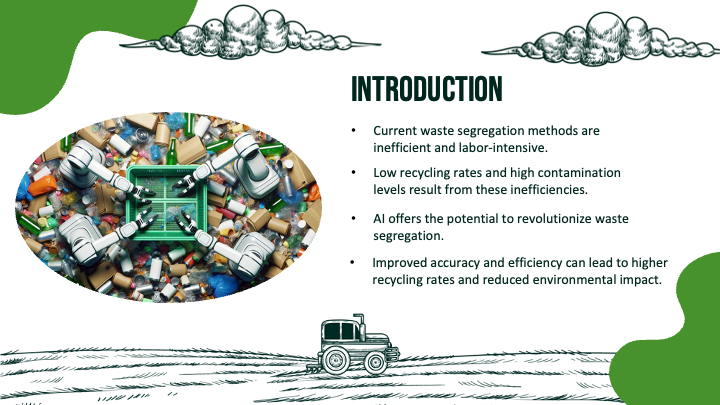
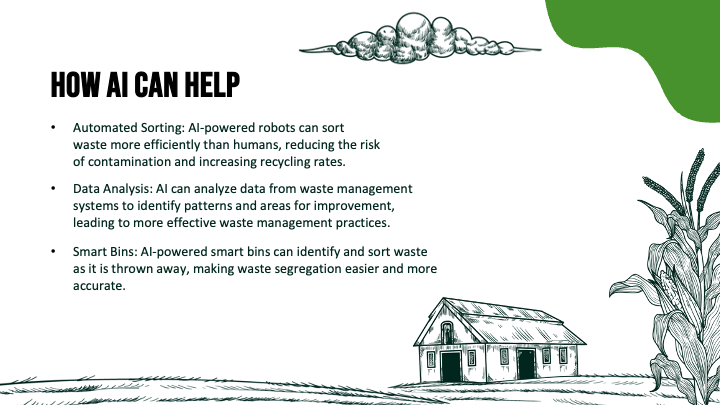
In our endeavor, we've harnessed the power of technology by training a sophisticated model capable of distinguishing between three distinct types of waste: biodegradable, non-biodegradable, and dry non-biodegradable materials. Our model excels in its ability to precisely identify and separate biodegradable waste from the rest of the trash.
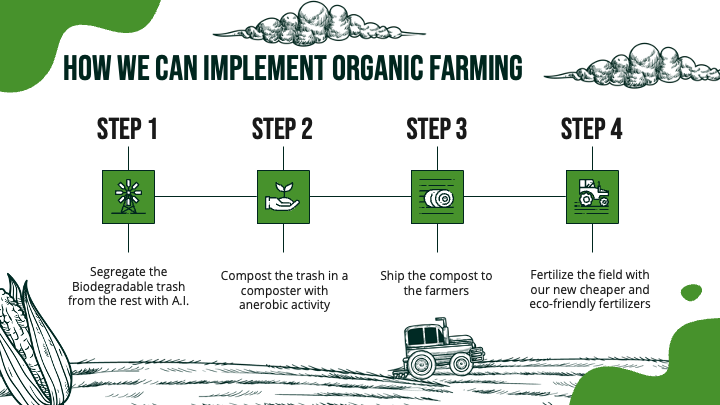
The theoretical underpinning of our project involves taking this separated biodegradable waste and channeling it into an anaerobic tank, which contains a community of anaerobic bacteria. Within this controlled environment, we encourage the waste to compost naturally. Once the composting process is complete, we transport the resulting organic material to farmlands.
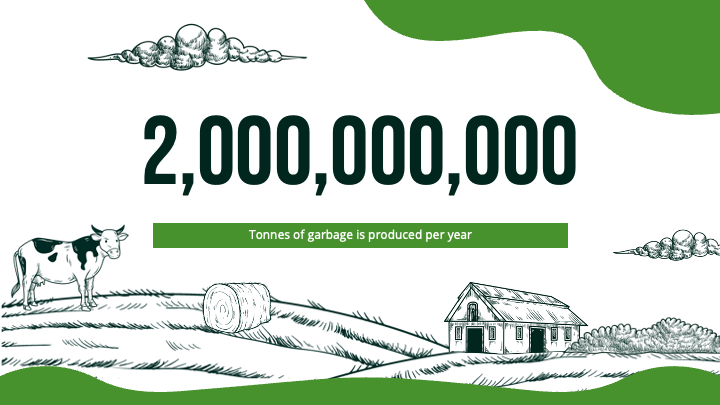
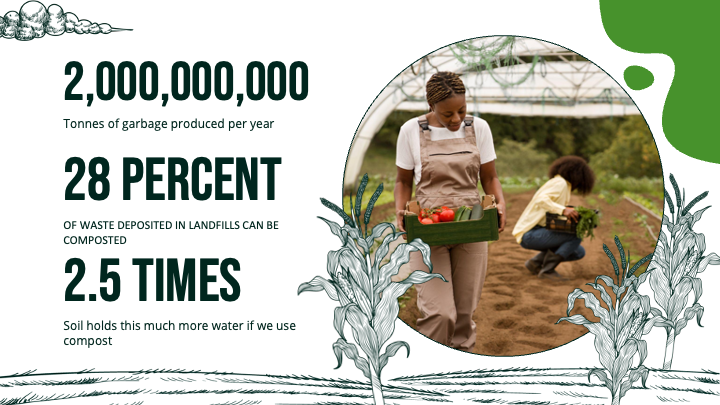
The innovative aspect of our project is that this compost serves as an eco-friendly substitute for traditional chemical fertilizers, providing farmers with an affordable and sustainable means of enriching their soil. By doing so, we contribute to both environmental conservation and the mitigation of the landfill crisis, which is a significant contributor to the ongoing degradation of our planet.
Our integrated approach not only enriches the soil but also helps address the critical issue of waste management, offering a practical solution to two pressing problems simultaneously. By focusing on sustainable waste management and composting, our project aligns with SDG 15 - Life on Land. It actively contributes to the protection and sustainable use of terrestrial ecosystems, supports sustainable forest management, helps combat desertification, and plays a role in halting and reversing land degradation and biodiversity loss.
📆 Plans for the future?
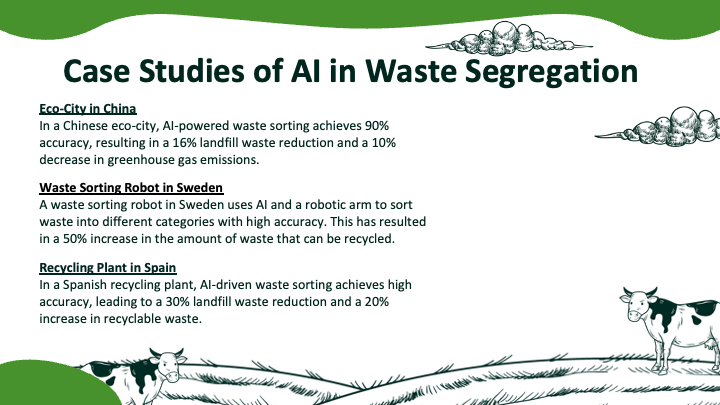
Through our in-depth analysis of the Eco-City project in China, we have learned the significance of holistic urban planning, resource efficiency, and sustainable waste management. The Eco-City serves as a model for how innovative waste sorting and recycling technologies can be integrated into urban environments, leading to reduced environmental impact and enhanced quality of life for residents. This insight has underscored the importance of not only developing efficient waste management solutions but also seamlessly integrating them into our modern cities to create eco-friendly, livable spaces.
The Waste Sorting Robot project in Sweden has showcased the potential of automation and artificial intelligence in revolutionizing the recycling industry. By drawing inspiration from this case study, we aim to design a robot that can adapt to a wide range of waste materials and sort them with precision, minimizing contamination and maximizing recycling rates. This innovation has the potential to significantly reduce the environmental burden of waste disposal and contribute to a circular economy where resources are conserved and reused efficiently. Automation and AI-driven technologies will play a crucial role in shaping the future of waste management and environmental sustainability.
💻 How did we build the product/code?
Utilizing Python and OpenCV, we have crafted a robust detection program with exceptional precision. Our approach leverages the power of Machine Learning and Deep Learning algorithms, ensuring that our program is not only rapid but also highly efficient. At the heart of our solution is a meticulously trained resnet18 classification model, capable of accurately categorizing various types of trash, including biodegradable, dry & non-biodegradable, and non-biodegradable items. Our extensive dataset, comprising 150 images per category, totaling 600 images, forms the backbone of our model. We've enriched our dataset by applying data augmentation techniques, enhancing its diversity and overall quality.
During the model training process, we fine-tuned hyperparameters, including the learning rate, to achieve optimal performance. While exploring various models like resnet34 and resnet50, we discovered that resnet18 exhibited the best results in terms of accuracy and speed. To ensure ease of deployment and compatibility, we seamlessly converted our PyTorch-based model into the Onnx format, making it readily accessible for runtime execution.
Our vision extends beyond mere model creation. We've seamlessly integrated our model into real-time classification tasks using OpenCV, thereby empowering our program to provide instant, on-the-fly recognition and classification of trash items, a testament to our commitment to both precision and practicality.
😢 Problems Faced? It wouldn’t be a hackathon without some problems!
It took us a lot of time to develop an idea to solve. Our code was very inconsistent sometimes - sometimes it worked, sometimes it didn’t. We ended up fixing this problem however this especially was something that frustrated us. One of our team members kept having internet issues which made it difficult to work - the rest of us had to pick up the slack and work extra hard.


Log in or sign up for Devpost to join the conversation.