-
-
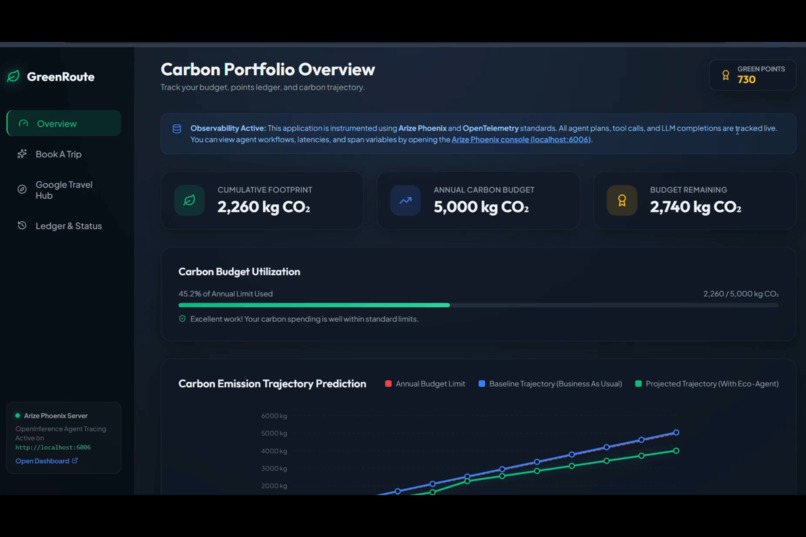
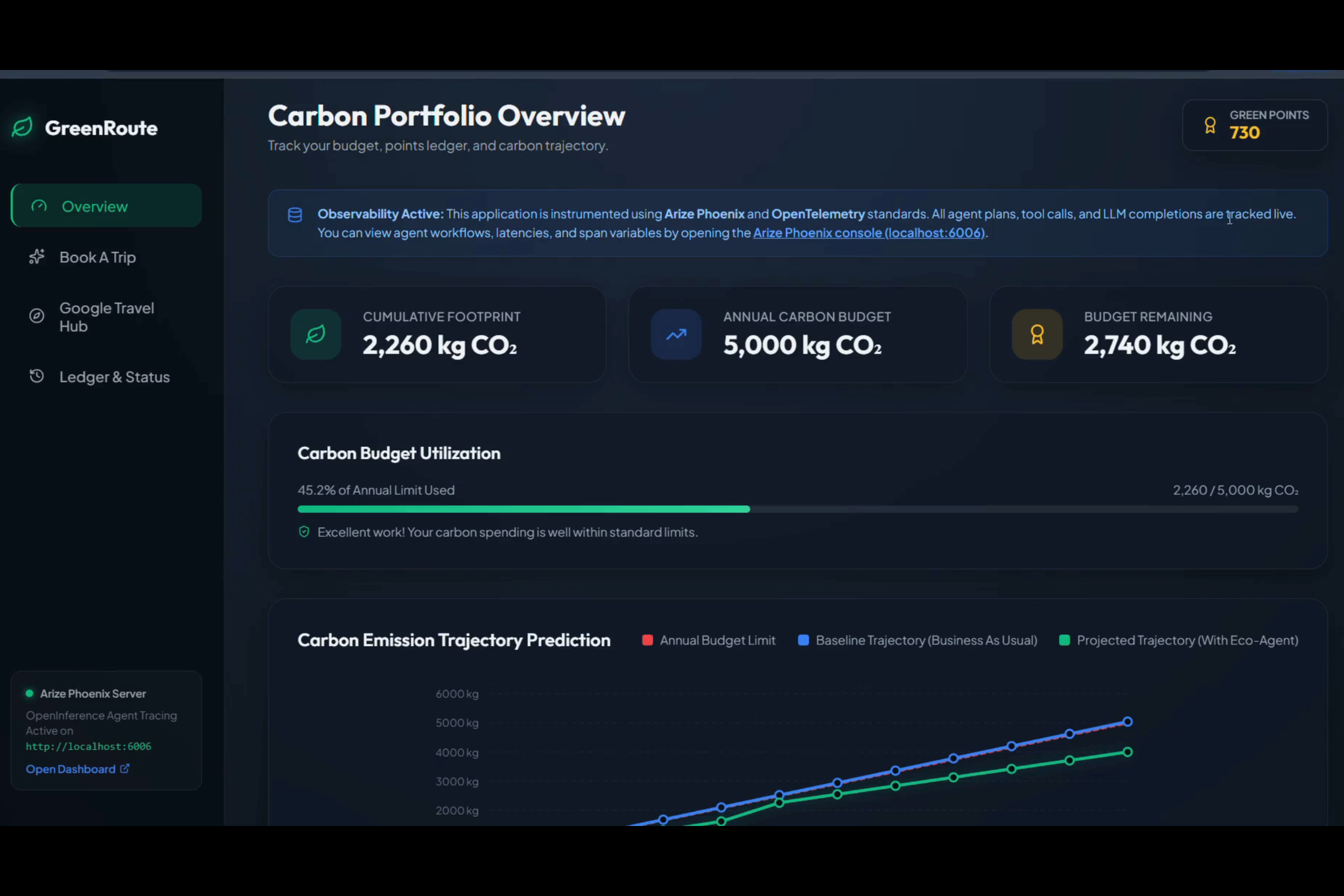
Overview Page: Current Emissions, Annual Carbon Budget, and Remaining Carbon Emission left
-
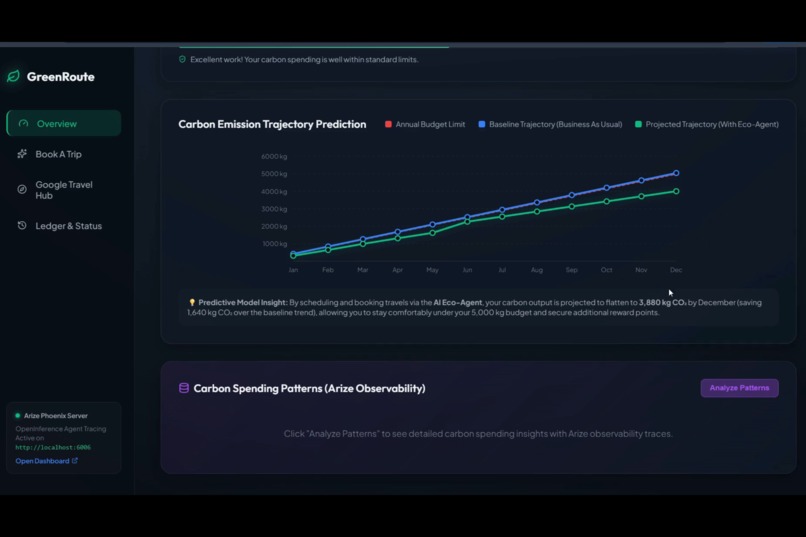
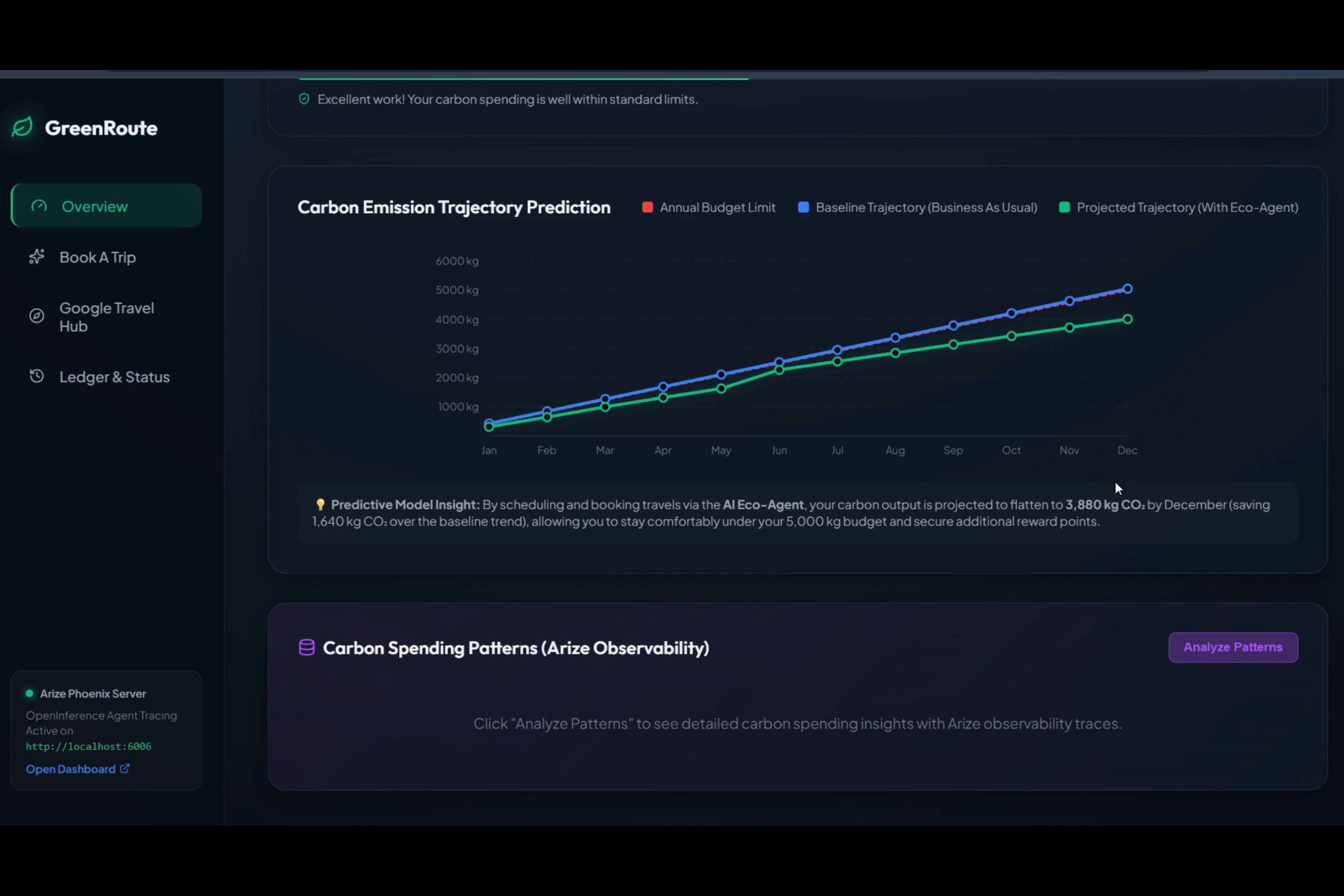
Carbon Emission Trajectory (Baseline and Projected Path)
-
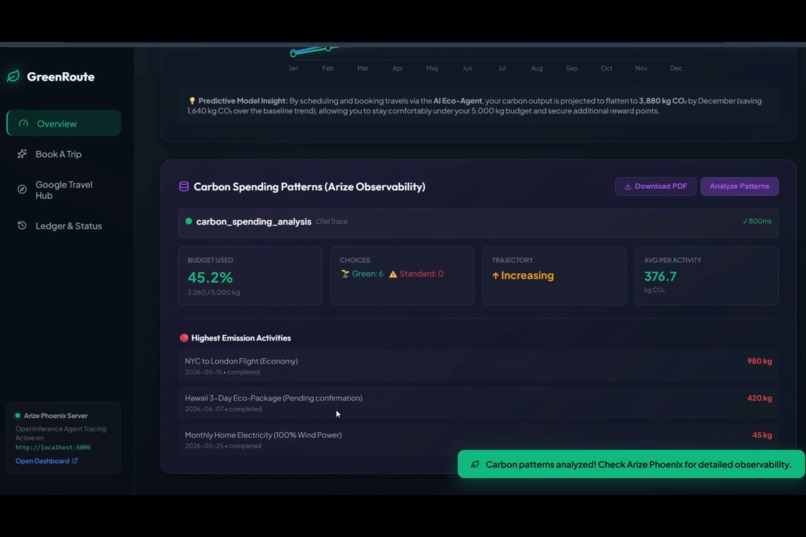
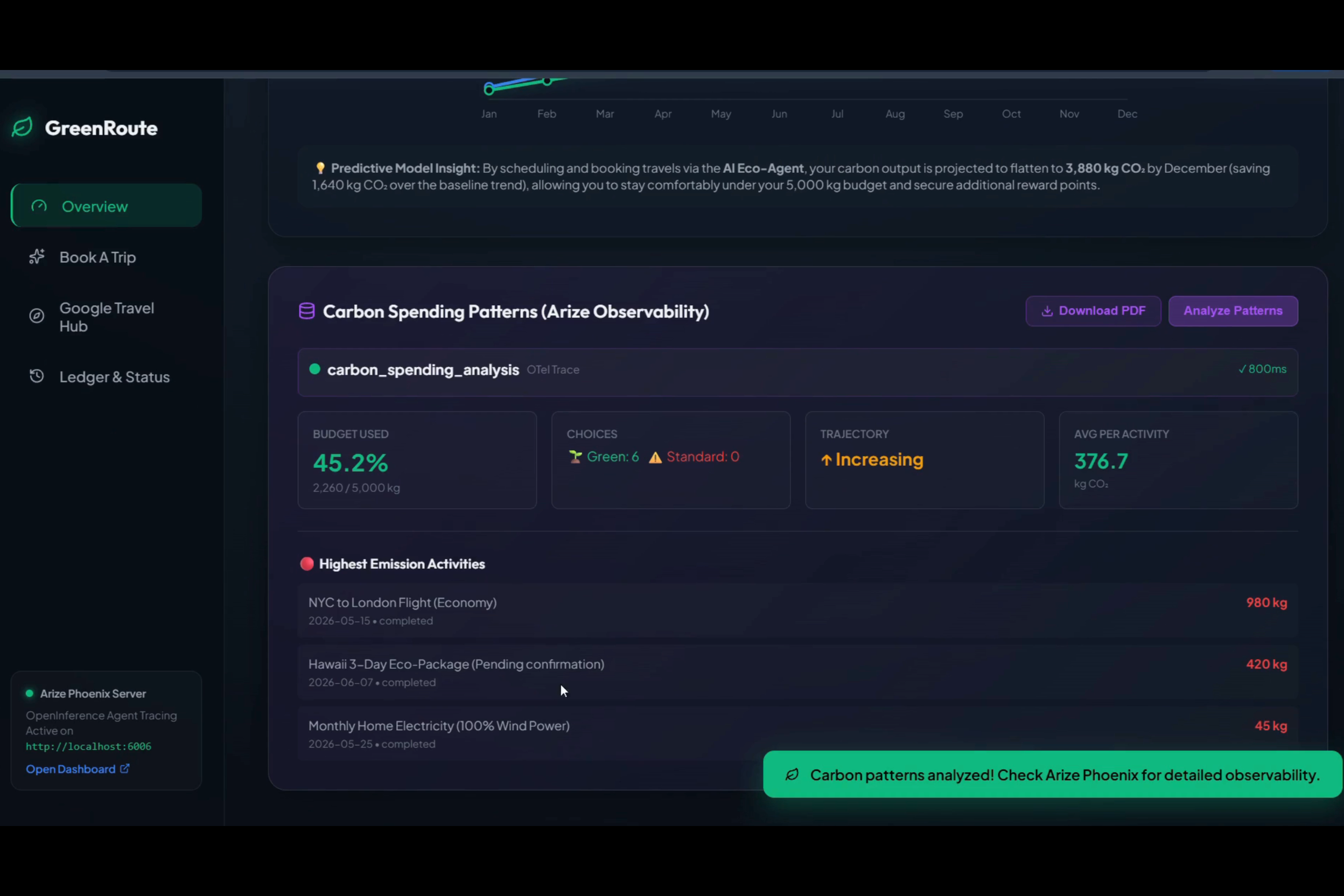
Arize Observability to analyze Carbon Emission patters
-
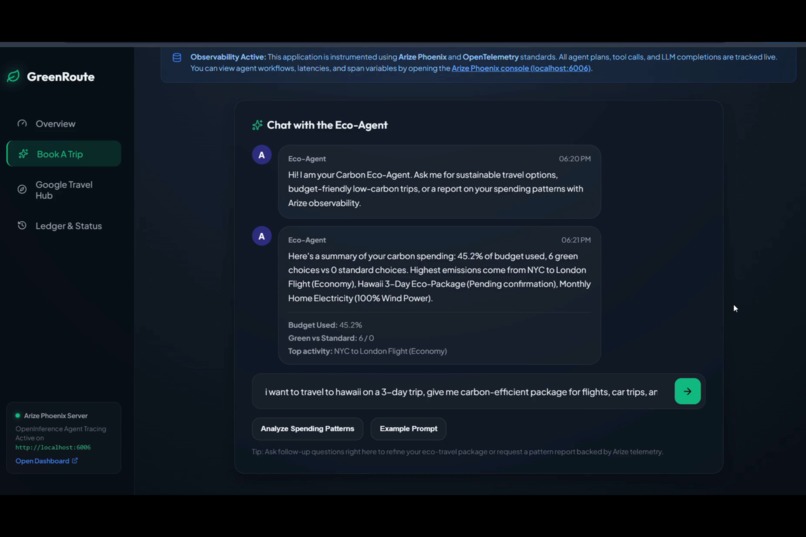
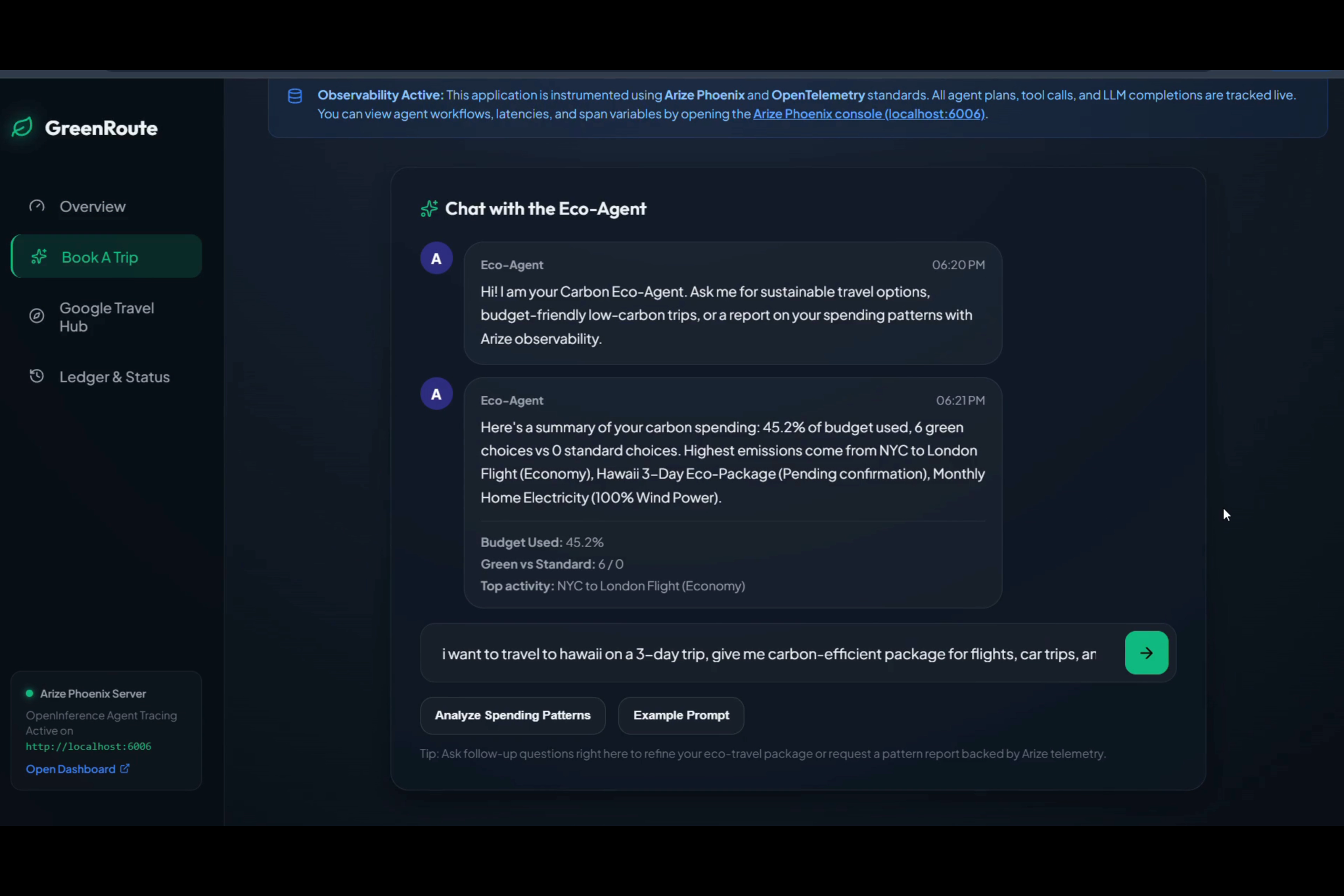
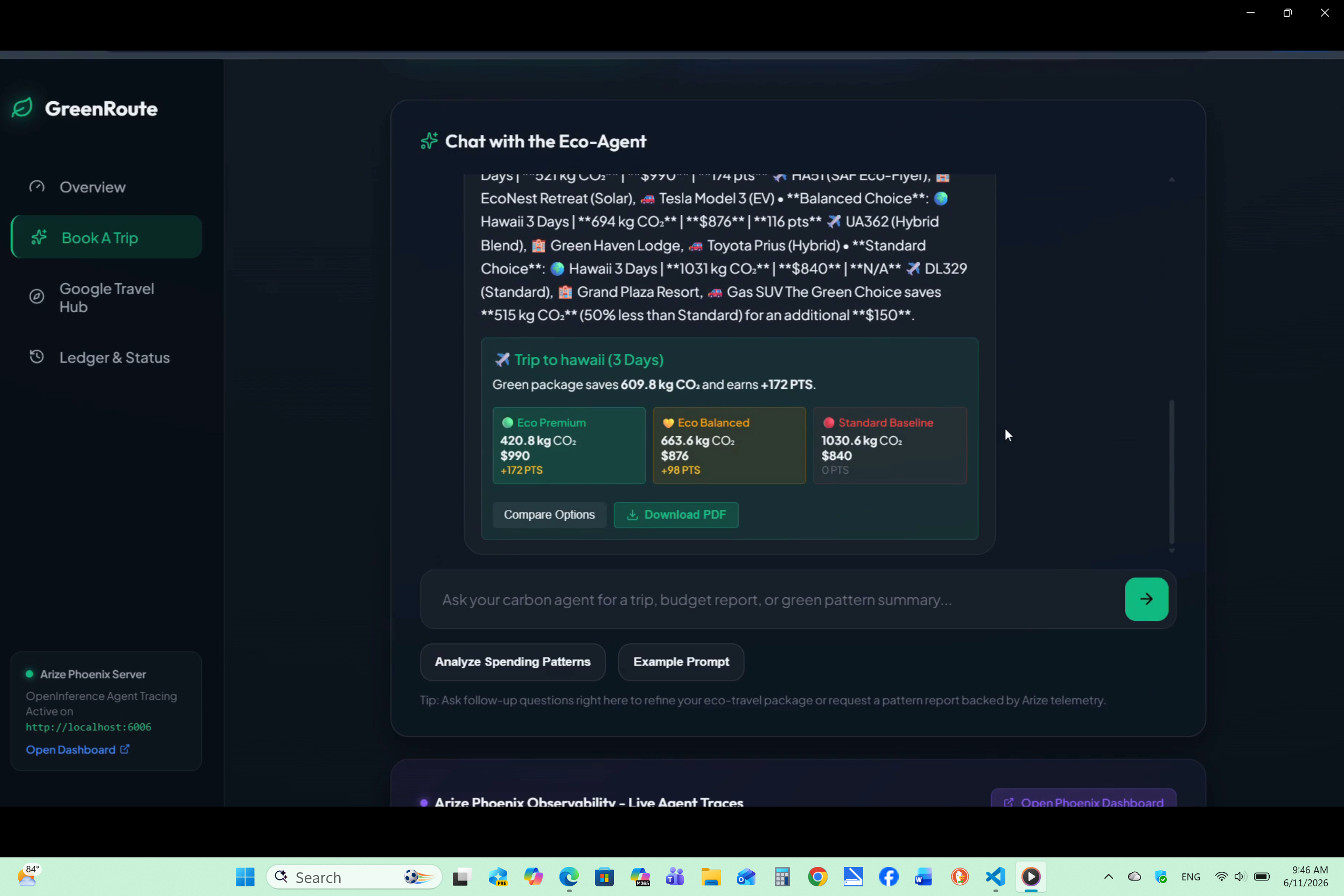
Eco AI Agent Chat
-
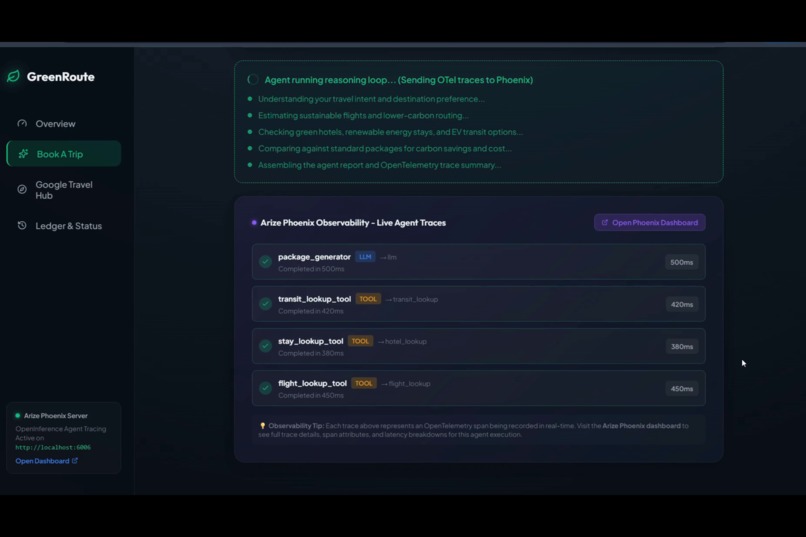
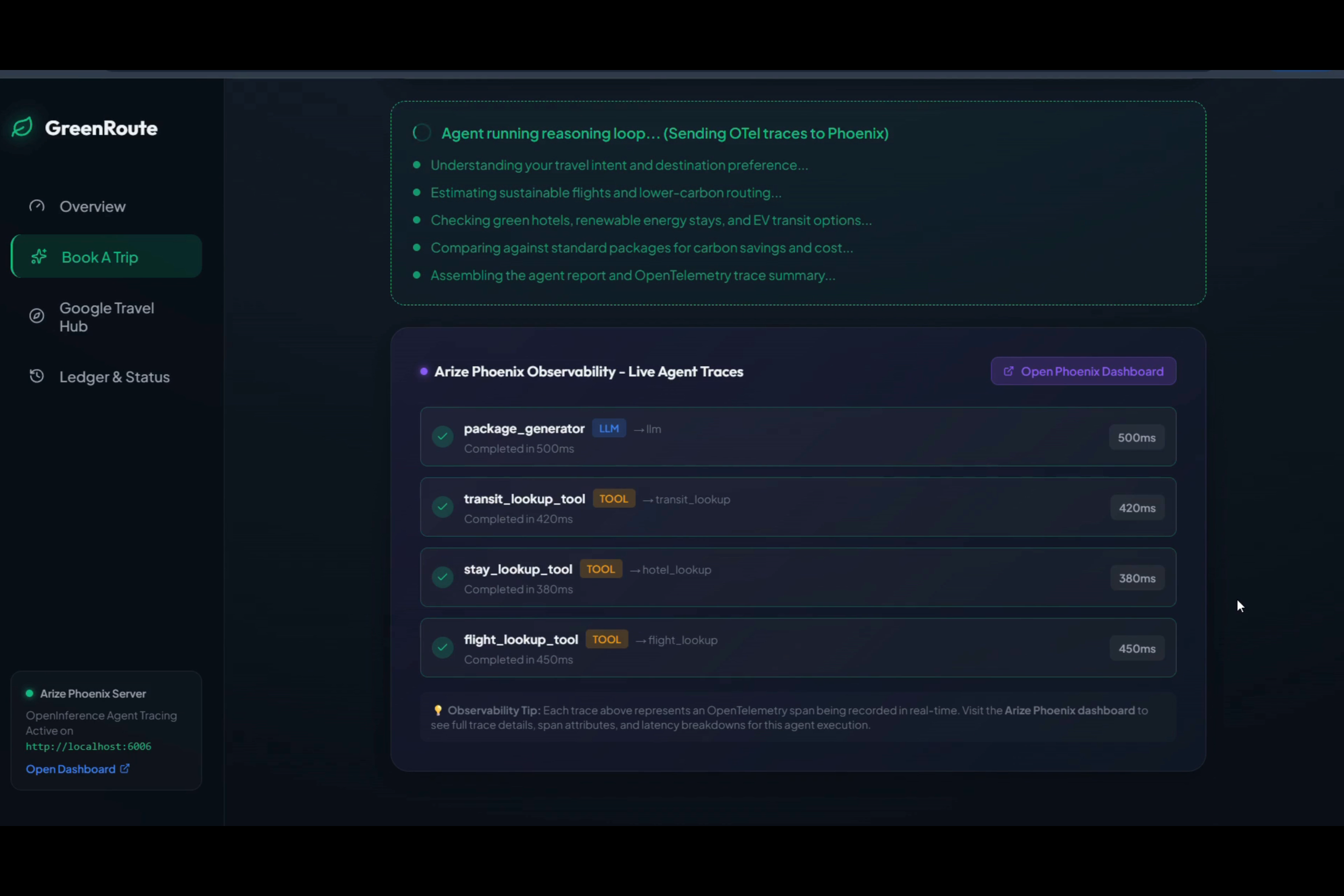
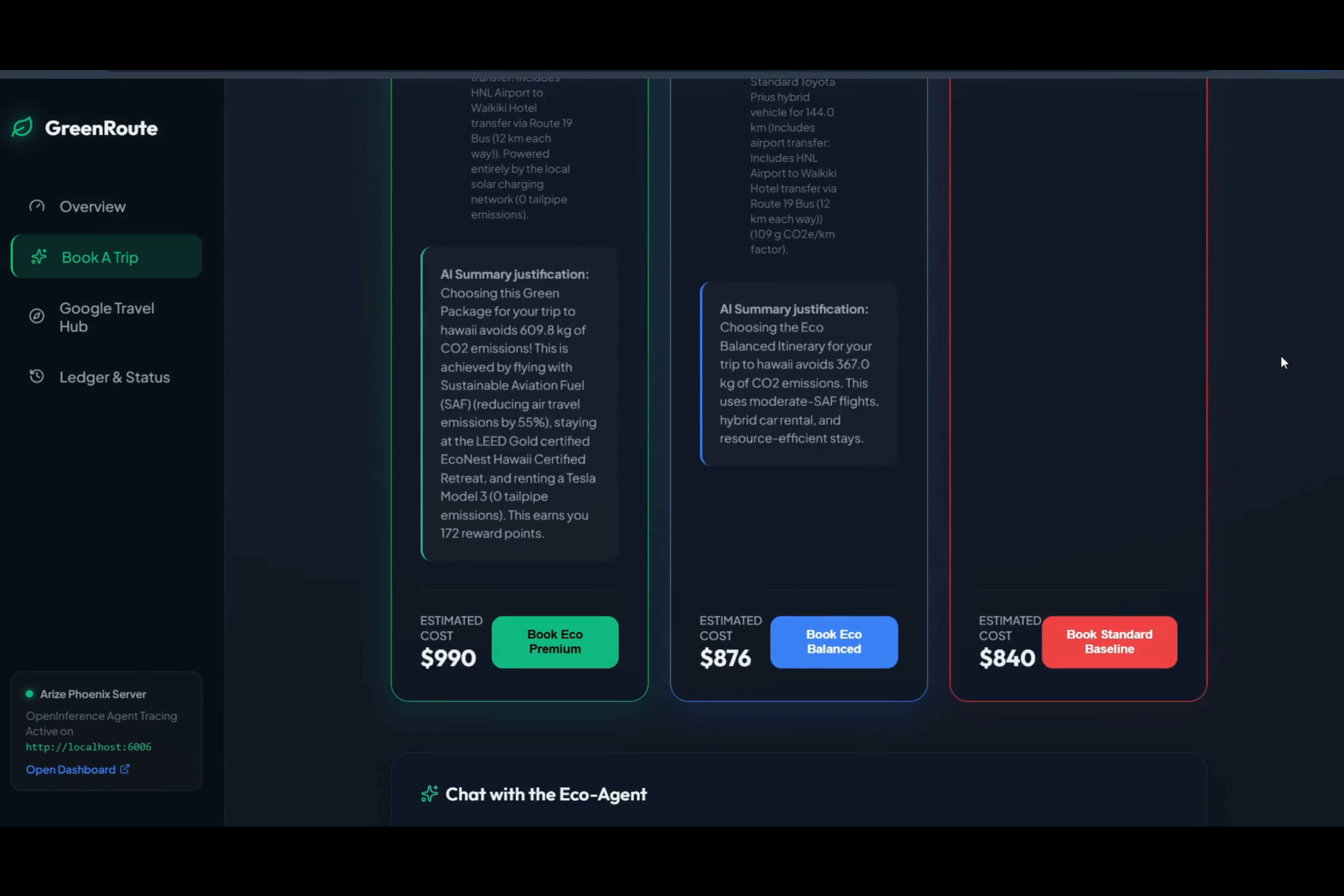
Arize Pheonix Carbon Packages
-
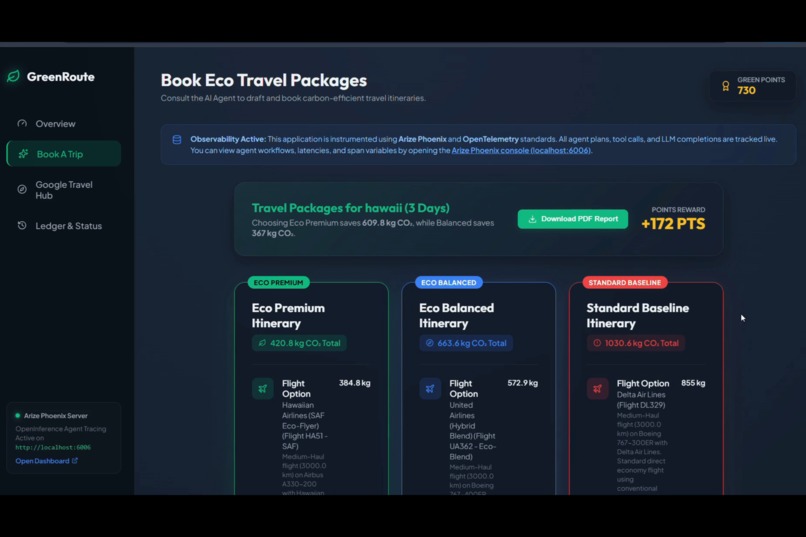
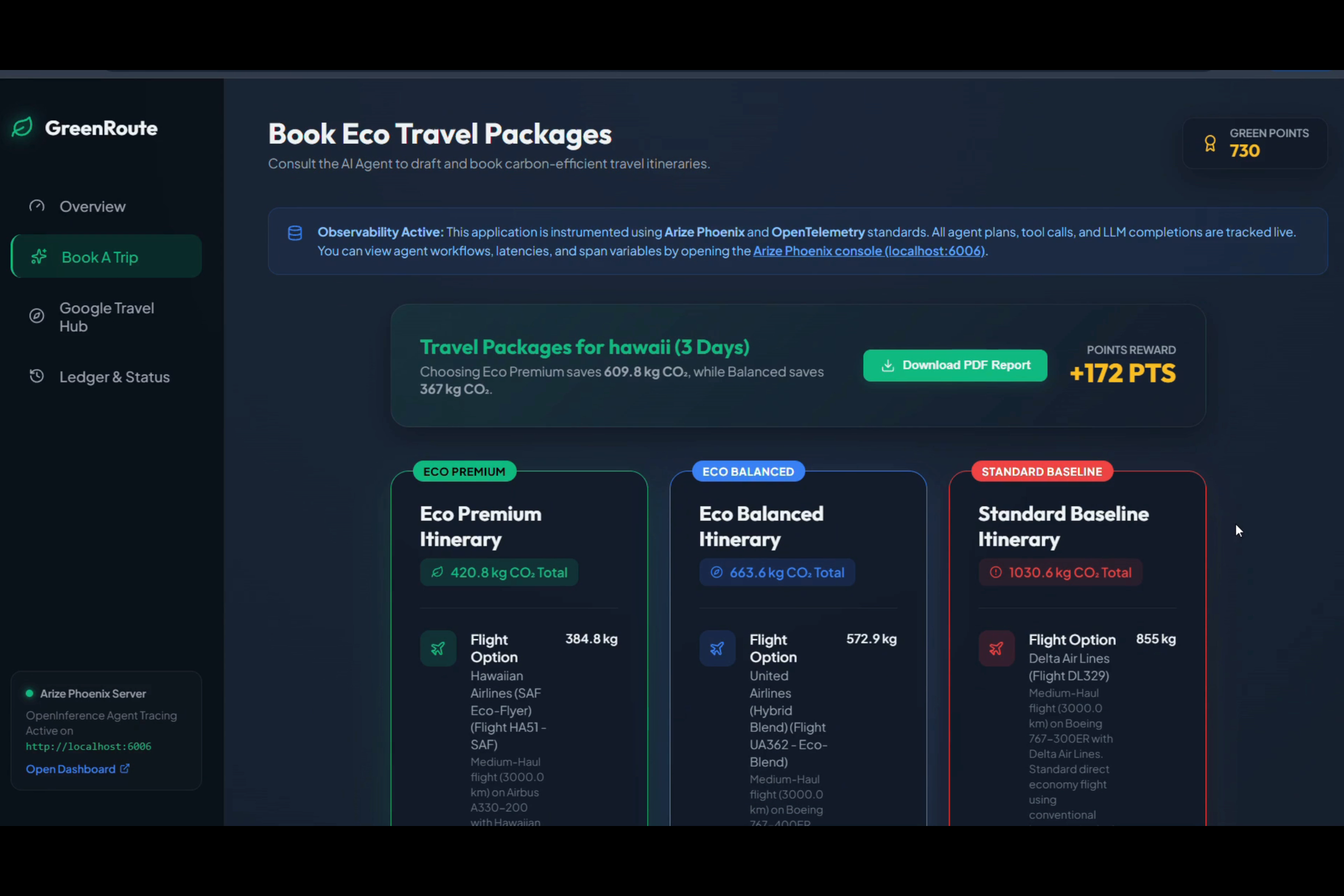
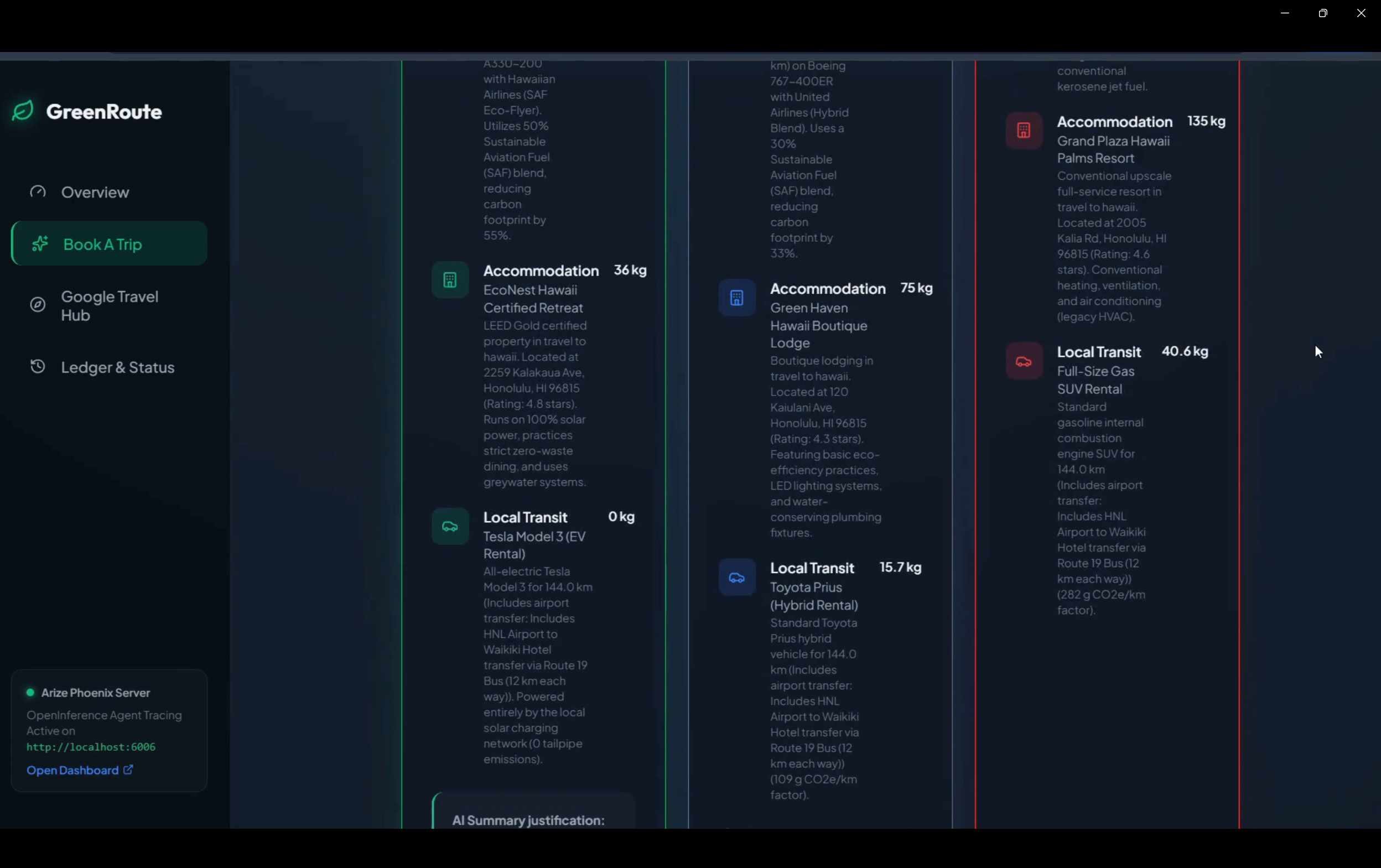
Eco Travel Packages Image 1
-
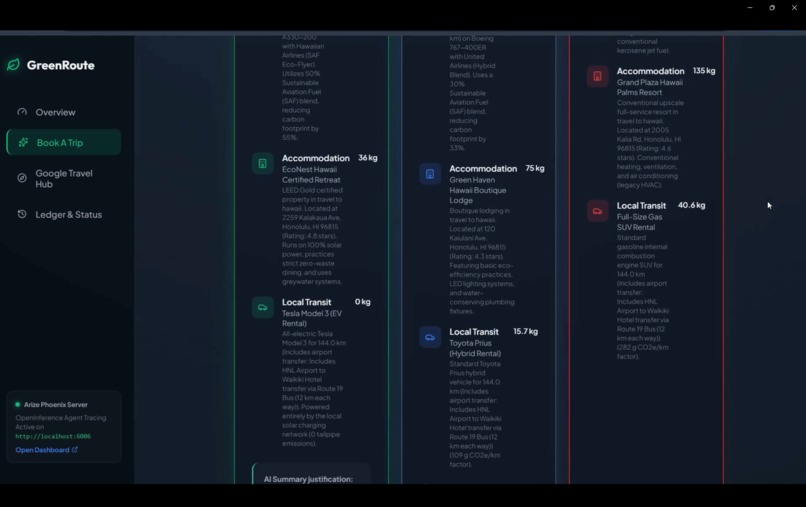
Eco Travel Packages Image 2
-
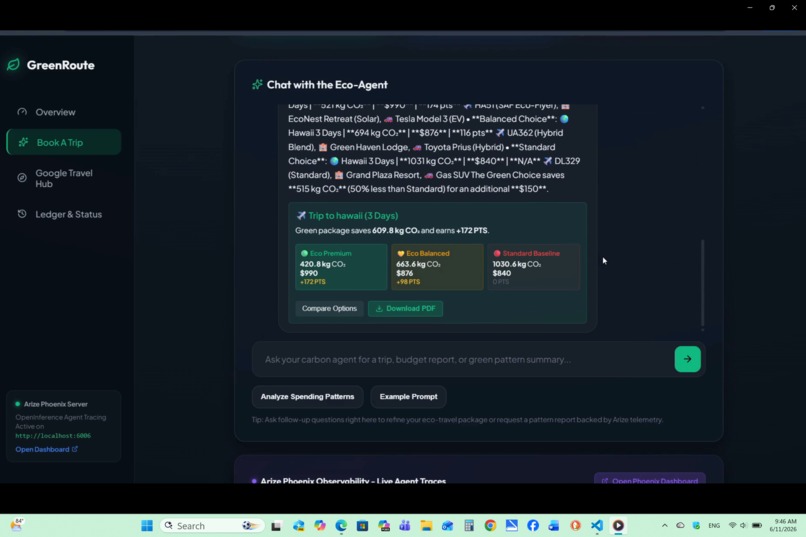
Compare and Download PDF Report Features
-
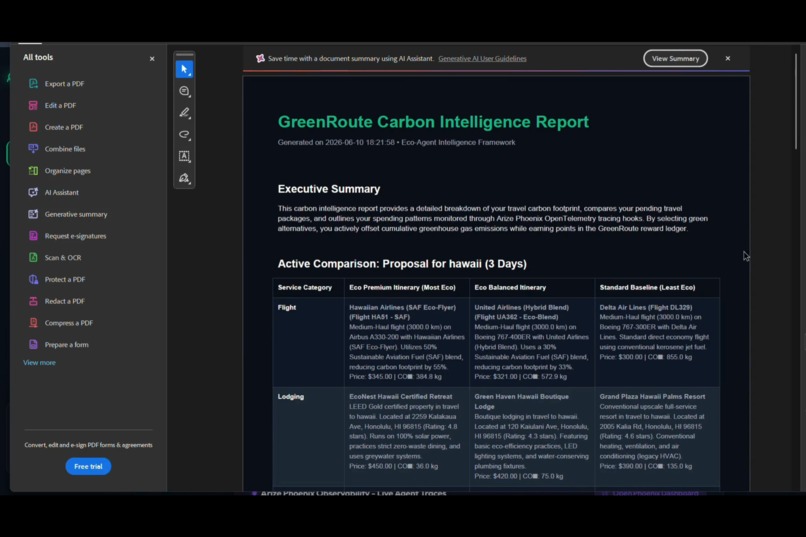
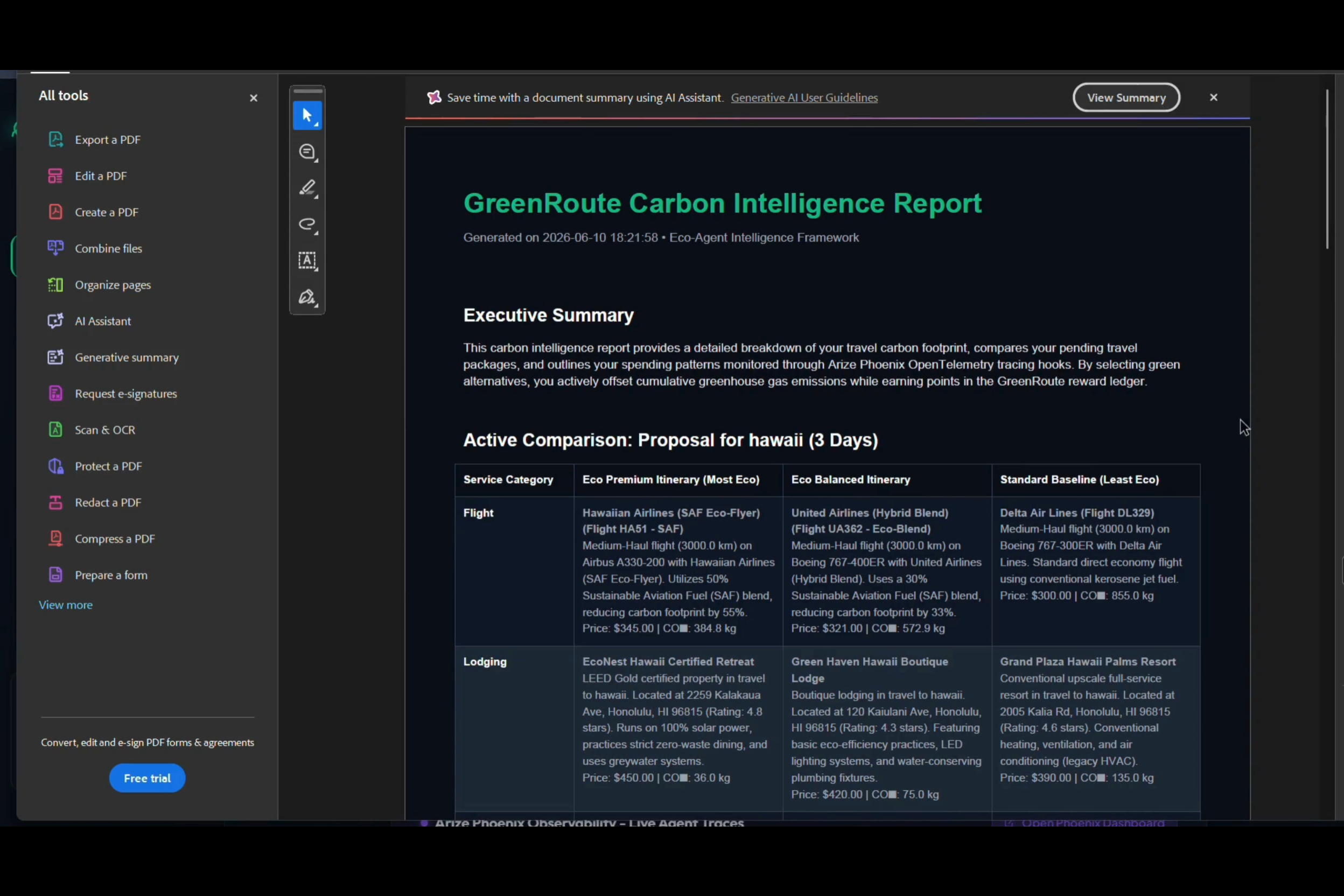
PDF Report Open
-
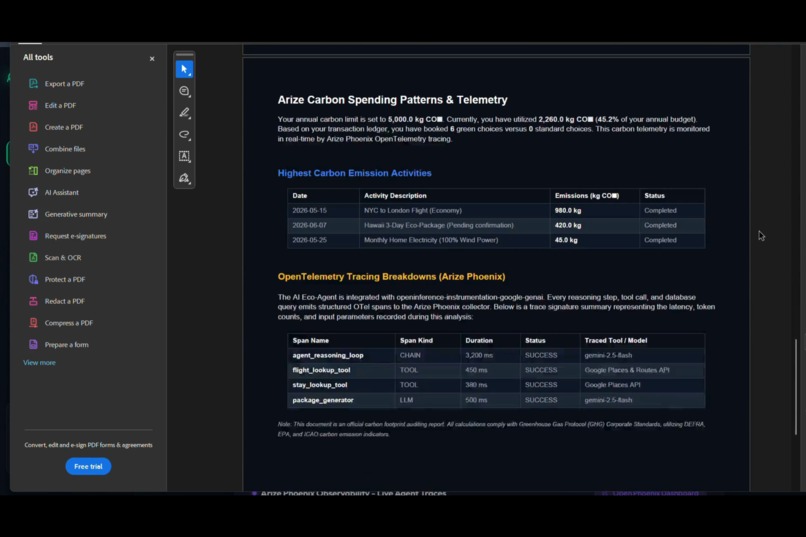
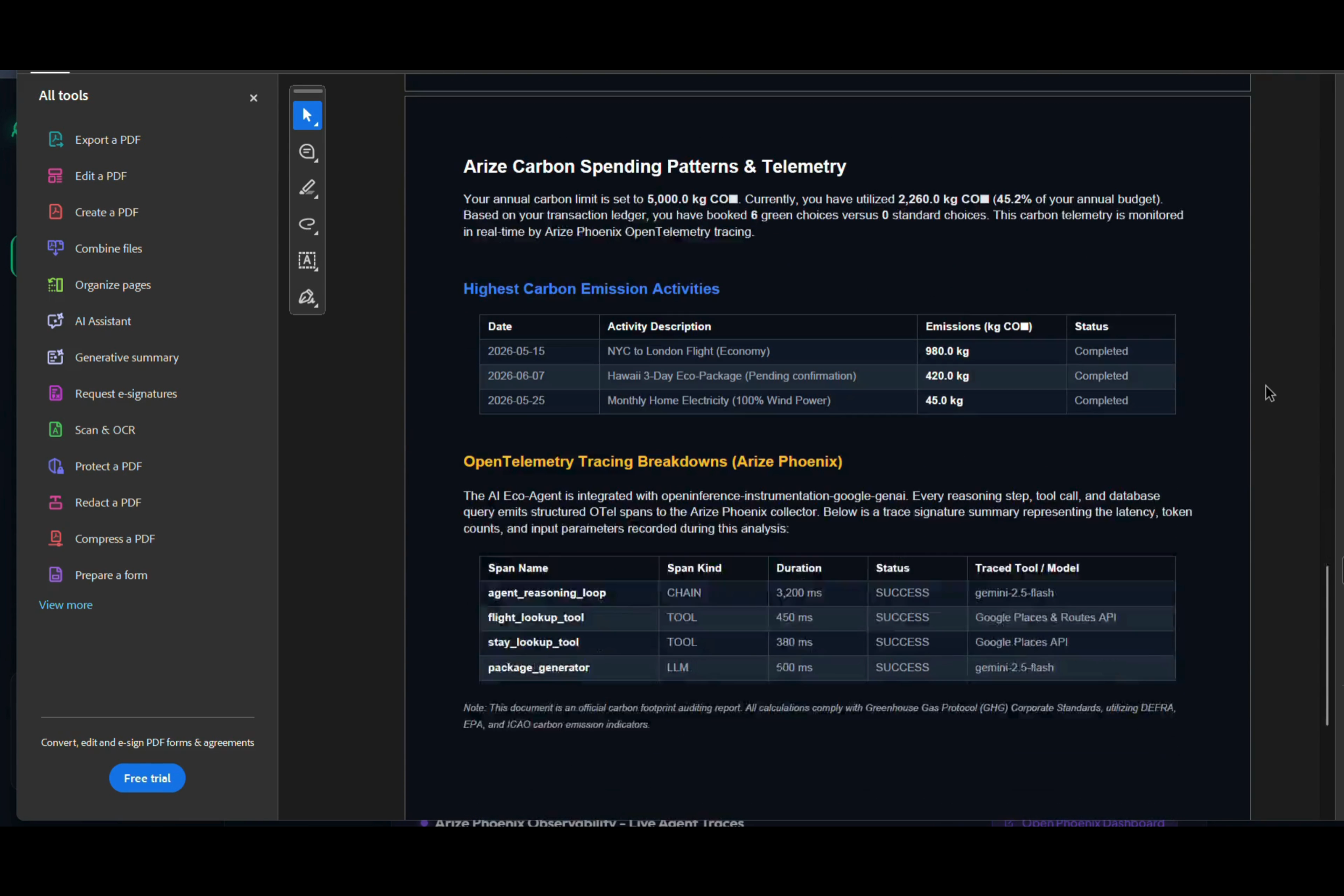
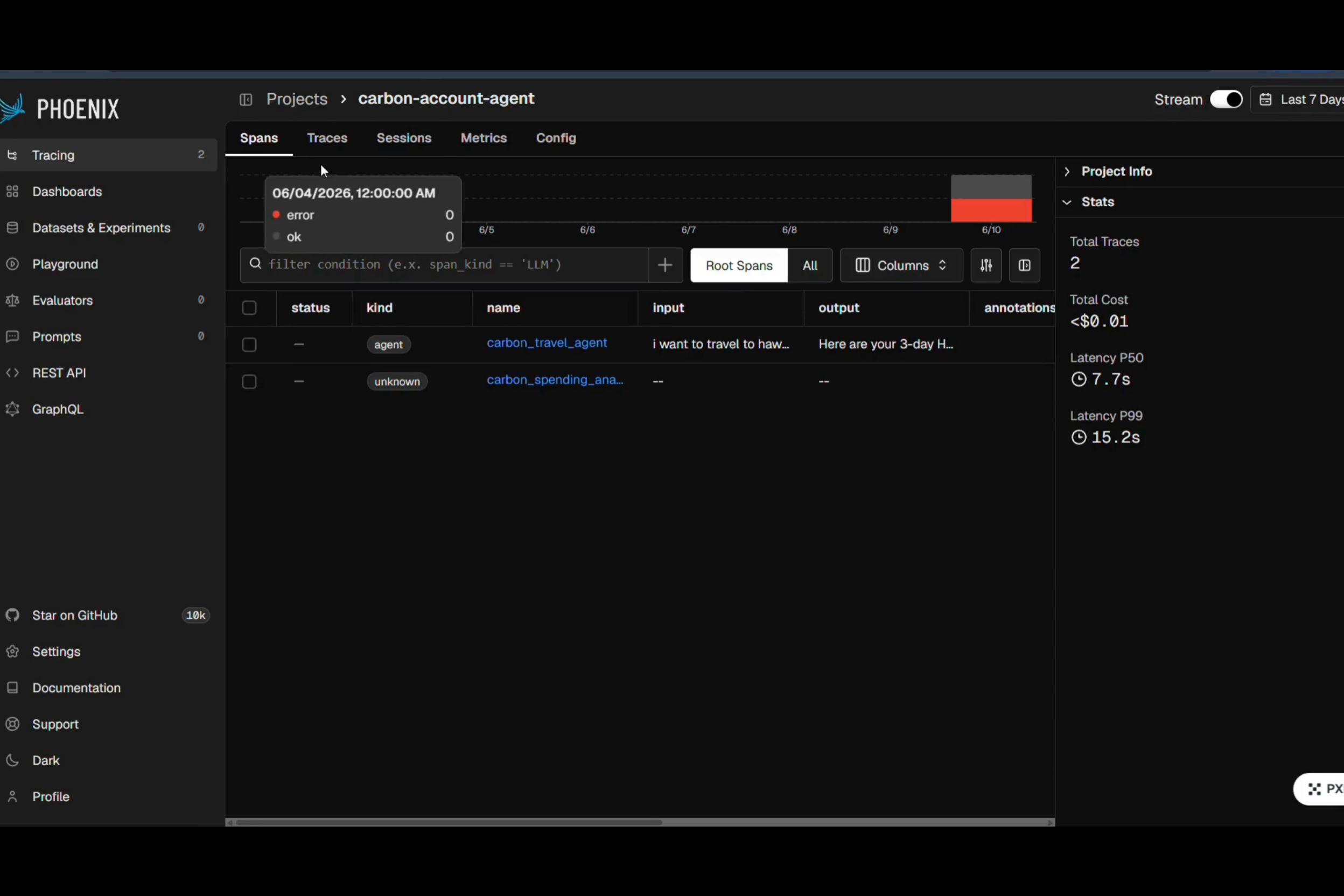
Arize Carbon Spending Patterns and Telemetry
-
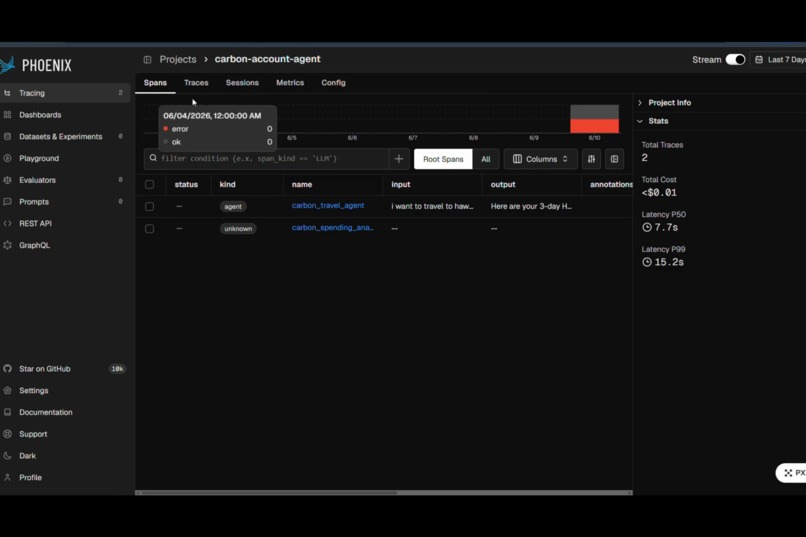
Arize Pheonix Spans Log
-
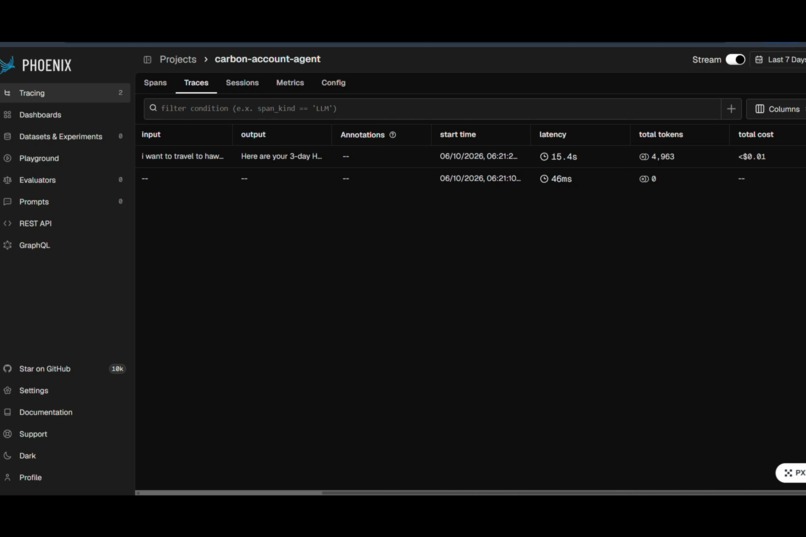
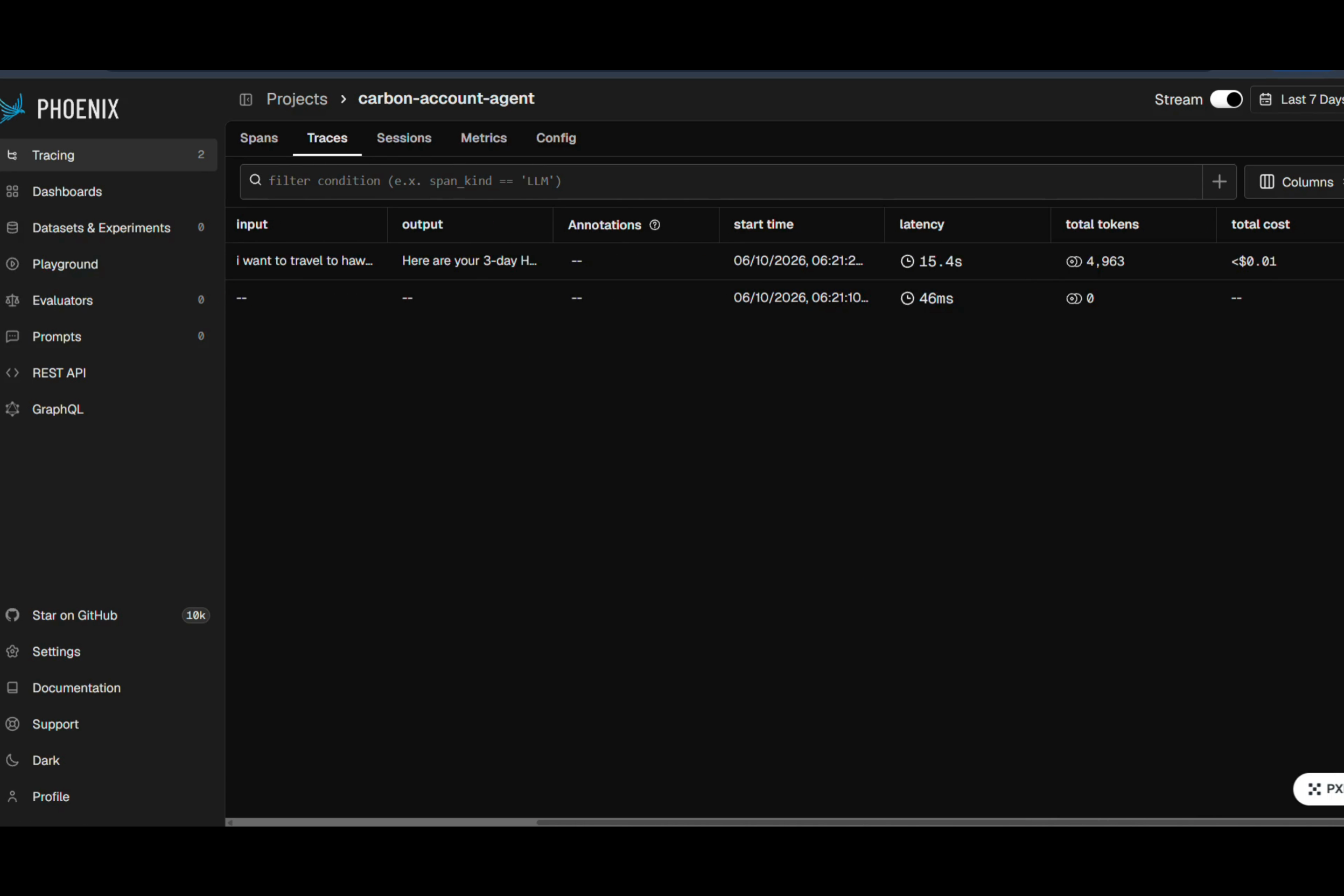
Arize Pheonix Traces Log
-
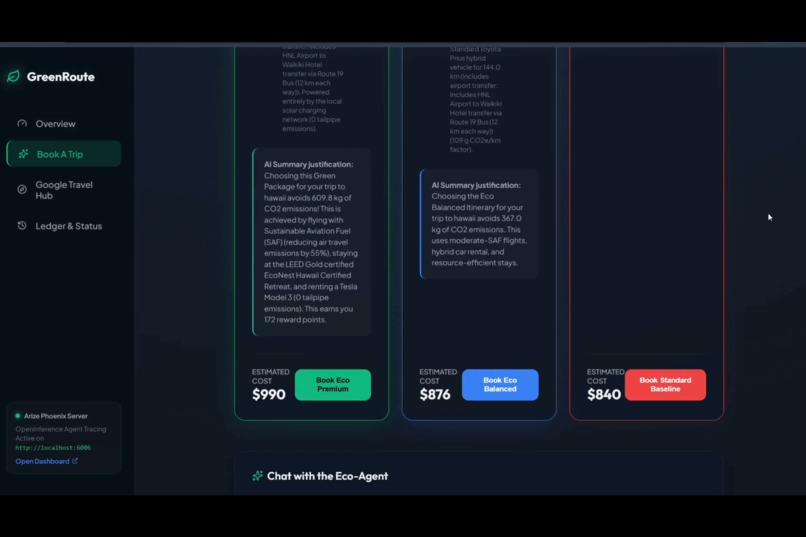
Book Travel Package Buttons, from Most Green Efficient to Least
-
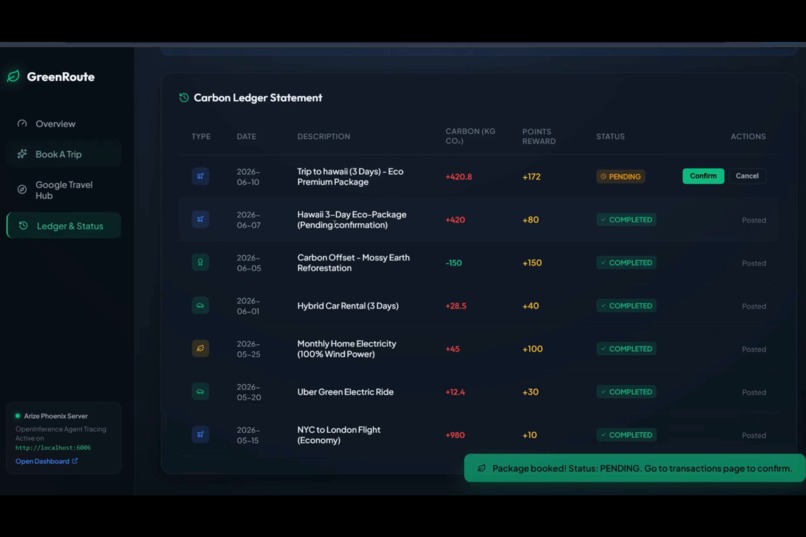
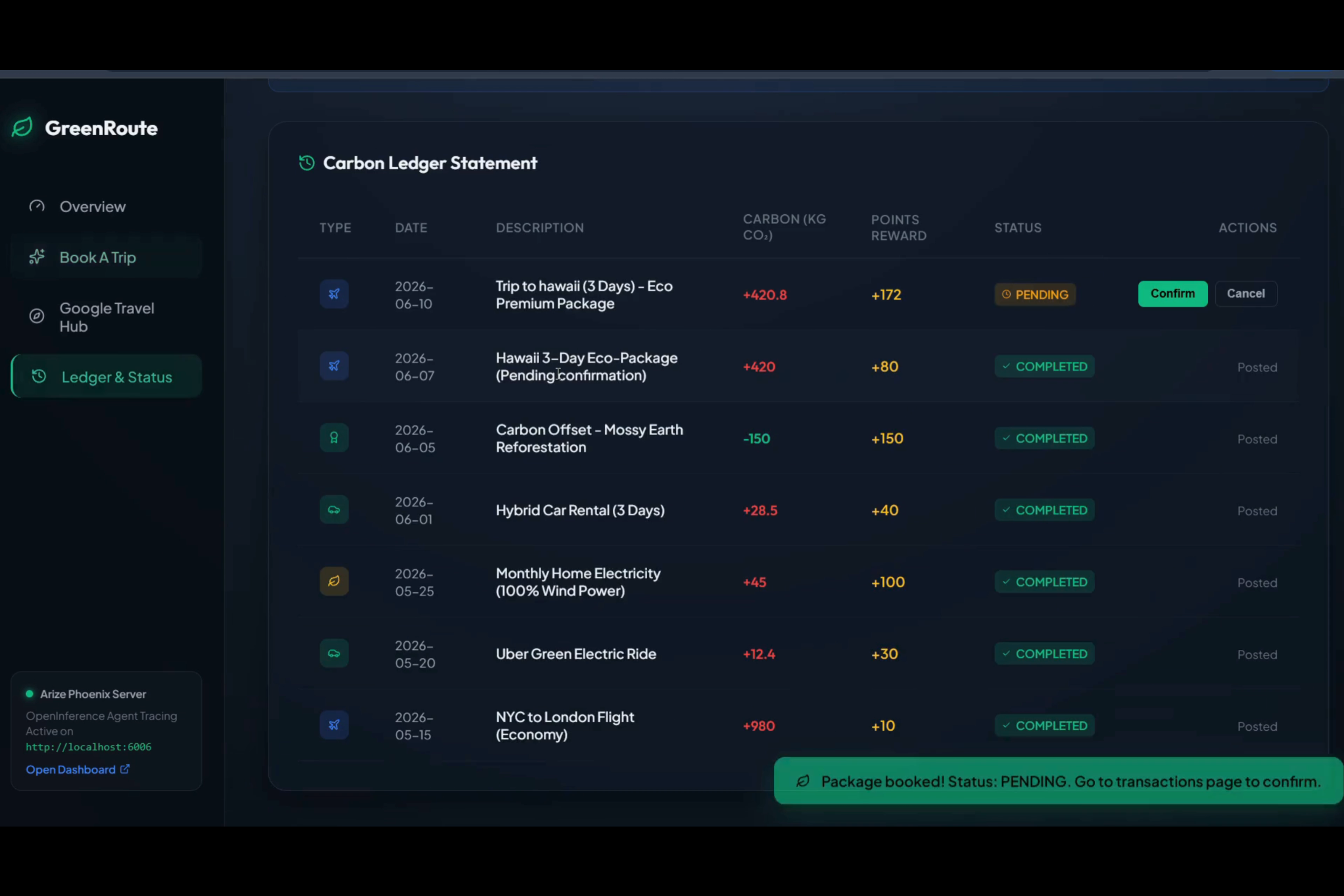
Carbon Ledger Confirmation Status
-
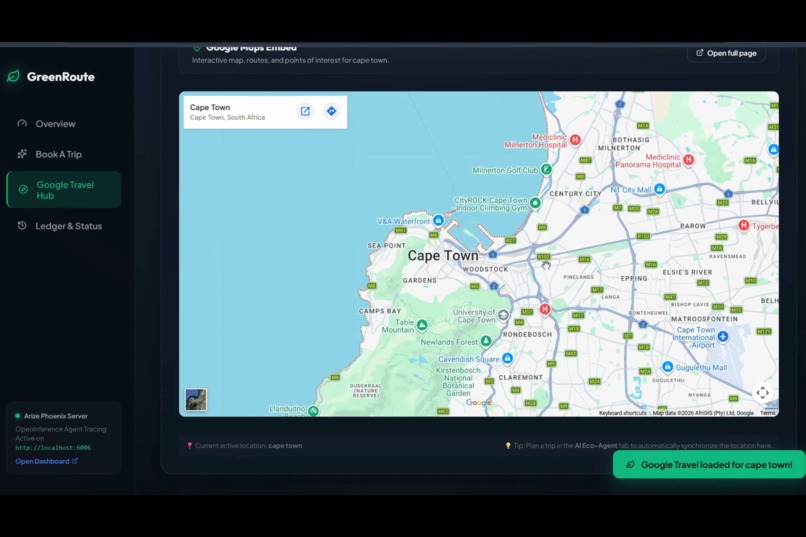
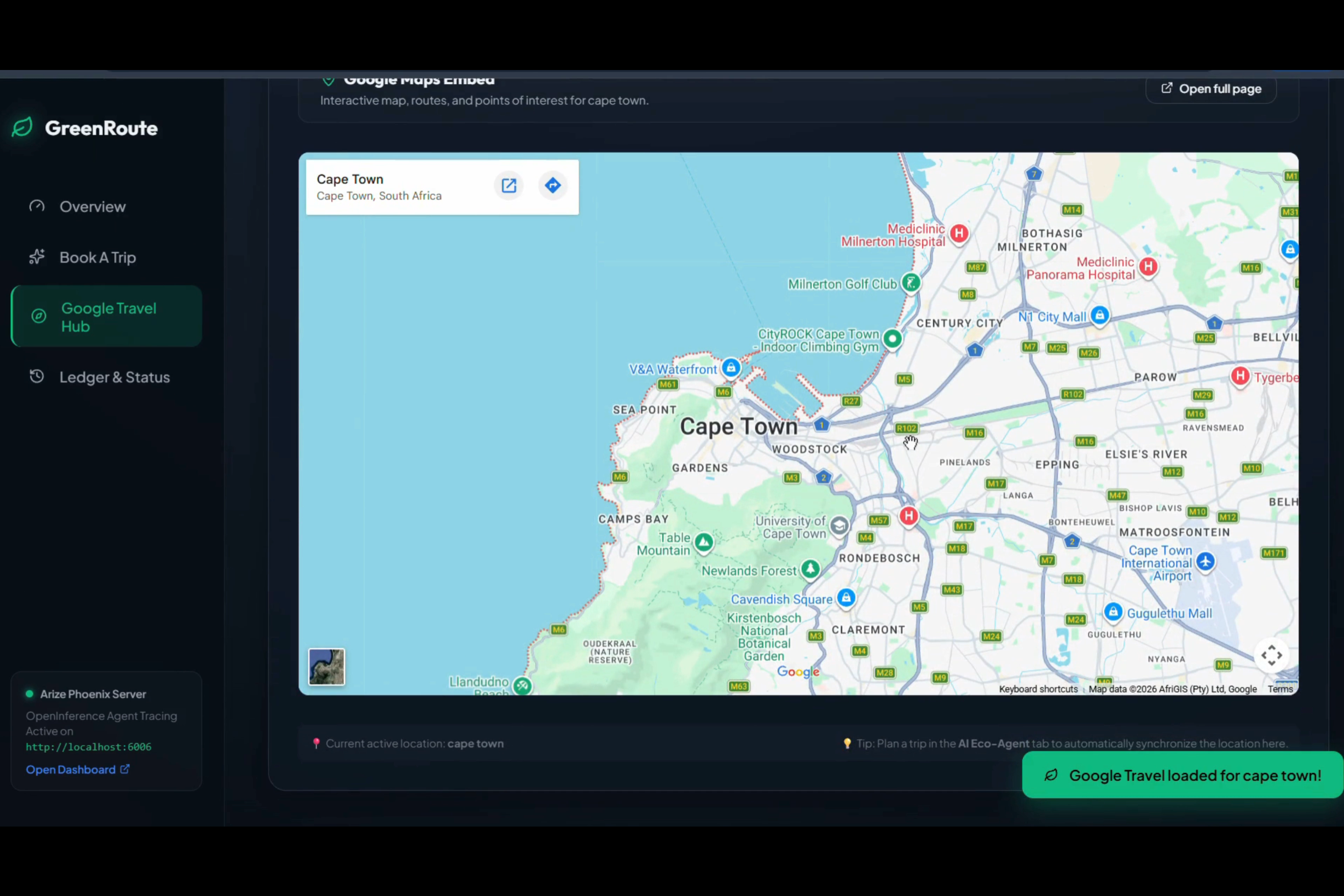
Google Maps Feature
-
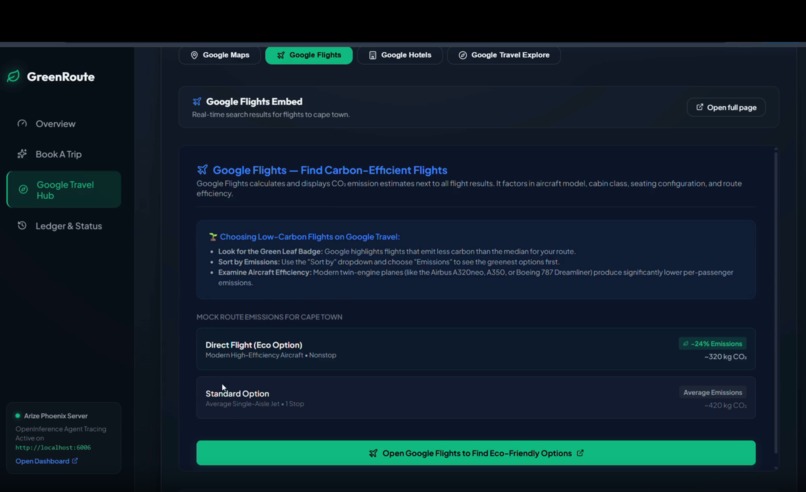
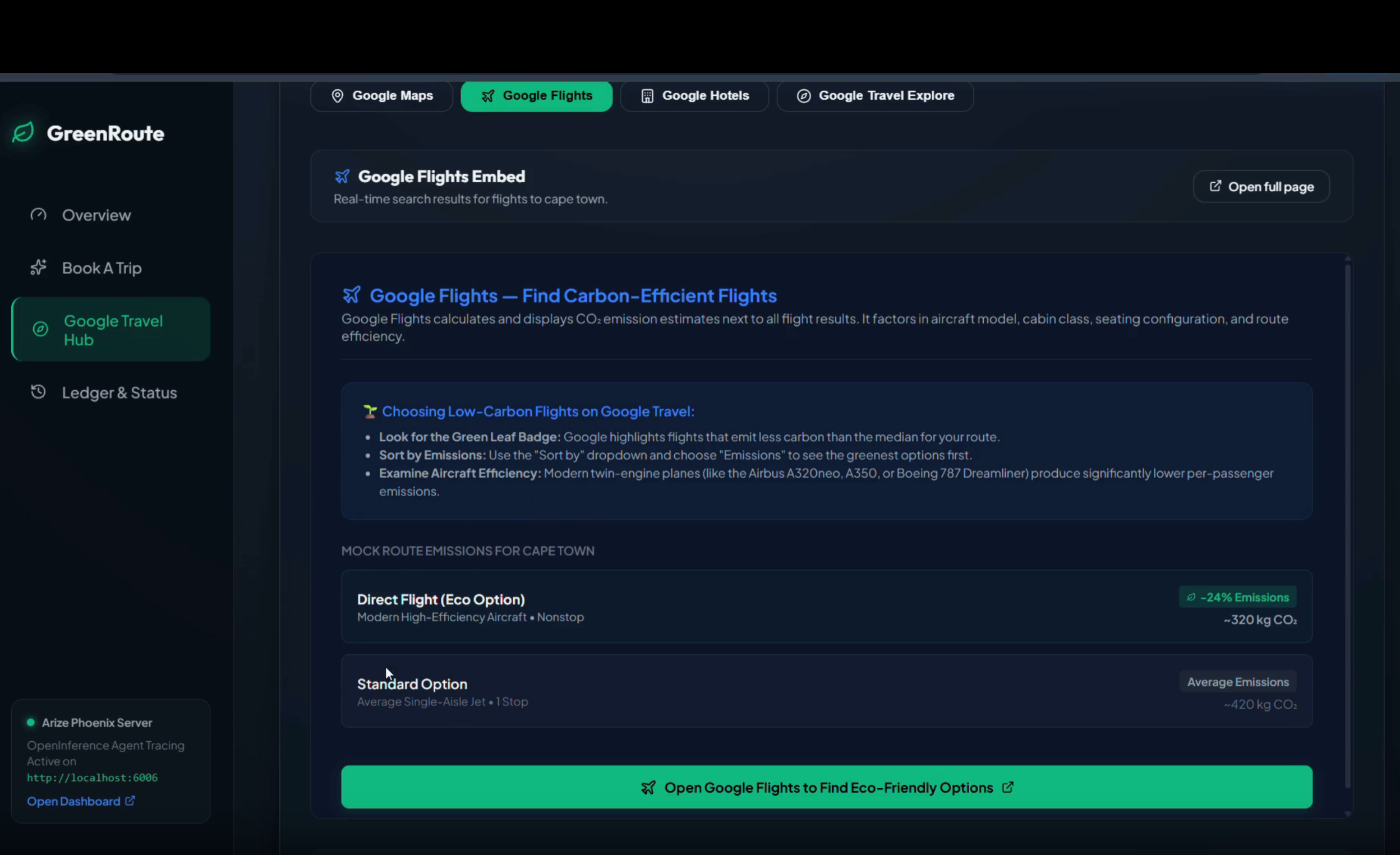
Google Flights Feature
-
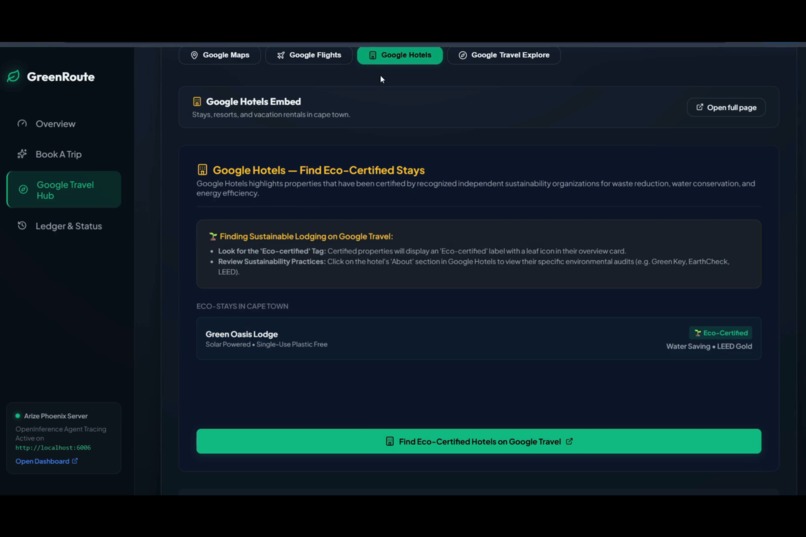
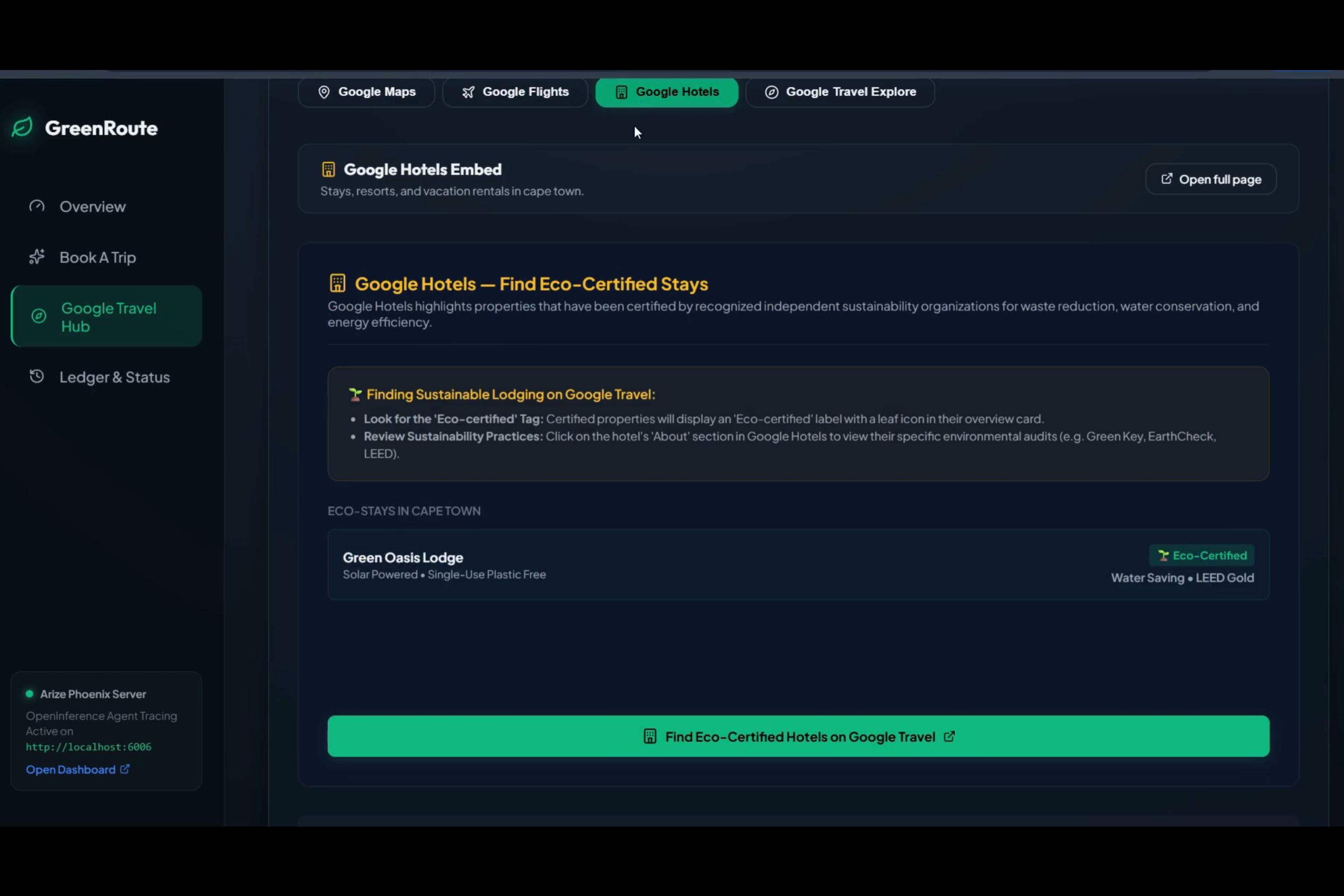
Google Hotels Feature
-
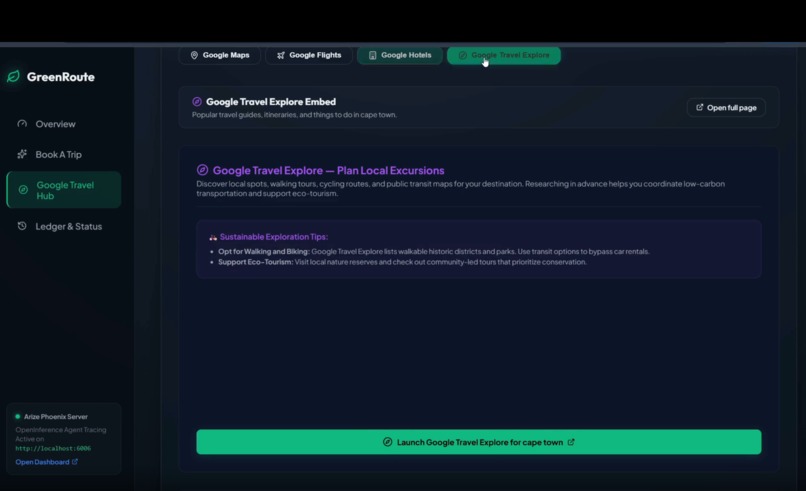
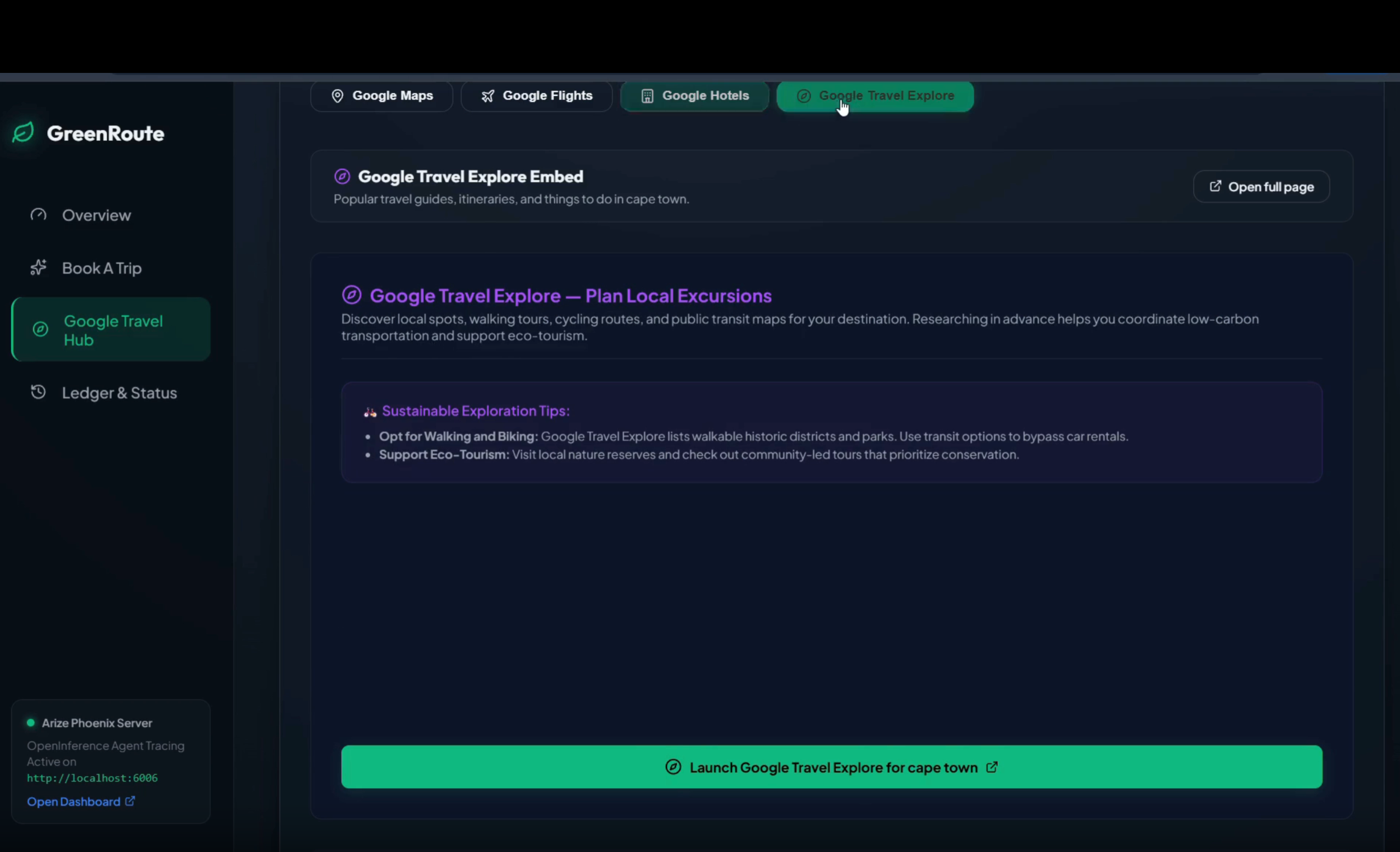
Google Travel Feature
Inspiration
Every year, the global travel industry emits over 1.9 billion tonnes of CO2; with the 2026 FIFA World Cup on the horizon, summer vacations being planned, and the everyday reality of getting from one place to another, the travel influx has never been more impossible to ignore. Despite growing awareness around climate change, most travel platforms still treat carbon emissions as an afterthought, if they mention them at all.
Our team comes from diverse backgrounds, each with different perspectives on travel, immigration, and sustainability. What if travel apps told you not just where you're going, but what it's costing the planet? And so, GreenRoute was born.
What it does
GreenRoute is a carbon account for your travel life. Just like a bank account tracks your spending, GreenRoute tracks your carbon footprint: logging every trip, flight, ride, and activity against your personal annual carbon budget.
At the heart of the experience is the AI Eco-Agent, powered by Google Travel and Google Maps, that helps you plan, compare, and book travel packages ranked by both environmental impact and affordability. Before confirming any trip, simply ask the agent to generate detailed comparisons and downloadable PDF reports, complete with charts, graphs, and side-by-side breakdowns of your options: weighing carbon emissions, total cost, and sustainability level so you can travel smarter and greener.
A real-time Carbon Portfolio tracks your emissions, budget, and trajectory, showing exactly where you're headed versus where you could be. Every trip is logged in your Carbon Ledger, and every smart choice earns Green Points you can redeem toward future travel. Do good. Go places.
How we built it
We developed GreenRoute as a full-stack web application using Google AI Studio, Google Cloud Run, Google Cloud SQL for PostgreSQL, and Firebase Hosting for persistent data storage, built and shipped end-to-end over the course of the hackathon.
Firstly, our process began with the AI Eco-Agent, powered by Gemini 2.5 Flash, which handles natural language trip planning, carbon calculations, and package comparisons in JSON mode, giving us structured responses we could pipe directly into the UI and into our custom PDF reports. Built from scratch with ReportLab, each PDF report includes crafted charts, cost comparisons, pie breakdowns, and a carbon pattern analysis.
We spent significant time on prompt engineering, crafting a detailed emissions reference dataset, covering flight SAF factors, vehicle types, hotel tiers, grounding destination, and routing data with Google Maps and Google Travel, and additional Google APIs (Google Places API, Google Geocoding API, AviationStack). Even with a strong prompt, language models miscalculate totals. So we built a math fact-checker layer that runs after every Gemini response: recomputing CO2 totals, savings, and Green Points.
- $$ Total CO2 = flight_co2 + stay_co2 + transit_co2 $$
- $$ CO2 Savings = standard_total_co2 - green_total_co2 $$
- $$ Green Points = round(savings_kg × 0.2) + 50 (+50 is a flat bonus for choosing the green package) $$
Central to our engineering was a full Arize Phoenix observability integration via OpenTelemetry. Every step of the agent pipeline is recorded and tracked in our Phoenix project: flight lookup, stay lookup, transit lookup, Gemini LLM call, and the math fact-checker. That same transparency extends into analyzing Carbon Spending Patterns and every downloadable PDF report using Arize Observability.
The final touch was the Carbon Ledger and Trajectory Chart, where every trip, flight, ride, and offset is logged in real time against a personal annual carbon budget.
The result is GreenRoute: a Carbon Account backed by an Eco AI-Agent for greener travels.
Challenges we ran into
As three 18-year-olds building an AI-powered application for the first time, we were learning the fundamentals simultaneously while trying to ship a product. Our biggest challenge was utilising prompt engineering for the Eco-Agent to produce reliable, structured responses while learning how large language models work from scratch. Concepts such as context windows, temperature, JSON mode, and how model parameters affect output quality were all new to us, and getting Gemini 2.5 Flash to behave consistently under real-world conditions took significant trial and error.
A major technical hurdle was that our initial Gemini model (Gemini 1.5 Flash) frequently returned fallback mode instead of useful recommendations, limiting the agent's effectiveness. After analyzing model behavior and testing alternatives, we migrated to Gemini 2.5 Flash that provided more reliable and complete responses, significantly improving the user experience.
To further enhance robustness, we implemented scope detection to identify unrelated queries and return a clear message indicating that the Eco-Agent is specifically designed for sustainable travel planning. We also added pre-built sample prompts, allowing users to immediately explore the agent's capabilities without needing to craft their own requests.
Finally, we worked through the challenge of presenting AI-generated outputs in a clear and user-friendly way. Our goal was to surface useful insights without overwhelming users or making overly prescriptive recommendations. To address this, we leveraged Gemini to produce probabilistic suggestions that guided users toward informed actions based on their inputs. We also built in straightforward controls that allow users to edit or override these outputs, ensuring a balance between intelligent automation and user autonomy.
Accomplishments that we're proud of
One of our proudest achievements is building something with a great impact. GreenRoute reimagines travel planning not as a convenience tool, but as a carbon accountability system, giving users a real-time window into the environmental cost of every flight, hotel, and rental car they choose. The idea that someone could open our app, plan a trip, see exactly how many kilograms of CO2 their choices carry, earn rewards for going greener, and download a full audit report of their decision is the kind of creative ambition we set out with from day one, and we're proud we actually built it.
Our dedication to building exclusively within the Google ecosystem not only streamlined our development process but ensured that GreenRoute remains a robust, trustworthy tool; one that leverages the full power of Google's infrastructure to deliver results users can actually rely on.
Lastly, we are proud of our commitment to transparency in an AI-assisted application. We gave users complete visibility into how every carbon figure was calculated, verified, and corrected: from the agent's reasoning to the fact-checker's corrections to the full audit trail in their downloaded report. We confirmed this by having our friends and family try out GreenRoute and provide essential feedback that we worked on. In a space where trust is everything, we made sure GreenRoute earns it.
What we learned
Building GreenRoute from the ground up provided a level of learning that extended far beyond the classroom. As high school seniors entering AI development for the first time, every milestone was achieved through persistence, experimentation, and continuous iteration. Countless hours spent in Google AI Studio refining prompts, tuning parameters, and analyzing how subtle changes in language influenced agent behavior gave us a deep, practical understanding of prompt engineering and strengthened our overall problem-solving skills.
Working within the Google Cloud ecosystem presented another valuable learning experience. From configuring API keys and managing service credentials to integrating Gemini, Google Maps, and Google Travel into a unified application, we gained firsthand exposure to the challenges and best practices of modern software development.
Arize Phoenix introduced us to a critical aspect of AI engineering: observability and accountability. By tracing each agent decision through the Phoenix dashboard as a live, named span, we learned that responsible AI development extends beyond generating outputs; it requires transparency, traceability, and confidence in every recommendation produced.
Most importantly, developing GreenRoute for real users instilled a strong sense of responsibility. Knowing that individuals would rely on our platform to make informed, environmentally conscious travel decisions motivated us to prioritize accuracy, clarity, and transparency throughout every stage of the design and development process. Facing our first hackathon, we feel challenged to learn beyond our limits and to persist in providing a better user experience while protecting our planet!
What's next for GreenRoute
GreenRoute is just getting started. Our vision extends far beyond; we want to make carbon-conscious travel the default, not the exception. Here's where we're headed:
Enhanced Agent Capabilities: Expanded International Travel Data: We plan to broaden the Eco-Agent's emissions dataset to cover a far wider range of international destinations, carriers, and hotel tiers, ensuring that GreenRoute can deliver accurate, locally grounded carbon comparisons powered by Google Travel. Personalized Carbon Coaching: Rather than waiting for users to ask, the agent will proactively surface insights, spotting patterns in a user's Carbon Ledger and suggesting concrete, personalized steps to bring their trajectory down while keeping it affordable.
Technical Improvements: User Accounts & Authentication: Integrating Google account sign-in so every user's Carbon Ledger, Green Points balance, and trajectory data follow them seamlessly across devices. Expanded Emissions Dataset: Broadening our emissions reference to include trains, ferries, and cycling. Smarter PDF Reports: Embedding AI-generated narrative summaries alongside the charts and tables, turning each report into a personalized carbon report rather than a spreadsheet. Feedback Integration: Giving users the ability to rate and respond to agent recommendations will allow our AI models to continuously learn and improve, making GreenRoute sharper, more relevant, and more trusted.
Expansion into New Use Cases: We see GreenRoute growing into a corporate travel sustainability tool, enabling organizations to monitor, report, and offset the combined carbon footprint of their entire workforce. Scaling from individual accountability to collective impact is the natural next step toward making a dent in the current 1.9 billion tonnes of CO2 emitted.
Built With
- arize-openinference
- arize-opentelemetry
- arize-pheonix
- aviationstack
- fastapi
- firebase-hosting
- google-ai-studio
- google-artifact-registry
- google-cloud-build
- google-cloud-run
- google-cloud-sql
- google-compute-engine
- google-gemini-2.5-flash
- google-geocoding
- google-maps
- google-places
- google-travel
- javascript
- python
- react
- uvicorn
- vite


Log in or sign up for Devpost to join the conversation.