-
-
GreenProof-AI
-
How it works
-
Technology Stack
-
Overview
-
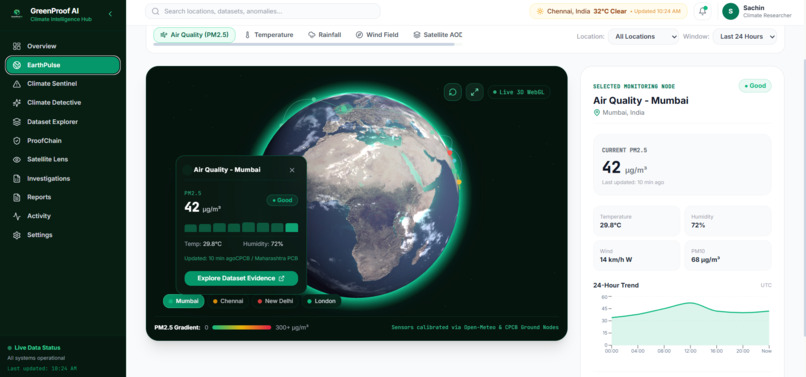
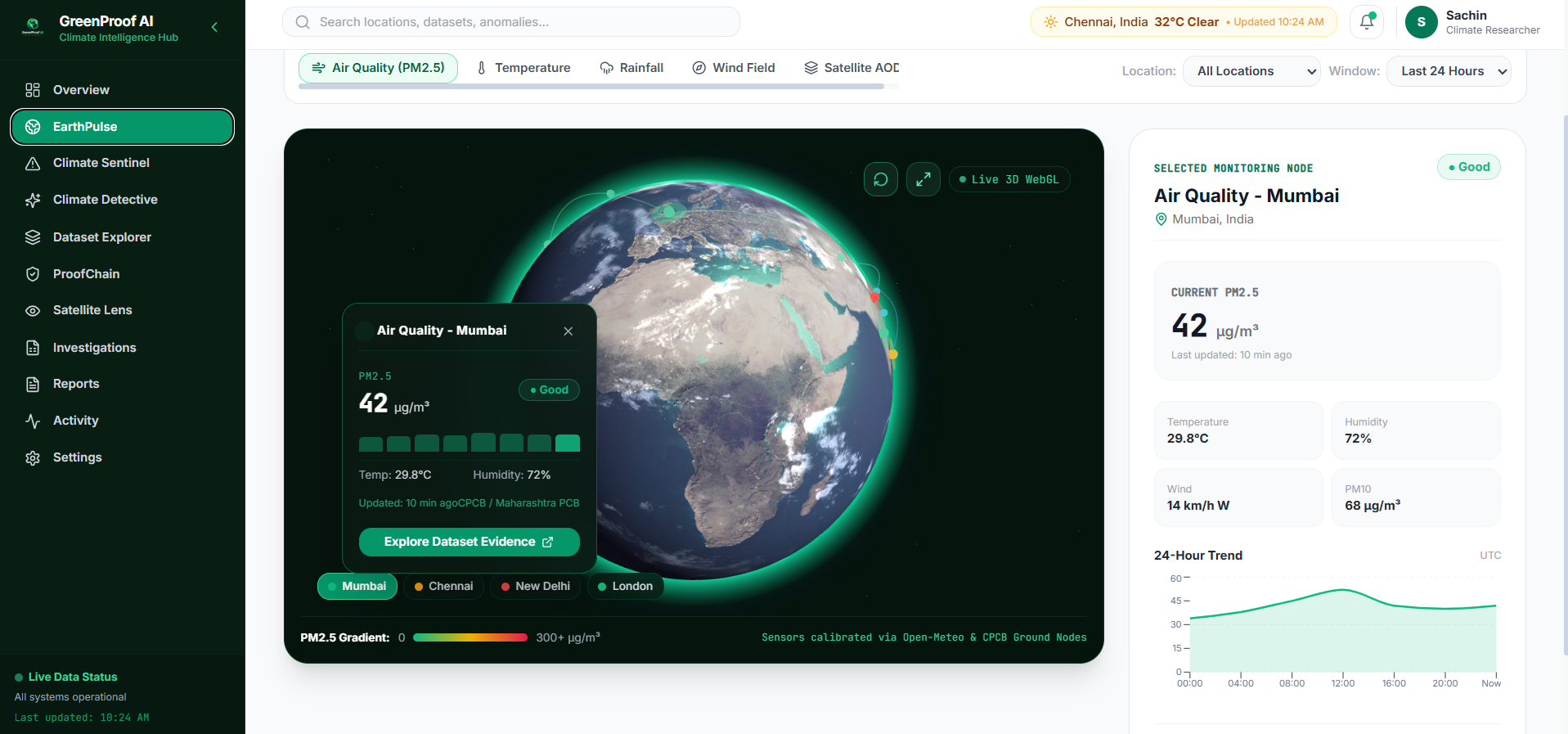
Earth Pulse
-
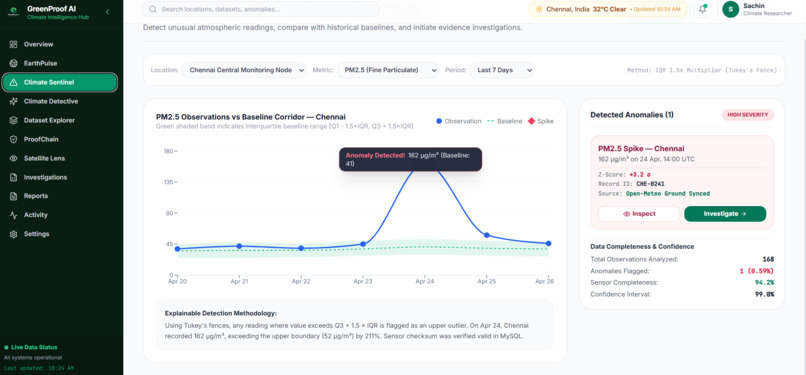
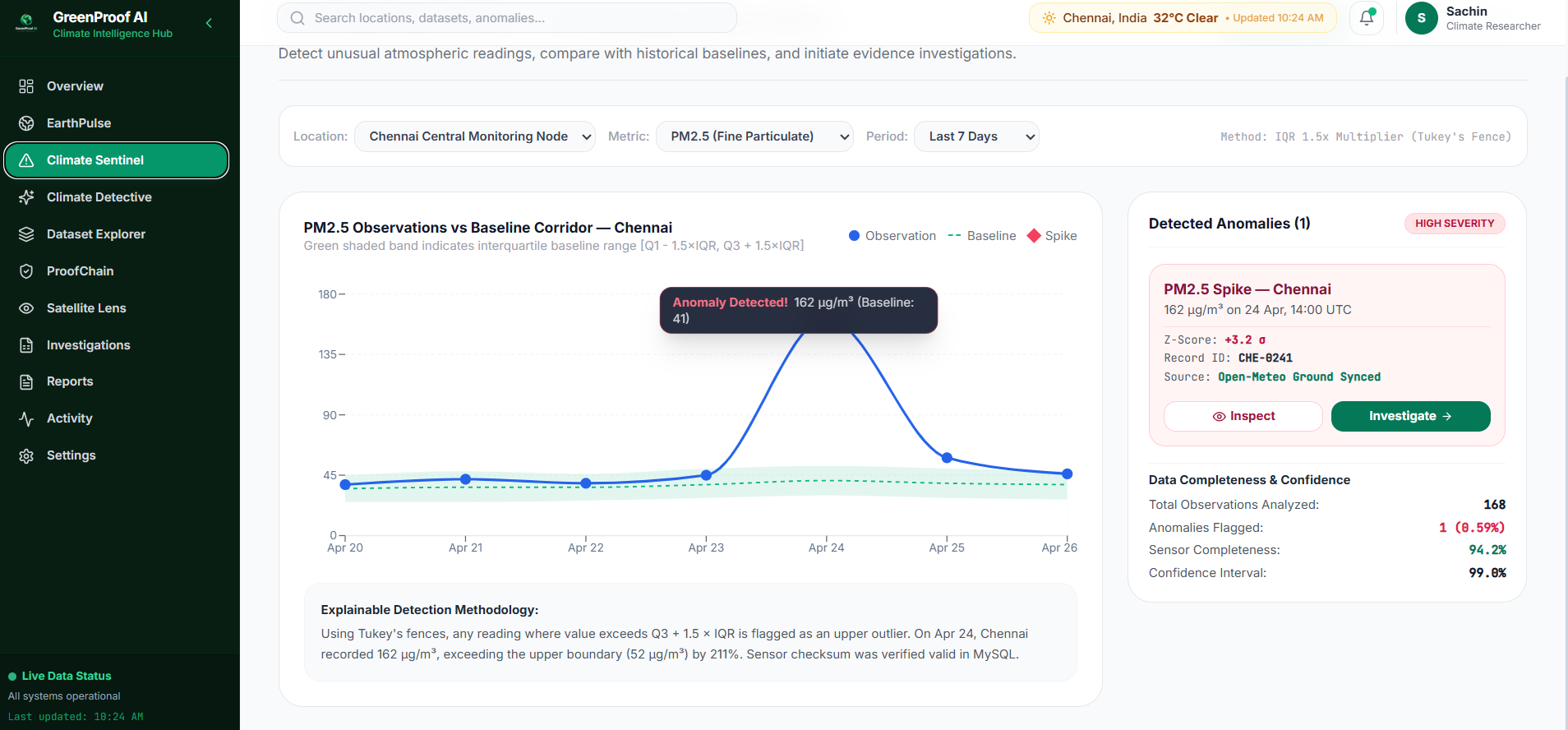
Climate Sentinel
-
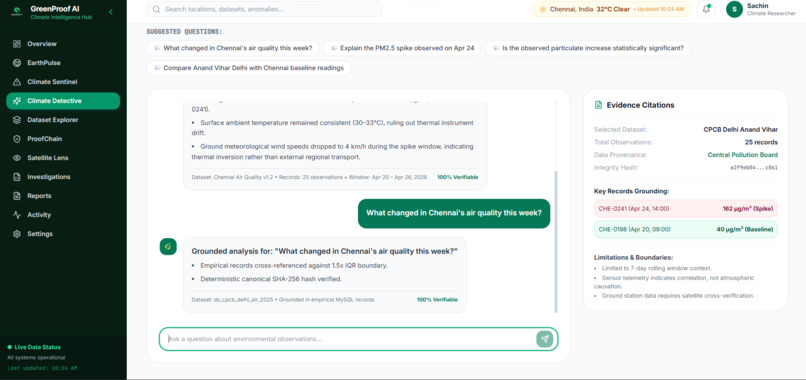
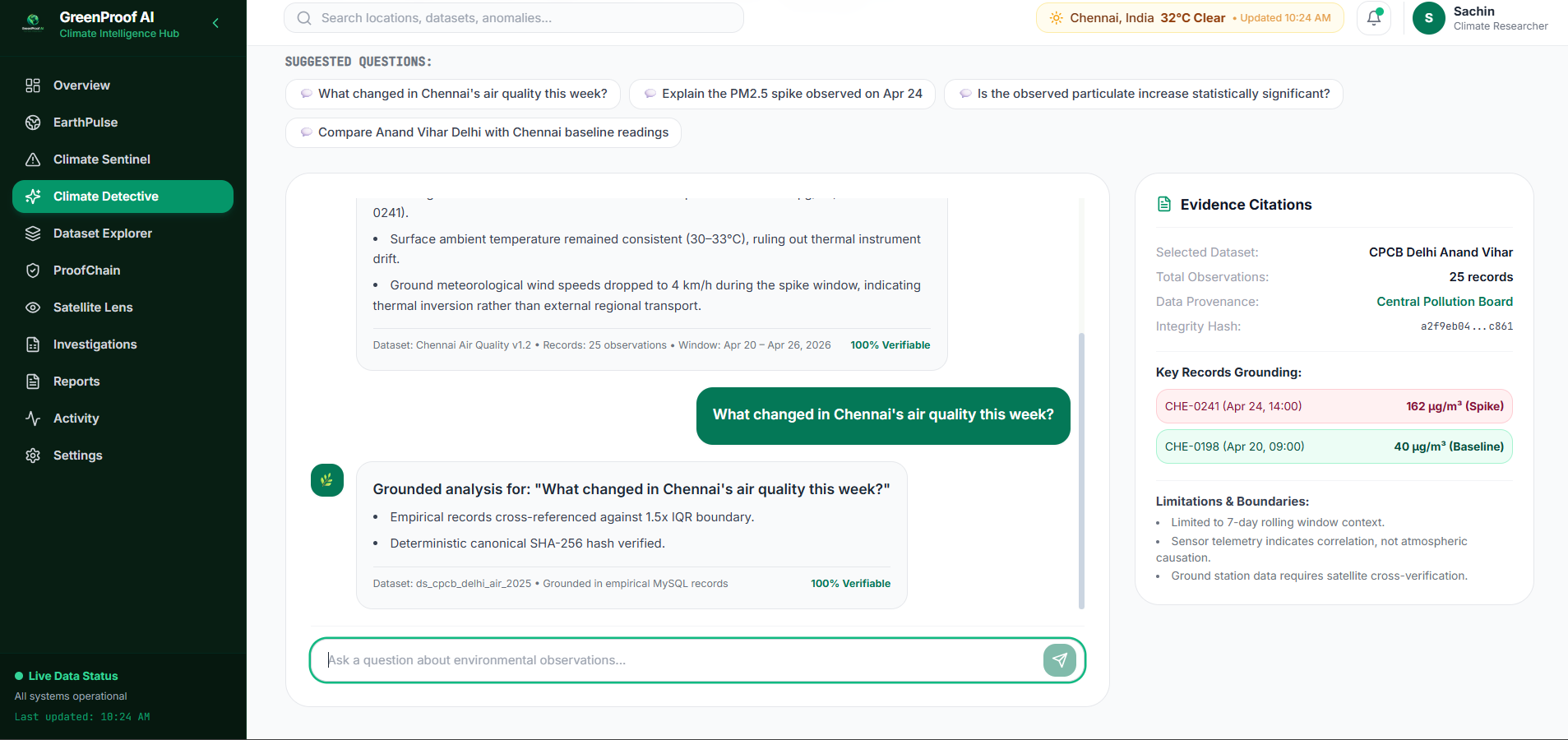
Climate Detective
-
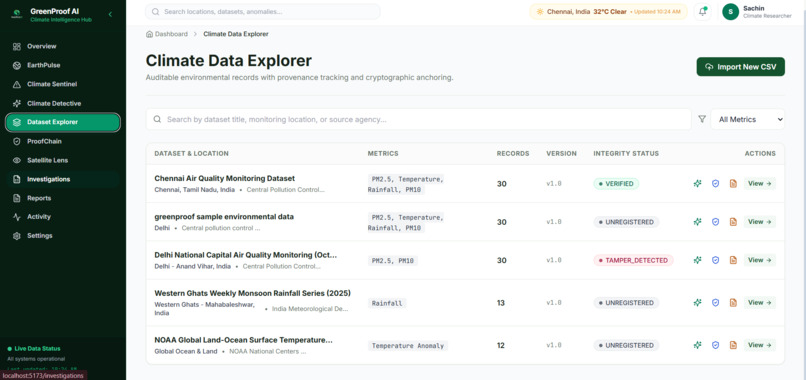
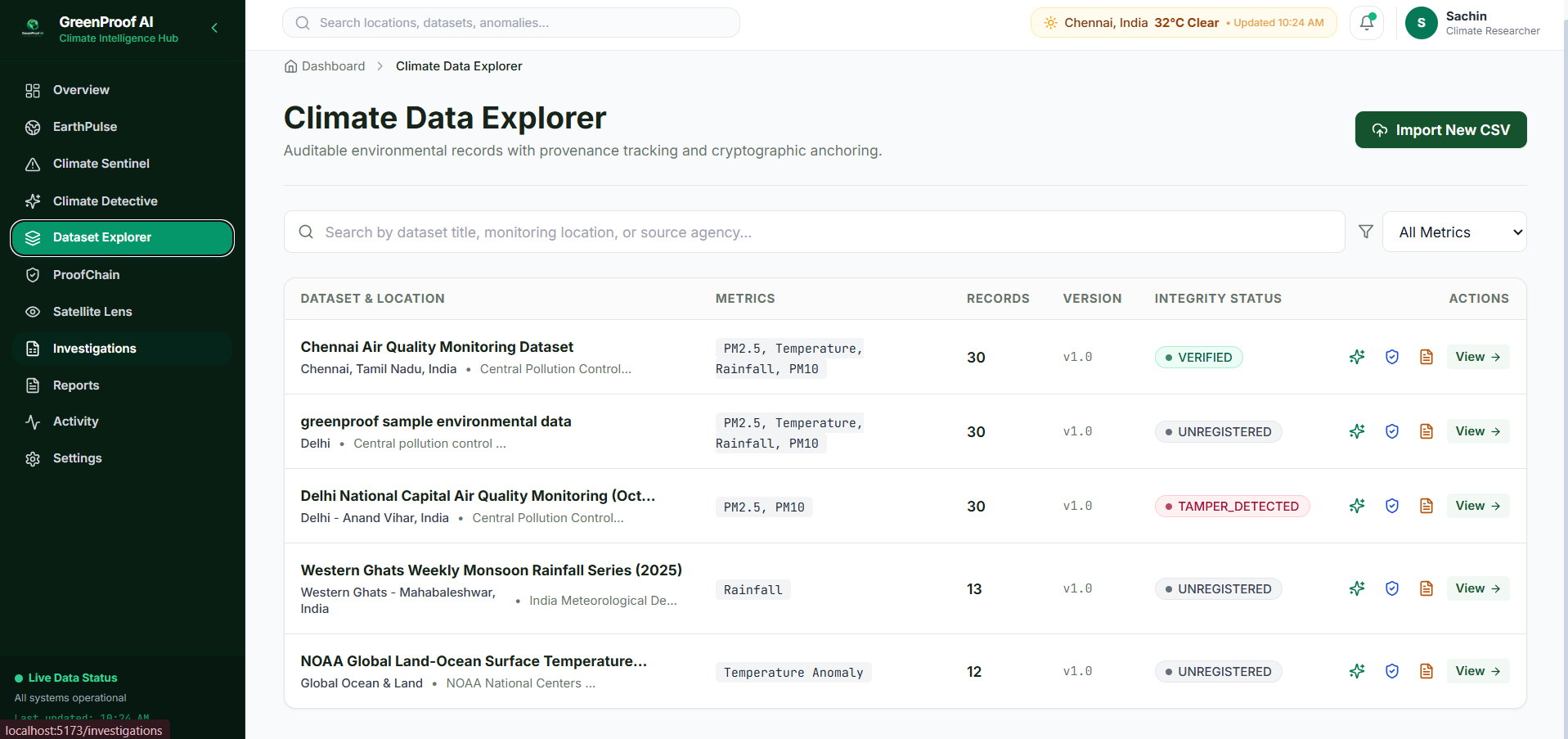
Dataset Explorer
-
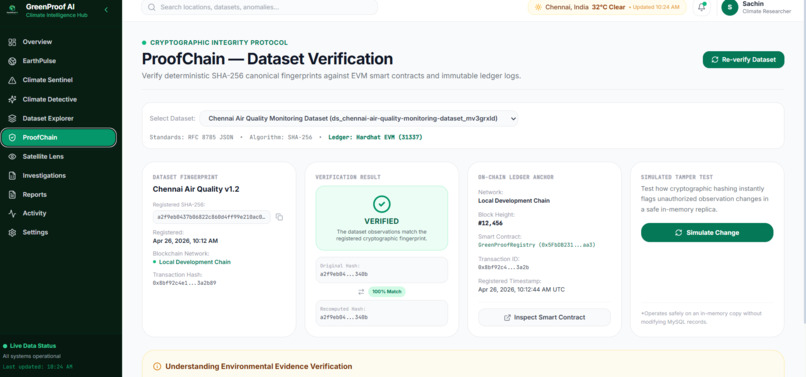
Proof Chain
-
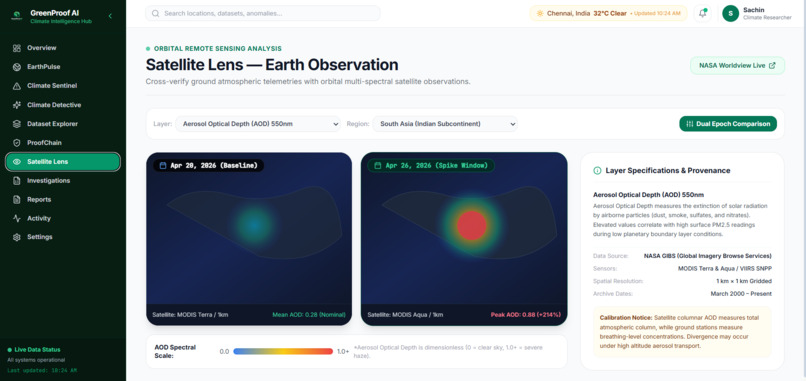
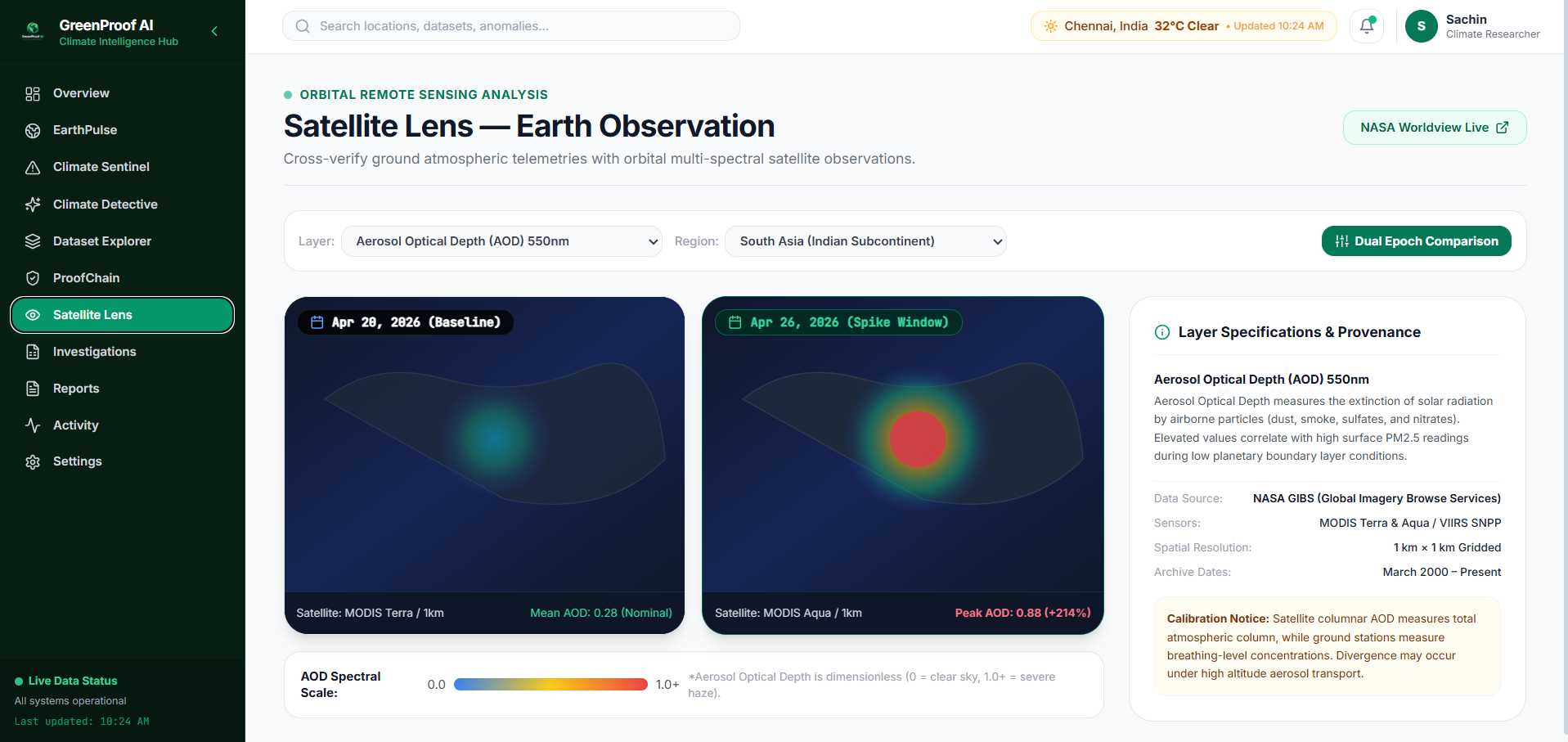
Satellite Lens
-
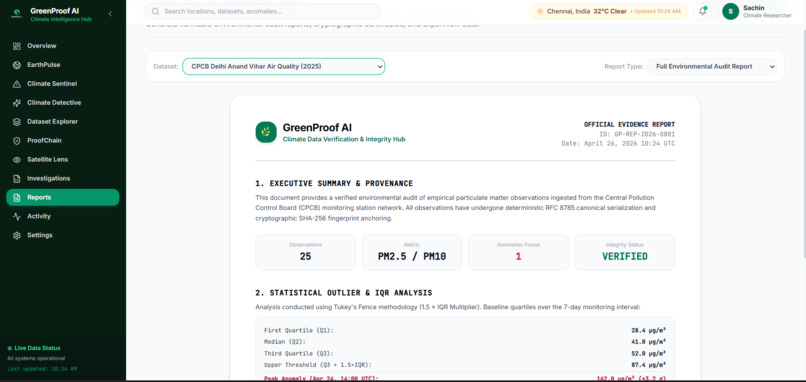
Reports
-
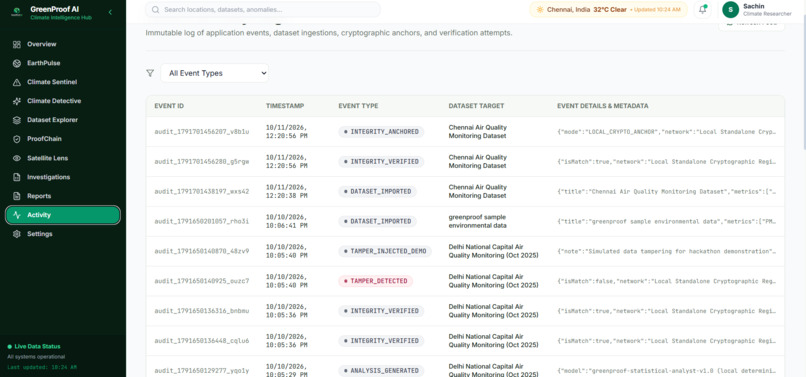
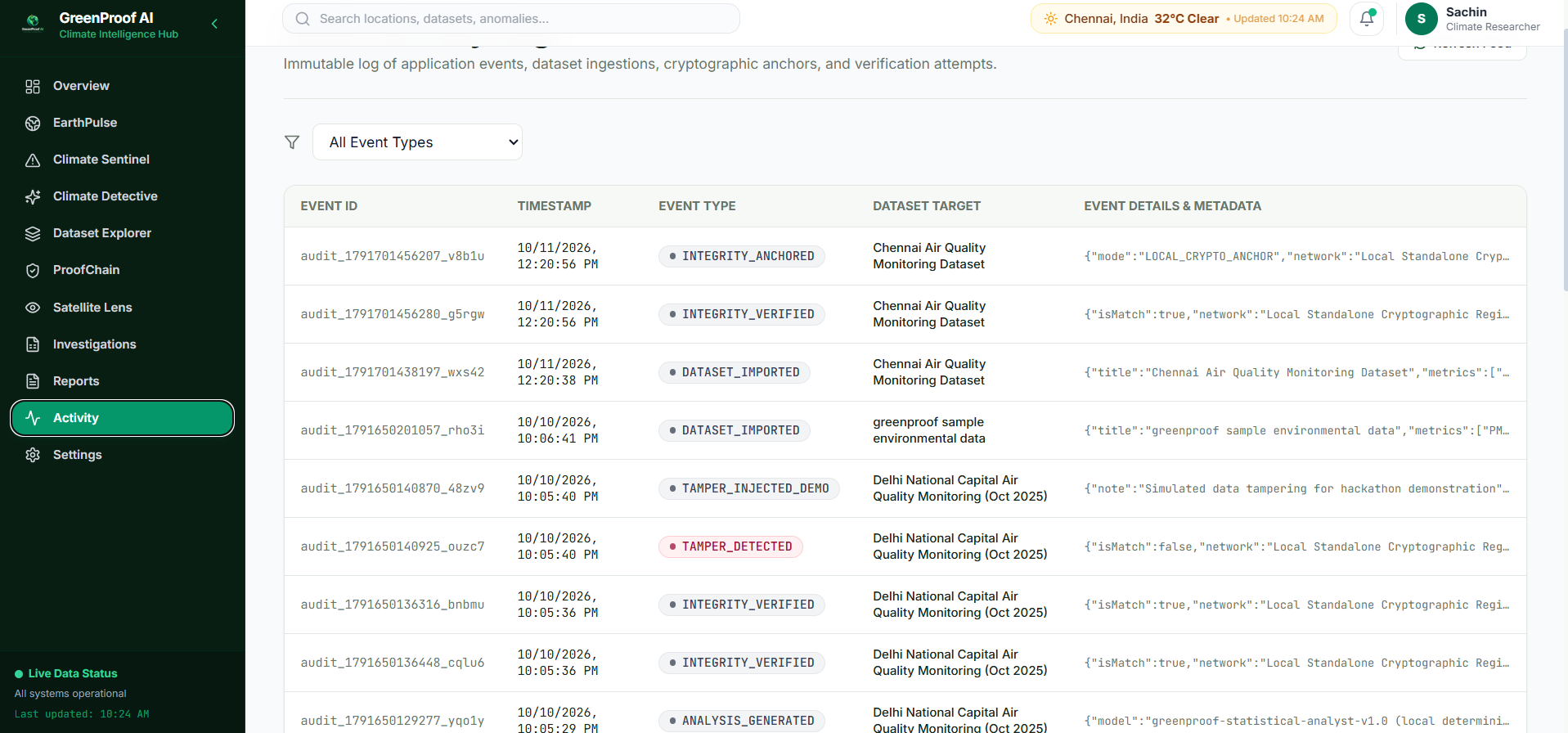
Activity
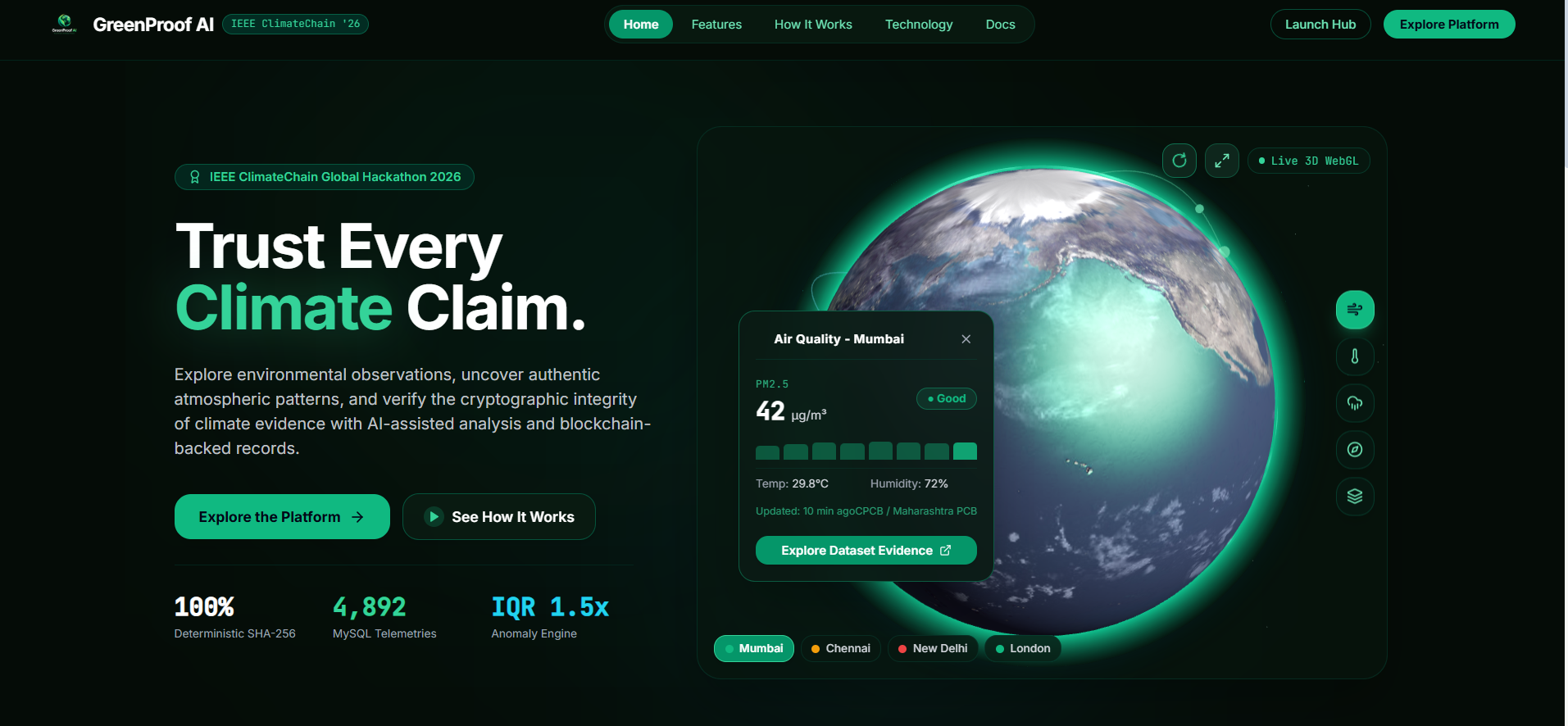
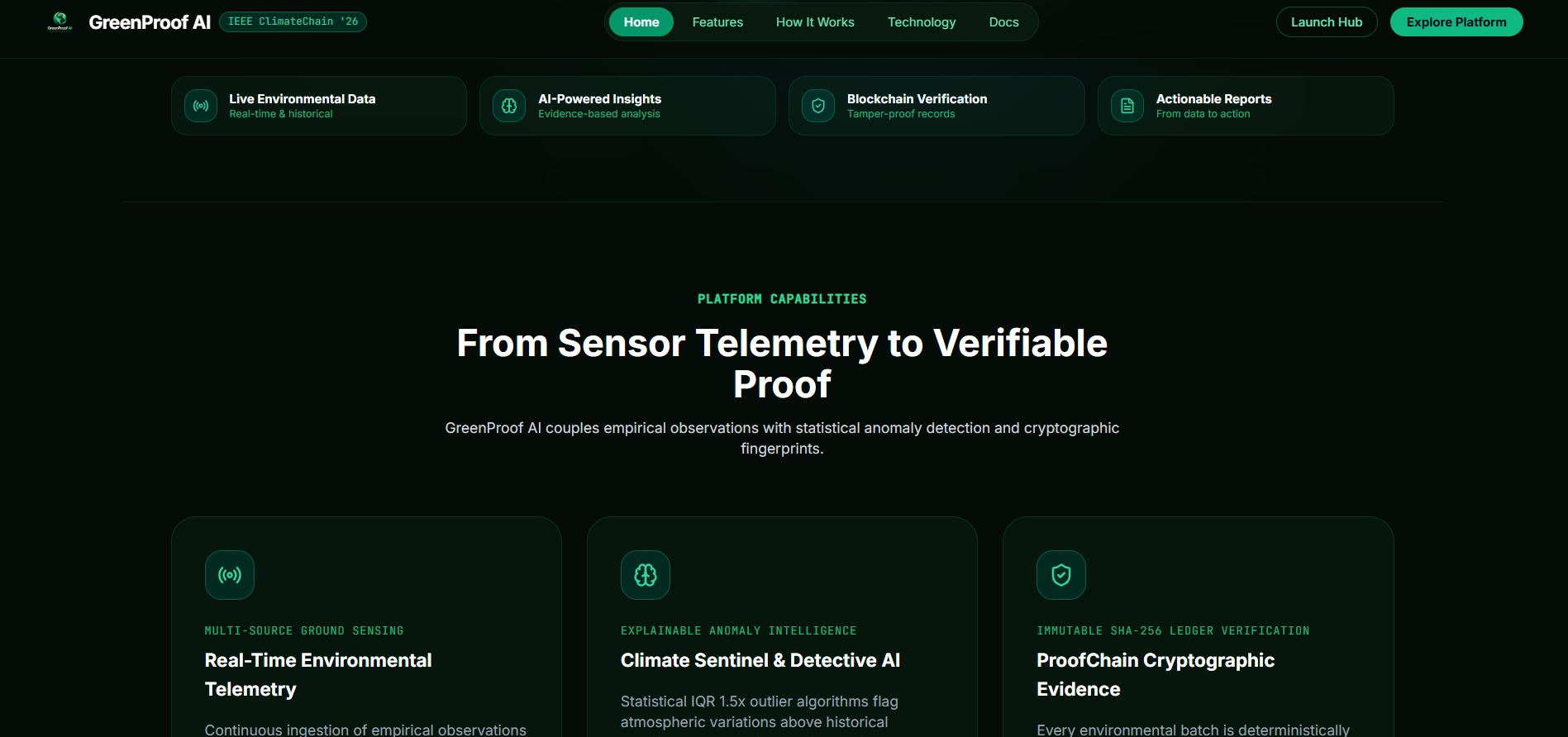
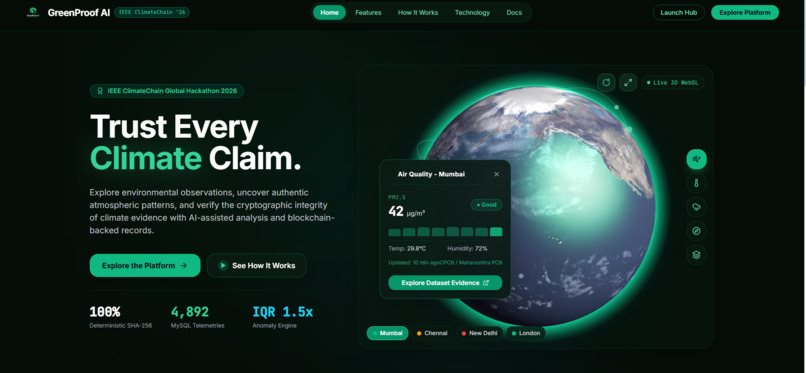
GreenProof AI — Trust Every Climate Claim
Chosen Track: Climate Data & Environmental Monitoring
Inspiration
Climate action depends on trustworthy environmental information. Yet environmental datasets are often scattered across different portals, stored in different formats, and difficult to analyze or independently verify.
We wanted to explore how Artificial Intelligence, statistical analysis, and blockchain technology could work together to address this challenge.
This inspired GreenProof AI — Trust Every Climate Claim, a climate-data intelligence and verification platform built for the IEEE ClimateChain Global Hackathon 2026.
Our central idea is simple: environmental data should not only be easy to analyze; its origin and integrity should also be open to inspection.
What it does
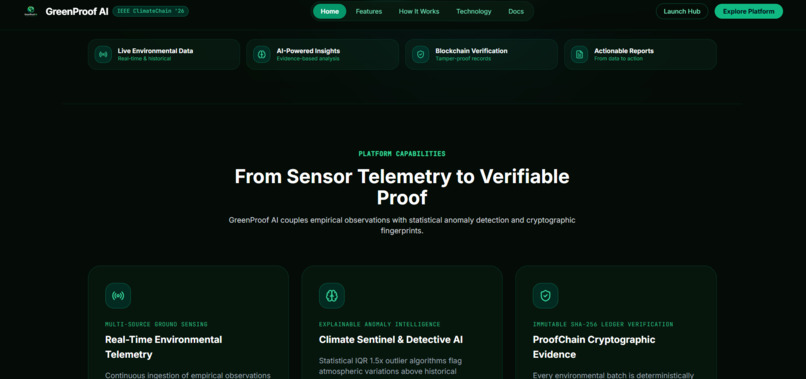
GreenProof AI combines environmental data exploration, statistical analysis, AI-assisted interpretation, and cryptographic verification in one platform.
The project works with environmental datasets covering air quality, global temperature anomalies, and monsoon rainfall.
Its core capabilities include:
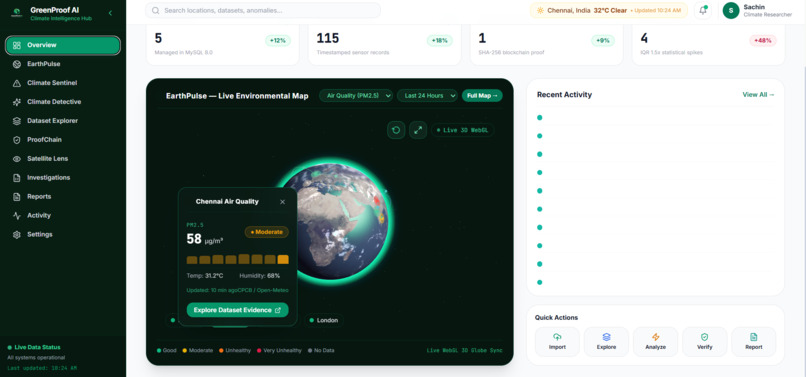
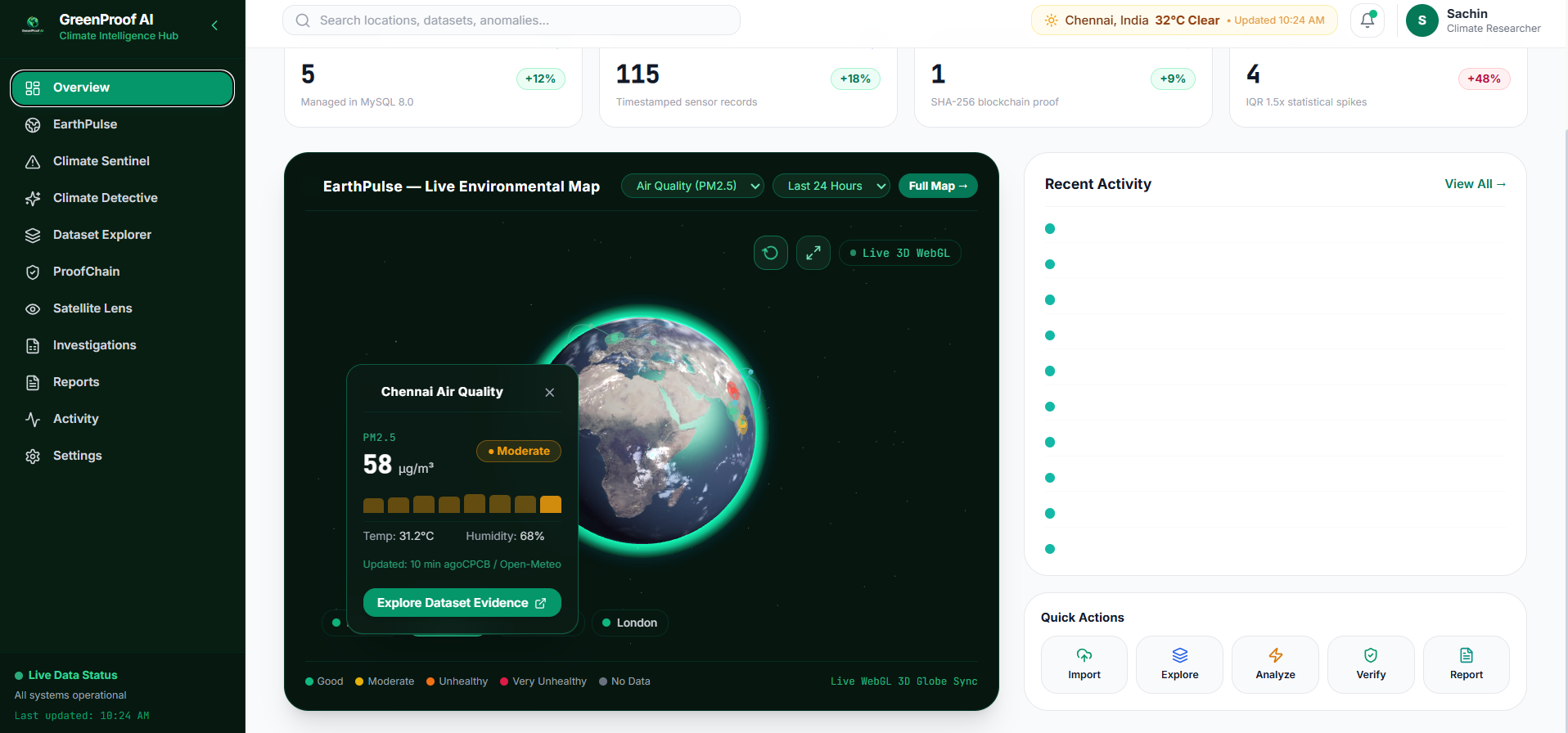
- Environmental Data Explorer: Browse, filter, and visualize environmental observations from datasets attributed to India's Central Pollution Control Board (CPCB), NOAA, and the India Meteorological Department (IMD).
- AI Climate Analyst: Combine statistical analysis, trend calculations, and structured AI-generated explanations to help users interpret environmental observations.
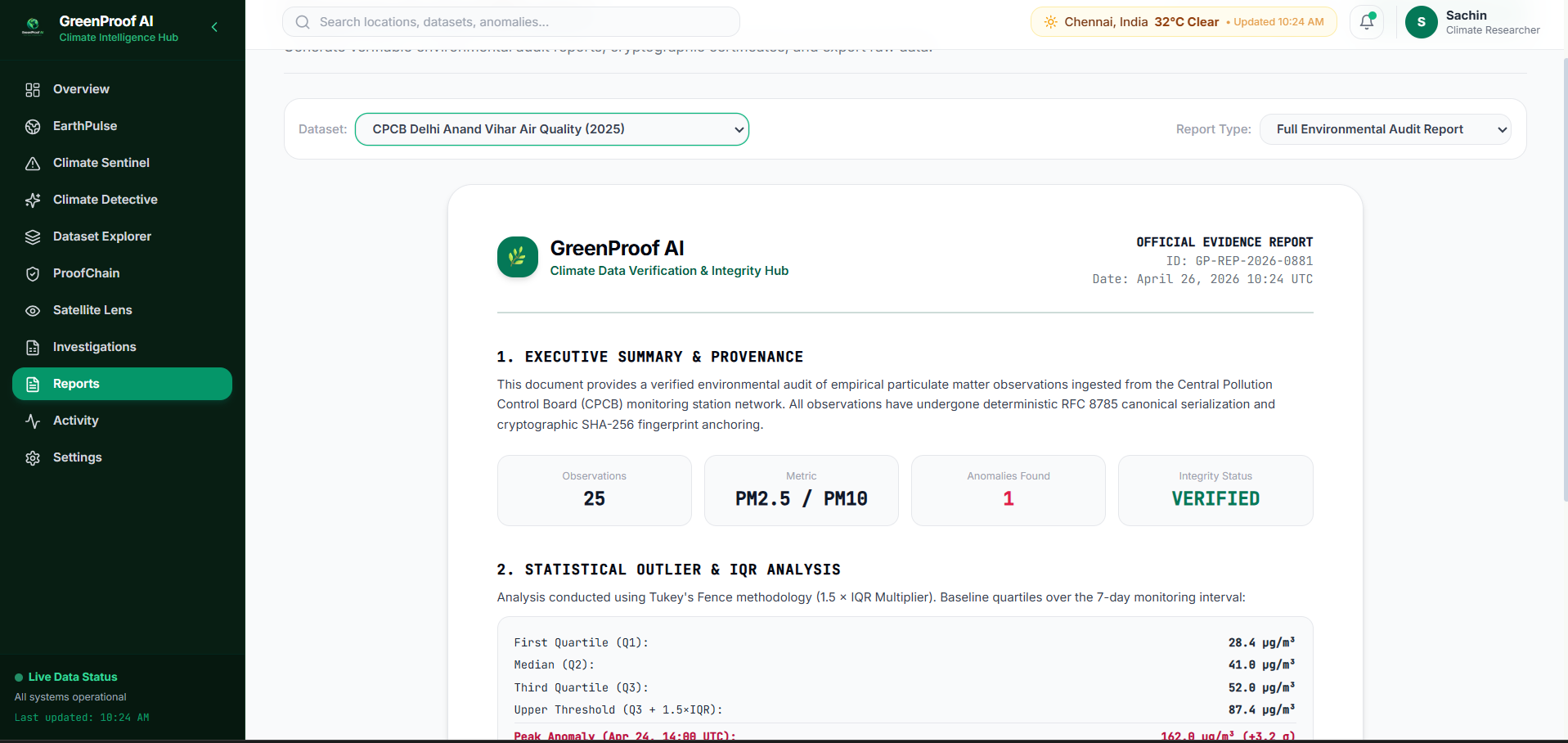
- Anomaly Detection: Apply the interquartile range (IQR) method to identify unusual measurements that may warrant further investigation.
- Dataset Provenance: Associate environmental data with source information and relevant metadata.
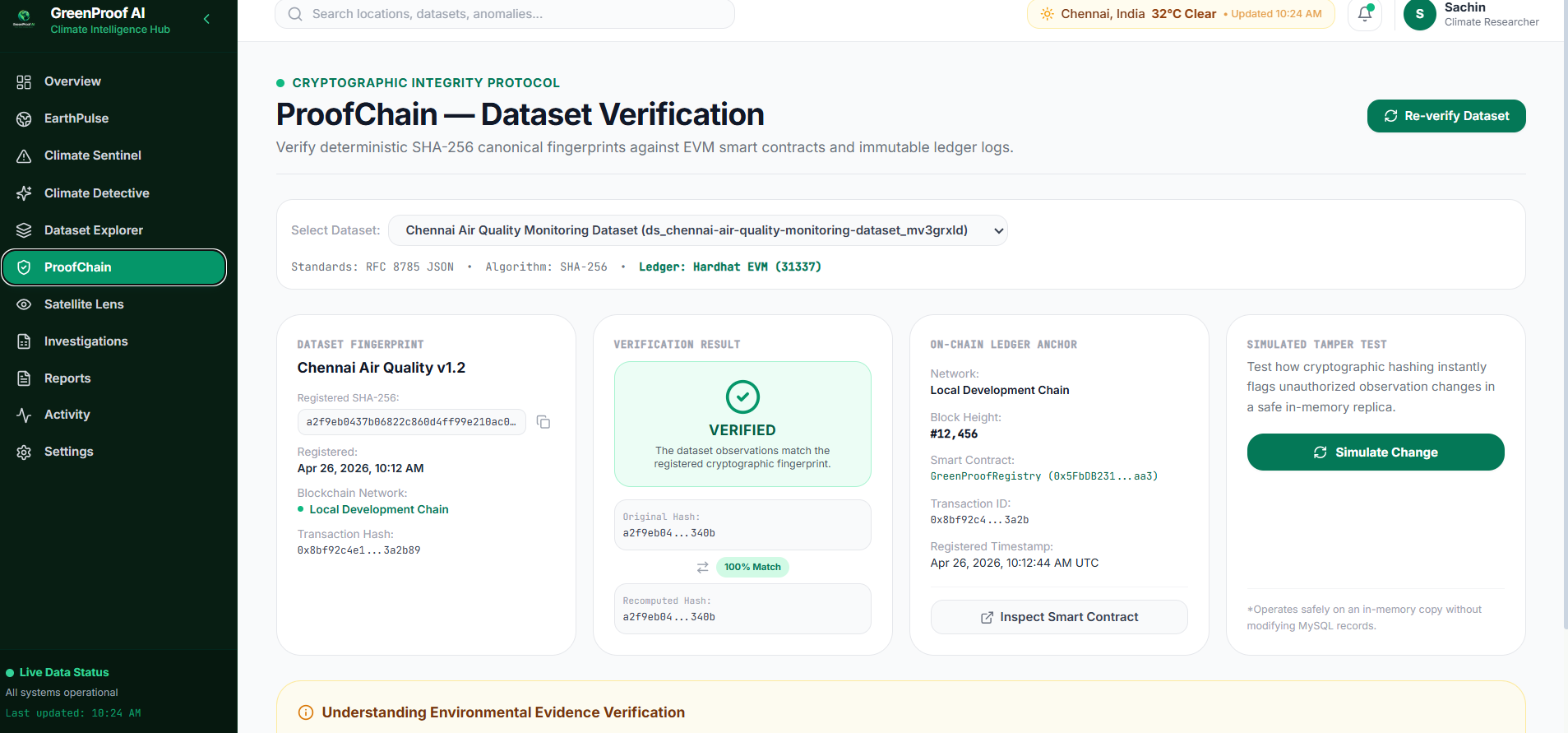
- SHA-256 Integrity Verification: Generate deterministic cryptographic fingerprints so that dataset changes can be detected when compared against a trusted registered fingerprint.
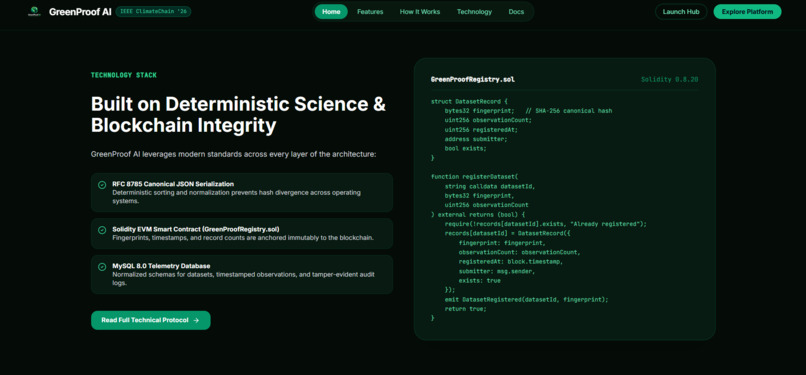
- Blockchain Evidence Registry: Use a Solidity-based registry design to record dataset fingerprints and support verification through an EVM-compatible blockchain environment.
- Tamper-Detection Demonstration: Demonstrate how altering a previously registered reading can produce an integrity mismatch, followed by restoration and re-verification.
- Evidence Reports: Generate reports combining dataset provenance, statistical findings, AI-assisted analysis, and cryptographic verification information, with print-friendly PDF and machine-readable JSON output described in the project documentation.
GreenProof AI is designed to help environmental researchers, data analysts, auditors, and sustainability organizations investigate environmental information and maintain more transparent records.
An important distinction guides the project: cryptographic verification can establish data integrity relative to a trusted reference, but it cannot prove that the original environmental measurements are scientifically accurate.
How we built it
GreenProof AI uses a full-stack architecture that connects an interactive web application to backend processing, persistent storage, analytical services, and cryptographic verification.
Frontend
- React 18, Vite, and TypeScript
- React Router for navigation
- Tailwind CSS for interface styling
- Recharts for environmental data visualizations
- Lucide React for interface icons
Backend and database
- Node.js and Express for REST API endpoints
- MySQL 8.0 for structured data storage
mysql2/promisefor database connections- Parameterized SQL queries, centralized error handling, rate limiting, and Helmet security headers
AI and statistical analysis
- Google Gemini API integration for AI-assisted narratives
- Deterministic statistical fallback for analysis without an external AI service
- IQR-based outlier detection and trend calculations
Cryptographic verification and blockchain
- Node.js cryptographic utilities for SHA-256 hashing
- Deterministic dataset canonicalization using fixed ordering, normalized UTC timestamps, and defined numeric precision
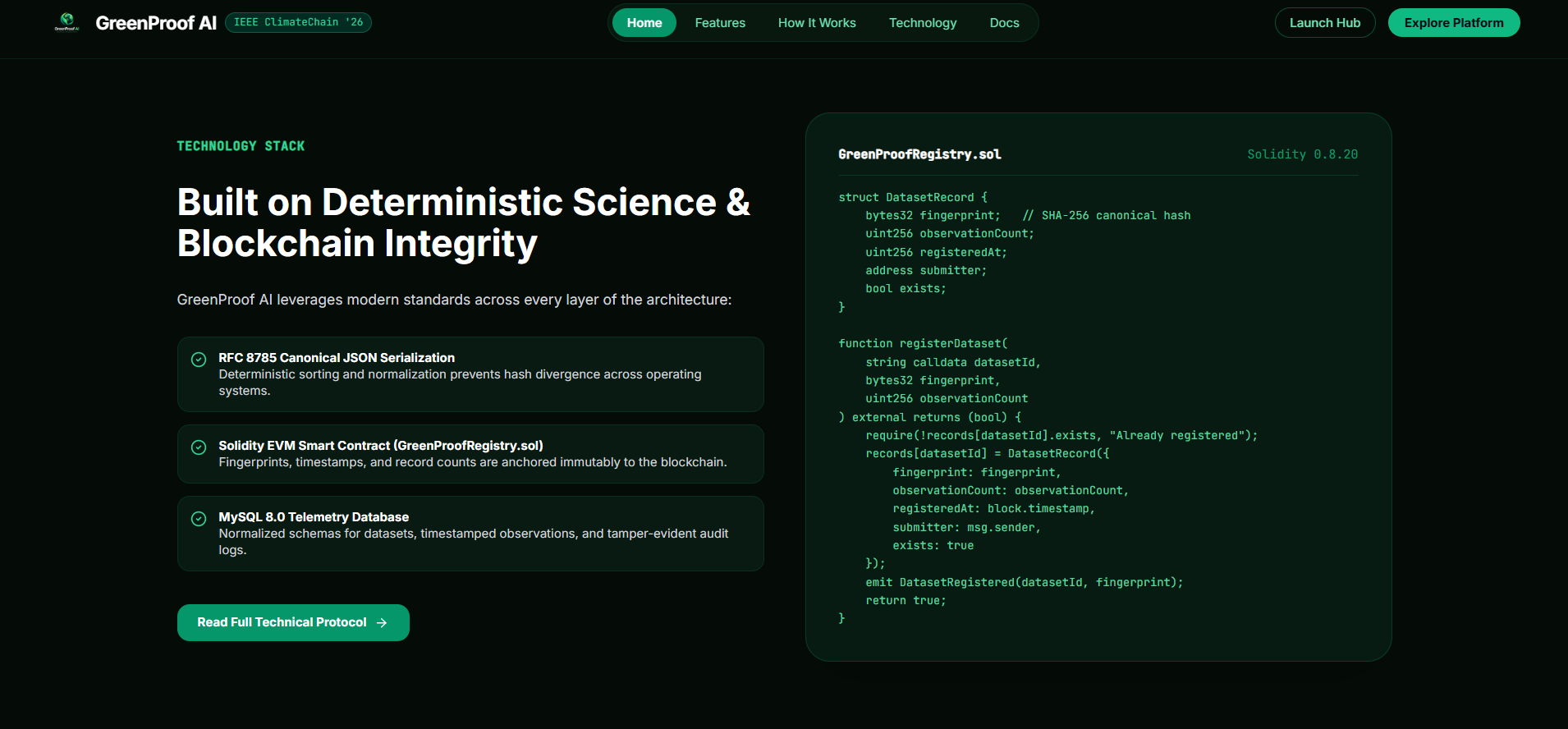
- Solidity smart contracts using version 0.8.20
- Hardhat for smart-contract development and testing
- ethers.js v6 for EVM interaction
- A local Hardhat EVM environment using chain ID 31337
- A standalone cryptographic ledger fallback when the local blockchain environment is not running
The intended workflow connects dataset exploration with analysis and verification. Dataset content is normalized into a deterministic representation, fingerprinted, and associated with verification records. When the dataset is checked again, its fingerprint can be compared with the registered reference to detect changes.
The architecture is designed to keep statistical analysis useful even when an external AI API is unavailable, while separating cryptographic integrity checks from scientific interpretation.
Challenges we ran into
One major engineering challenge in this type of system is maintaining consistent dataset representations. Environmental data can contain different timestamp formats, measurement precision, and record ordering. Without deterministic normalization, equivalent datasets could produce different fingerprints.
Another challenge is distinguishing meaningful statistical signals from unusual but legitimate environmental observations. An outlier may reflect a measurement issue, a genuine environmental event, or another factor that requires further investigation.
Integrating AI with statistical analysis also requires care. AI-generated explanations should complement numerical evidence rather than replace it, and the application needs a fallback when an external AI service is unavailable.
Finally, blockchain verification introduces an important architectural distinction: generating a cryptographic hash is not the same as recording it on-chain. A reliable demonstration needs to make clear where the fingerprint is stored, how verification occurs, and whether the system is using a deployed network, a local development chain, or a standalone fallback.
These are the engineering concerns that GreenProof AI's architecture is designed to address. The actual development challenges encountered should be described according to your experience building and testing the project.
Accomplishments that we're proud of
We are proud to bring several complementary capabilities into a single climate-data workflow.
- Connecting environmental data visualization with statistical anomaly detection and AI-assisted interpretation.
- Designing deterministic dataset fingerprinting to support reproducible integrity checks.
- Developing a Solidity registry approach for fingerprint registration and verification.
- Creating a tamper-detection demonstration that illustrates how changing a reading can be detected against a trusted reference.
- Designing evidence reports that bring provenance, analytical findings, and verification information together.
- Planning for offline statistical analysis so the application is not entirely dependent on external AI availability.
The project reflects our goal of making environmental information more transparent and easier to investigate, while treating data integrity and scientific truth as separate concerns.
What we learned
GreenProof AI reinforced the importance of combining software engineering with careful reasoning about environmental data.
We learned that:
- Environmental data needs context, provenance, and validation before its results can be interpreted responsibly.
- Statistical anomaly detection identifies unusual observations, not automatic proof of fraud.
- AI-generated explanations should be grounded in available evidence and communicated with appropriate limitations.
- SHA-256 fingerprints can help detect modifications, but they cannot establish the truth of the original measurements.
- Blockchain records can support auditability when fingerprints and transactions are genuinely registered and independently verifiable.
- A useful fallback strategy improves resilience when external AI services or local blockchain infrastructure are unavailable.
These principles shape our approach to building technology that supports environmental transparency without overstating what the technology can prove.
What's next for GreenProof AI — Trust Every Climate Claim
Our next goal is to make GreenProof AI more useful for real-world environmental monitoring and independent verification.
Potential improvements include:
- Integrating additional trusted environmental data sources and live sensor feeds.
- Expanding support for environmental dataset formats, units, and measurement types.
- Improving anomaly detection and adding clearer explanations for flagged observations.
- Strengthening dataset provenance and versioned audit trails.
- Expanding blockchain verification and evaluating appropriate deployment networks.
- Improving evidence reports with more comparative analysis and clearer uncertainty explanations.
- Strengthening security, automated testing, deployment, and usability for researchers and environmental organizations.
Our long-term vision is to help people analyze environmental information and verify its integrity through a transparent, accessible platform.
GreenProof AI — Trust Every Climate Claim.
Built With
- anomaly-detection
- artificial-intelligence
- blockchain
- climate-tech
- cryptography
- data-analytics
- data-visualization
- environmental-monitoring
- ethers.js
- express.js
- google-gemini-api
- hardhat
- html
- javascript
- mysql
- node.js
- react
- recharts
- rest-api
- sha-256
- solidity
- tailwind-css
- typescript
- vite

Log in or sign up for Devpost to join the conversation.