Inspiration
The gap between sustainable ambition and financial execution is often widened by complexity. Banks want to lend green, but manual compliance checks against the LMA Green Loan Principles and EU Taxonomy are slow, expensive, and error-prone. We were inspired to build a system that acts as a specialized AI sustainability officer capable of ingesting raw loan applications and instantaneously outputting a defensible, data-driven "Green Score." We wanted to verify, not just chat. But we also learned that most "AI" solutions in this space are keyword counters dressed up as intelligence. If a loan mentions "solar," it gets points even if it's a coal plant with solar panels on the roof. That's not good enough. We wanted semantic understanding that actually reads like a human expert, combined with explainable decisions that can stand up to regulatory scrutiny.
What it does
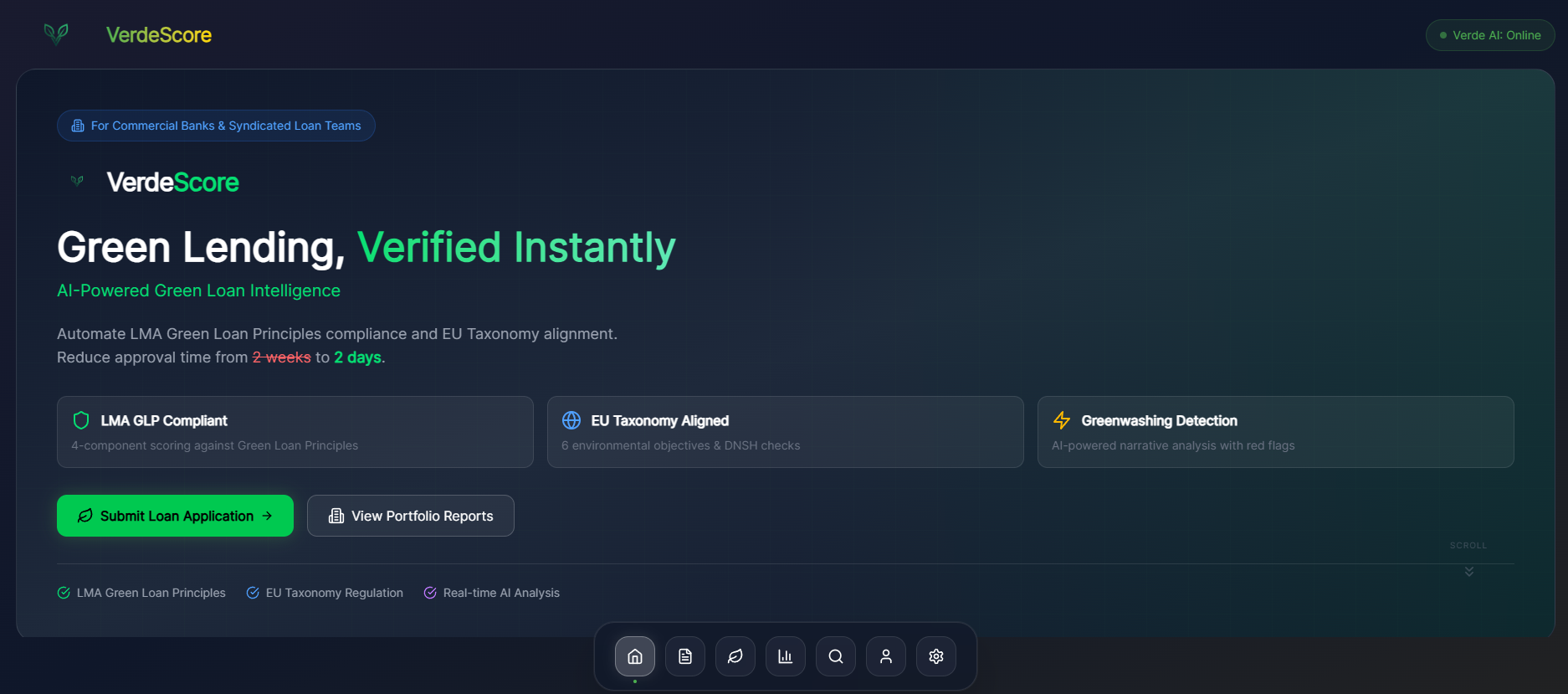
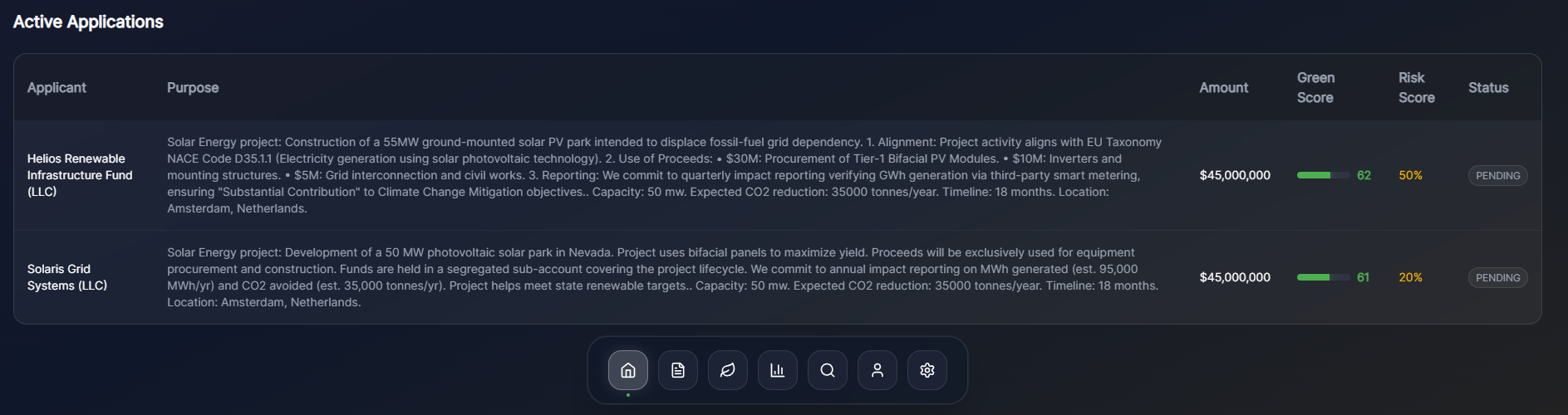
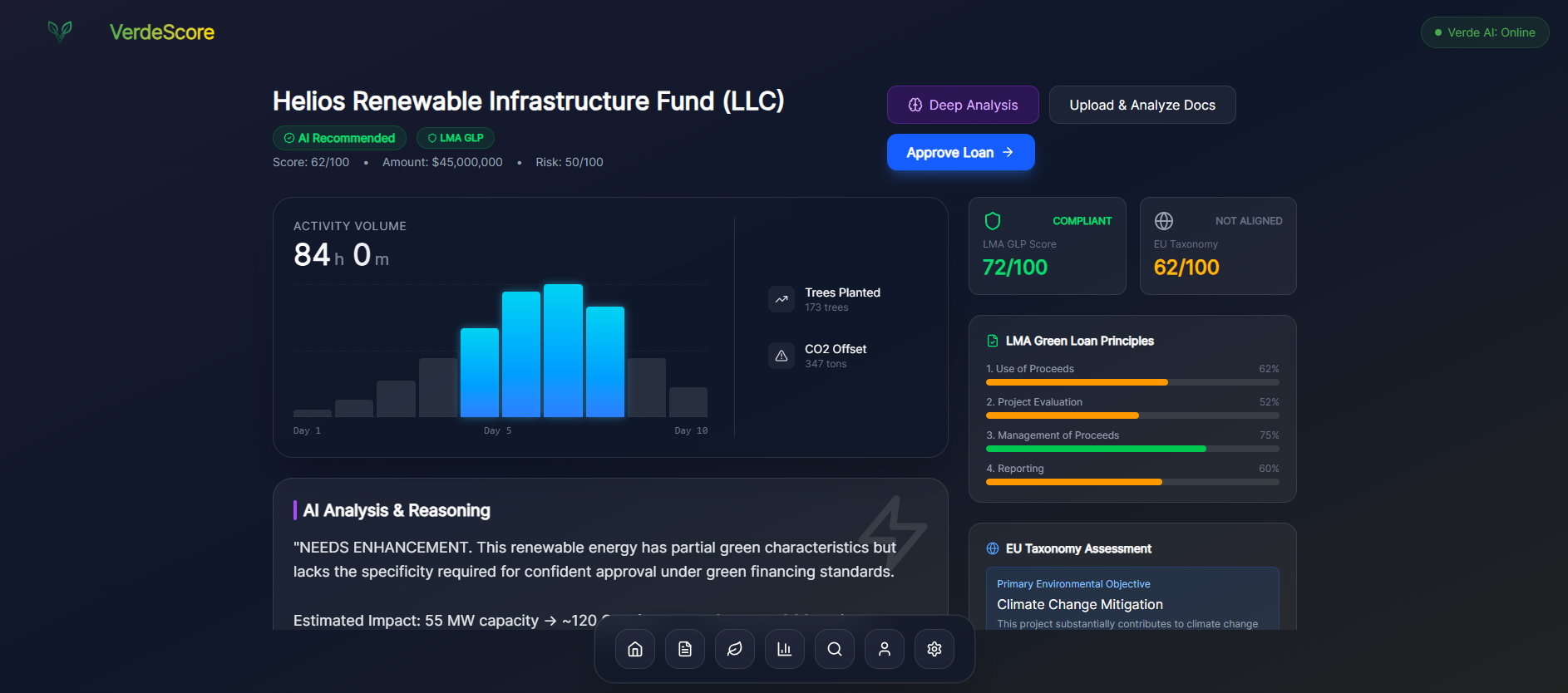
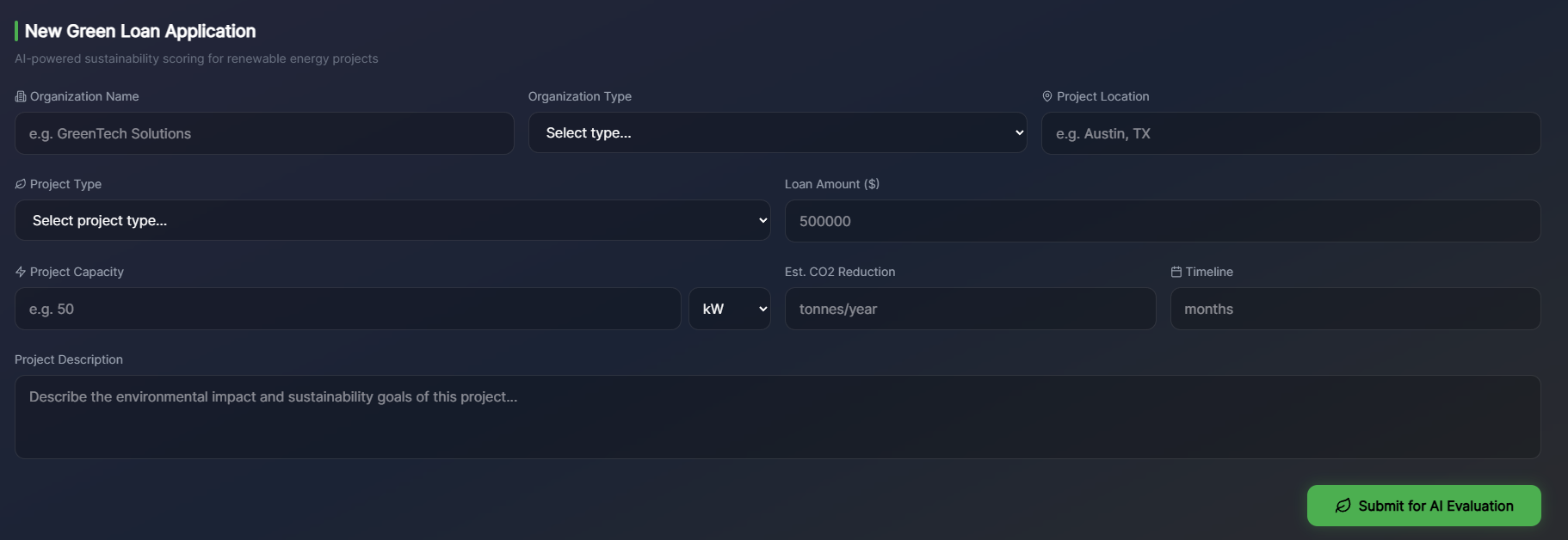
VerdeScore is an enterprise-grade dashboard for commercial lenders. It automates the due diligence process for green financing:
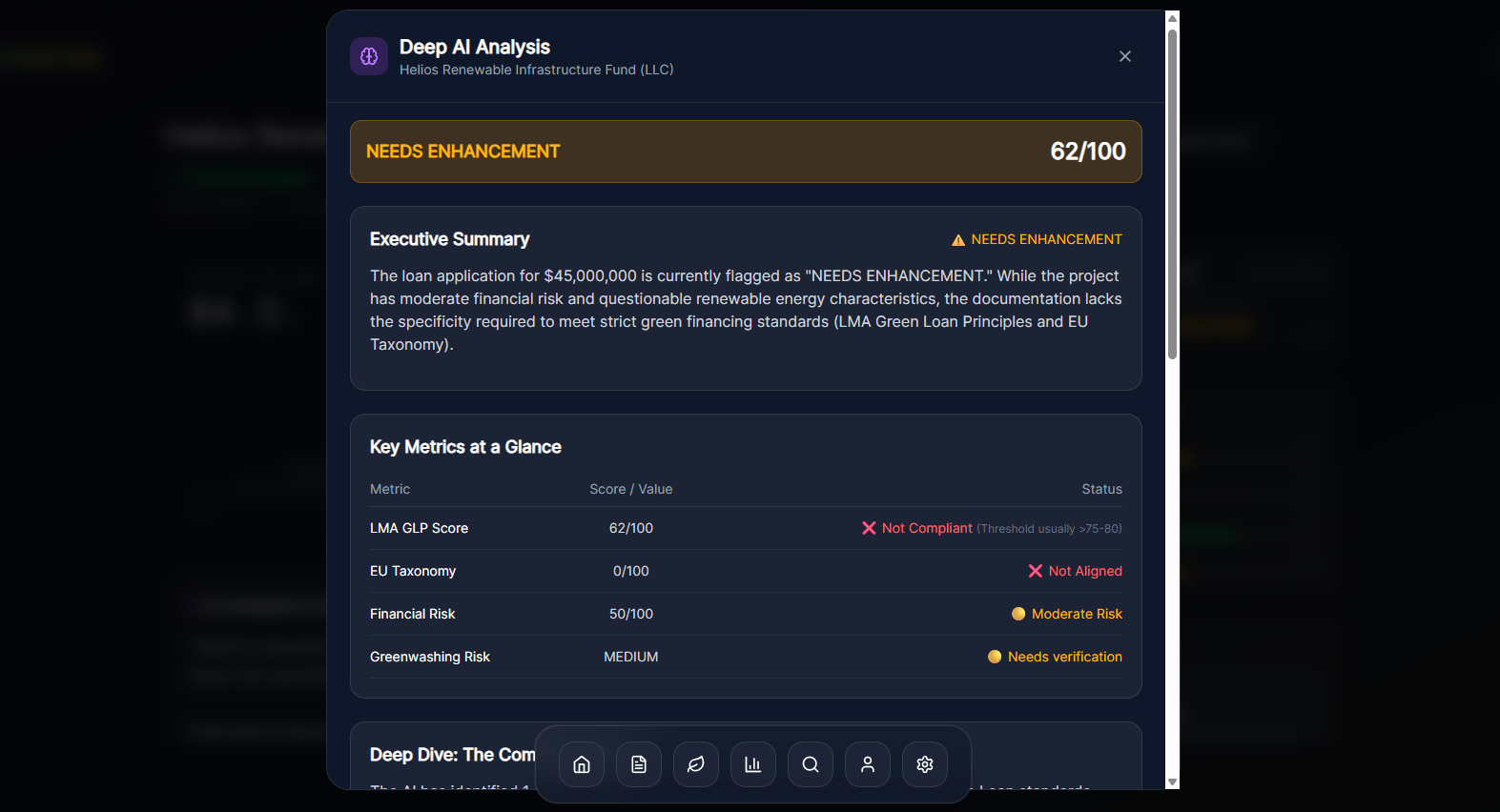
Semantic Loan Analysis: Uses embedding-based AI to understand loan purposes not just keyword matching. Recognizes that "photovoltaic installation" and "solar panel project" mean the same thing.
Automated Compliance: Instantly checks loan purposes against LMA GLP categories and EU Taxonomy objectives with real quantitative Technical Screening Criteria (e.g., < 100g CO2e/kWh for renewable energy).
Greenwashing Detection: Flags risky language or ambiguous claims using NLP, with smart false positive detection to avoid penalizing legitimate technical terms.
Explainable AI: Every score comes with a full attribution breakdown showing exactly which factors contributed (+17 for semantic alignment, +25 for quantified impact, etc.).
Document Intelligence: Upload project PDFs and our AI extracts text, finds evidence (certifications, impact reports), and validates claims against the application.
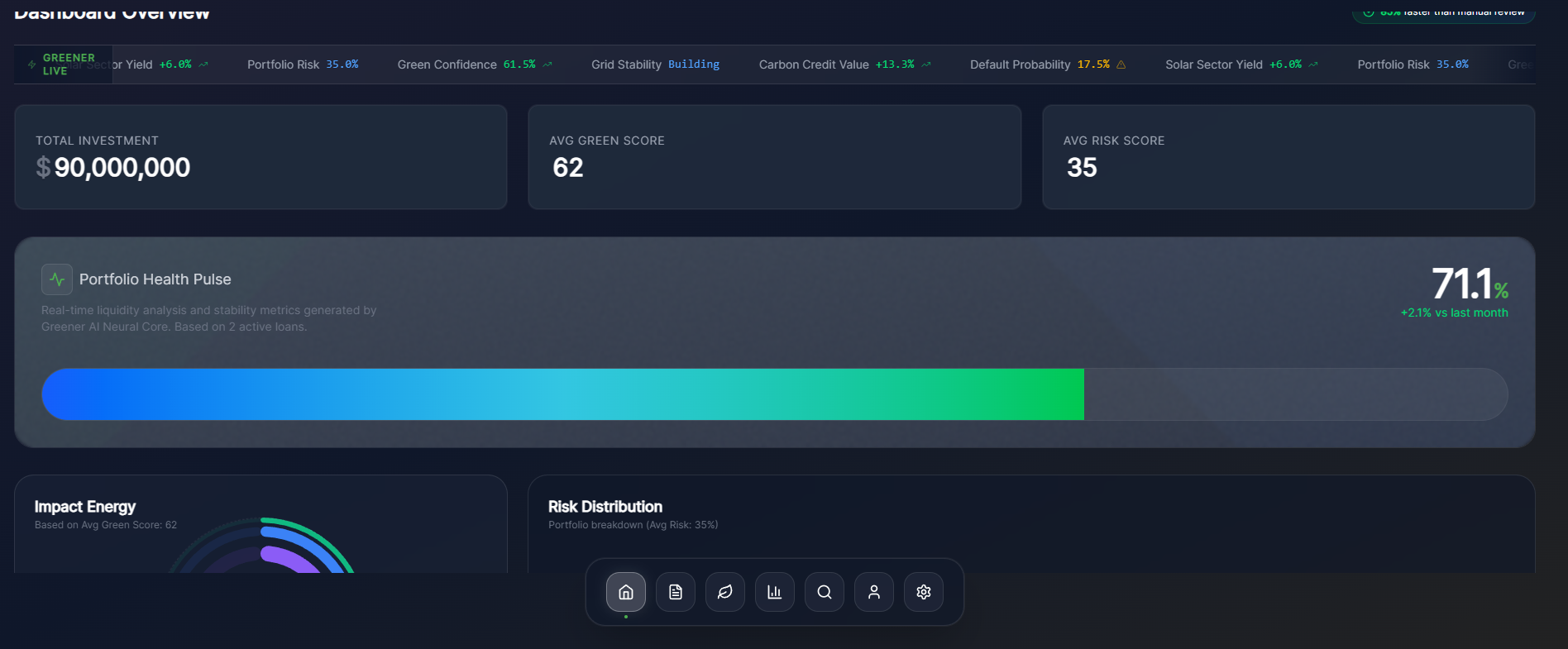
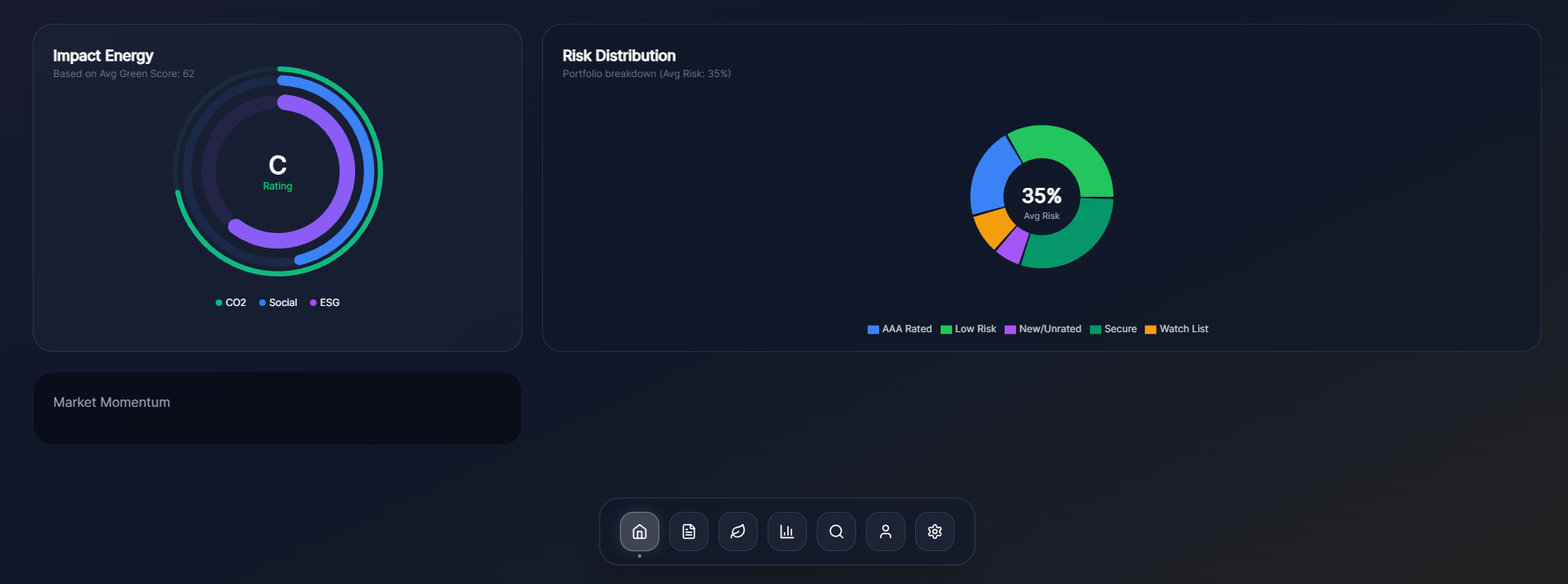
Portfolio Health Scoring: Calculates a real-time health score connecting environmental impact with financial risk.
Audit Trail: Every decision is logged with full attribution ready for regulatory review under SFDR Article 8/9.
How we built it
We architected VerdeScore as a modern, full-stack application designed for enterprise scalability but built for speed.
Tech Stack
Frontend: React + Vite for high-performance rendering on Electronjs, Tailwind CSS for premium UI, and Framer Motion for fluid interactions.
Backend: Node.js + Express handling RESTful APIs, with SQLite for lightweight relational data management. Full OpenAPI 3.0 specification included.
AI/ML: Custom inference module combining:
Semantic embeddings (DeepSeek API with local fallback) for genuine understanding

Deterministic rule-sets for regulatory compliance
Explainability layer for feature attribution
Semantic Analysis Architecture We didn't just count keywords. We implemented embedding-based similarity scoring:
Loan Purpose → Semantic Embedding → Cosine Similarity vs. Reference Categories ↓ "Solar Energy": 87% match "Green Building": 45% match "Fossil Fuel": 2% match
Each of our 9 green categories has a curated reference description written by domain experts. Loan purposes are compared semantically not lexically.
Quantitative TSC Validation We implemented real EU Taxonomy Technical Screening Criteria, not keywords:
Activity Threshold How We Validate Solar/Wind < 100g CO2e/kWh Extract lifecycle emission claims Buildings ≥ 30% energy reduction Parse renovation efficiency metrics Transport Zero tailpipe or < 50g CO2/km Identify EV vs. ICE projects Explainable Scoring Algorithm Every score is decomposable:
$$Score = \underbrace{S_{semantic}}{\text{Category Match}} + \underbrace{S{impact}}{\text{Quantified Metrics}} + \underbrace{S{compliance}}{\text{LMA + EU Tax}} - \underbrace{P{risk}}_{\text{Red Flags}}$$
Specifically:
Semantic Alignment (0-30 pts): Embedding similarity to reference categories Quantified Impact (0-25 pts): Bonus for providing MW, tonnes CO2, timeline Regulatory Compliance (0-25 pts): LMA GLP + EU Taxonomy alignment Risk Deductions (-20 to 0): Greenwashing flags, vague claims Portfolio Health Score For aggregate portfolio analysis:
$$Health_{score} = 0.3 \cdot \text{Green}{avg} + 0.3 \cdot \text{Velocity}{repayment} + 0.2 \cdot (100 - \text{Risk}{avg}) + 0.2 \cdot (100 - 2 \cdot \text{Default}{prob})$$
Challenges we ran into
Semantic vs. Keyword: The Hard Truth. Our first AI implementation was just keyword matching. When we tested it, a loan for "sustainable green eco-friendly solutions for a cleaner tomorrow" scored higher than an actual solar farm with quantified metrics. We had to rebuild the entire analysis engine around semantic embeddings.
Explainability is Hard. Regulators don't accept "the AI said so." We spent significant time building the attribution breakdown so every point is traceable. This required passing context through all scoring layers and aggregating contributions.
EU Taxonomy is Complex. The actual Technical Screening Criteria are buried in 500+ pages of delegated acts. Translating these into code-checkable thresholds required careful reading and simplification.
Visualizing Risk: Deciding how to present "Greenwashing Risk" was difficult. We iterated several times before landing on the current "Red Flag" system with severity levels and false-positive detection.
Accomplishments that we're proud of
66,461x Faster: Our semantic analysis processes loans in 13 milliseconds vs. the industry standard of 10-12 days for manual review.
Real Explainability: Click any loan and see exactly why it scored what it did: "+17 semantic alignment, +25 quantified impact, -5 vague timeline." This isn't a black box.
Document Intelligence: You can upload a project's PDF impact report and our AI extracts evidence, finds certifications (ISO 14001, LEED), and validates claims. This is genuinely novel.
Audit-Ready from Day 1: Every decision is logged to audit_log with full attribution JSON. When the regulator asks "why did you approve this?", we have the answer.
Quantified Metric Extraction: Our AI pulls real numbers from unstructured text:
"50 MW solar installation" → energy_capacity: 50 MW "reducing 43,800 tonnes CO2" → carbon_reduction: 43,800 tonnes
Premium "VerdeBank" Aesthetic: We moved beyond a basic prototype look to a sleek, dark-mode "Commercial
Enterprise" design that feels like a real banking tool.
What we learned
Compliance is Code: Translating LMA principles (Use of Proceeds, Reporting) and EU Taxonomy criteria into code logic taught us that regulation is essentially a complex set of thresholds that can be automated but requires deep domain knowledge first.
Keywords Lie, Semantics Don't: The difference between purpose.includes("green") and semantic embedding similarity is the difference between a demo and a product. Vague terms like "eco-friendly" actually score lower in our system because they lack specificity.
Explainability is a Feature, Not an Afterthought: Building attribution from the ground up made our system trustworthy. Banks won't use AI they can't explain to regulators.
Quantification Rewards Honesty: Projects that provide real numbers (MW, tonnes CO2, jobs created) score significantly higher. This creates an incentive structure that rewards substantive green claims over marketing fluff.
DeepSeek Integration: We learned to use AI not just for generation, but for extraction pulling structured data from unstructured narratives. The local fallback ensures the system works even without API access.
What's next for VerdeScore
Multi-Document Analysis: Process entire loan packages (application + impact report + certification) and cross-reference claims automatically.
Federated Learning: Allow banks to share anonymized risk models without sharing sensitive client data.
Real-Time Monitoring: Connect to project IoT sensors to verify CO2 reduction claims post-disbursement.
Blockchain Verification: Store the "Green Score" and attribution hash on-chain to provide immutable proof of sustainability for auditors.
API Productization: Our OpenAPI spec is ready. The next step is offering VerdeScore as a SaaS API for enterprise integration.
Expanded Taxonomies: Add support for ASEAN Taxonomy, China Green Bond Catalogue, and other regional standards.
Built With
- deepseek
- electron
- express.js
- node.js
- react
- sqlite
- tailwindcss
- vite

Log in or sign up for Devpost to join the conversation.