Inspiration Renewable energy systems—Solar, Wind, and Hydro—are the future, but they suffer from a "Black Box" problem. Operators often see raw data streams (like "Wind Speed: 12 m/s" or "Irradiance: 800 W/m²") but don't understand why efficiency drops or when a breakdown is imminent. Existing Digital Twin solutions are often prohibitively expensive, siloed (requiring different software for different assets), and lack explainability.
We wanted to democratize this technology. Greenmind AI was born from the idea of creating a single, polymorphic platform that adapts to any renewable asset. Our goal was to combine high-fidelity 3D visualization, Physics-ML hybrid models, and Generative AI to make energy data instantly understandable for everyone—from rural microgrid operators to enterprise engineers.
What it does Greenmind AI is an intelligent, multi-modal Digital Twin platform that predicts the efficiency, health, and risk of renewable energy assets in real-time.
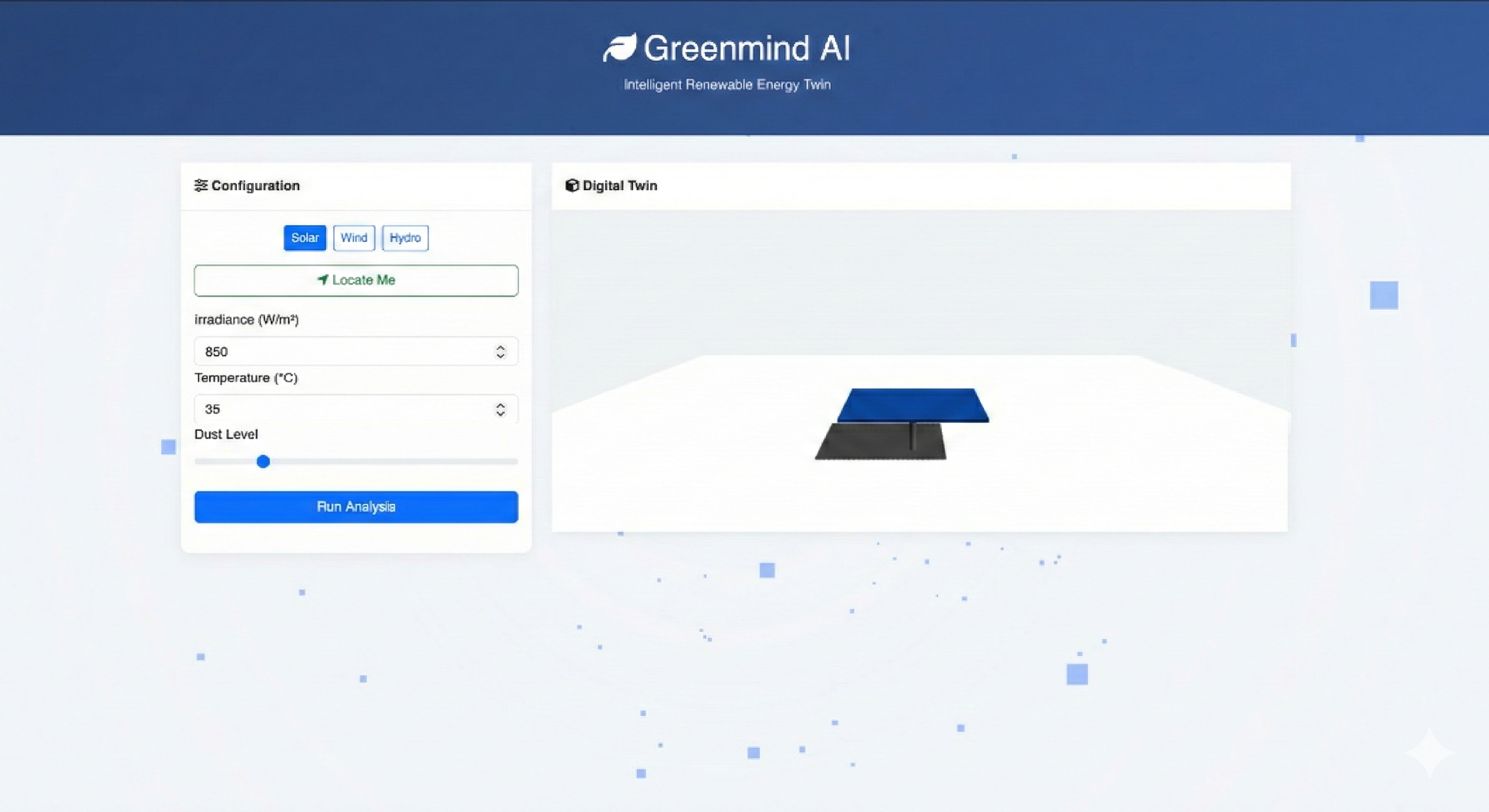
Universal Asset Support: Instantly switches between Solar Panels, Wind Turbines, and Hydro Generators, adapting the entire dashboard and prediction engine to the selected technology.
Live 3D Digital Twin: Renders a physics-accurate 3D model (using Three.js) that mirrors real-world conditions. Solar panels change color with dust accumulation, wind turbines spin based on wind speed, and hydro turbines react to flow rates.
Hybrid Physics-AI Engine: Combines Machine Learning (XGBoost) with physics-based constraints (e.g., air density corrections, fluid friction) to predict efficiency with high accuracy.
"Ask Greenmind" Consultant: An integrated GenAI chatbot (powered by OpenAI) that analyzes the live telemetry. Instead of reading complex charts, operators can simply ask, "Why is my output low?" and get a plain-English diagnosis based on the current data.
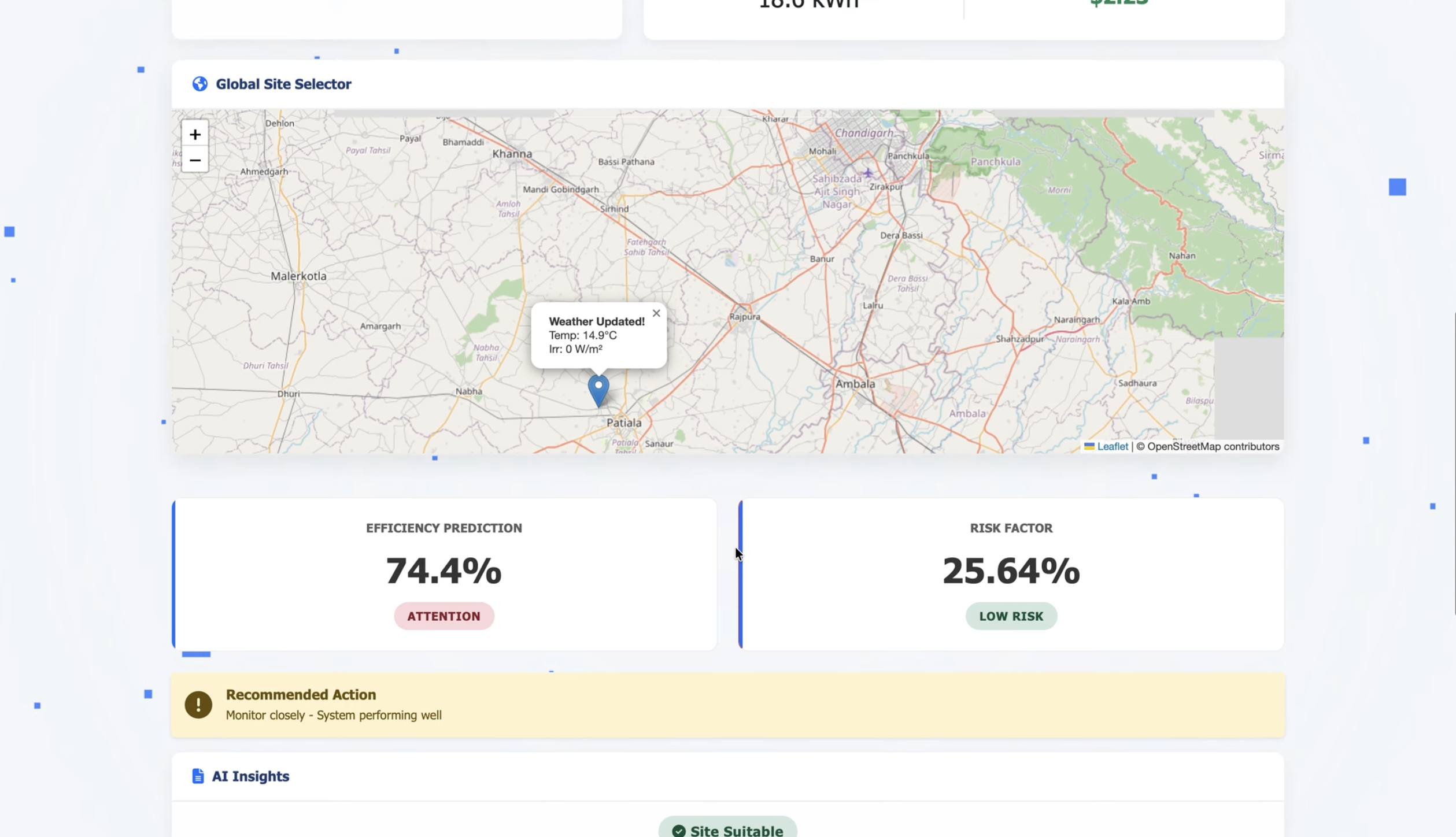
Global Site Intelligence: A live map integration that pulls real-time weather data (Irradiance, Wind Speed, Temperature) from any location on Earth to simulate asset performance.
How we built it We built Greenmind AI using a modern, scalable tech stack:
Backend: Python Flask serves as the core API, handling model inference and data processing.
Machine Learning: We trained separate XGBoost regressors for Solar, Wind, and Hydro efficiency on synthetic datasets generated with physics-aware noise.
Frontend:
Three.js: For rendering the interactive 3D Digital Twins.
Leaflet.js & Open-Meteo API: For the interactive global map and real-time weather fetching.
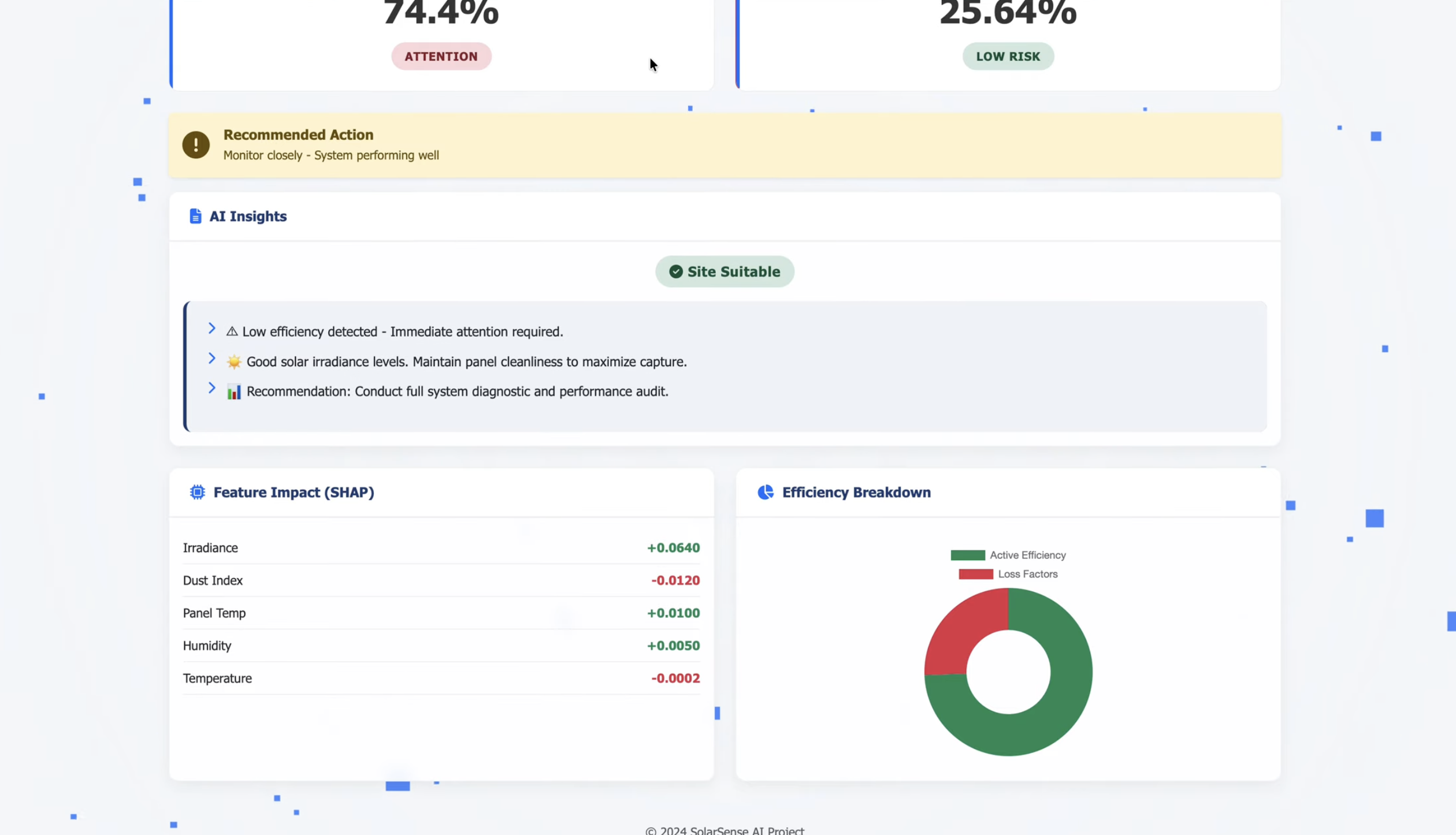
Chart.js: For visualizing efficiency loss and risk factors.
AI Integration: We used the OpenAI API to build the "Greenmind Consultant," injecting live sensor context into the system prompt for context-aware answers.
Challenges we ran into Polymorphic Architecture: Designing a single backend that could seamlessly switch between three completely different physics models (Solar/Wind/Hydro) without crashing or requiring a page reload was difficult. We solved this by creating a modular "Asset Switcher" logic in both the frontend and backend.
Physics-ML Balance: Pure ML models sometimes predicted unrealistic efficiencies (e.g., >100% output during storms). We had to implement a physics-constraint layer that applies real-world limits (like Betz's Law for wind) to "sanity check" the AI's predictions.
3D Synchronization: Mapping numerical inputs (like 0-1 dust index) to visual properties (hex color interpolation) in real-time required precise state management in Three.js.
Accomplishments that we're proud of Successfully integrating Generative AI into the control loop, turning a standard dashboard into a conversational assistant.
Building a responsive 3D visualization that runs smoothly in the browser while handling complex animations.
Creating a robust, error-tolerant architecture that handles missing API keys or weather data gracefully without breaking the user experience.
What we learned The power of Hybrid AI: Relying solely on data isn't enough for engineering; you need to bake physics into the code.
User-Centric Design: A Digital Twin is only useful if the operator can understand it. Adding the "Ask AI" feature drastically improved the interpretability of our data.
Scalability: We learned how to structure an application so that adding a fourth asset (like Geothermal) would be as simple as adding a new model file and 3D asset.
What's next for GREENMIND AI Edge Deployment: Porting the inference engine to Raspberry Pi/NVIDIA Jetson for offline, on-device monitoring.
IoT Security: Implementing mTLS (Mutual TLS) for secure device-to-cloud communication.
Blockchain Integration: To create immutable efficiency logs for carbon credit verification
Built With
- allowing-users-to-have-natural-language-conversations-with-their-energy-data.-open-meteo-api:-provided-real-time
- api
- bootstrap
- chart.js
- flask
- hydro)-directly-in-the-browser.-xgboost:-the-machine-learning-library-used-to-train-the-high-performance-regression-models-for-efficiency-prediction.-openai-api-(gpt-3.5):-powered-the-"greenmind-consultant"-chatbot
- leaflet.js
- location-based-weather-data-(irradiance
- numpy
- open-meteo
- openai
- pandas
- python
- three.js
- wind-speed
- wind-turbine
- xgboost

Log in or sign up for Devpost to join the conversation.