-
-
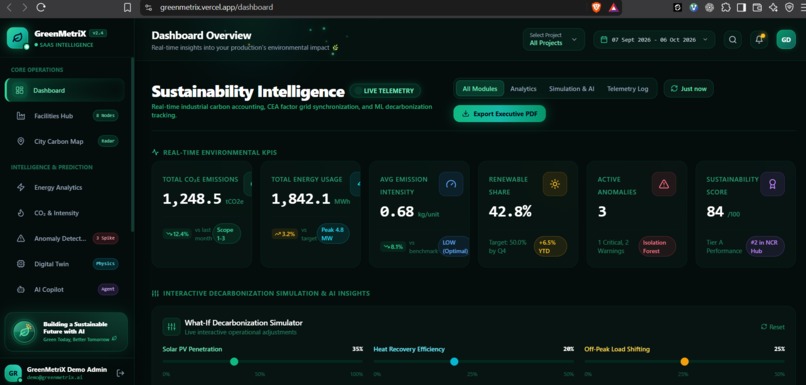
dashboard
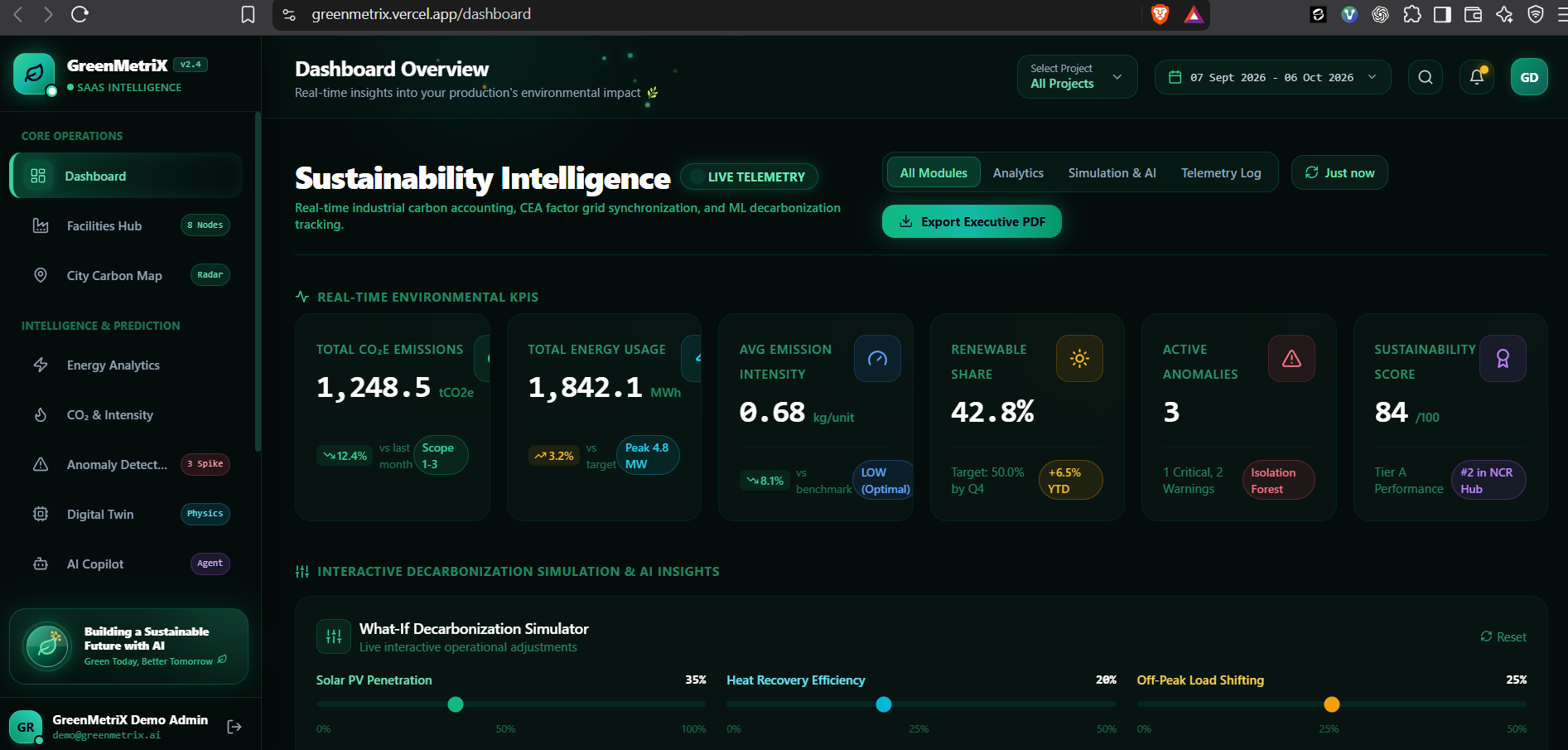
GreenMetriX is an AI-powered industrial sustainability intelligence platform designed for smart manufacturing facilities, with the goal of helping industries measure, understand, predict, and reduce their environmental impact. The project was inspired by the need to transform raw factory energy and environmental data into meaningful and actionable insights. I wanted to build a system that could not only monitor energy consumption and carbon emissions in real time, but also identify unusual operational behavior, predict future energy and emission trends, and help users evaluate different decarbonization strategies before implementing them. The platform provides an enterprise dashboard with real-time environmental KPIs such as total CO2e emissions, total energy usage, average emission intensity, renewable energy share, active anomalies, and overall sustainability score. It also includes a City Carbon Map focused on industrial regions across Delhi NCR, allowing users to monitor facilities such as Okhla, Noida, Bawana, Faridabad, Mayapuri, Patparganj, Gurugram, and Manesar through emission, energy-load, freight, and telemetry information. The dashboard was designed with a modern dark glassmorphic interface containing interactive KPI cards, charts, status indicators, telemetry information, alerts, filters, and executive reporting features. On the analytics side, GreenMetriX uses a CEA emission factor baseline of 0.716 kg CO2 per kWh for factor-based carbon accounting and includes safeguards for zero-production facilities so that emission-intensity calculations do not result in division errors. For machine learning, I worked with a chronological industrial energy dataset containing 4,320 hourly records covering 180 days, including production units, energy consumption, estimated CO2 emissions, emission intensity, renewable share, temperature, humidity, cooling degree days, active shifts, and anomaly information. I evaluated multiple machine learning models including Random Forest, Gradient Boosting, XGBoost, and a baseline persistence model. Gradient Boosting achieved the best performance with an R2 score of 0.9891, an RMSE of 59.94, and an MAE of 41.15, so it was selected as the production forecasting model. I also implemented Isolation Forest for unsupervised anomaly detection to identify abnormal energy consumption and emission behavior. One of the most important features of the project is the What-If Decarbonization Simulator, which allows users to interactively change parameters such as solar PV penetration, heat recovery efficiency, and off-peak load shifting to estimate their potential impact on emissions. GreenMetriX also includes an AI Decarbonization Copilot with tool-calling and RAG capabilities, designed to combine sustainability knowledge, factory telemetry, machine learning predictions, and scenario analysis to provide more useful recommendations. I built the platform using a full-stack architecture with a modern Vite-based frontend, Python FastAPI backend, PostgreSQL database support, machine learning pipelines, interactive visualizations, and Docker deployment. The project also includes authentication, facility monitoring, energy analytics, CO2 and intensity analysis, anomaly detection, digital twin functionality, AI assistance, telemetry history, CSV export, and executive PDF reporting. During development, one of the major challenges was presenting a large amount of industrial and sustainability data without making the interface difficult to understand, so I focused on clear information hierarchy, KPI cards, interactive charts, status indicators, filters, and visual alerts. Another challenge was handling edge cases such as facilities with zero production, dynamic emission-factor changes, and abnormal operational data. I also had to compare different machine learning models carefully instead of selecting a model only based on assumptions. Through this project, I learned practical full-stack development, data preprocessing, feature engineering, machine learning, forecasting, anomaly detection, API development, database integration, RAG systems, AI tool calling, interactive data visualization, digital twin concepts, Docker deployment, and automated testing. The backend test suite achieved 20 out of 20 successful tests, covering carbon calculations, zero-production safeguards, machine learning inference, anomaly detection, digital twin simulations, dynamic emission-factor updates, and executive PDF generation, while the frontend production build completed successfully without errors. Overall, GreenMetriX helped me understand how artificial intelligence, data science, software engineering, and sustainability can be combined to create a practical decision-support system for modern manufacturing. The main objective of the project is not simply to display environmental data, but to help users understand what is happening, predict what may happen next, explore possible solutions, and make better decisions for reducing industrial emissions.
Built With
- artificial-intelligence
- chart.js
- data-science
- data-visualization
- docker
- fastapi
- git
- github
- gradient-boosting
- isolation-forest
- javascript
- leaflet.js
- machine-learning
- numpy
- pandas
- postgresql
- python
- rag
- random-forest
- react
- rest-api
- scikit-learn
- tailwind-css
- vite
- xgboost

Log in or sign up for Devpost to join the conversation.