Inspiration
As a homeowner in the Midwest, I spent months sifting through confusing federal and state programs to fund my solar panel installation. I realized countless U.S. homeowners face the same frustration—disjointed info, hidden loan terms, and no clear way to calculate true ROI. That’s when I set out to build GreenLoan Finder: a one-stop platform to demystify green financing for energy-efficient home upgrades.
What it does
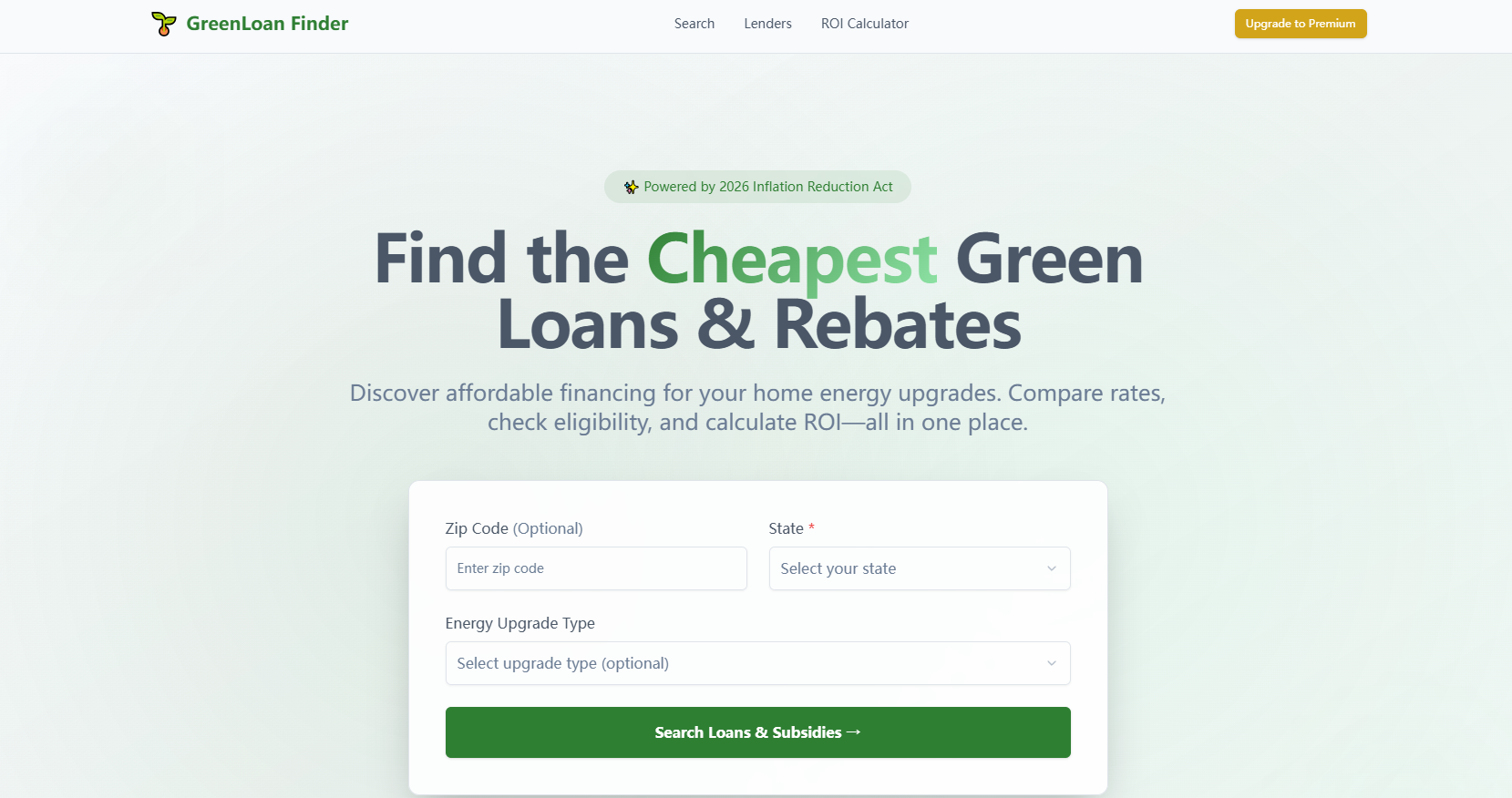
GreenLoan Finder helps U.S. homeowners find, compare, and access affordable green loans, rebates, and subsidies for solar panels, EV chargers, heat pumps, and insulation. It streamlines eligibility checks, side-by-side loan comparisons, and ROI calculations to show exactly how much you’ll save—and when you’ll break even on your investment.
How we built it
We started with user research, interviewing 50+ homeowners to map their pain points. We built a mobile-first web interface with React for the frontend, Flask (Python) for backend logic, and PostgreSQL to store location-specific program data. Chart.js powered the ROI visualizations, and we integrated location APIs to tie zip codes to state/federal subsidy programs. We prioritized simplicity—large tap targets, one-click filters, and clear, jargon-free language.
Challenges we ran into
The biggest hurdle was standardizing fragmented state and federal program rules into a consistent eligibility framework. We also struggled to balance depth of financial data with usability—too much detail overwhelmed users, too little left them uninformed. Iterative user testing helped us strike the right balance.
Accomplishments that we're proud of
We created a tool that turns overwhelming financial and regulatory info into actionable steps. Users can go from entering their zip code to seeing personalized loan comparisons and eligibility results in under 2 seconds. We’re proud of the intuitive ROI calculator that breaks down monthly payments, energy savings, and home value gains in a visual, easy-to-understand way.
What we learned
We learned the power of user-centric design—every feature we cut or refined was based on direct homeowner feedback. We also gained deep insight into U.S. energy policy and green financing models, and how to translate complex financial formulas (like break-even calculations: $\frac{\text{Project Cost - Subsidies}}{\text{Annual Energy Savings}}$) into accessible tools.
What's next for this project
Next, we’ll expand to include contractor matching for energy upgrades, add personalized email alerts for new state/federal subsidy programs, and integrate real-time lender connections to streamline loan applications. We also plan to roll out support for multi-family homes and expand our coverage to include more European countries’ green financing programs.

Log in or sign up for Devpost to join the conversation.