Inspiration
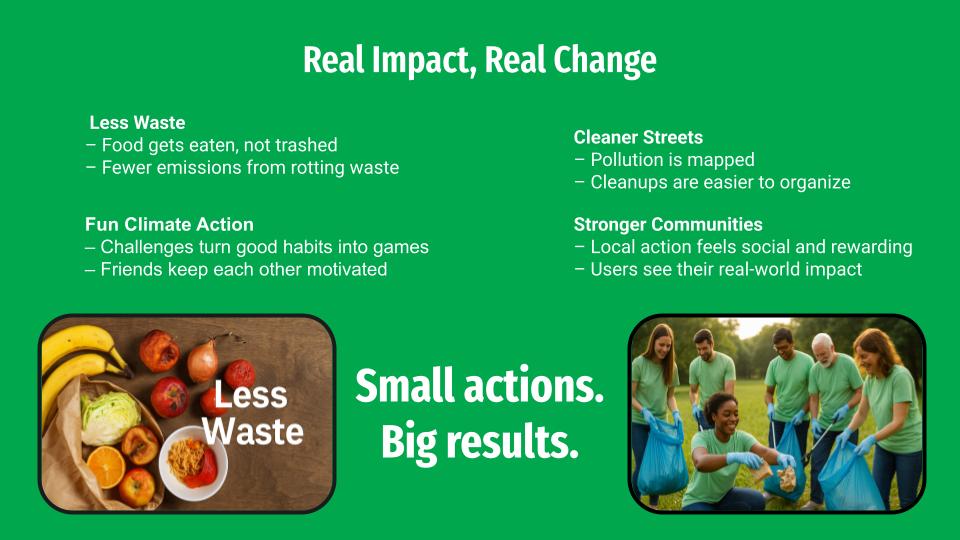
One of our grandmothers has a garden that grows more food than she can use, leading to unnecessary waste. This waste doesn't come from a lack of effort, but a lack of accessible ways to share food. We asked ourselves: what if technology could make that process as natural as taking a photo? That idea sparked GreenLink: a platform designed to reduce waste, connect communities, and show how generative AI can make sustainable living more human, natural, and impactful.
What it does
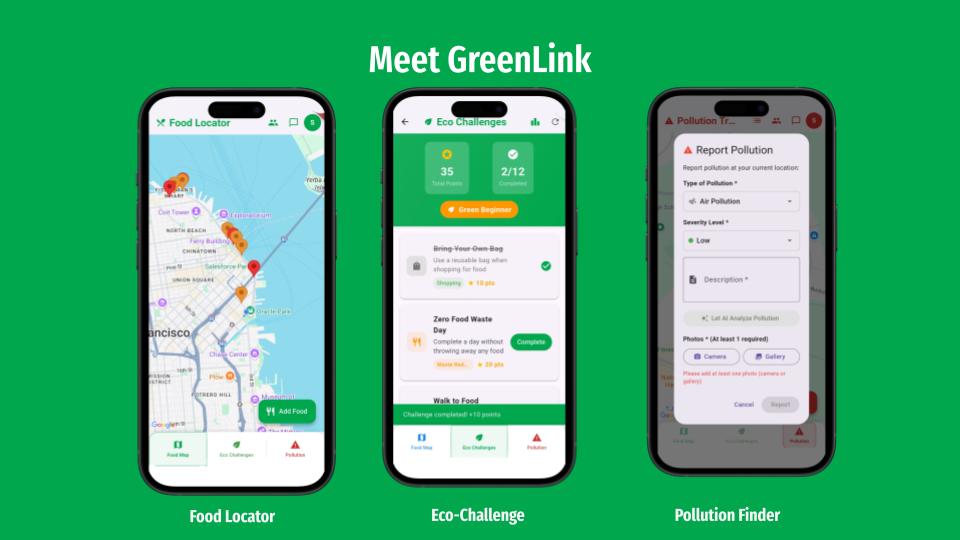
GreenLink is built around intuitive, photo-driven interaction and has three main tabs:
- Food Locator: Users can snap a picture of surplus food—anything from extra fruit at home to unsold grocery store produce—and our generative AI automatically creates a natural description and title. These listings appear on a real-time map, where others can search by distance, name, or date posted, and message each other to arrange pickup
- Eco-Challenges: A gamified space where users can complete sustainability challenges, compete on leaderboards, and connect with friends. This turns eco-friendly habits into fun, social activities with real impact
- Pollution Reporter: Similar to the food locator, this tab lets users document local pollution with photos. Our AI generates descriptions and clusters nearby reports on the map, revealing community hotspots and helping neighbors coordinate cleanup events
By combining these three tabs with generative AI, real-time maps, and chat, GreenLink makes human–computer interaction as simple as pointing a camera while turning everyday photos into accessible, actionable impact.
How we built it
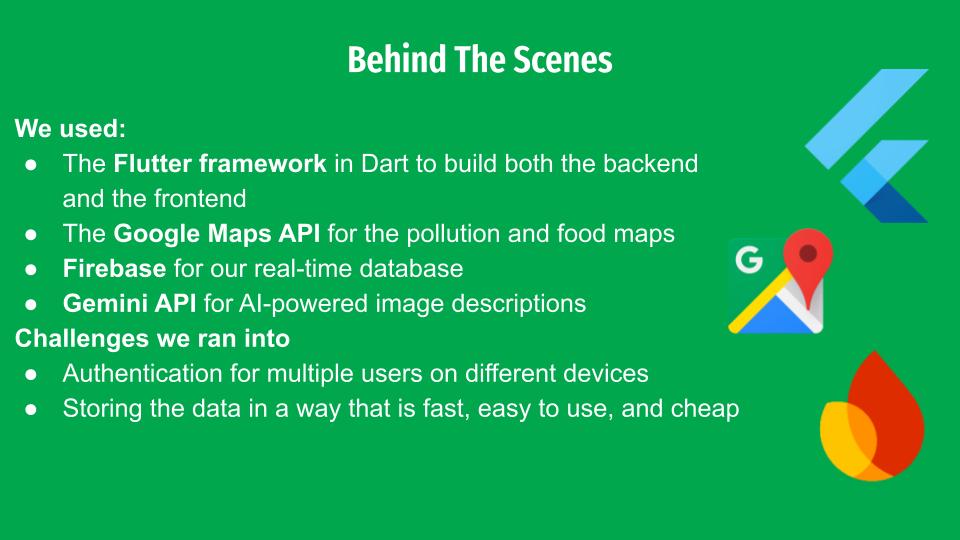
We built GreenLink using the Flutter framework in Dart for both the frontend and backend. We integrated the Google Maps API for the food locator and pollution reporter maps, and the Google Sign-In API for authentication. The Google Gemini API handles image analysis, generating contextual titles and descriptions from photos. Firebase manages real-time data storage, user listings, chat, and eco-challenges.
Challenges we ran into
- Authentication for multiple users on different devices
- Storing the data in a way that is fast, easy to use, and cheap
Accomplishments that we're proud of
- Integration with multiple APIs and Firebase
- Fast and responsive app
- Ability for users to share photos and messages about food and pollution, with a relatively quick time between a user’s post and another user being able to view the post
- Login system and AI analysis to increase efficiency
What we learned
We learned how to:
- Use Firebase and various Google APIs
- Problem solve errors that came up
- Code effectively and efficiently as a team under time pressure
What's next for GreenLink
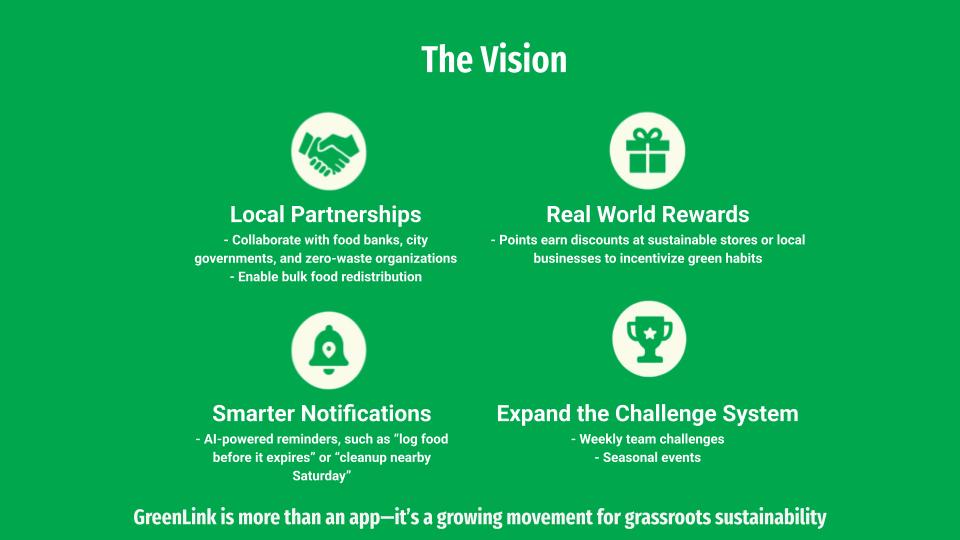
- Reward Integrations: GreenPoints earned through challenges or reports could be redeemed at sustainable local businesses or used for community perks
- Community Challenges & Events: We'll expand team-based eco challenges and support local cleanups with push alerts and leaderboard features
- Accessibility Features: Add audio narration of AI-generated descriptions for visually impaired users
- Scaling: Adapt the platform for multiple languages and regional sustainability efforts

Log in or sign up for Devpost to join the conversation.