-
-
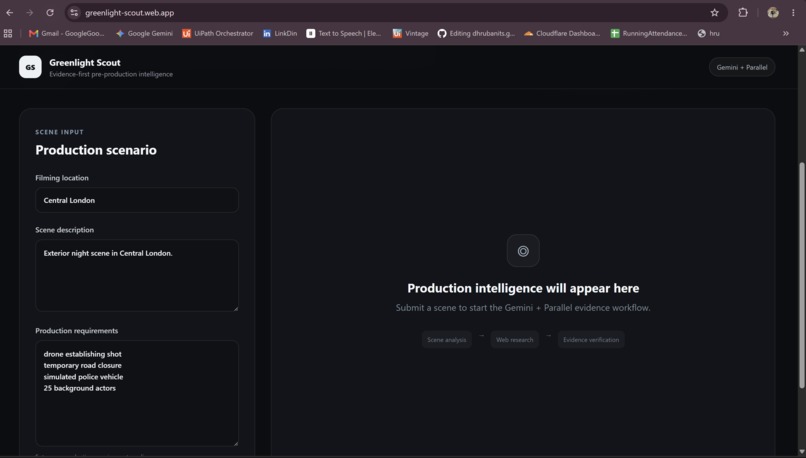
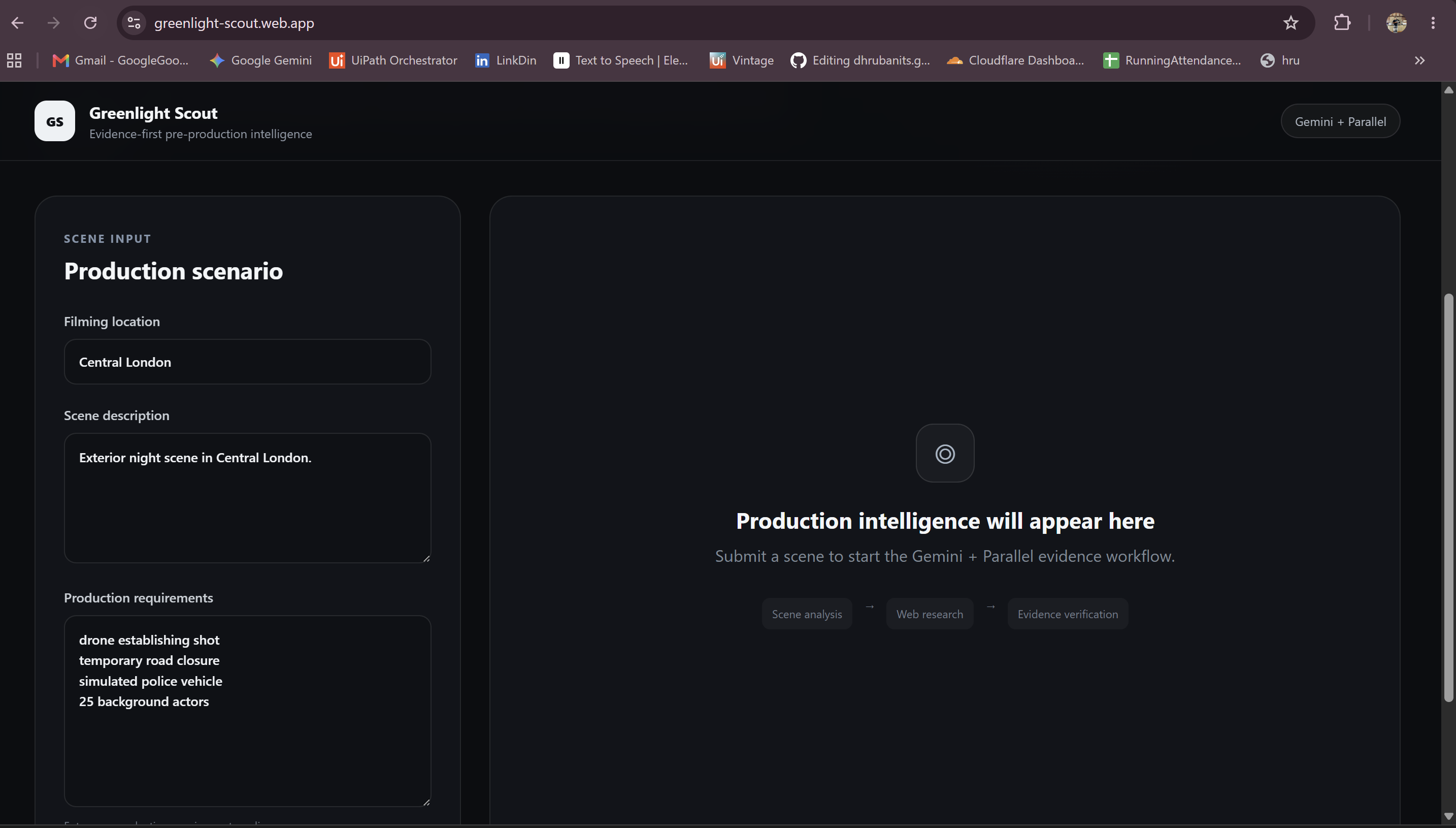
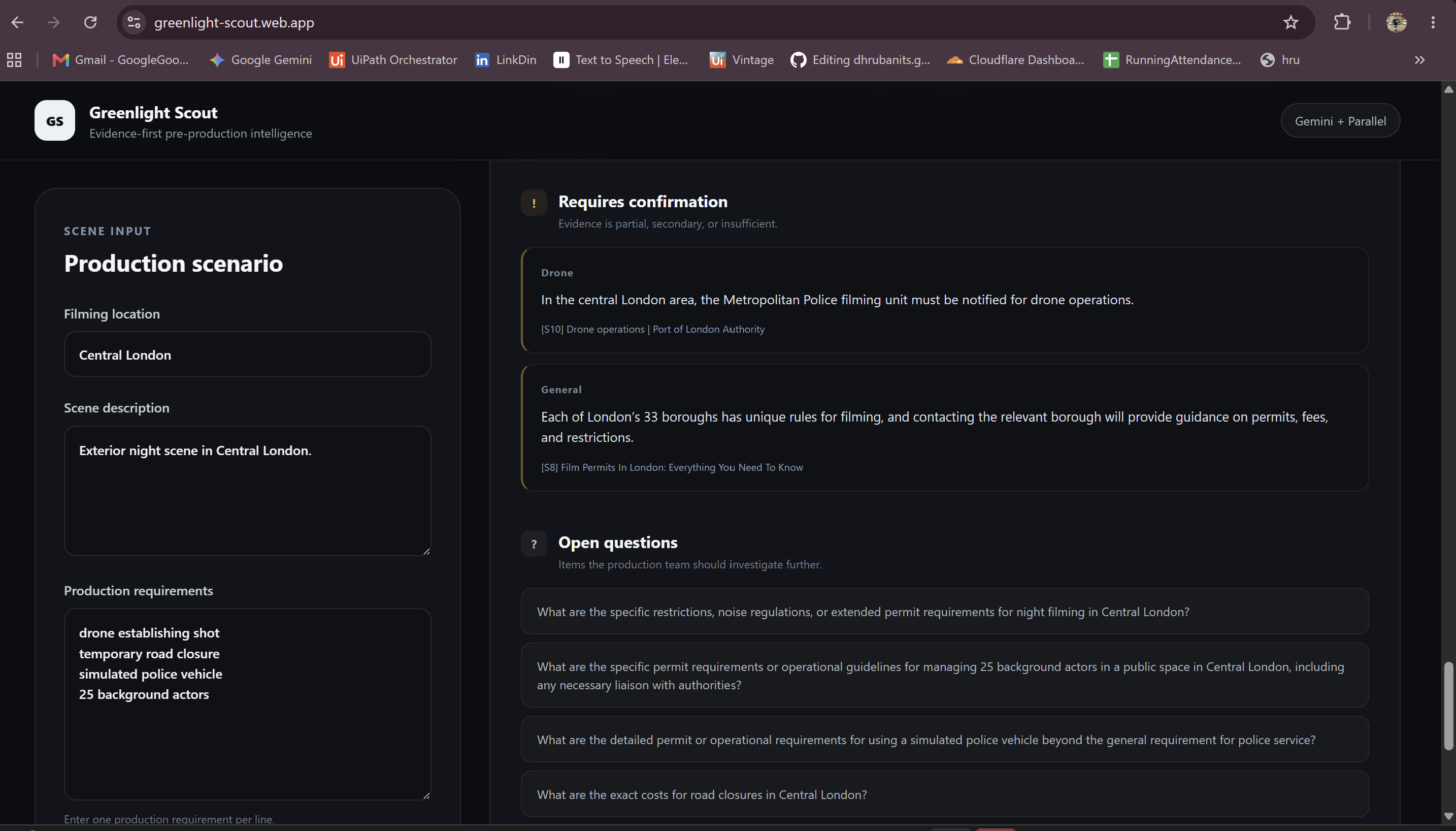
Start with a filming location, scene description, and production requirements.
-
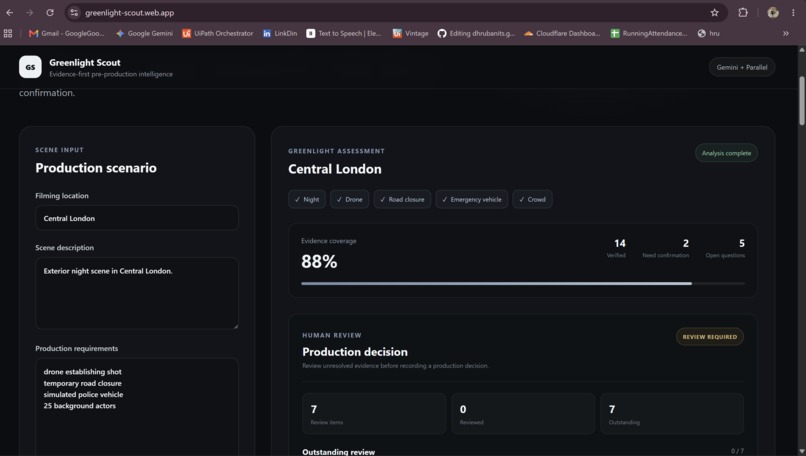
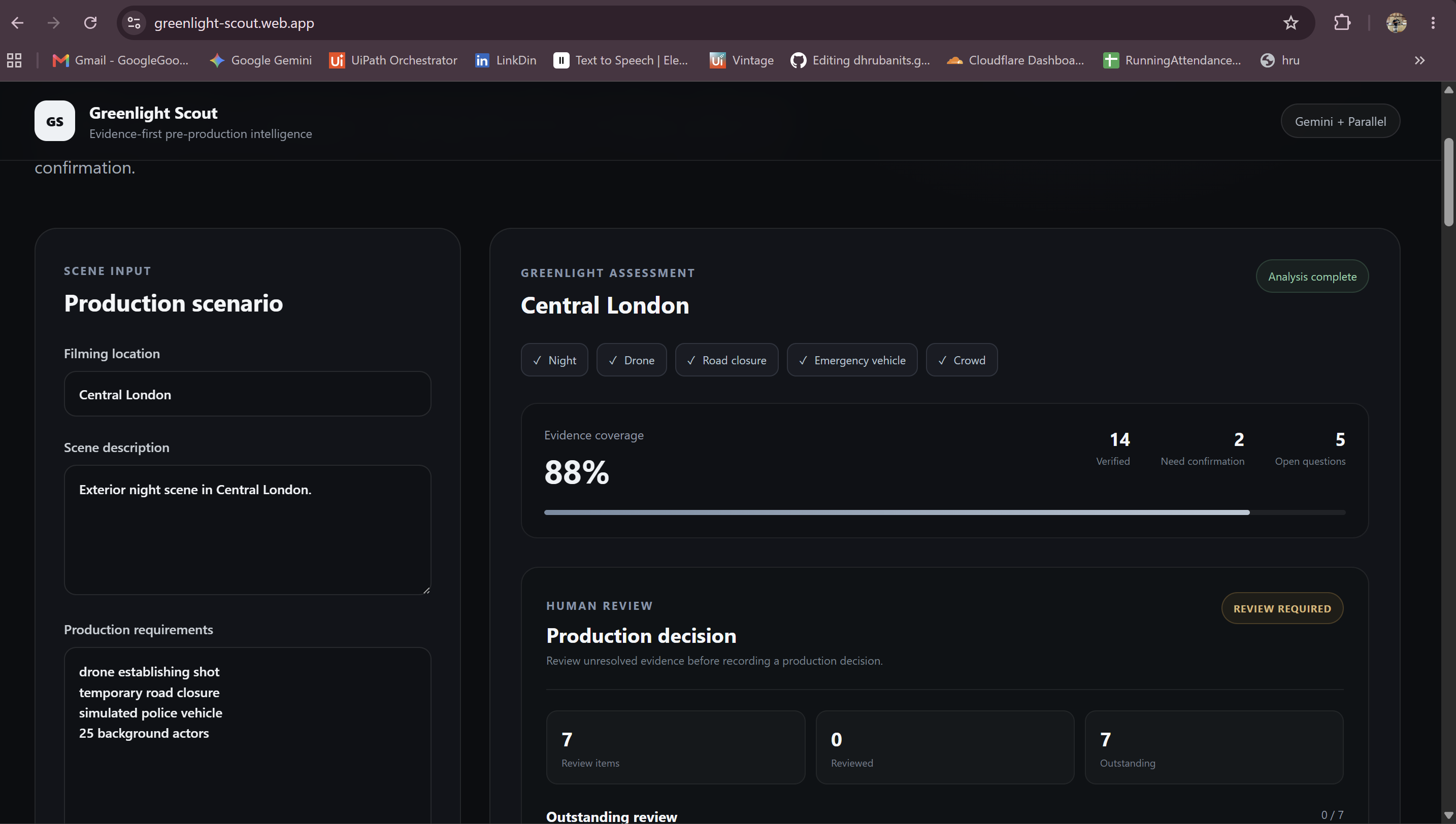
Greenlight Scout summarizes the scene, highlights verified findings, and shows what still needs review.
-
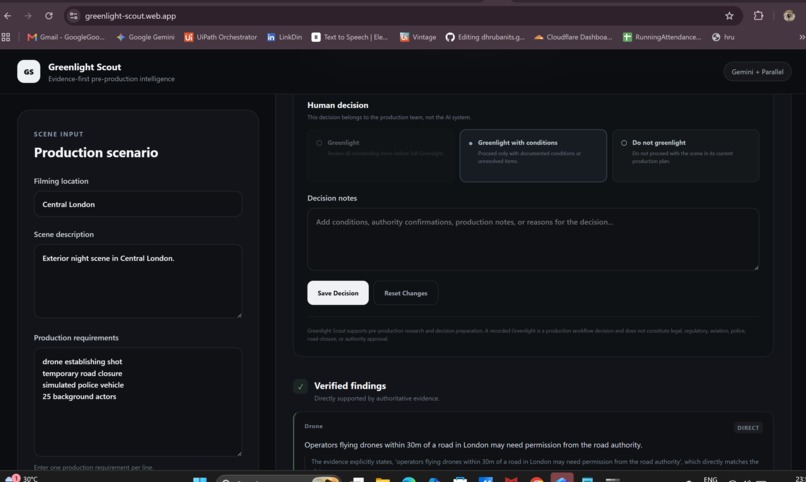
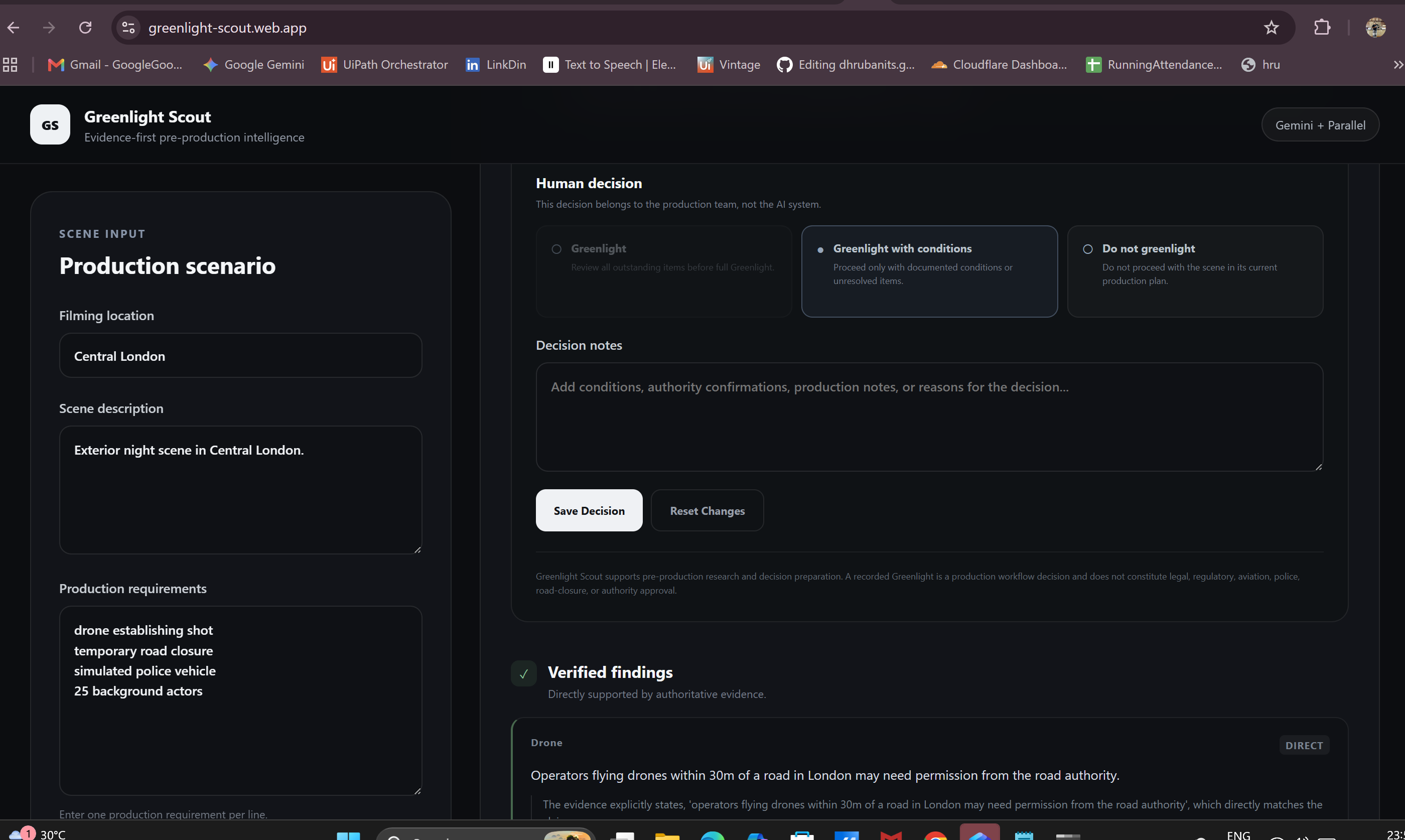
The production team stays in control with Greenlight, Greenlight with conditions, or Do not greenlight
-
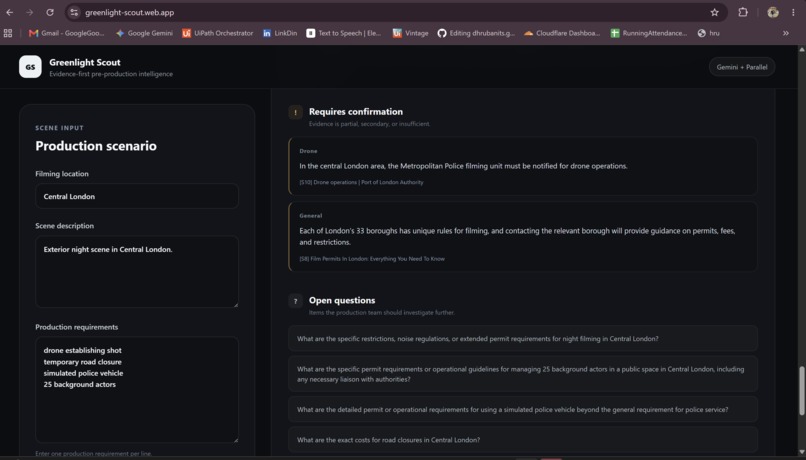
Uncertain or incomplete findings are kept separate so the crew knows exactly what still needs follow-up.
-
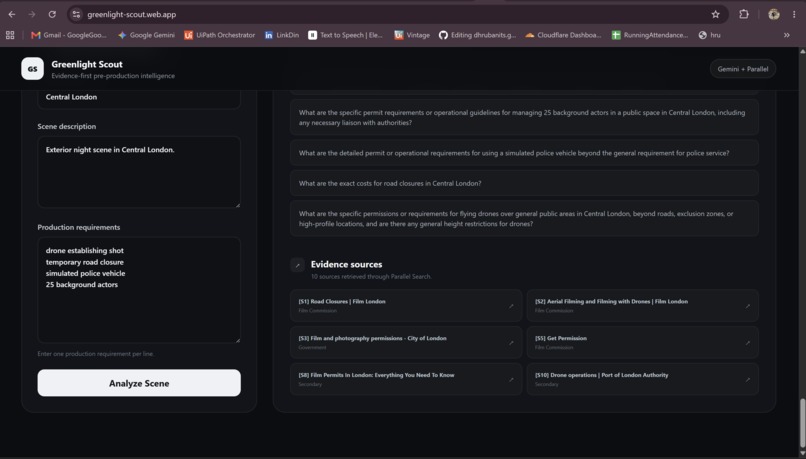
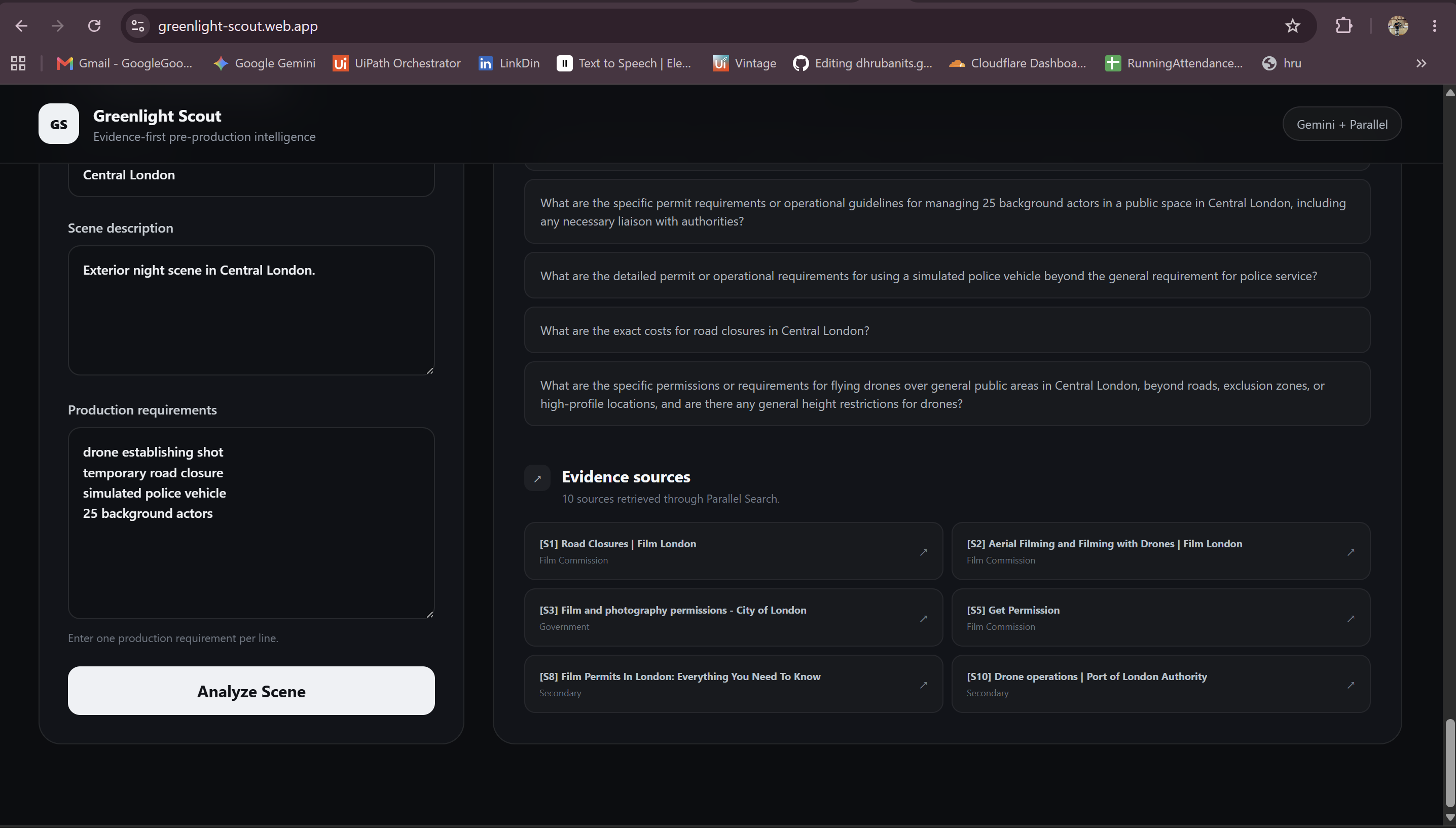
Parallel Search brings together current web sources that support the research and verification workflow
Inspiration
Pre-production research can get messy very quickly. A single scene may involve drone rules, road closures, night filming, emergency vehicles, crowd management, local permits, and different authorities.
The difficult part is not just finding information. It is knowing which information is actually reliable, which rule applies to the exact location, and what still needs to be confirmed by a human before a production team makes a decision.
That was the idea behind Greenlight Scout: build something that helps a film crew research a scene, collect current evidence, and clearly separate what is supported from what still needs follow-up.
What it does
Greenlight Scout takes a filming location, a scene description, and production requirements.
For example, a user can enter a night shoot in Central London involving a drone, temporary road closure, simulated police vehicle, and background actors.
The system identifies the important production requirements, researches current information using Parallel Search, and then uses Gemini to structure and verify the findings.
Instead of presenting every result as a definite answer, Greenlight Scout separates the output into:
- Verified findings
- Items that require confirmation
- Open questions
- Evidence sources
There is also a Human Review section where the production team can review outstanding items and record a decision:
- Greenlight
- Greenlight with conditions
- Do not greenlight
The analysis, reviewed items, notes, and decisions are saved so they can be restored later.
How we built it
The frontend is built with React, TypeScript, and Vite.
The backend is built with FastAPI and Python.
Gemini is used through Vertex AI and Google ADK for the research verification workflow. Parallel Search is called at runtime to retrieve current web evidence related to the scene and location.
The workflow is split into multiple stages rather than relying on a single model response.
First, the application performs deterministic scene analysis to identify requirements such as drone use, road closure, night shooting, emergency vehicles, and crowds.
Parallel Search then retrieves relevant web sources.
Gemini processes the research into structured claims. After that, the application performs additional checks on the cited sources and excerpts. A separate semantic verification step checks whether the evidence actually supports each claim.
The final result is passed through deterministic validation before it is shown as verified.
For deployment, the frontend is hosted on Firebase Hosting and the backend runs on Google Cloud Run. Cloud SQL PostgreSQL stores analyses and human decisions, while Secret Manager is used for credentials.
Challenges we ran into
One of the biggest challenges was avoiding confident answers when the evidence was incomplete.
During development, we found that a source could be related to a topic without actually proving the exact claim being made. We added a separate evidence verification step and deterministic validation so that weak or partial evidence is moved into "Requires confirmation" instead of being shown as verified.
Location scope was another challenge. A rule for the City of London, for example, should not automatically be treated as a rule for all of Central London. We added checks to reduce this type of over-generalization.
Deployment also took some work. We had to configure Cloud Run, Cloud SQL, IAM permissions, Secret Manager, Firebase Hosting, CORS, and compatible versions of the Google ADK and Vertex AI libraries.
Accomplishments that we're proud of
We are most proud that Greenlight Scout is not just a chat interface.
It produces a structured research result with evidence, separates verified information from uncertain information, and keeps the final production decision with the human user.
We also completed the full cloud deployment, including persistent analysis and decision history.
The final application now runs publicly with Firebase Hosting, Cloud Run, Gemini on Vertex AI, Parallel Search, Cloud SQL, and Secret Manager.
What we learned
The biggest lesson was that AI research is much more useful when uncertainty is visible.
A model giving a confident answer is not enough for a workflow involving permits, authorities, or production planning. The application needs to show where the information came from and make it clear when evidence is incomplete.
We also learned that combining AI reasoning with deterministic checks gives much better control than relying on one model response.
From the deployment side, we gained practical experience connecting a full application across Firebase Hosting, Cloud Run, Cloud SQL, IAM, Secret Manager, Vertex AI, and an external search API.
What's next for Greenlight Scout
The next step would be script-based scene analysis, where a production team could upload a screenplay and automatically identify scenes that may require additional research.
We would also like to add more detailed resolution tracking for Human Review, such as recording whether an item was confirmed with an authority, marked not applicable, or resolved through a production change.
Another useful extension would be generating a downloadable pre-production research report that can be shared with production managers and location teams.
Built With
- cloud-run
- cloud-sql
- fastapi
- firebase-hosting
- gemini
- google-adk
- google-cloud
- parallel-search-api
- postgresql
- python
- react
- secret-manager
- sqlalchemy
- typescript
- vertex
- vite


Log in or sign up for Devpost to join the conversation.