-
-
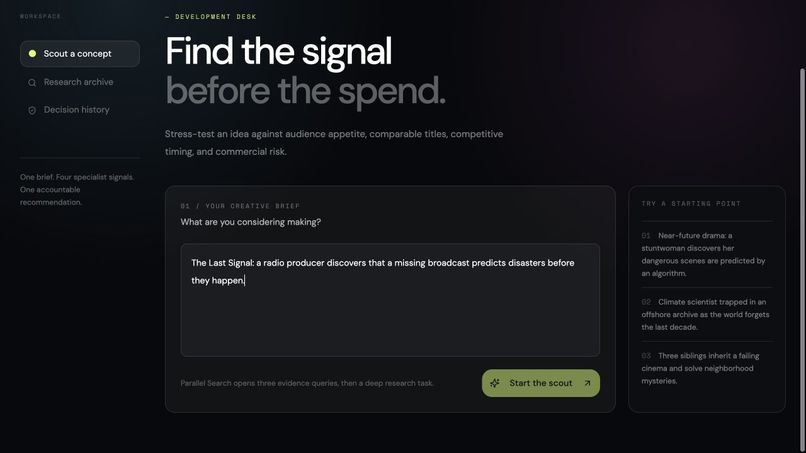
Concept Intake
-
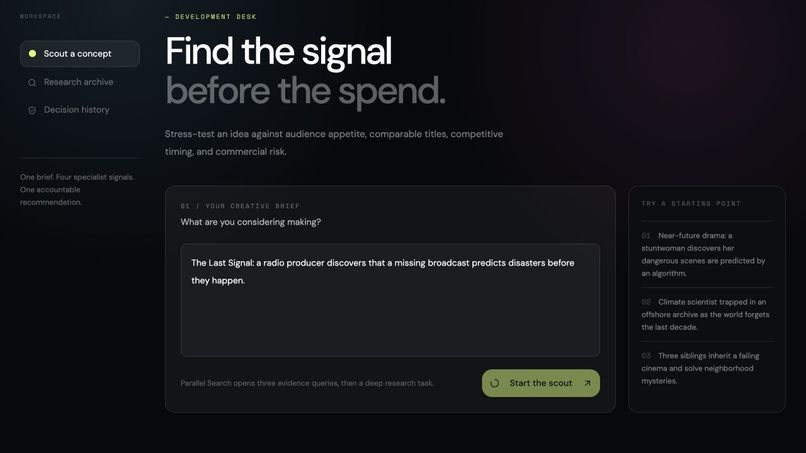
Parallel Research
-
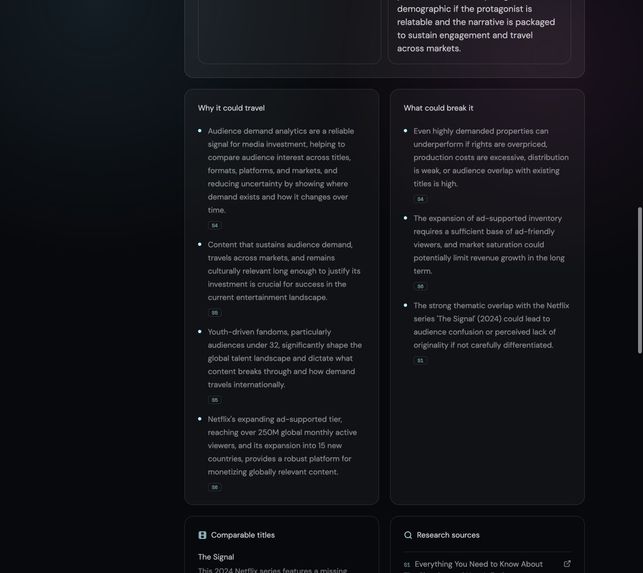
Evidence Memo
-
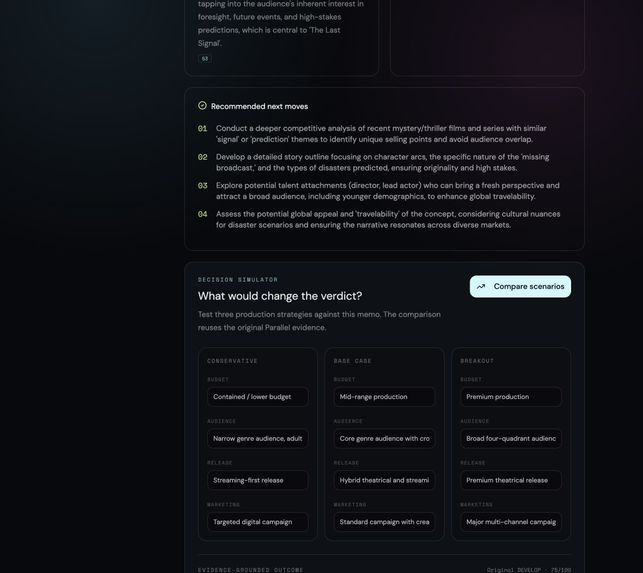
Scenario Simulator
About the Project
Greenlight is a film-development research workspace that helps producers move from a rough concept to a clearer next action.
Inspiration
Film ideas often begin with creative instinct, but development decisions also require evidence. Producers need to understand audience demand, comparable titles, release timing, competitive positioning, and production risks before committing significant time and budget.
I wanted to build a tool that supports that decision without pretending to replace creative judgment. Greenlight asks: what does the available market evidence suggest the producer should do next?
How It Works
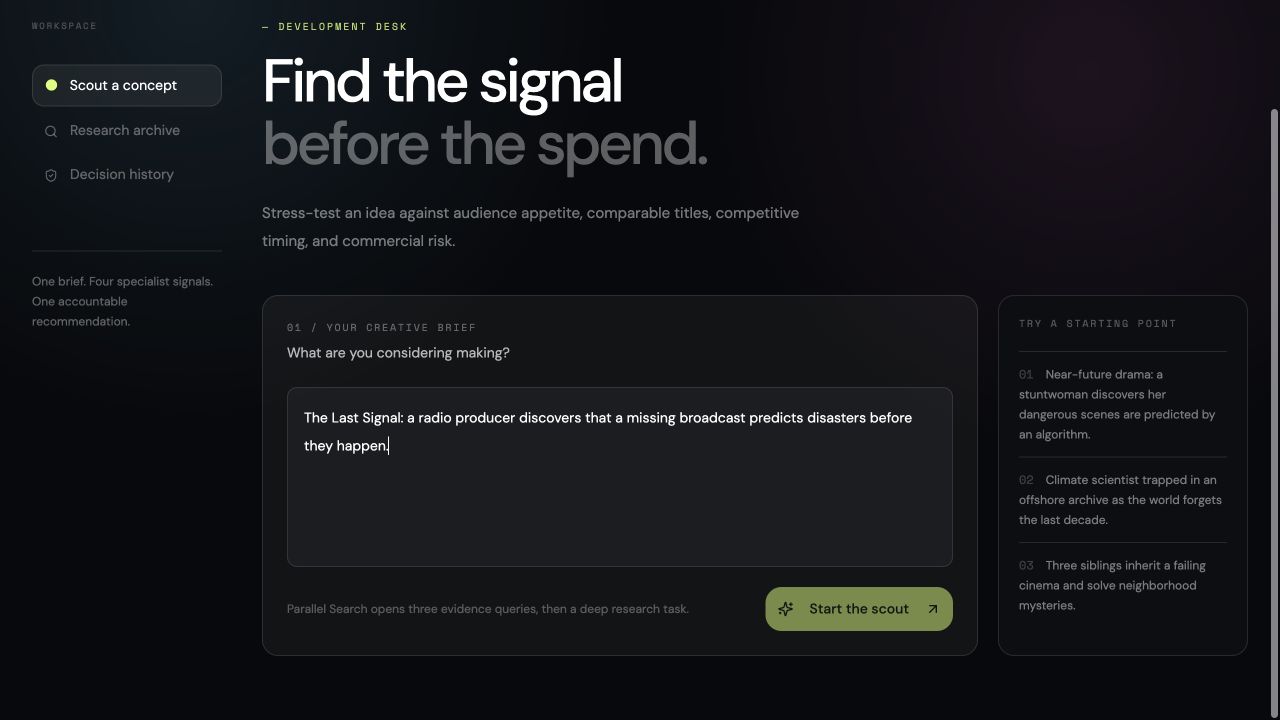
A producer enters a film concept, such as The Last Signal, a story about a radio producer who discovers that a missing broadcast predicts disasters before they happen.
Greenlight then:
- Creates focused market research queries.
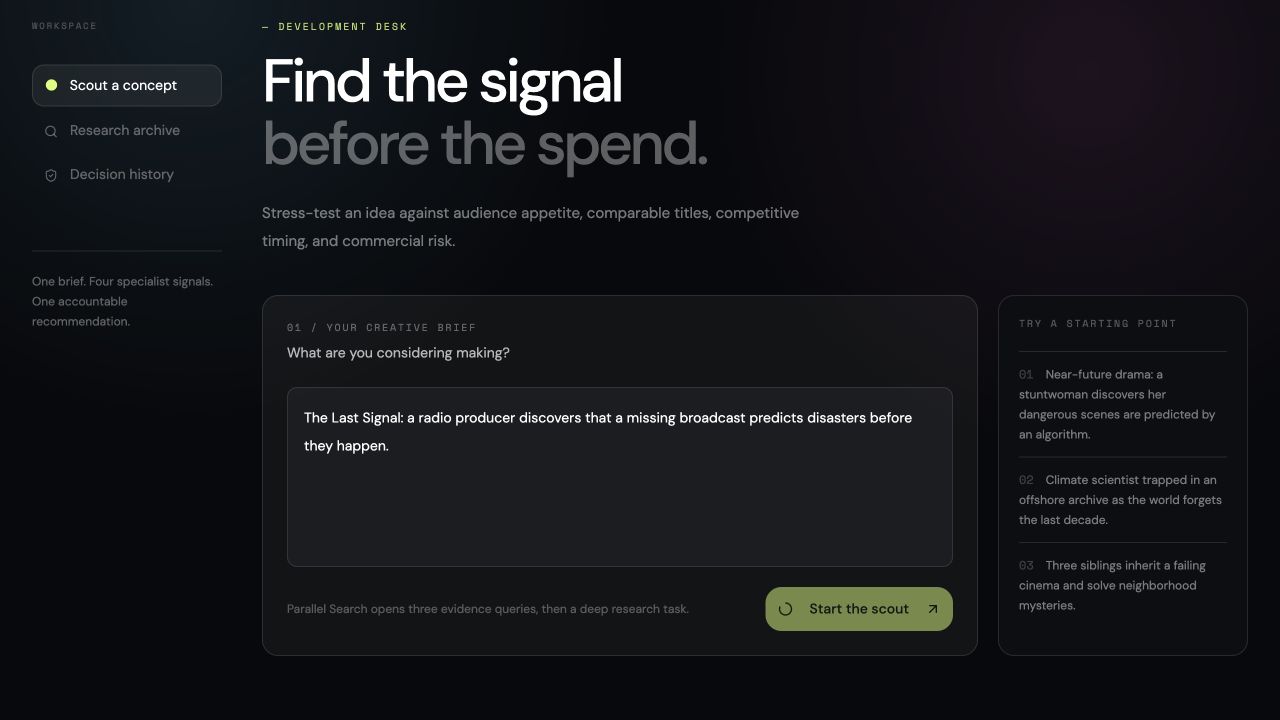
- Uses Parallel Search to collect relevant sources.
- Uses Parallel Task to expand the research into a deeper evidence trail.
- Sends the collected evidence to Gemini for synthesis.
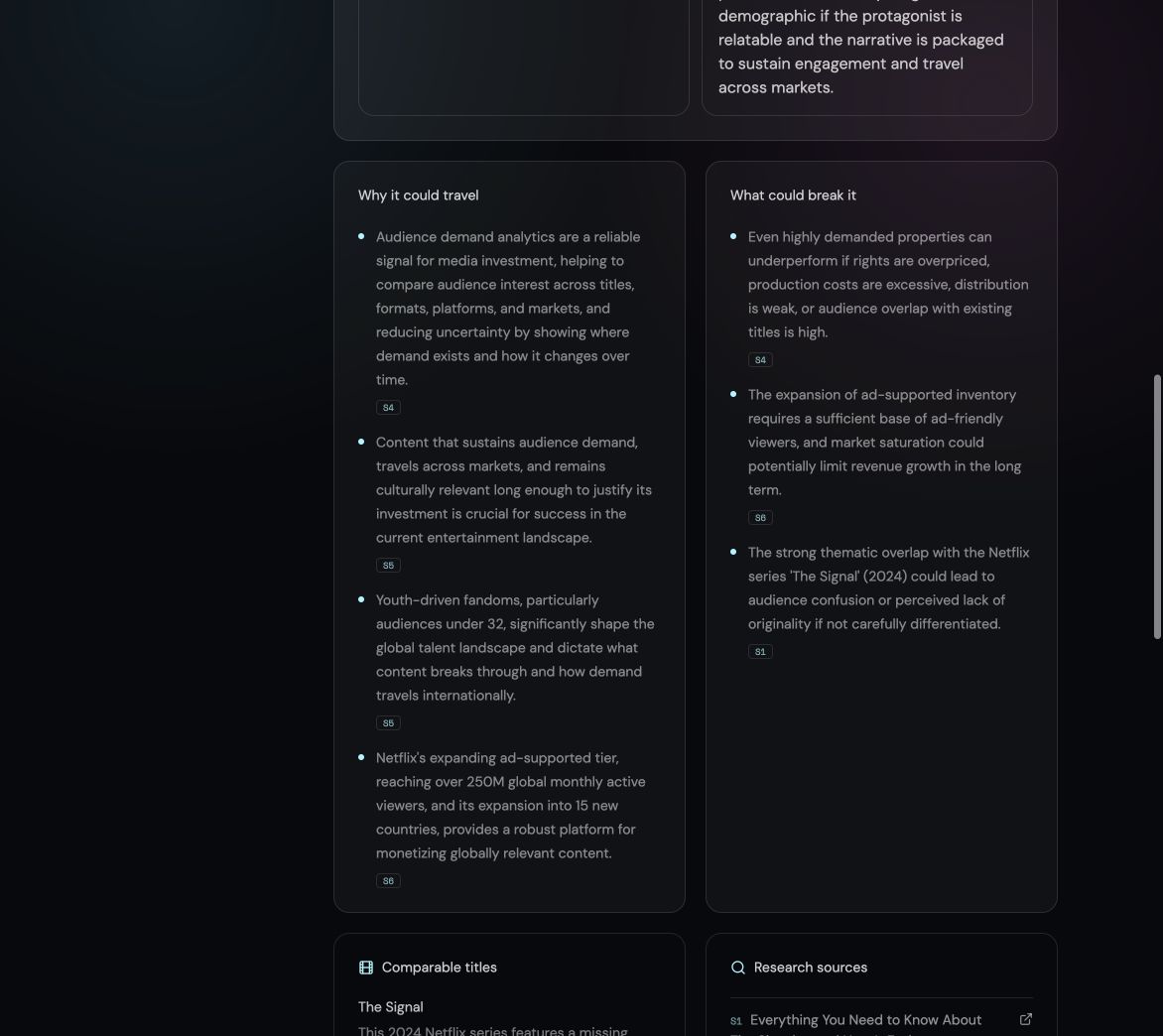
- Produces a source-linked development memo.
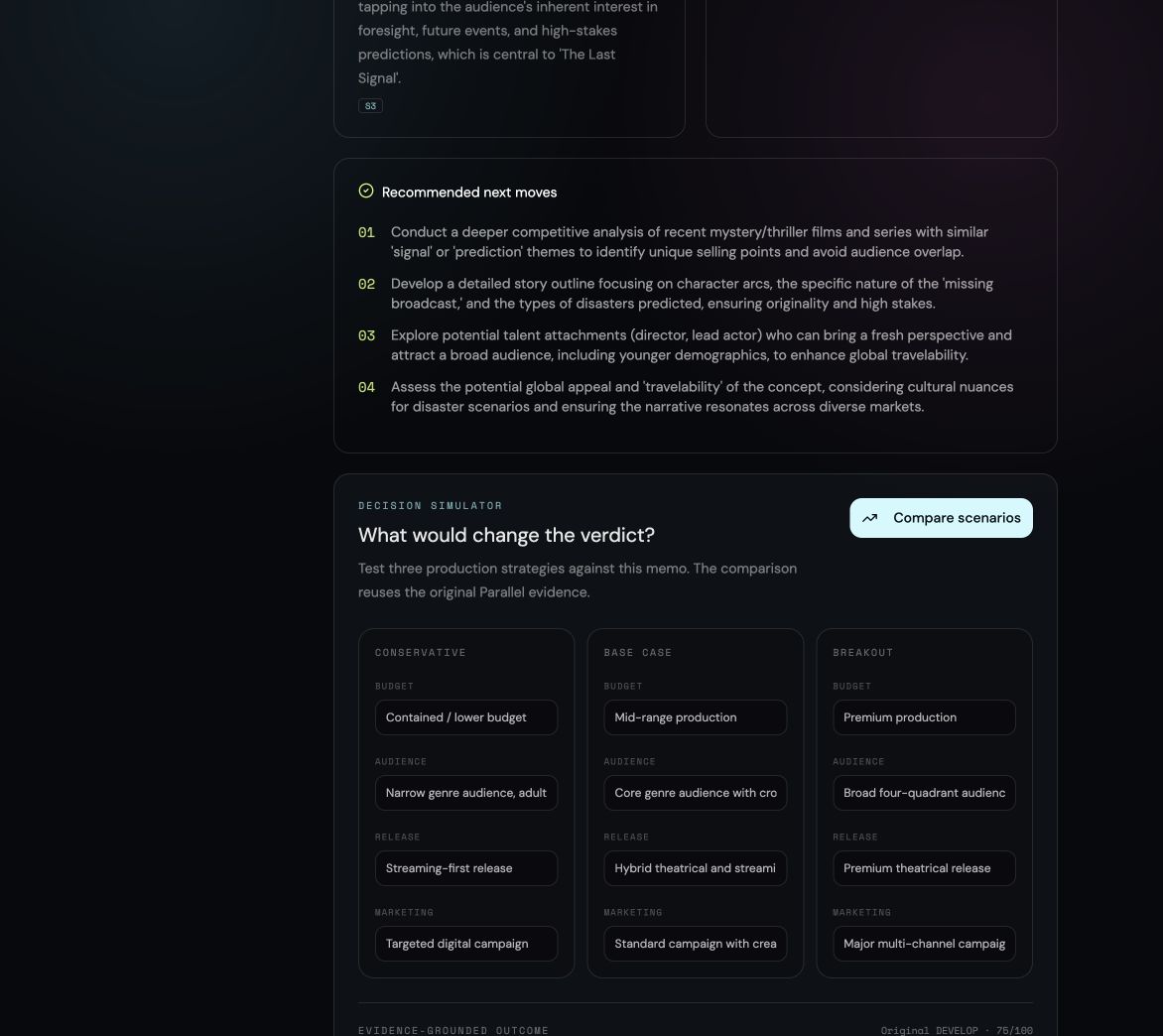
- Allows the producer to test different production scenarios.
The Decision Simulator compares Conservative, Base Case, and Breakout assumptions across budget, audience, release strategy, and marketing scale. The original evidence remains unchanged while the production assumptions change, making it easier to understand why a recommendation moves from DEVELOP to GREENLIGHT or PASS.
How I Built It
The frontend is built with React and Vite. The backend uses Express and tRPC for the asynchronous research workflow.
The Parallel integration provides the research layer through Search and Task. Greenlight uses Gemini through Google Cloud Vertex AI Express Mode with the official @google/genai SDK. Gemini is used to interpret the evidence collected through Parallel rather than independently researching the market.
The application keeps provider metadata visible, including Search IDs, Task run IDs, evidence counts, and source links. A strict provenance check ensures that memo citations can only refer to URLs collected during the original Parallel research run.
For reliability, the application preserves the completed research state if memo synthesis fails. It can retry Gemini once using the same evidence and never repeats the Parallel research unnecessarily.
The project also includes rehearsal mode with deterministic results so the complete workflow can be explored without API credentials.
What I Learned
The most important lesson was that an AI-generated answer is not enough for a trustworthy workflow. The system also needs to show where the answer came from.
I learned to treat evidence provenance as a data contract rather than a presentation detail. Source IDs, URLs, provider metadata, and citation validation all need to be handled explicitly by the application.
I also learned that scenario analysis is more useful than presenting a single score. A producer needs to understand which assumptions affect the recommendation and what action to take next.
Challenges
The biggest technical challenge was coordinating a long-running workflow across Parallel Search, Parallel Task, and Gemini synthesis while keeping the interface understandable.
Another challenge was handling citation mismatches. Gemini may return a source that was not part of the collected evidence, so Greenlight validates every citation and performs a bounded Gemini-only retry when necessary. This keeps the evidence trail truthful without repeating paid research calls.
Designing the simulator was also challenging because it needed to feel interactive while remaining clear about what changes. The scenarios modify production assumptions, not the original research. Keeping that distinction visible was essential.
Greenlight is designed to support creative decision-making with evidence. It does not predict a guaranteed hit or replace a producer’s judgment. It helps make the next decision clearer.
Built With
- express.js
- google-cloud-vertex-ai-express-mode
- parallel-task-api
- react
- trpc
- typescript
- vite

Log in or sign up for Devpost to join the conversation.