Inspiration
Evaluating whether a film is worth investing in requires much more than having a strong creative concept. Producers need to consider comparable films, box-office performance, audience trends, critical reception, market saturation, and potential risks before making an informed decision. However, gathering this information manually can be time-consuming, particularly when relevant information is distributed across many different sources. We wanted to explore how agentic AI could transform this process by allowing an AI system to conduct the initial market research automatically.
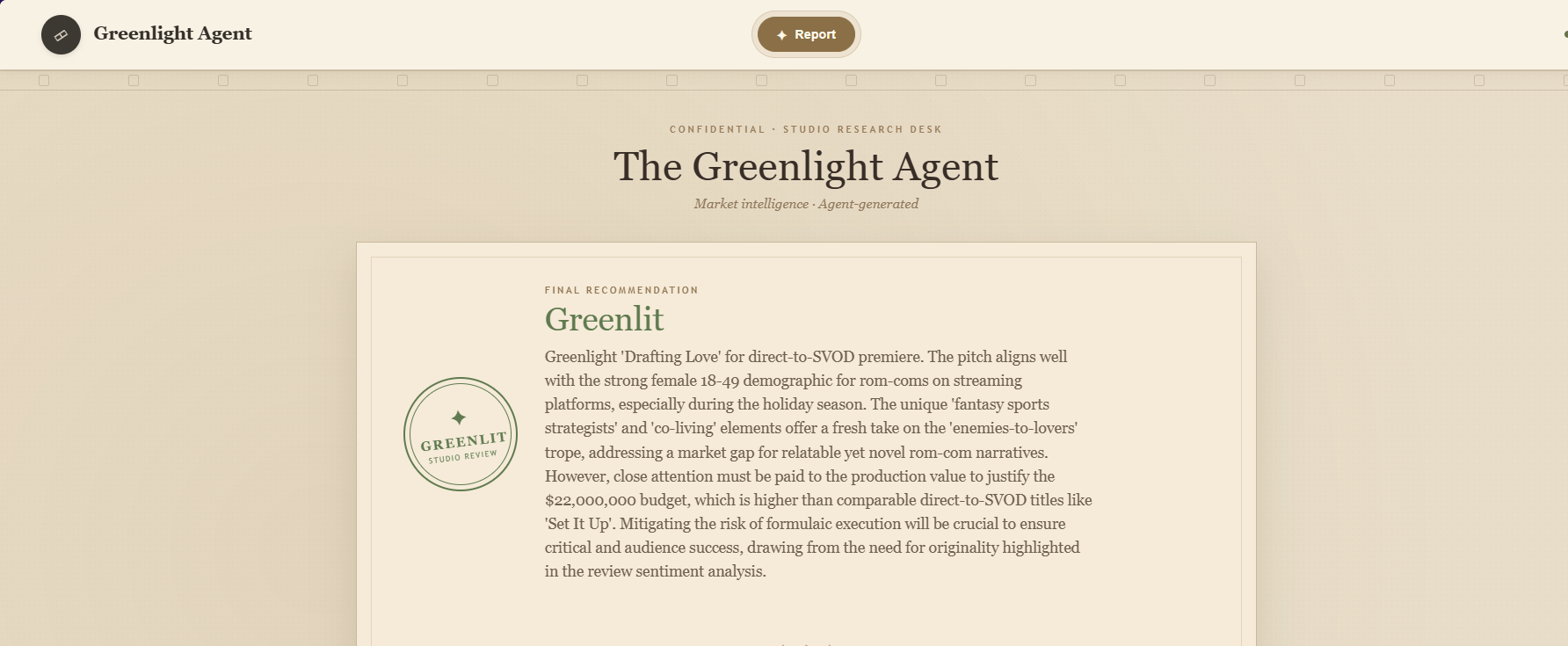
This inspired us to build Greenlight Report Agent, an AI-powered research assistant that evaluates a film pitch and produces a structured GREENLIGHT or FAIL recommendation supported by live market research.
Our goal was not to replace producers or industry analysts, but to provide a fast and evidence-based first step that can help them make more informed decisions.
What it does
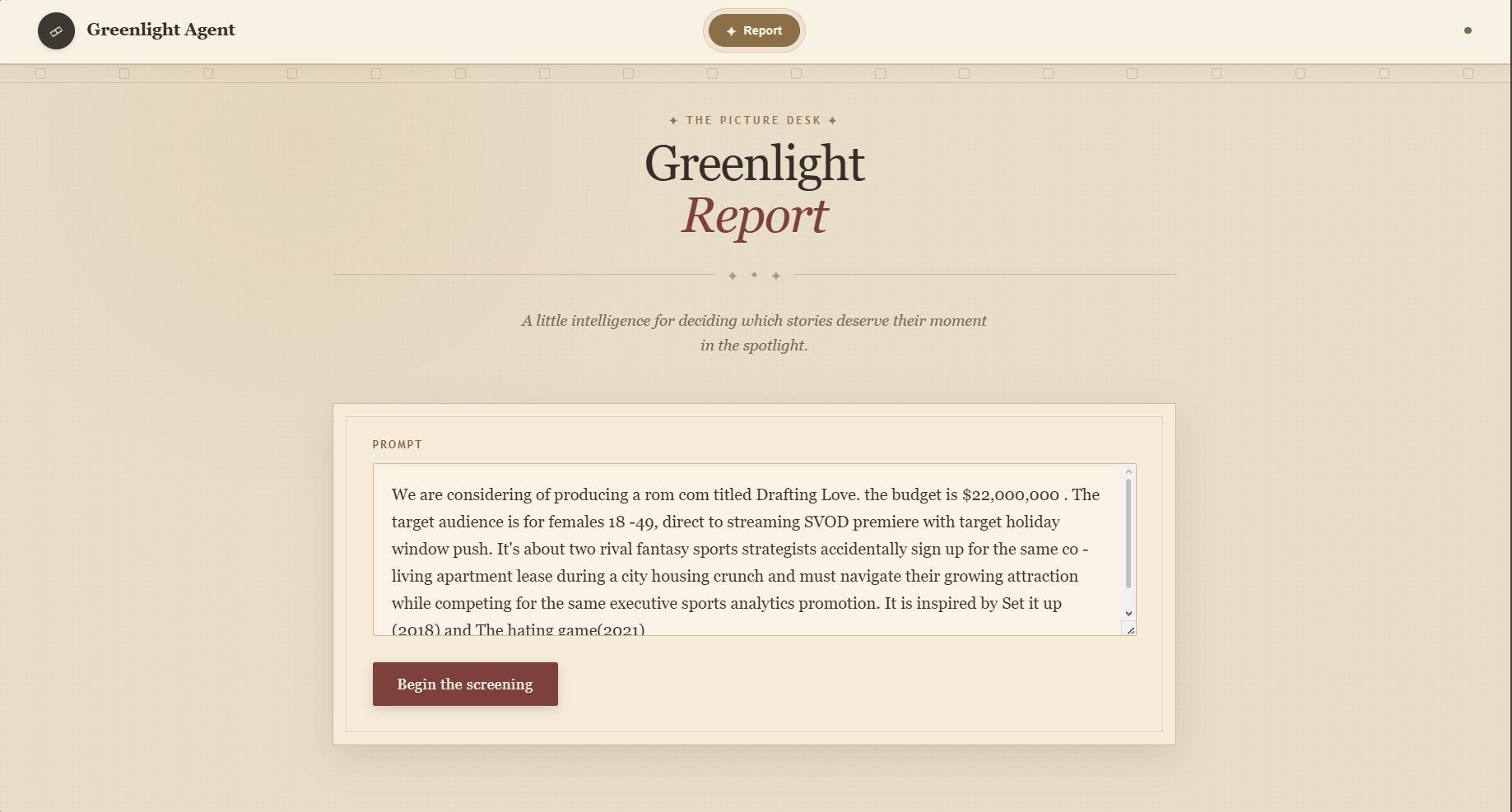
Greenlight Market Report Agent allows a producer to submit a film pitch containing information such as the genre, concept or logline, production budget, target audience, target market, and potential release window.
The agent then conducts live market research using Parallel's Search API across five key areas:
- Competing Films — identifies comparable films and explains their relevance to the proposed project.
- Box Office Performance — researches the commercial performance of comparable films.
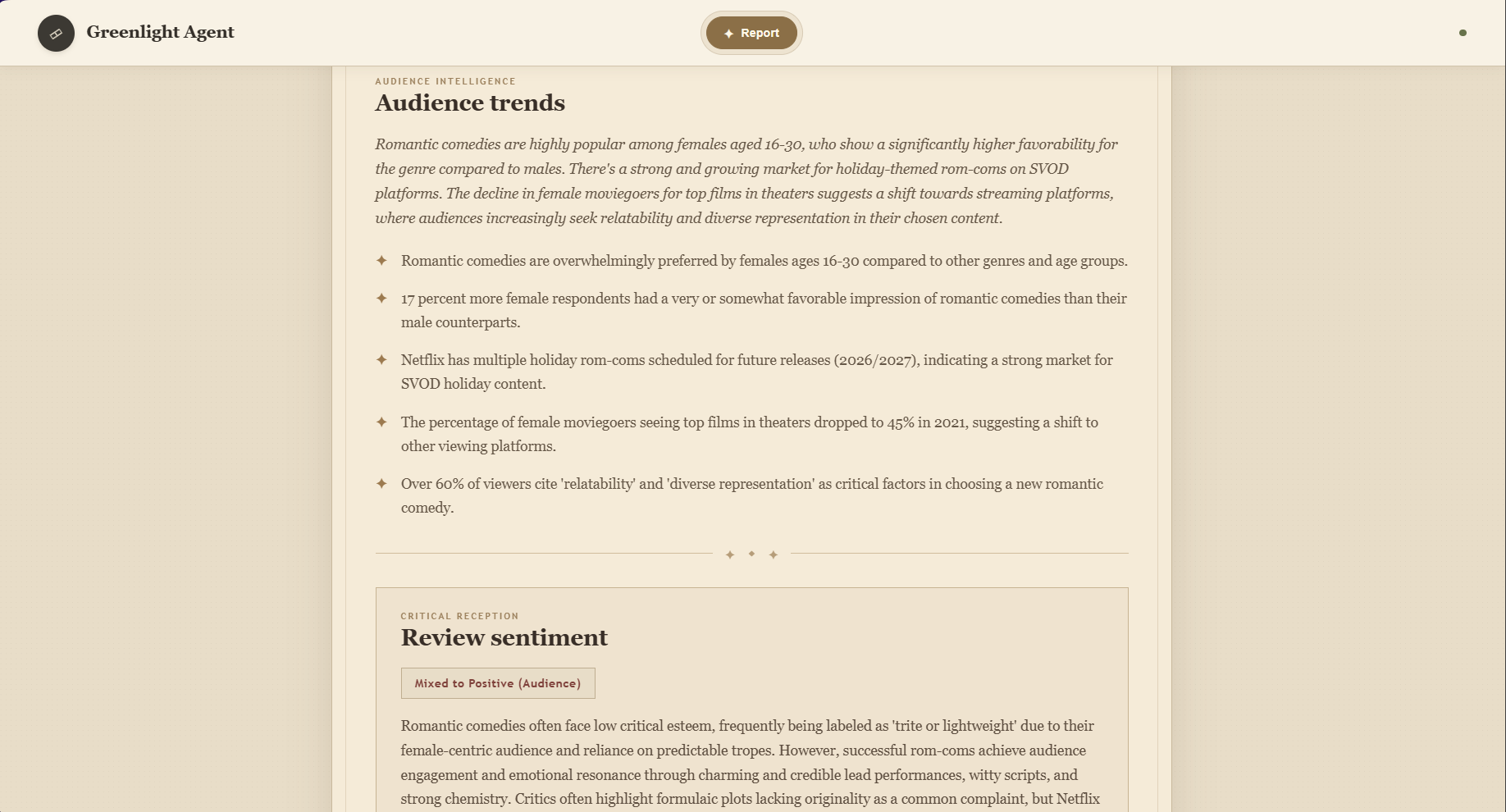
- Audience Trends — investigates audience behaviour and relevant market trends.
- Review Sentiment — analyses critical reception and sentiment surrounding comparable films.
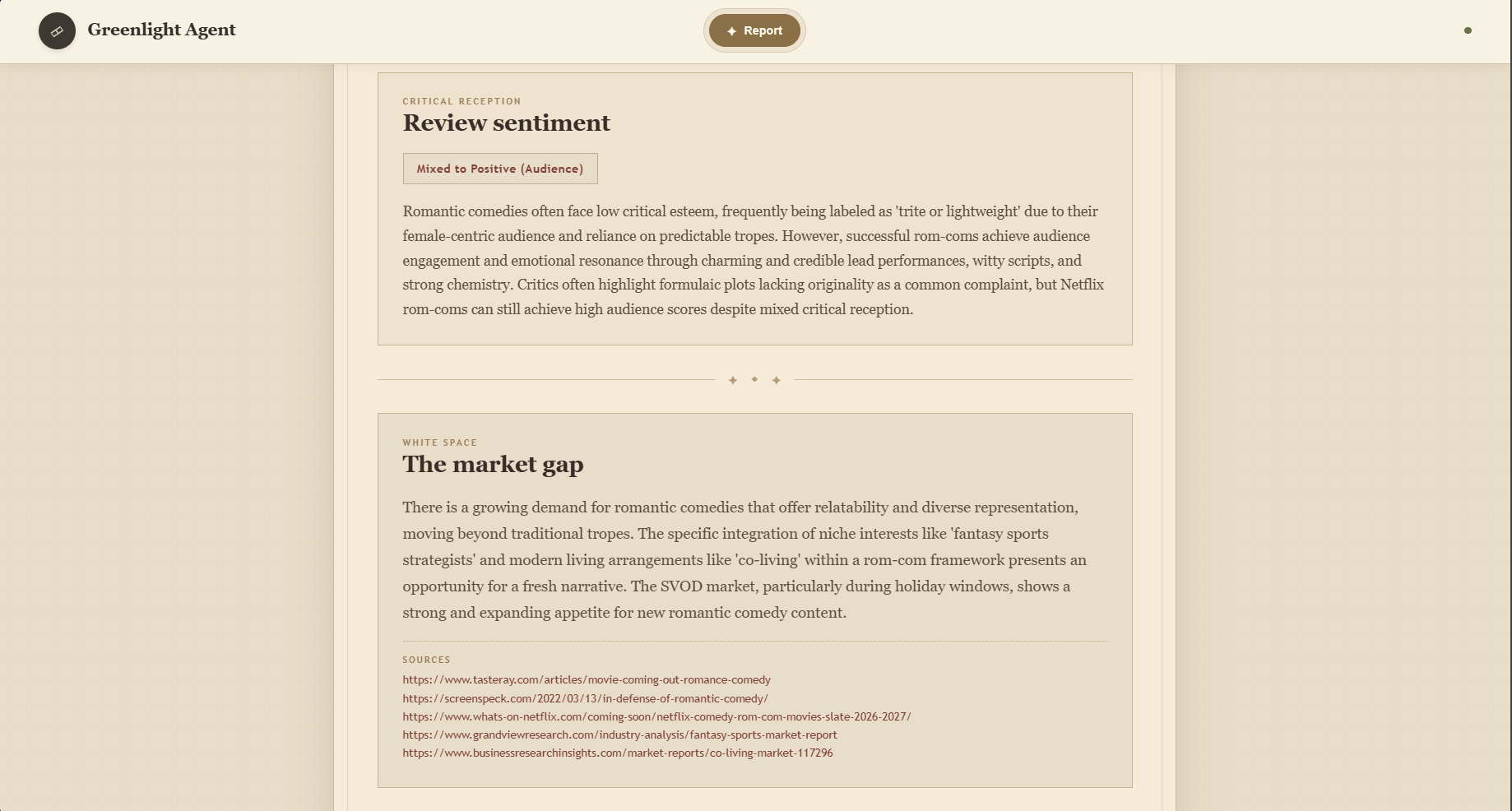
- Market Gaps — identifies potential opportunities and gaps within the market.
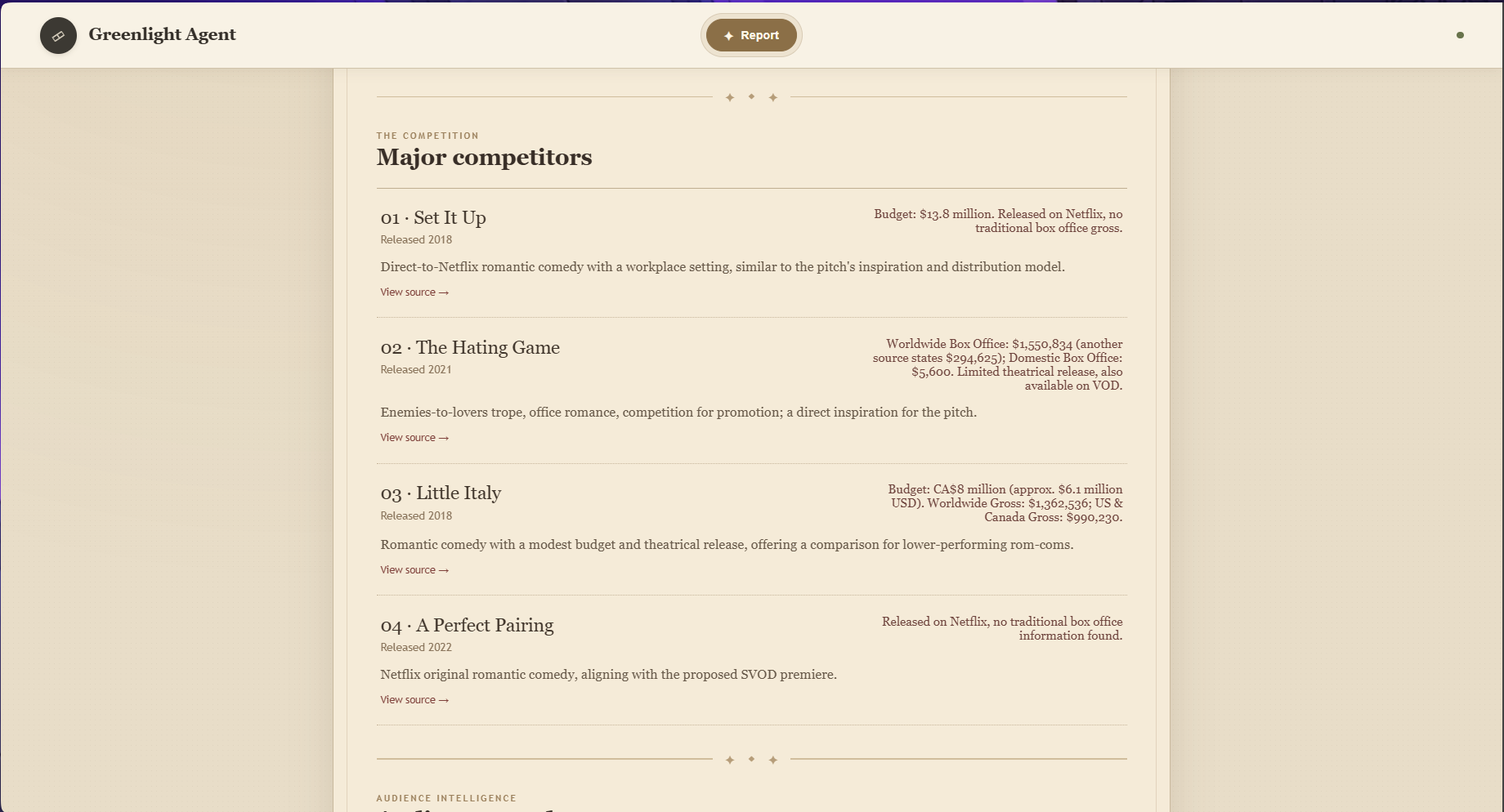
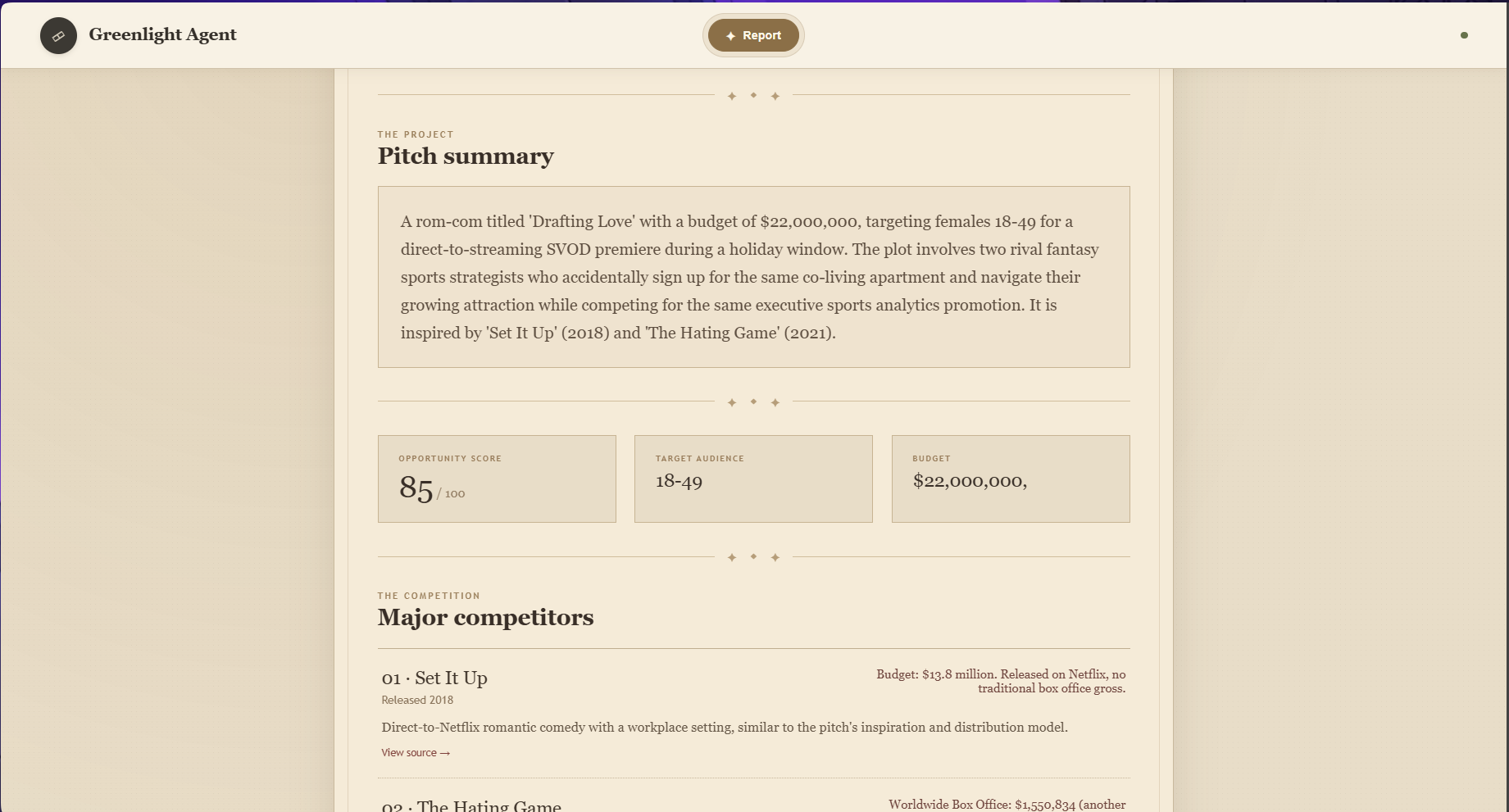
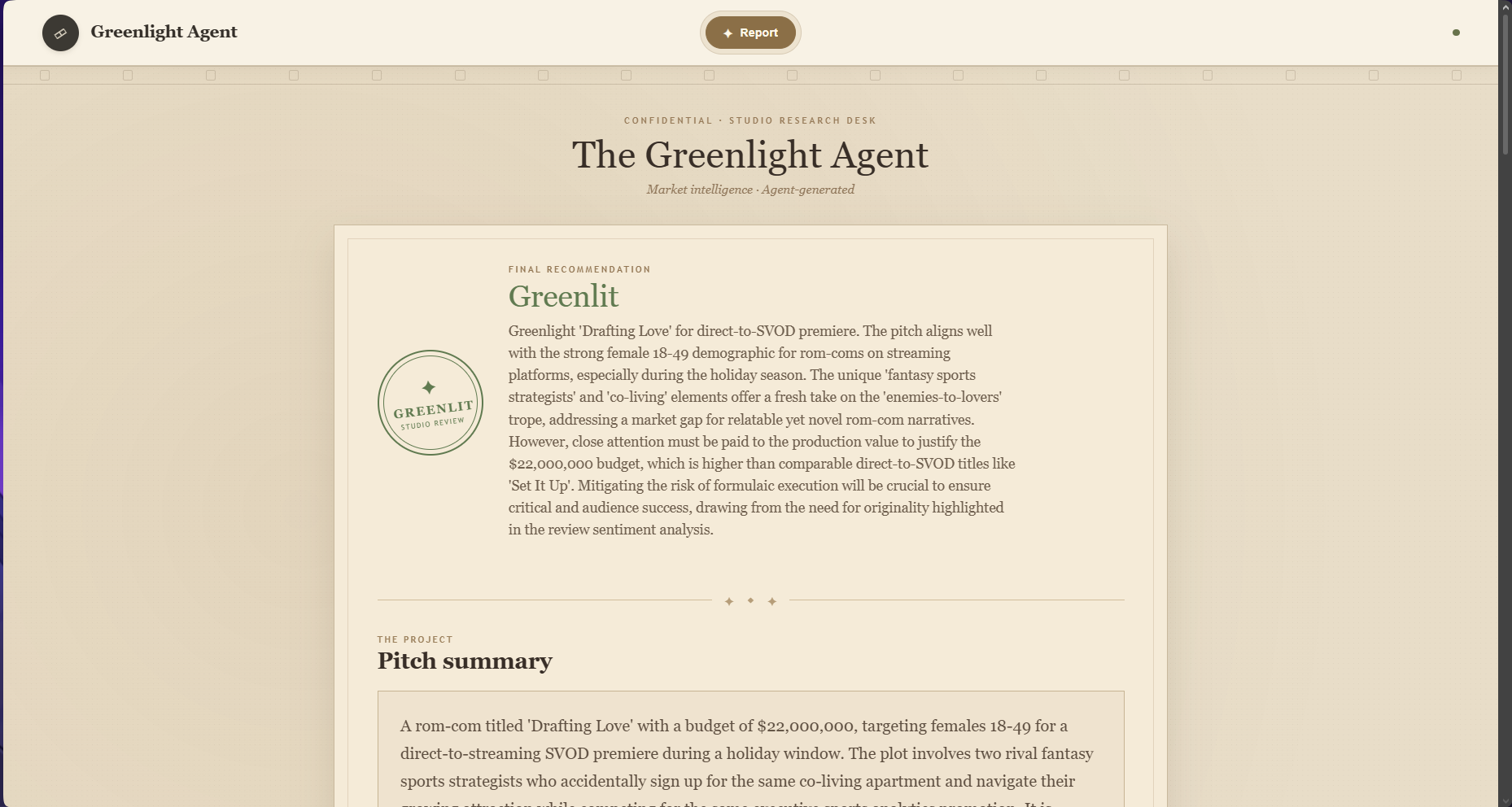
Gemini then synthesizes the research into a structured Greenlight Report containing:
- A GREENLIGHT or PASS verdict
- A decision score
- Comparable films
- Audience trends
- Review sentiment
- Market opportunities
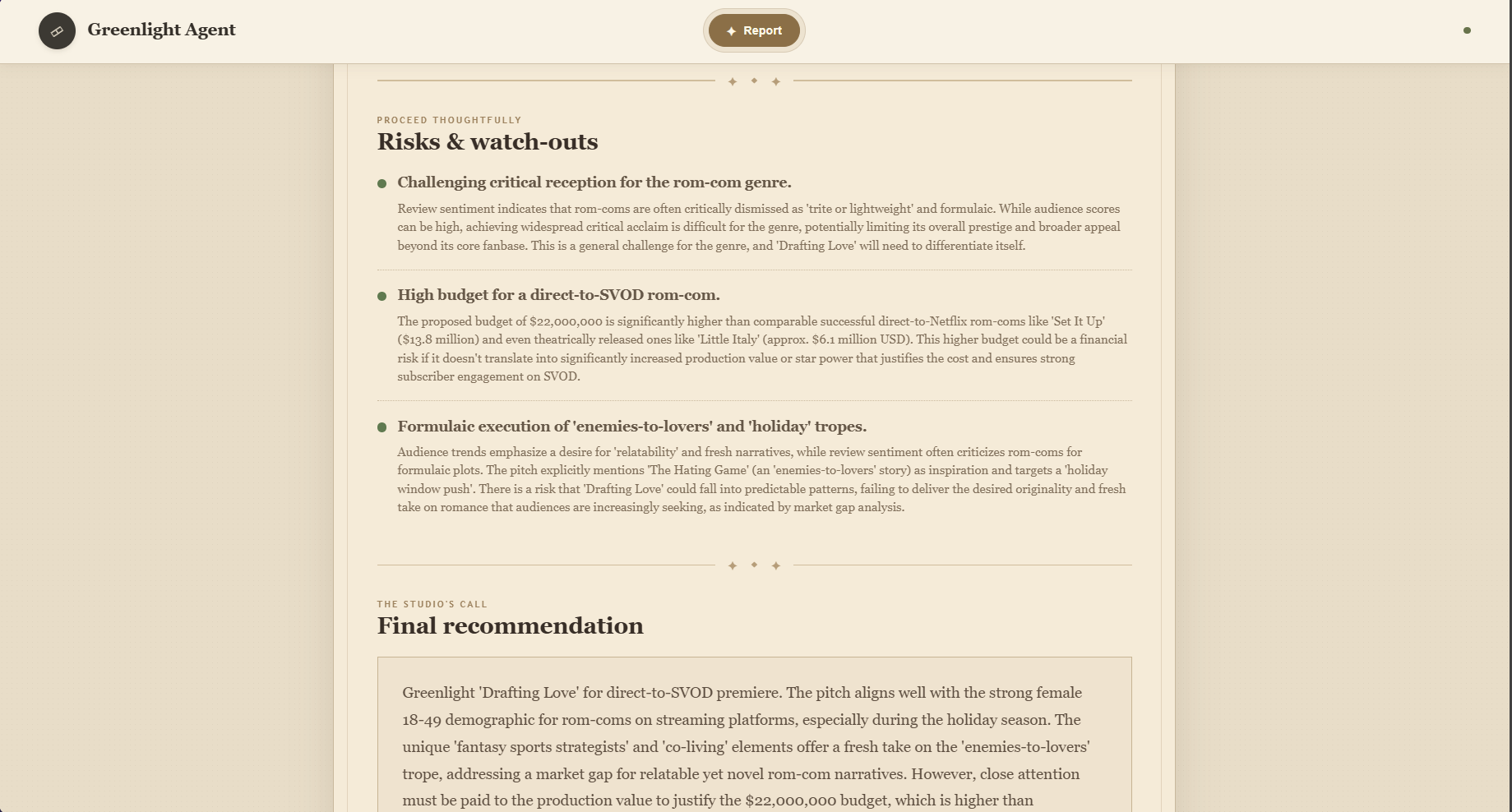
- Potential risks
- A final recommendation
- Supporting sources
The system is designed to ground its findings in the information retrieved during the research process, allowing users to trace the report back to the sources used by the agent.
How we built it
We built the project as an agentic pipeline connecting a web interface, an AI agent, and live web research.
The frontend was developed using React, Vite, and Tailwind CSS, providing the interface through which producers submit their film pitches and view the resulting report.
The backend was developed in Python and handles requests between the web application and the AI agent.
Our agent uses Gemini 2.5 Flash for reasoning and synthesis and Google Cloud Agent Runtime / Agent Development Kit (ADK) for agent orchestration and deployment.
For live market research, we integrated Parallel's Search API through five specialised research tools. Each tool focuses on a different research question, allowing the agent to gather evidence systematically before producing its final recommendation.
The overall workflow is:
Producer Pitch → Web Application → Gemini Agent → Parallel Research → Gemini Synthesis → Greenlight Report
The final report is returned as structured JSON, allowing the frontend to consistently render the score, verdict, competitors, trends, risks, recommendation, and sources.
Challenges we ran into
One of our biggest challenges was integrating several different technologies into one reliable workflow. Our application involved the React frontend, Python backend, Gemini, Google Cloud Agent Runtime, and Parallel's API, meaning that an issue in one component could affect the entire pipeline.
Connecting the frontend and backend also required us to correctly handle API endpoints, CORS configuration, ports, and consistent request and response formats.
Another major challenge was ensuring that the agent's conclusions were supported by evidence. A language model can produce a convincing analysis very easily, but a convincing answer is not necessarily an accurate one.
To address this, we designed the agent to conduct dedicated research before synthesising its conclusions. Its instructions emphasise grounding claims in the results returned by its research tools and including supporting sources in the final report.
We also had to design a consistent output schema so that information gathered from different research areas could be transformed into a single structured report that the frontend could reliably display.
Accomplishments that we're proud of
We are particularly proud of building a complete end-to-end agentic workflow rather than a simple chatbot or single API call.
The system can take an unstructured film pitch, conduct multiple live searches across different market dimensions, synthesise the results, and return an actionable investment recommendation.
We are also proud of our use of five distinct Parallel research tools. This allowed us to treat market research as several specialised tasks rather than relying on one generic search.
Another accomplishment we value is the emphasis on traceability. Every report includes supporting sources, making it possible for users to investigate the evidence behind the agent's findings instead of treating the AI's recommendation as an unexplained conclusion.
Most importantly, we were able to bring these components together into a user-facing application that demonstrates a practical use case for agentic AI in the film industry.
What we learned
This project taught us that building an effective agentic AI system requires careful consideration of the entire workflow, not just the language model.
We learned how important tool design and orchestration are when giving an AI agent access to external information. Breaking a complex research problem into specialised tools made the agent's process more structured and allowed us to target different aspects of film evaluation independently.
We also learned the importance of grounding AI-generated decisions in external evidence. For a decision involving potentially significant financial investment, generating a confident response is not enough. The information behind that response needs to be accessible and verifiable.
From a technical perspective, we gained experience integrating frontend and backend systems, working with APIs, designing structured JSON outputs, connecting AI agents to external research tools, and deploying agent-based applications using Google Cloud infrastructure.
What's next for Greenlight Market Report Agent
We see Greenlight Market Report Agent as a starting point for a more comprehensive AI-assisted film investment platform.
Future versions could incorporate additional factors such as:
- Actor and director marketability
- Social media and search interest
- More detailed financial projections
- Human feedback from producers and industry analysts
We would also like to introduce an interactive workflow where users can challenge or refine the agent's recommendation, ask follow-up questions about specific competitors, and explore the evidence behind individual claims.
Ultimately, our vision is to move beyond simply answering "Should this film be greenlit?" and instead help users understand why the recommendation was made, what evidence supports it, and what could be changed to improve the project's market potential.

Log in or sign up for Devpost to join the conversation.