-
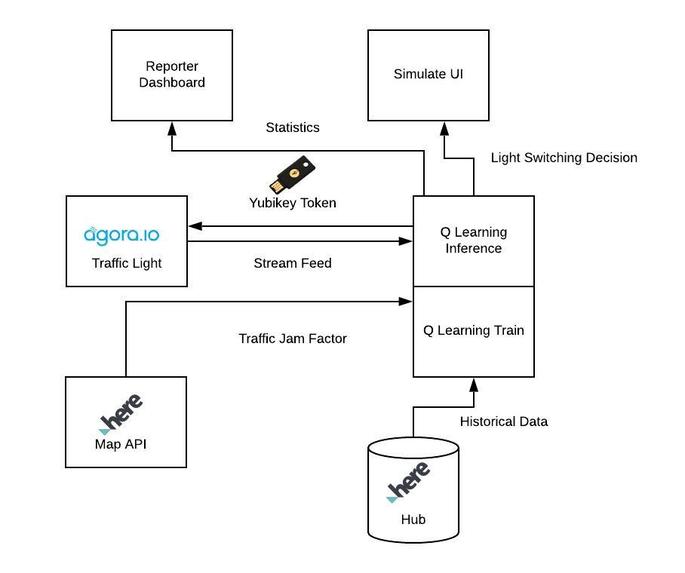
Architectural Overview

Inspiration
DeveloperWeek 2020 Hackathon Challenge
As a team we are interested in using the HERE API to produce a real-time interactive application to simulate traffic lights based on streaming data. The Map API is to determine coordinates of longitude and latitude and analyze the traffic flow on each street. For this proof of concept, we used sixteen points, on a four by four grid in a small sample map of downtown San Francisco. To determine the color of the light, the current traffic flow value is used as a baseline, with a negative flow indicating red and a positive flow indicating green.
For the implementation of our application, we used React Framework based on Javascript with a Python Reinforcement Learning framework using Q-learning. Our data is parsed from a JSON format and passed on to our model to generate a dynamic graphical representation of a traffic four-way light. The goal for this work is to optimize traffic lights to reflect real world driving conditions. For example, by knowing the current traffic flow, traffic lights can be automated to change based on the intensity of traffic. If the model hears a current siren, it will change light color accordingly to allow for prioritized access. Our goal is that the simulation can be used in production to create a smart road system using 5G network to create less congested roads.
What it does
How I built it
React/Node.JS for front-end, Python for back-end and acting as a webserver
Challenges I ran into
Latency and issues with training to deploy an application for real-time performance.
Accomplishments that I'm proud of
Using a ML/DL framework to analyze an audio stream and rasterize results on a map as a visualization.
What I learned
Complexities of using a MAP API to parse data and integration of various components for video and audio analysis
What's next for GreenLight
Hosting on a cloud environment using AWS and creating a CI/CD pipeline. Using streaming data to do live inferencing.

Log in or sign up for Devpost to join the conversation.