-
-
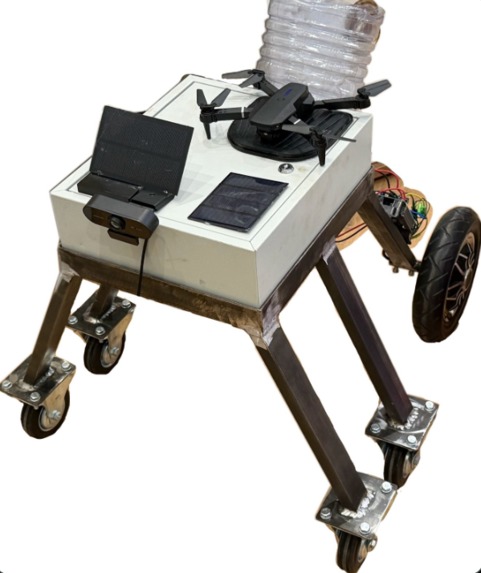
Greenix set-up
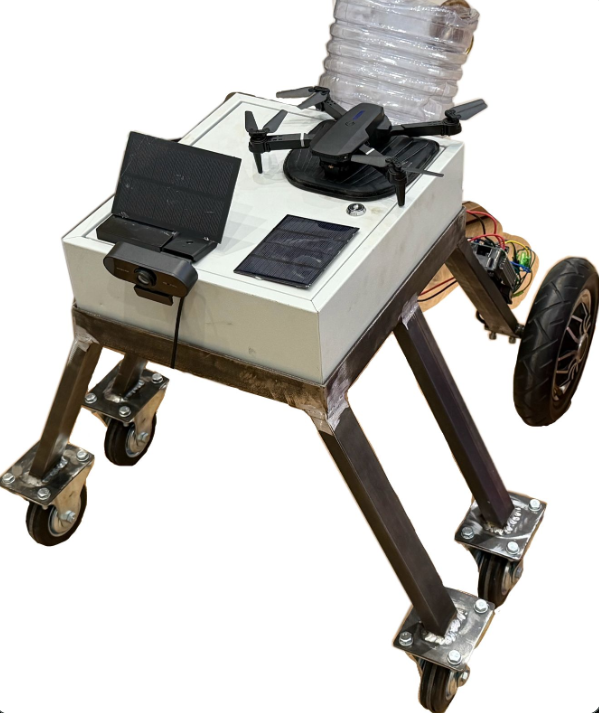
The inspiration behind Greenix came from the growing global problem of soil degradation and declining agricultural productivity. Many agricultural lands are losing fertility because of intensive farming practices, excessive chemical use, erosion, and climate-related stress. This results in wasted resources, unnecessary chemical usage, and limited long-term effectiveness.on
Greenix is an autonomous land restoration system designed to identify degraded soil areas and apply targeted ecological treatment. It works as a system consisting of an aerial drone and a ground-based robot. The drone performs environmental monitoring by capturing high-resolution images of the land. These images are analyzed using an artificial intelligence model that detects vegetation density, weeds, and signs of soil degradation. Based on this analysis, the system generates a geo-referenced intervention map that highlights zones requiring restoration. After the analysis stage, the ground robot autonomously navigates to the identified locations. It performs targeted actions such as planting restoration crops or applying organic treatment solutions. The robot uses onboard sensors to validate the conditions before applying treatment, ensuring that interventions are precise and necessary. The system follows a closed-loop workflow that includes data collection, AI analysis, targeted intervention, and continuous monitoring. By focusing only on specific problem areas, GREENIX reduces energy consumption, limits soil disturbance, and improves restoration efficiency.
GREENIX was developed as a two-layer system combining aerial environmental sensing with ground-level ecological intervention. The aerial layer consists of a drone responsible for large-scale field perception. It captures detailed images of agricultural land and gathers environmental data. These images are processed using a computer vision model based on the YOLO architecture. The neural network was trained on annotated agricultural imagery so that it can detect weeds, vegetation types, and soil degradation patterns in real time.
One major challenge was achieving accurate environmental detection using computer vision. Agricultural environments are complex, with varying lighting conditions, plant densities, and soil textures. Training the neural network to reliably distinguish between weeds, crops, and degraded soil required careful dataset preparation and modeling.
One of the main achievements of Greenix is successfully combining artificial intelligence, robotics, and ecological restoration into a single operational system. The project demonstrates how advanced technologies can be used to support environmental sustainability
Working on Greenix provided valuable insights into technological development and environmental problem-solving. We learned that interdisciplinary learning is essential when solving complex environmental challenges. The project required knowledge from robotics, agriculture, ecology, and mechanical engineering.
The next stage of development for Greenix focuses on expanding its technological abilities and real-world applications. Future work will be improving the accuracy of the AI detection system.


Log in or sign up for Devpost to join the conversation.