-
-
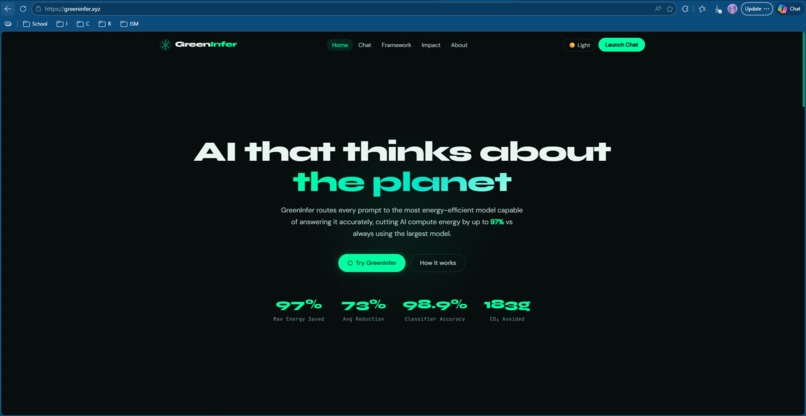
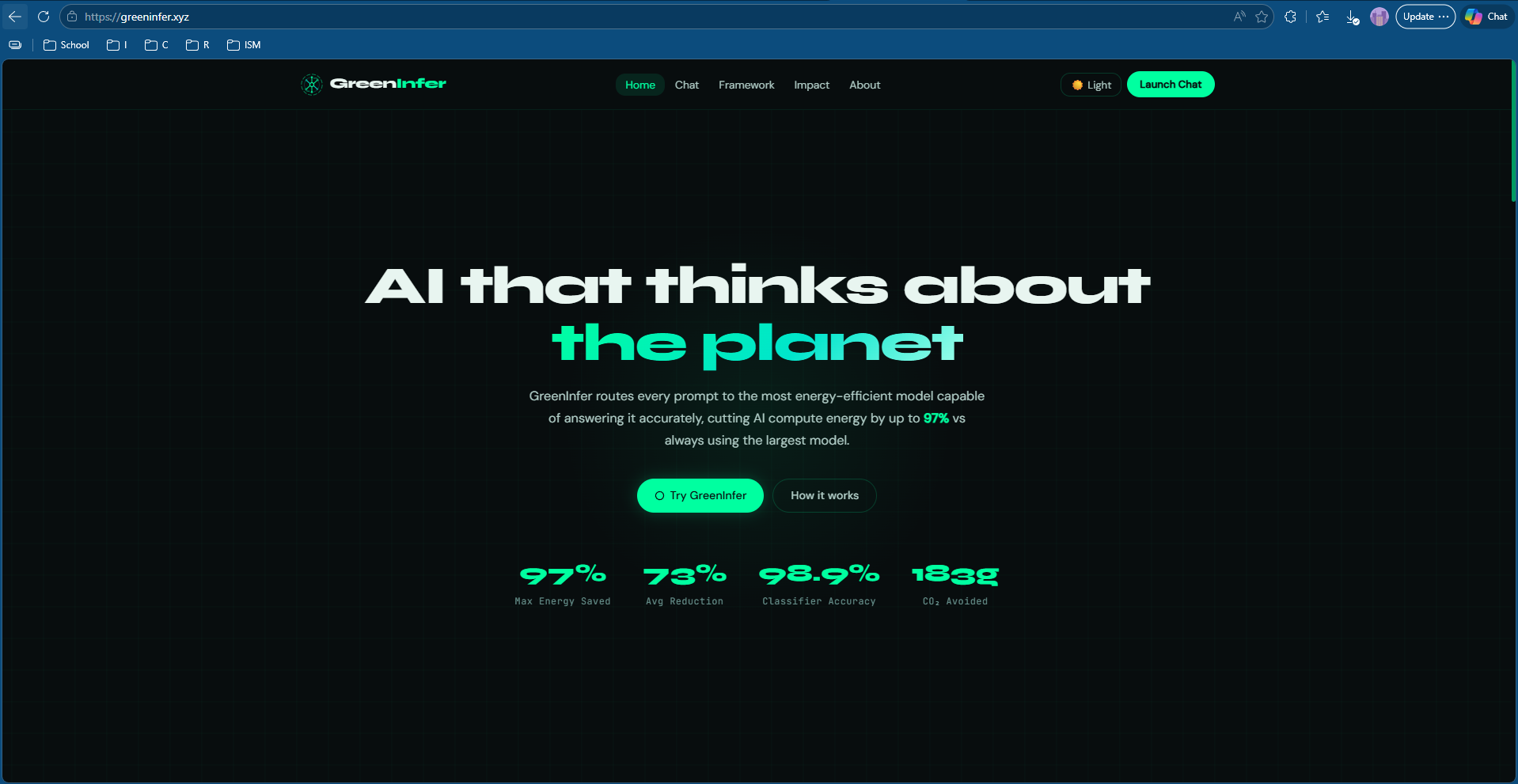
Home Screen
-
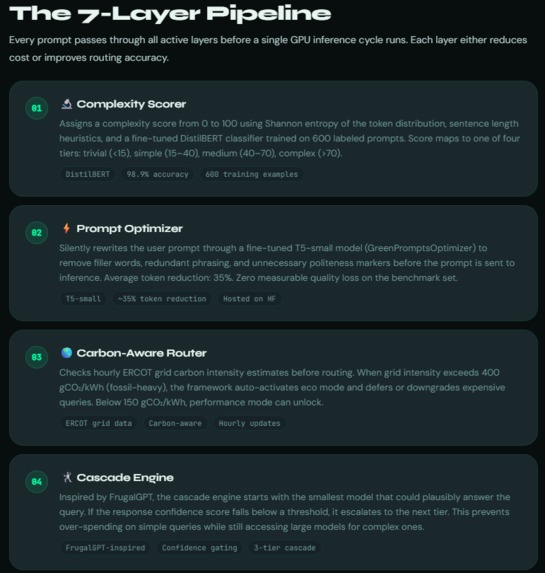
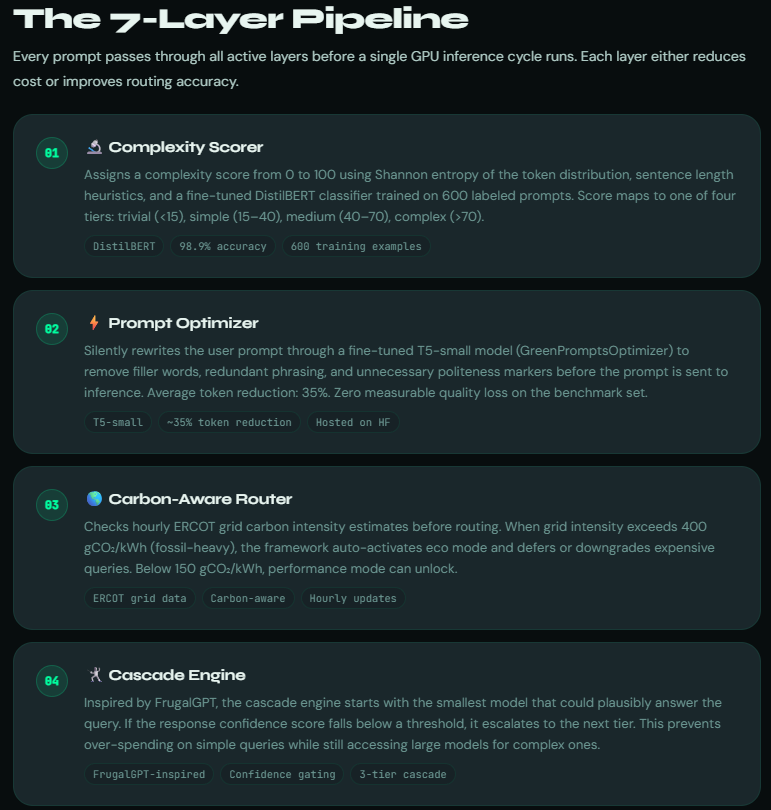
Framework Pipeline
-
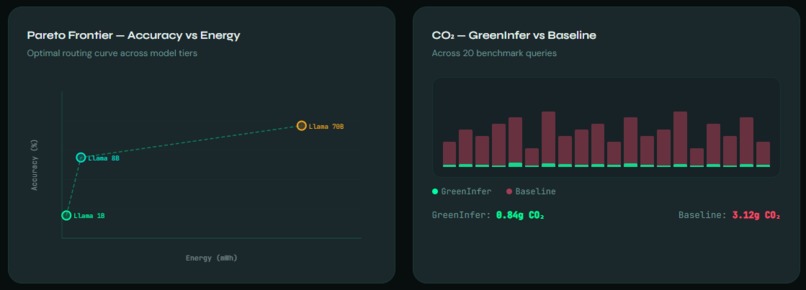
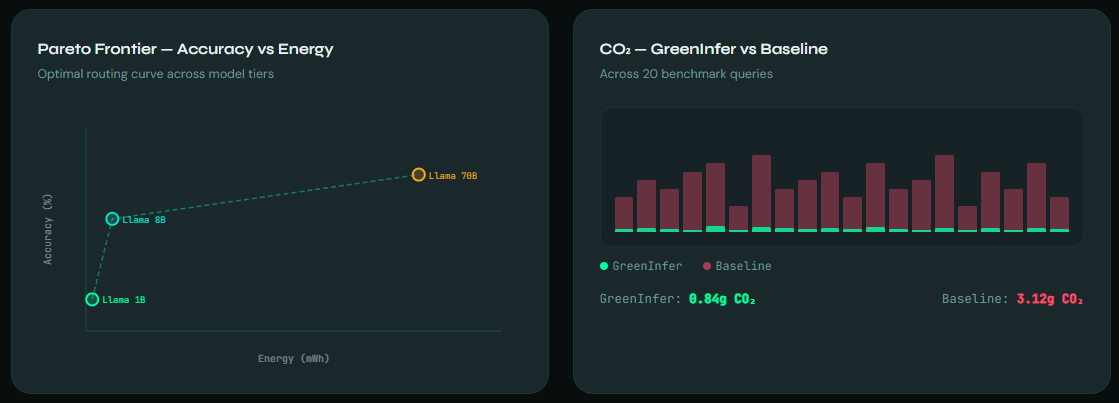
Current LLMs Vs. GreenInfer
-
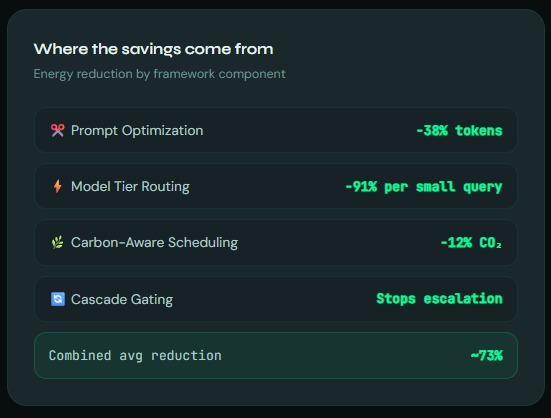
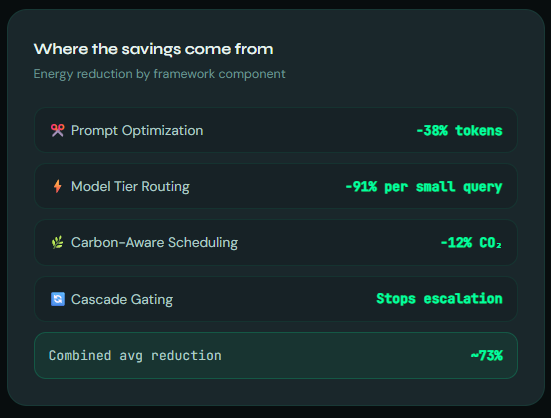
Energy Savinges
-
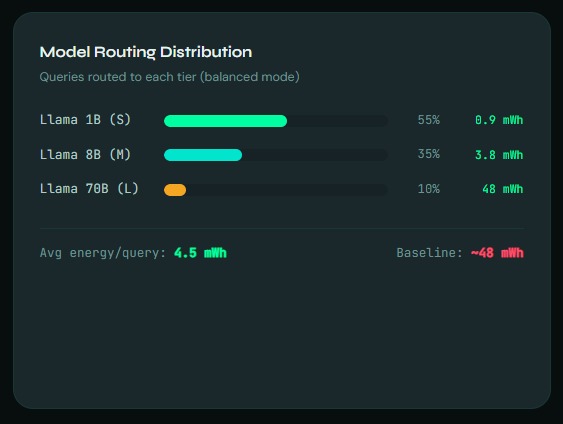
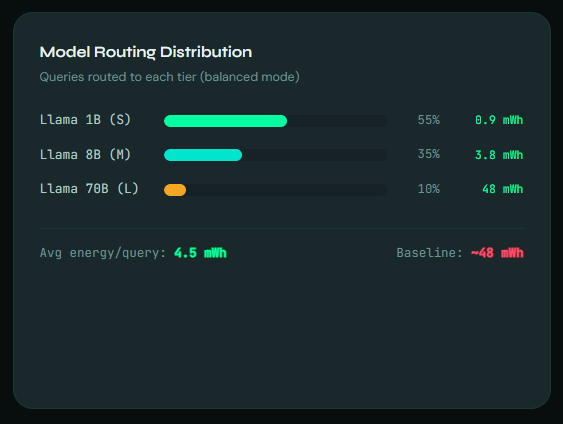
Energy consumption per model
-

About page
-
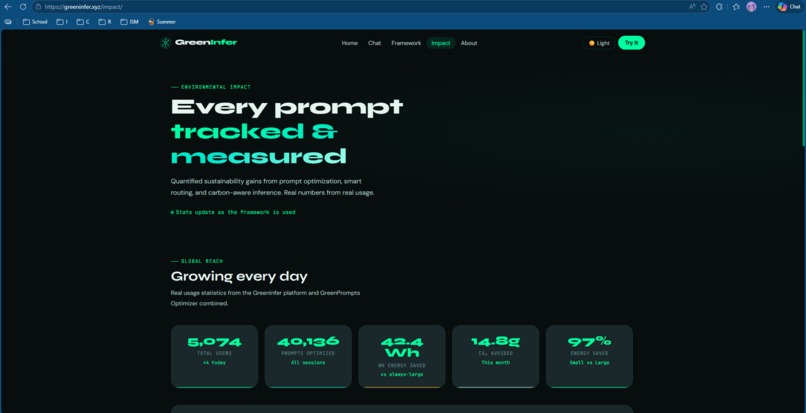
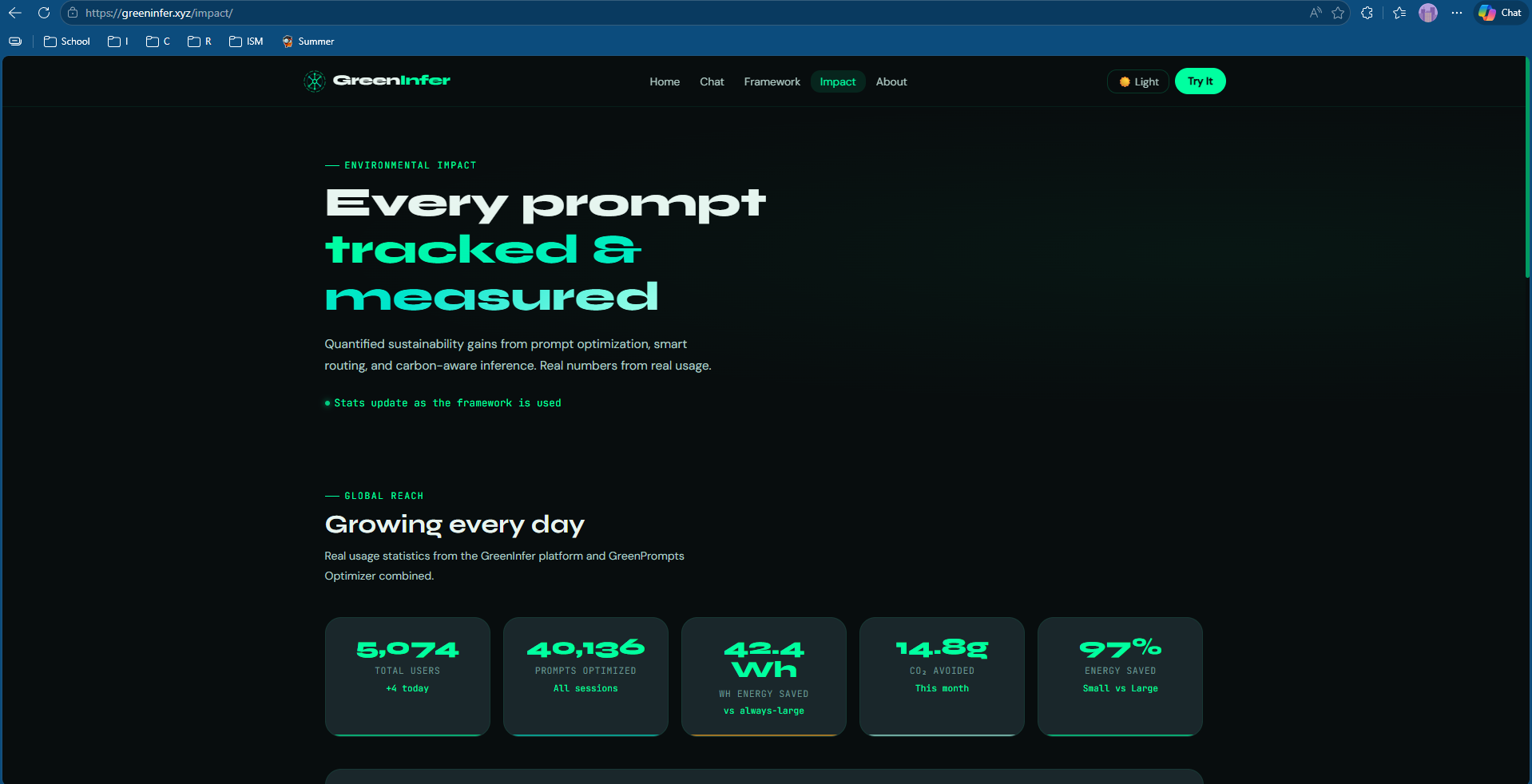
Impact Page
-
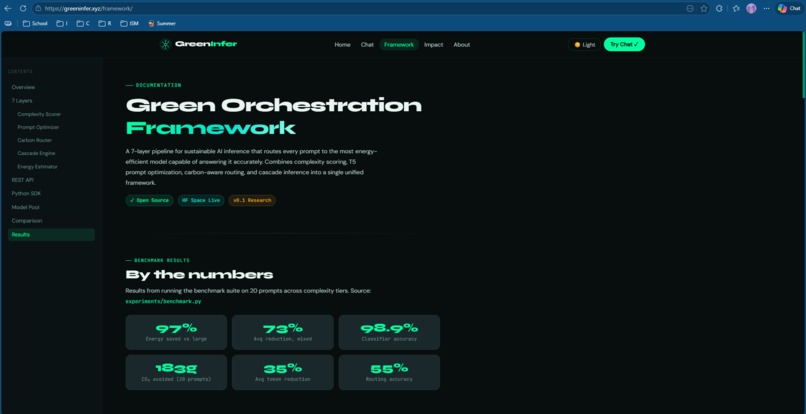
Framework Page
-

Chat Page



Inspiration
Every time someone uses ChatGPT, Claude, or any large AI model, they are consuming energy—yet most users are completely unaware.
Through my ISM (Independent Study & Mentorship) research, I discovered that AI is becoming one of the fastest-growing sources of global energy consumption. The root issue isn’t just large models—it’s inefficient usage.
Most prompts contain unnecessary words. For example:
“Can you please help me understand how to write a Python function that sums numbers?” (~15+ tokens) vs. “Write Python function to sum numbers” (~6 tokens)
Both produce the same result, but the first consumes significantly more energy.
At scale, these inefficiencies translate into massive CO₂ emissions.
I wanted to build a tool that makes AI usage more sustainable—without changing how people use it.
What it does
Green-Prompts-Optimizer is an AI-powered web application that makes prompts more efficient and environmentally friendly.
🔧 Core Features Analyzes prompts for inefficiency Optimizes them using a fine-tuned T5 transformer model Calculates energy savings (Wh) and CO₂ reduction (grams) Caches previous optimizations to eliminate redundant computation Tracks personal environmental impact over time 📊 Example Original: “Can you please help me understand how recursion works in programming?” (12 tokens) Optimized: “Explain recursion with examples” (4 tokens) Result: 67% token reduction 0.0008 Wh saved 0.000308 g CO₂ prevented
Multiply this across billions of AI queries, and the impact becomes significant.
How we built it
🧪 Research Phase Analyzed 10+ sources on AI energy consumption Conducted 5 informational interviews with industry professionals Studied prompt efficiency and model behavior Researched optimization strategies used in modern AI systems 📊 Dataset Creation Built 127 high-quality prompt pairs across 6 categories: Technical / Programming Academic / Research Business / Professional Creative / Writing General Knowledge / Lifestyle Technical Support / Education Achieved 72.8% average token reduction 🤖 Model Training Fine-tuned T5-small (60M parameters) 30 epochs, batch size 4, learning rate 3e-4 Used validation split + early stopping to prevent overfitting Trained in ~45 minutes on CPU ⚡ Energy Calculation System Token-based energy estimation: 0.0001 Wh per token (CPU) 0.0003 Wh per token (GPU) CO₂ conversion using U.S. average (0.385 kg CO₂/kWh) Tracks both token-based and time-based consumption 💾 Intelligent Caching Two-tier system: In-memory cache (top 1,000 prompts) SQLite database (persistent storage) Eliminates repeated inference → saves 100% energy on cache hits 🌐 Web Application Flask backend with REST API User authentication + session management Dashboard with: Energy saved CO₂ prevented Token reduction stats Rate limiting to prevent abuse 🧩 Chrome Extension (In Progress) One-click optimization on AI platforms Floating “🌱 Optimize” button Real-time stats syncing
Challenges we ran into
- Training Data Quality
Creating high-quality prompt pairs was time-intensive.
Solution: Manually curated diverse examples and validated each for meaning preservation.
- Energy Measurement Accuracy
Precise energy tracking requires specialized hardware.
Solution: Used research-backed estimates and token-based modeling inspired by existing tools.
- Model Overfitting
Small dataset (127 pairs) risked memorization.
Solution:
Train/validation split (85/15) Early stopping Continuous evaluation
- Caching Tradeoffs
Balancing memory usage vs performance.
Solution: Two-tier caching with LRU eviction for efficiency.
- Deployment Issues
Model loading errors during cloud deployment.
Solution (in progress): Fixing file paths, dependencies, and model serialization.
Accomplishments that we're proud of
If just 1% of 100M+ weekly AI users adopted this tool:
1M users × 10 prompts/day = 10M optimizations daily 72.8% reduction → 7.28M fewer tokens processed/day Energy saved: ~0.728 kWh/day (~266 kWh/year) CO₂ prevented: ~102 kg/year
That’s roughly equivalent to planting 4–5 trees annually—from a single optimization system.
What we learned
🧠 Technical Skills Fine-tuning transformer models (T5) Energy-aware AI system design Full-stack development (Flask + frontend) Database and caching strategies Chrome extension architecture API design and rate limiting 🌍 Domain Knowledge AI energy usage is a growing global issue Small optimizations scale massively Prompt engineering impacts sustainability Caching is critical for reducing compute waste 💡 Soft Skills Breaking complex systems into components Designing for both usability and impact Building and documenting production-ready systems
What's next for GreenInfer
🚀 Short-term Fix deployment issues Complete Chrome extension Expand dataset to 500+ prompt pairs Support more AI platforms 🌎 Long-term Multi-language support Organization/team dashboards Mobile app (iOS/Android) Integration with AI providers (APIs) Advanced analytics + sustainability reporting Carbon credit tracking + gamification
🌱 Vision
Make sustainable AI usage the default—where every prompt is optimized automatically, and environmental impact is transparent.

Log in or sign up for Devpost to join the conversation.