
Inspiration
Greenify is an architectural design platform to greenify major cities around the world. It is an application tailored to city builders, architects, and city planners to create a more sustainable and eco-friendly city by populating existing skyscrapers and buildings with trees, solar panels, and bushes to combat climate change, biodiversity loss, resource depletion, and environmental degradation.
For city planners, Greenify provides the best way to design a greener city.
What it does
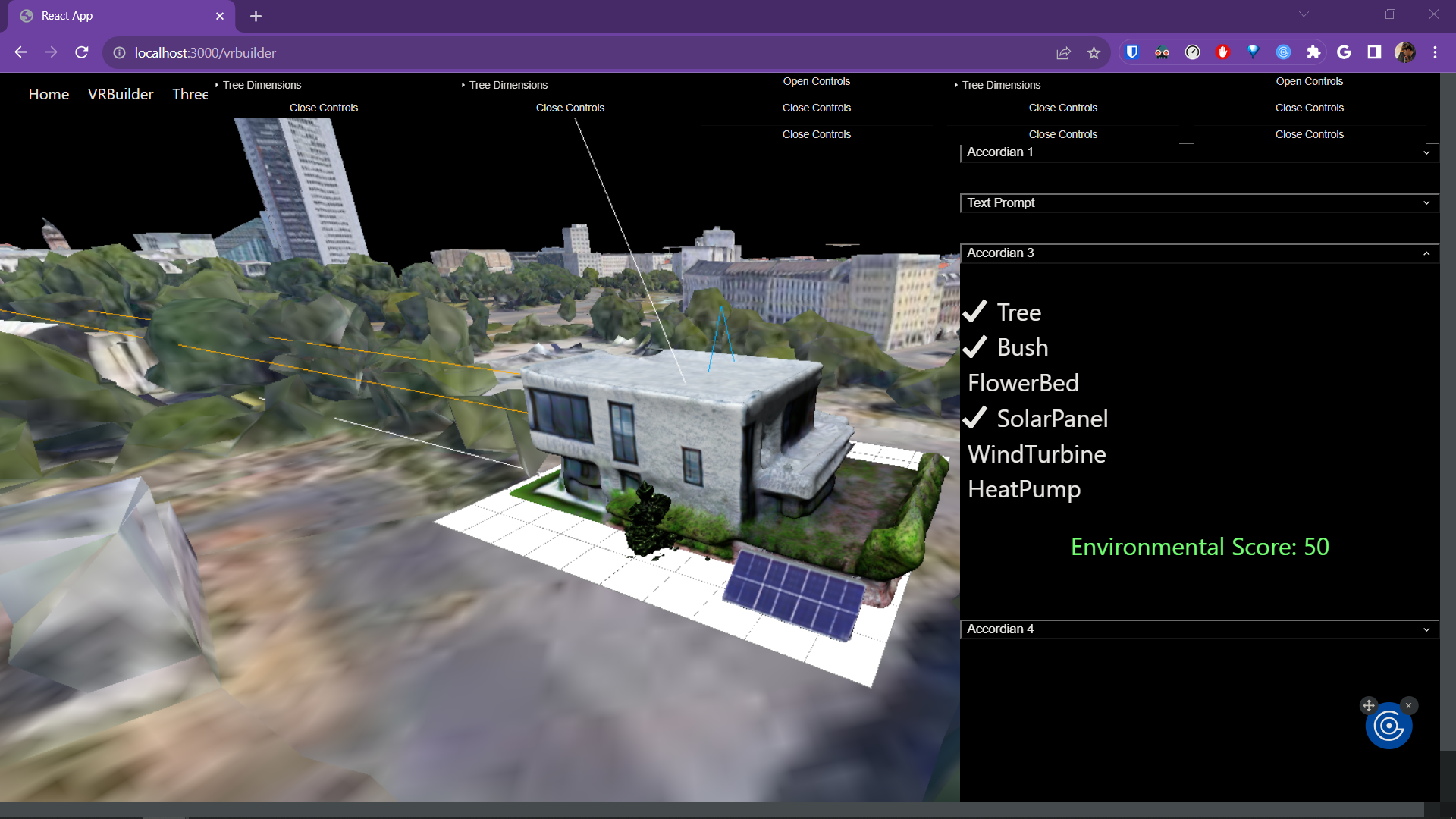
Greenify uses text prompts to generate 3D image assets with Neural Radiance Fields (NeRFs). These images are then automatically added to a 3D renderer in Three.js. Once the assets are loaded, users can drag around buildings, skyscrapers, trees, and solar panels to design their dream city. When assets are placed, our Carbon Emissions reduced and the Energy Saved counters will automatically calculate metrics for how green the city has become. Finally, users can also scale objects to different sizes, change color schemes, change materials, and alter the composition of 3D assets in our modeling software.
How we built it
We use LumaAI's Genie platform to generate image assets. We use Three.js and orbit controls to create the modeling software to navigate the scene and place assets. On the backend, we have a MySQL database that tracks and stores the image assets and CO2 emissions and energy saved.
Challenges we ran into
We wanted to experiment with something completely knew that we didn't have any experience with before. So we tried NeRF generation with LumaAI's new software. We ran into quite a few issues with this since the software was released only 3 days ago. We had to write a Selenium script that would take prompt inputs from the react frontend and then access a discord server to generate images, refine those images, and finally download those image assets back on the frontend. We also faced lots of difficulty with 3D rendering. We initially tried to use Unity with the hopes of creating the models in AR/VR. However, Unity proved very difficult to integrate with the frontend. Instead, we opted for Three.js which renders 3D graphics models in javascript on the frontend which worked well with our react frontend. Finally, implementing orbit controls, interacting with objects, scaling objects, and drag and drop proved challenging but we were ultimately able to get a working product completed.
Accomplishments that we're proud of
Proud of working through new technology and exploring the 3D model space.
What we learned
We learned 3D graphics and transformations as well as glb file processing which is actually an area that is incredibly fascinating.
What's next for Greenify
There is big potential for this project to enter the AR/VR space. With AR/VR apps like IKEA's drag and drop furniture operating on a similar aspect, we see a lot of potential in users and architects exploring our 3D models in virtual reality.

Log in or sign up for Devpost to join the conversation.