-
-
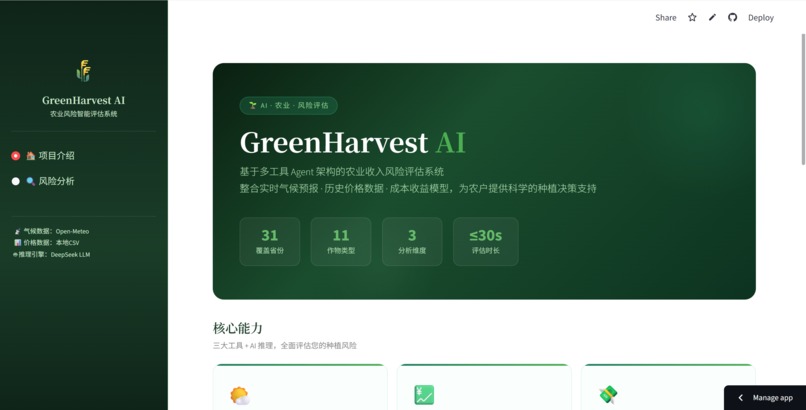
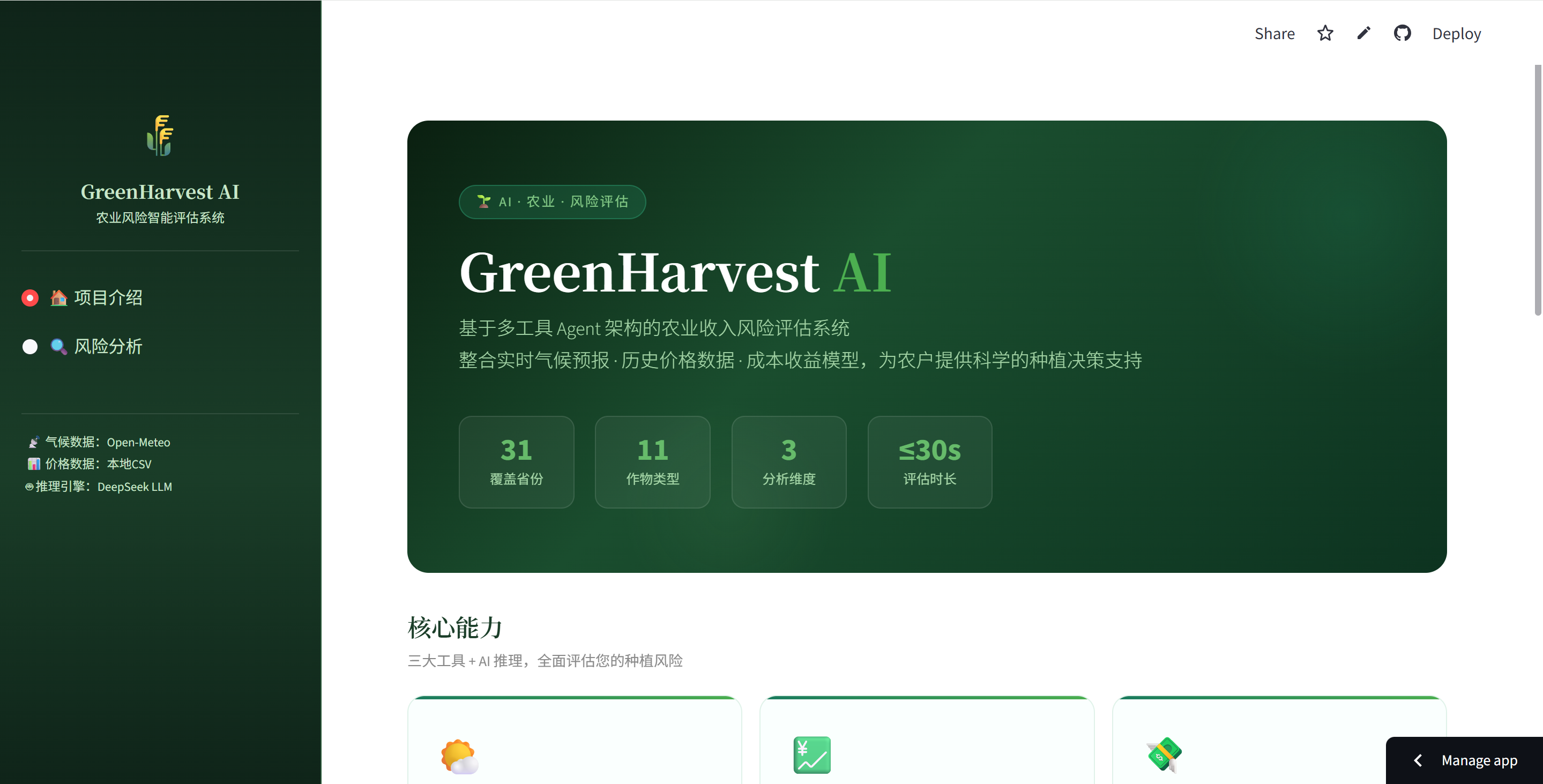
How GreenHarvestAI website looks like.
-
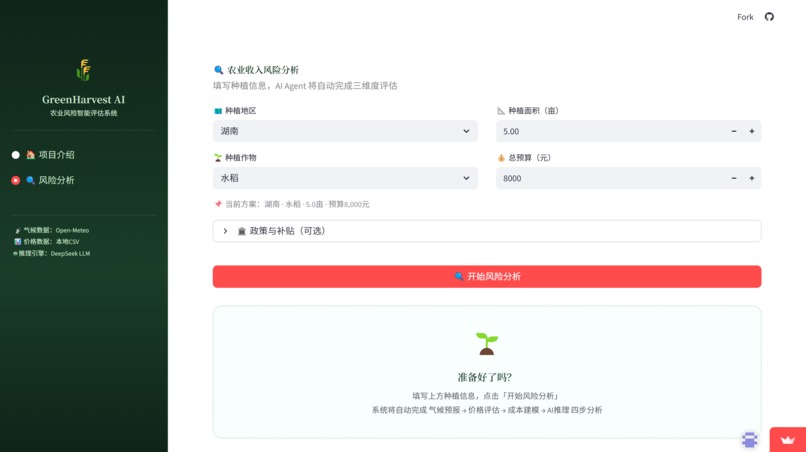
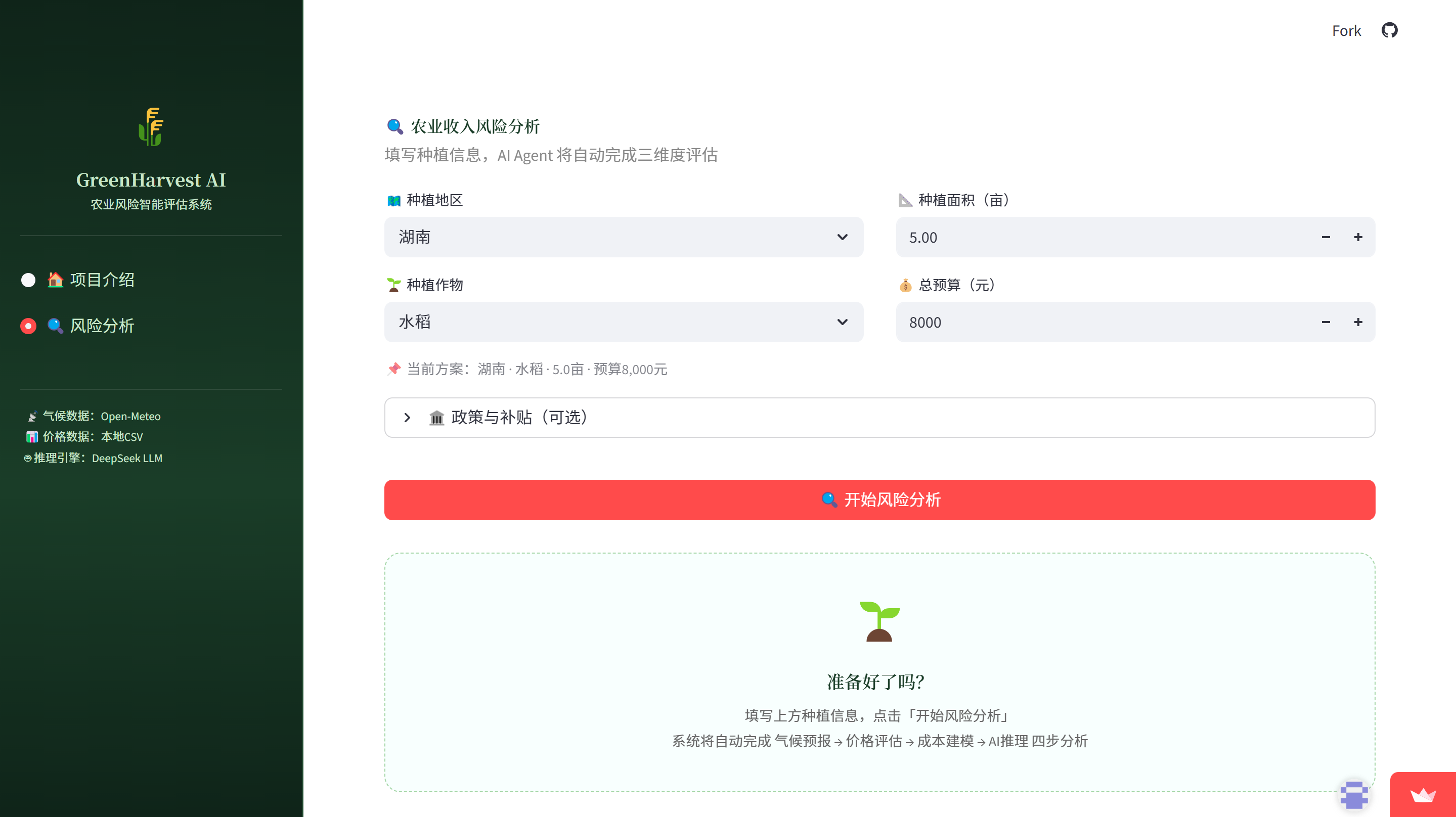
How GreenHarvestAI website looks like.
Inspiration
GreenHarvest AI was inspired by a common challenge faced by rural farming households:
Even after months of hard work, farmers often do not know whether their income will be stable until the harvest is over.
In many rural areas, farming decisions are still made based on experience rather than data. Farmers must decide how much to invest, what crops to grow, and how to manage inputs such as fertilizer and water, all while facing unpredictable weather, fluctuating market prices, and rising production costs. At the same time, environmental pressure from overuse of chemicals and water resources is increasing, threatening the long-term sustainability of agriculture.
We wanted to explore a simple but important question:
Can AI help farmers better understand income risk and make greener, more stable farming decisions?
What it does
GreenHarvest AI combines information from farmers and public data sources to form a complete picture of farming risk. First, the system collects basic farming data provided by farmers, such as crop types, planting area, past yields, production costs, and records of past disasters. This helps the system understand how stable a farmer’s production has been in the past. Second, the system incorporates local climate data, including rainfall, temperature patterns, and extreme weather events. These factors are important because weather conditions strongly affect crop growth and yield stability. Third, the system analyzes historical market price trends of agricultural products, since even stable yields can still result in unstable income when prices fluctuate.
How we built it
GreenHarvest AI is a decision-support tool designed for small-scale rural farmers.
Instead of trying to predict exact profits, the system focuses on helping farmers understand how risky their expected income might be and what actions could reduce that risk.
The system provides three main outputs:
- A clear income risk level (low, medium, or high) for the upcoming farming season
- Practical budget and production suggestions, such as whether to maintain, expand, or reduce planting scale
- Environment-friendly recommendations that support greener farming without significantly increasing costs
All results are presented in a simple and intuitive way, so farmers do not need technical or financial expertise to use the system.
Challenges we ran into
GreenHarvest AI combines information from farmers and public data sources to form a complete picture of farming risk. First, the system collects basic farming data provided by farmers, such as crop types, planting area, past yields, production costs, and records of past disasters. This helps the system understand how stable a farmer’s production has been in the past. Second, the system incorporates local climate data, including rainfall, temperature patterns, and extreme weather events. These factors are important because weather conditions strongly affect crop growth and yield stability. Third, the system analyzes historical market price trends of agricultural products, since even stable yields can still result in unstable income when prices fluctuate.
Accomplishments that we're proud of
We are proud of designing a conceptually complete and realistic AI-driven framework that addresses both income stability and environmental sustainability for rural farmers. Rather than focusing on complex technical implementations, we successfully translated agricultural, climate, and market data into clear risk indicators that are easy to understand and relevant to real farming decisions. Another key accomplishment is the integration of sustainability considerations into income risk assessment. By introducing environmental pressure indicators alongside income risk levels, GreenHarvest AI demonstrates that greener farming practices can be aligned with economic resilience, rather than treated as a separate or secondary goal. Finally, we are proud that the system is designed with accessibility in mind. The decision logic, outputs, and user-facing recommendations are intentionally simple, ensuring that the tool can be adapted to real rural contexts without imposing high technical or financial barriers on farmers.
What we learned
Through this project, we learned that agricultural risk management does not require complex tools or advanced technology for users. What farmers need most is clarity—a clear understanding of risk and practical guidance that fits their reality. GreenHarvest AI demonstrates how AI can be used as a supportive tool rather than a barrier, helping rural farmers improve income stability while gradually transitioning toward more sustainable agricultural practices.
What's next for GreenHarvest AI
Looking ahead, the next step for GreenHarvest AI is to validate and refine the system using real-world data. We plan to collaborate with agricultural cooperatives, local governments, or research institutions to test the framework with actual farming cases and improve its accuracy and relevance. In future iterations, we aim to enhance the AI agent’s decision logic by incorporating more region-specific data and expanding the range of sustainable farming practices considered. This would allow the system to provide more tailored recommendations for different crops, climates, and production conditions. In the longer term, GreenHarvest AI could be integrated with green finance mechanisms, such as preferential loans, insurance products, or sustainability-linked incentives. By connecting risk assessment with financial support, the system has the potential to further encourage environmentally responsible farming while improving income resilience for rural communities.


Log in or sign up for Devpost to join the conversation.