-
-
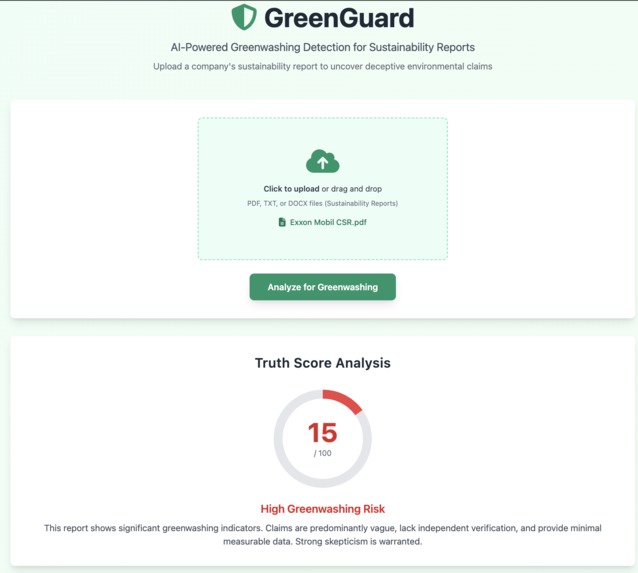
Truth Score of Exxon Mobil CSR Report
-
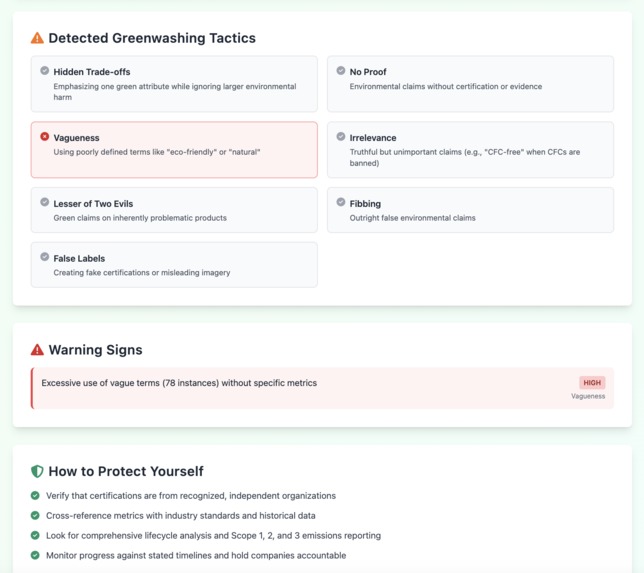
Brief Analysis of Exxon Mobil CSR Report
Inspiration
With my background in environmental health at UC Berkeley and corporate ESG work at the Bay Area Air District, I've witnessed countless companies weaponize sustainability language. Terms like "eco-friendly" and "carbon neutral" are thrown around without any supporting evidence. This is greenwashing, and it costs consumers billions while enabling corporate climate inaction. The breaking point came when reviewing corporate sustainability reports filled with impressive-sounding claims but zero measurable data. I realized AI could systematically detect these deceptive patterns at scale. GreenGuard was born to protect consumers, empower investors, and help regulators hold corporations accountable. Real sustainability deserves real proof.
What it does
GreenGuard is your shield against corporate greenwashing. The tool protects users from deceptive environmental marketing by detecting patterns that human readers miss. It's like having an environmental health expert and ESG analyst reviewing every corporate sustainability claim on your behalf. Users upload company ESG or sustainability reports (.txt format), and the AI protection system:
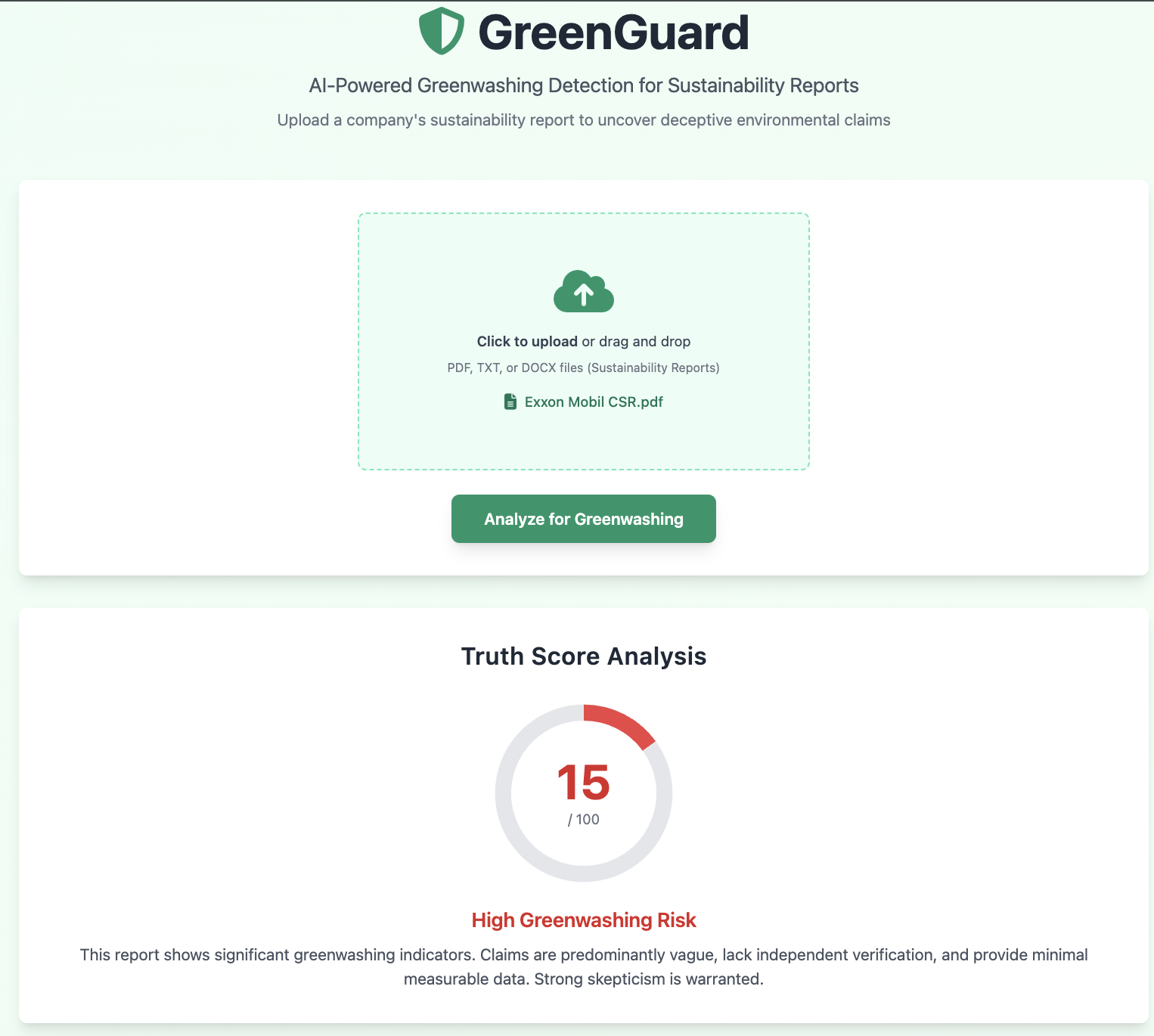
- Credibility Score (0-100): Calculates trustworthiness based on verification, specific metrics, timelines, and transparency
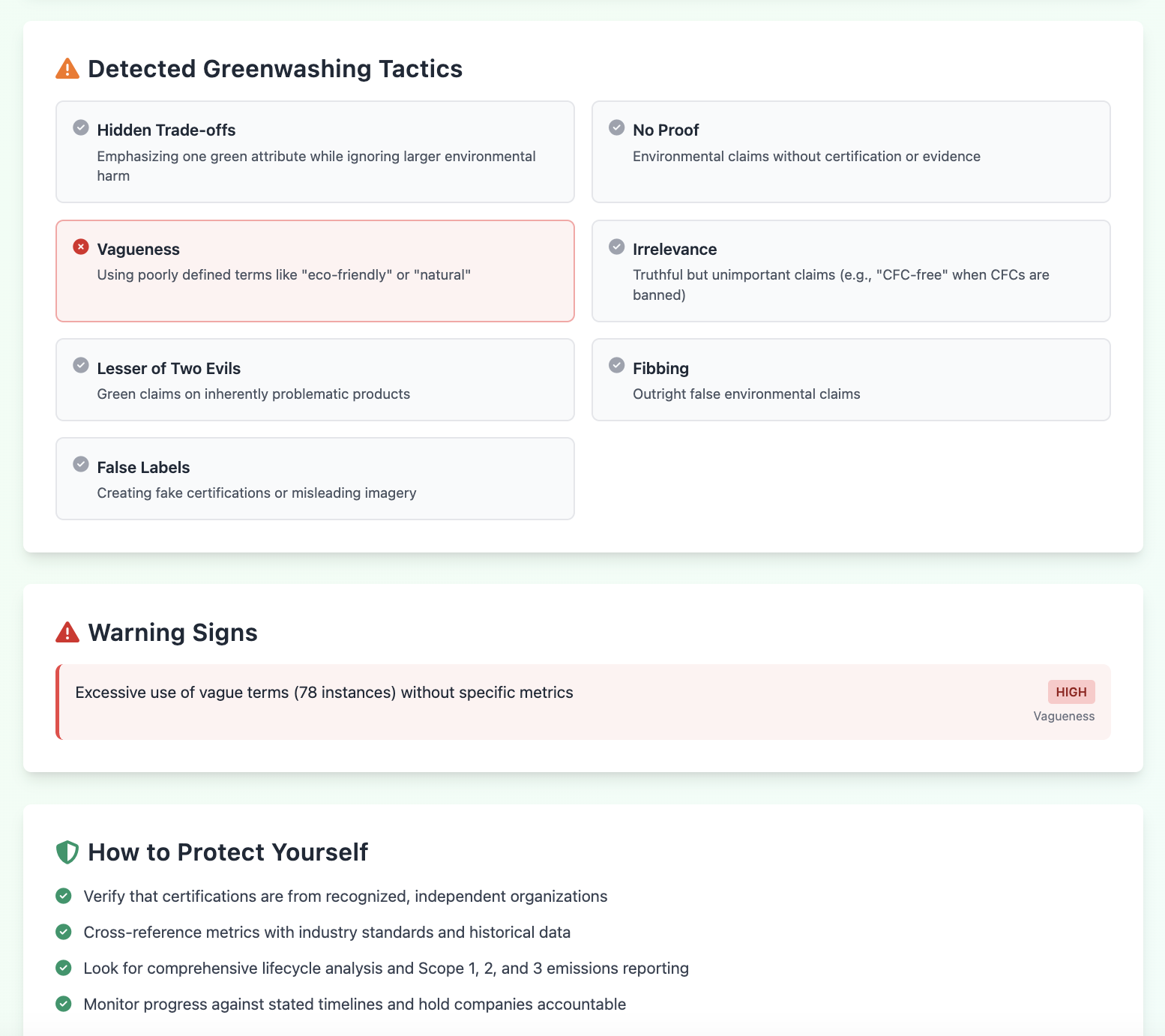
- Detects 7 Greenwashing Sins: Identifies misleading tactics including "Vagueness" (undefined terms like "eco-friendly"), "No Proof" (unverified claims), "Hidden Trade-offs" (cherry-picked metrics), "Fibbing" (false claims), and more
- Warning Signs: Highlights specific misleading claims with severity ratings (high/medium risk)
- Company Comparison: Upload multiple reports to benchmark companies and see who's genuinely sustainable vs. just marketing
- Protection Recommendations: Provides actionable steps to verify claims (demand third-party certification, specific metrics, transparent timelines)
How I built it
Built solo as a beginner project in under 24 hours for Cal Hacks 12.0: Frontend: React with Tailwind CSS for responsive, accessible UI. Lucide icons for visual clarity. The AI Protection Engine is an advanced pattern detection analyzing:
- Vagueness Detection: Counts undefined environmental terms without supporting definitions
- Verification Check: Searches for third-party certifications (ISO, B Corp, Bureau Veritas, etc.)
- Metrics Analysis: Identifies quantifiable data (percentages, metric tons CO2e, kWh, reduction baselines)
- Timeline Detection: Checks for specific deadlines, interim targets, and accountability measures
- Context-Aware Scoring: Penalizes vague claims, rewards transparency, adjusts for report length
Key Features:
- Multi-file upload and side-by-side comparison
- Dynamic credibility scoring algorithm (15-95 scale)
- Smart warning sign generation based on content analysis
- Visual credibility gauge with color-coded risk levels (green/yellow/red)
- "7 Sins of Greenwashing" framework integration
Claude AI Integration: Leveraged Claude to architect the detection logic, generate contextual recommendations, and structure the analysis framework based on environmental health research.
Tech Stack: React, JavaScript, Tailwind CSS, Claude AI, browser-based file processing
Challenges I ran into
- Defining Objectivity: Environmental claims exist on a spectrum. What counts as greenwashing vs. aspirational language? Solved by implementing the research-backed "7 Sins of Greenwashing" framework and requiring evidence for all absolute claims.
- Scoring Algorithm Balance: Too sensitive = false positives (flagging good reports). Too lenient = missing greenwashing. Achieved balance by weighing multiple factors: verification (+20), metrics (+15), timelines (+10), but heavily penalizing vagueness (-3 per term).
- Text Parsing Complexity: Real corporate reports have inconsistent formatting. Built robust pattern matching with regex for various ways companies express (or hide) data - "reduced by 23%" vs "23% reduction" vs "decreased emissions."
- Solo Time Constraints: 24 hours alone meant ruthless prioritization. Focused on rock-solid core analysis over features. Comparison mode was a late addition that proved crucial for demonstrating value.
- Building for Impact: As a beginner, balancing technical complexity with social impact goals. Leveraged my MPH training to ensure the analysis was scientifically sound, not just technically impressive.
Accomplishments that I'm proud of
Functional MVP in <24 hours as a solo beginner. Real-world impact potential. Intelligent protection system. Actionable protection steps. Makes complex ESG analysis accessible to everyday consumers. Scientifically grounded. Based on established greenwashing research frameworks. Leverages public health (UC Berkeley MPH), computer science (GT MSCS), and Bay Area Air District work expertise to tackle environmental justice.
What I learned
- Pattern recognition in unstructured text is challenging but solvable with smart heuristics and multi-factor analysis
- Greenwashing is shockingly prevalent - even "good" corporate reports often have 3-5 vague claims without evidence
- Comparison features dramatically increase user value - relative rankings (who's better?) are more actionable than absolute scores alone
- Time-boxing forces ruthless prioritization - better to have 3 excellent features (scoring, detection, comparison) than 10 mediocre ones
- AI can democratize expertise - ESG analysis previously required expensive consultants; now accessible to anyone
- Design matters for impact - making the tool visually clear (shield icon, color-coded scores) helps users trust and understand the analysis
- Domain expertise is crucial - my background enabled scientifically sound detection criteria that pure CS skills wouldn't have achieved
What's next for GreenGuard: AI-Powered Corporate Greenwashing Detector
Immediate (post-hackathon):
- Real Claude API integration for even deeper semantic analysis and fact-checking
- PDF upload support (most corporate reports are PDFs, not .txt)
- Export detailed protection reports as shareable PDFs
- Chrome extension to analyze company websites on-the-fly while shopping
Medium-term (3-6 months):
- Pre-analyzed database of Fortune 500 sustainability reports
- Historical tracking: has this company improved or gotten worse over time?
- Crowdsourced validation: users flag missed greenwashing patterns
- Industry-specific benchmarks (tech vs manufacturing vs fashion have different standards)
- Mobile app for scanning product packaging
Long-term vision (1-2 years):
- Partner with environmental NGOs to integrate verified certification databases
- B2B platform for investment firms doing ESG due diligence
- Regulatory tool: help FTC/EPA flag deceptive marketing at scale
- Integration with e-commerce platforms: credibility scores next to products
- Global expansion: analyze reports in multiple languages
Ultimate goal: Make greenwashing so easy to detect and so publicly visible that companies stop doing it. Create a world where "sustainable" means something real, measurable, and verified. Protect consumers, empower activists, and accelerate genuine environmental progress.
Built With
- anthropic
- claude-ai
- climate-tech
- consumer-protection
- environmental-sustainability
- esg
- greenwashing-detection
- javascript
- react
- social-impact
- tailwindcss


Log in or sign up for Devpost to join the conversation.